Ankle pain after a long run. Stiffness first thing in the morning. A sprain from stepping off a sidewalk at the wrong angle. None of these are freak occurrences.
They tend to happen when the ankle joint gets consistently ignored. Ankle circles are one of the simplest ways to stop that cycle. They take under five minutes a day.
They need no equipment, no gym, no warm-up ritual. And they work for rehabilitation patients, seniors, athletes, and desk workers alike.
This post covers what ankle circles are, exactly how to do them, their key benefits, and the best variations to try.
What Are Ankle Circles?
Ankle circles are an active range-of-motion exercise. You rotate the foot in a full, controlled circle at the ankle joint.
The movement covers all four ankle directions in one fluid sequence: dorsiflexion (toes pulling toward the shin), plantarflexion (toes pointing away), inversion (sole rolling inward), and eversion (sole rolling outward). The exercise targets two key joints.
The tibiotalar joint connects the shinbone to the ankle bone. The subtalar joint controls side-to-side foot movement.
Physical therapists use ankle circles both as a warm-up tool and a rehabilitation exercise following ankle injury or surgery.
Muscles Worked During Ankle Circles
The ankle relies on a network of muscles to stay stable and mobile. Here is a breakdown of what is doing the work during each rotation.
| Muscle Group | Location | Role During Ankle Circles |
|---|---|---|
| Gastrocnemius | Back of the lower leg (calf) | Controls plantarflexion — pointing the toes down |
| Soleus | Deep calf, below the gastrocnemius | Assists plantarflexion and deep ankle stability |
| Tibialis Anterior | Front of the shin | Controls dorsiflexion — pulling the toes toward the shin |
| Peroneals (Fibularis Muscles) | Outer lower leg | Control eversion — the sole rolling outward |
| Tibialis Posterior | Inner lower leg, behind the tibia | Controls inversion — the sole rolling inward |
| Flexor Hallucis Longus | Deep calf along the inner foot | Assists plantarflexion and foot arch support |
Key Benefits of Ankle Circles
Ankle circles do more than just loosen a stiff joint. Each rotation actively works the ankle in ways that matter for daily movement and long-term joint health.
- Improves Ankle Range of Motion: Ankle circles are among the most practical ankle mobility exercises, reducing stiffness and keeping the joint moving through its full range of motion.
- Reduces Risk of Ankle Sprains: Stronger stabilizing muscles help the ankle resist rolling on uneven ground, reducing the risk of sprains and other ankle injuries.
- Supports Rehabilitation After Injury: Ankle circles are among the first exercises used in ankle sprain rehab, with clinical evidence supporting the effectiveness of exercise therapy for recovery.
- Boosts Circulation in the Lower Leg: The circular movement increases blood flow to the foot and ankle, which helps reduce puffiness and stiffness that builds from prolonged sitting.
- Improves Balance and Stability: Improved ankle mobility enhances proprioception and lower-body balance, reducing fall risk during daily activities and sports.
How to Do Ankle Circles: 3 Different Methods
Getting the form right matters more than you might think. Here are three ways to perform ankle circles, each matched to a different ability level or situation.
1. Seated Ankle Circles
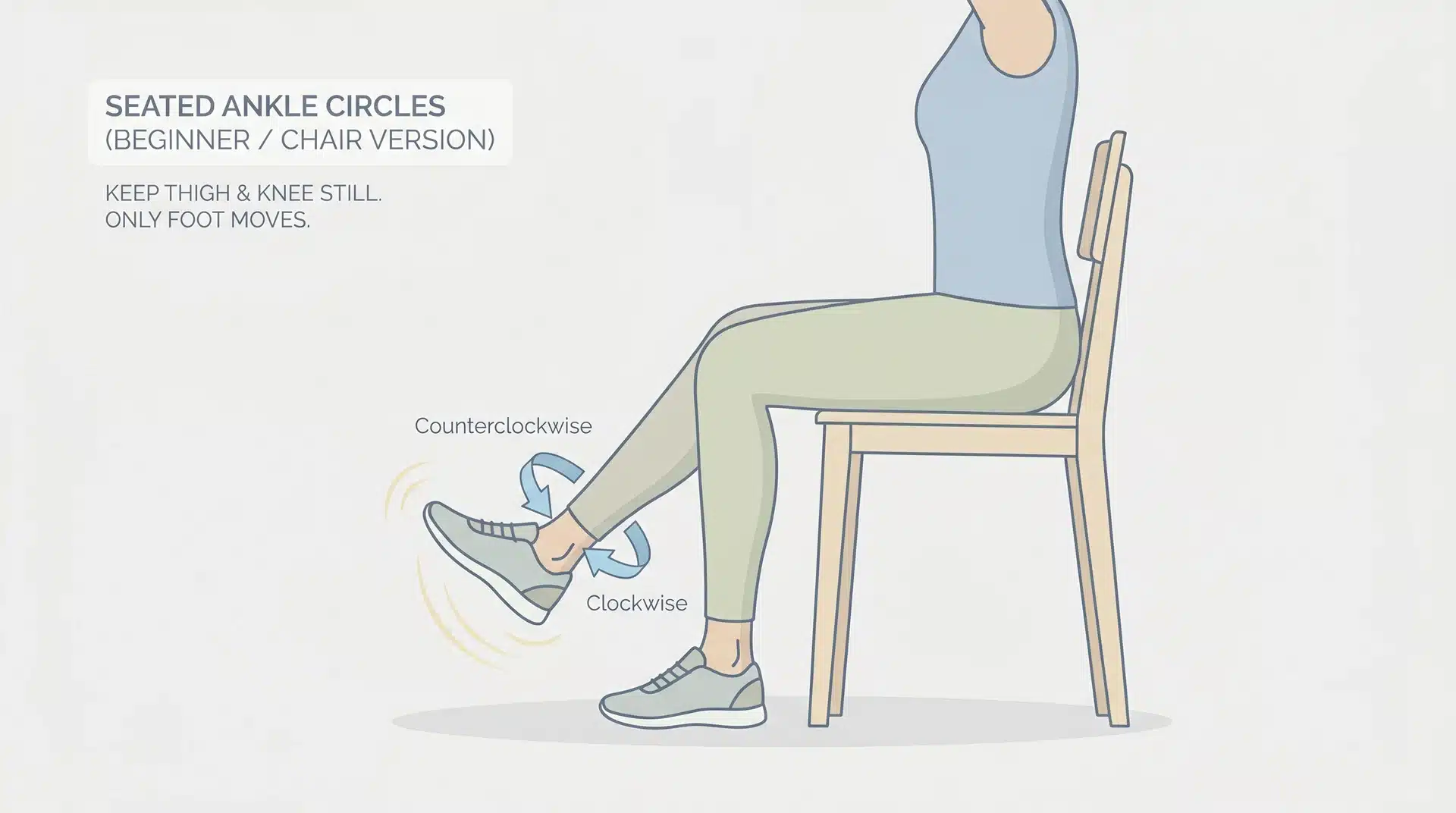
Purpose: Best for beginners, rehab patients, and anyone who needs to isolate the ankle without balance demands.
- Sit upright in a sturdy chair with both feet flat on the floor.
- Extend one leg slightly forward with a small bend at the knee.
- Lift your foot a few inches off the floor.
- Point your toes gently down to engage the ankle joint.
- Slowly rotate your ankle clockwise, making the circle as large as possible.
- Take 3 to 4 seconds per rotation and complete 10 to 15 full circles.
- Reverse direction and complete 10 to 15 counterclockwise circles.
- Lower your foot and repeat on the opposite side.
Key tips:
- Keep your knee and thigh completely still. Move only the foot and ankle.
- Breathe in as you rotate. Breathe out as you complete each circle.
- Start with small circles and increase the size as the joint loosens up.
2. Standing Ankle Circles
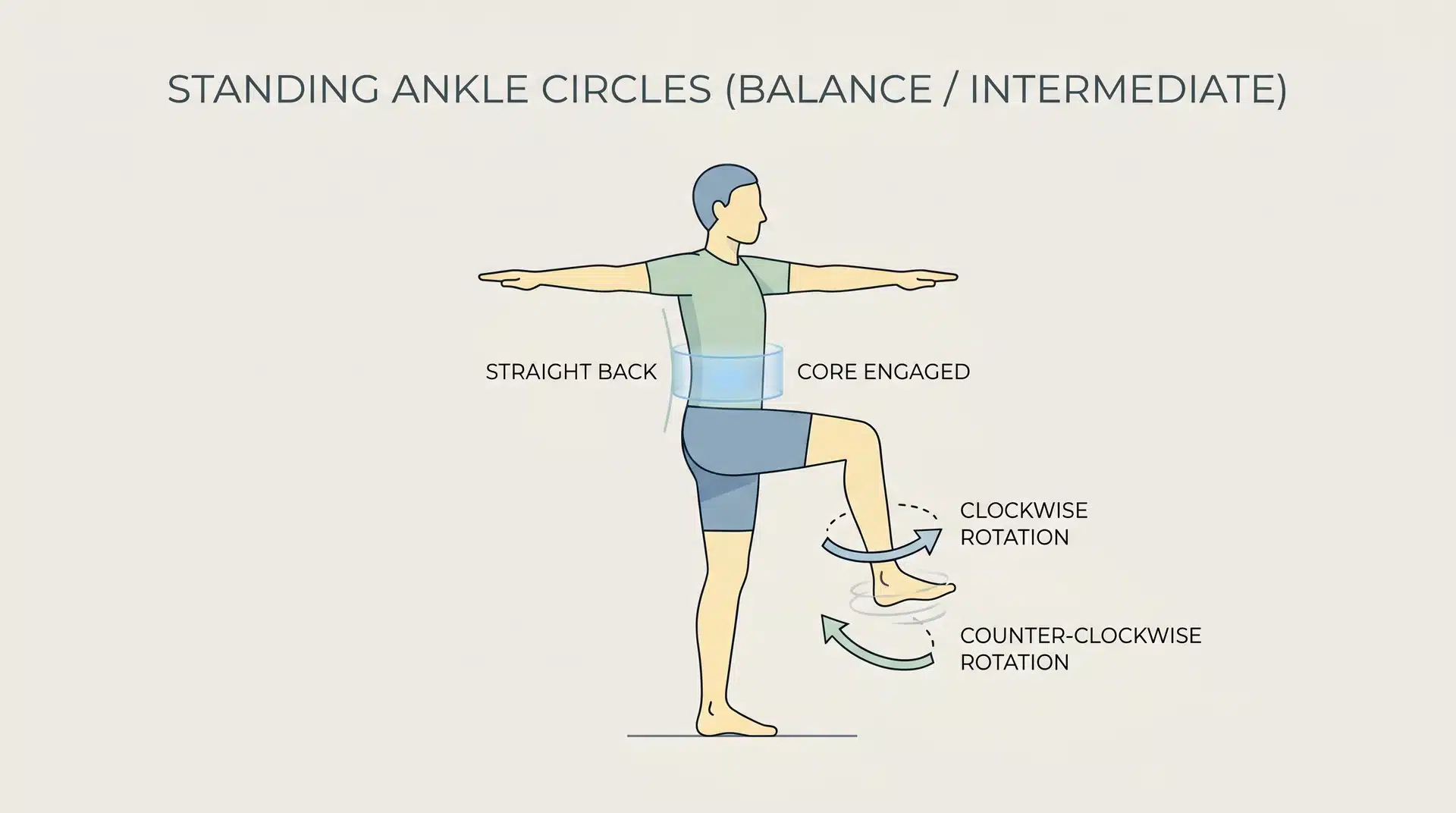
Purpose: Adds a balance challenge, working the core and lower-leg stabilizers alongside the ankle joint.
- Stand with feet hip-width apart, arms out to your sides or resting on a wall.
- Shift your weight onto your right foot with a slight bend in the knee.
- Lift your left foot a few inches off the floor.
- Point your left toes toward the ground.
- Rotate your left ankle clockwise for 10 to 15 controlled reps.
- Reverse and complete 10 to 15 counterclockwise reps.
- Lower the foot and switch sides.
Key tip: Keep a slight bend in the standing knee throughout. This protects the joint and keeps the movement stable.
3. Supine (Lying Down) Ankle Circles
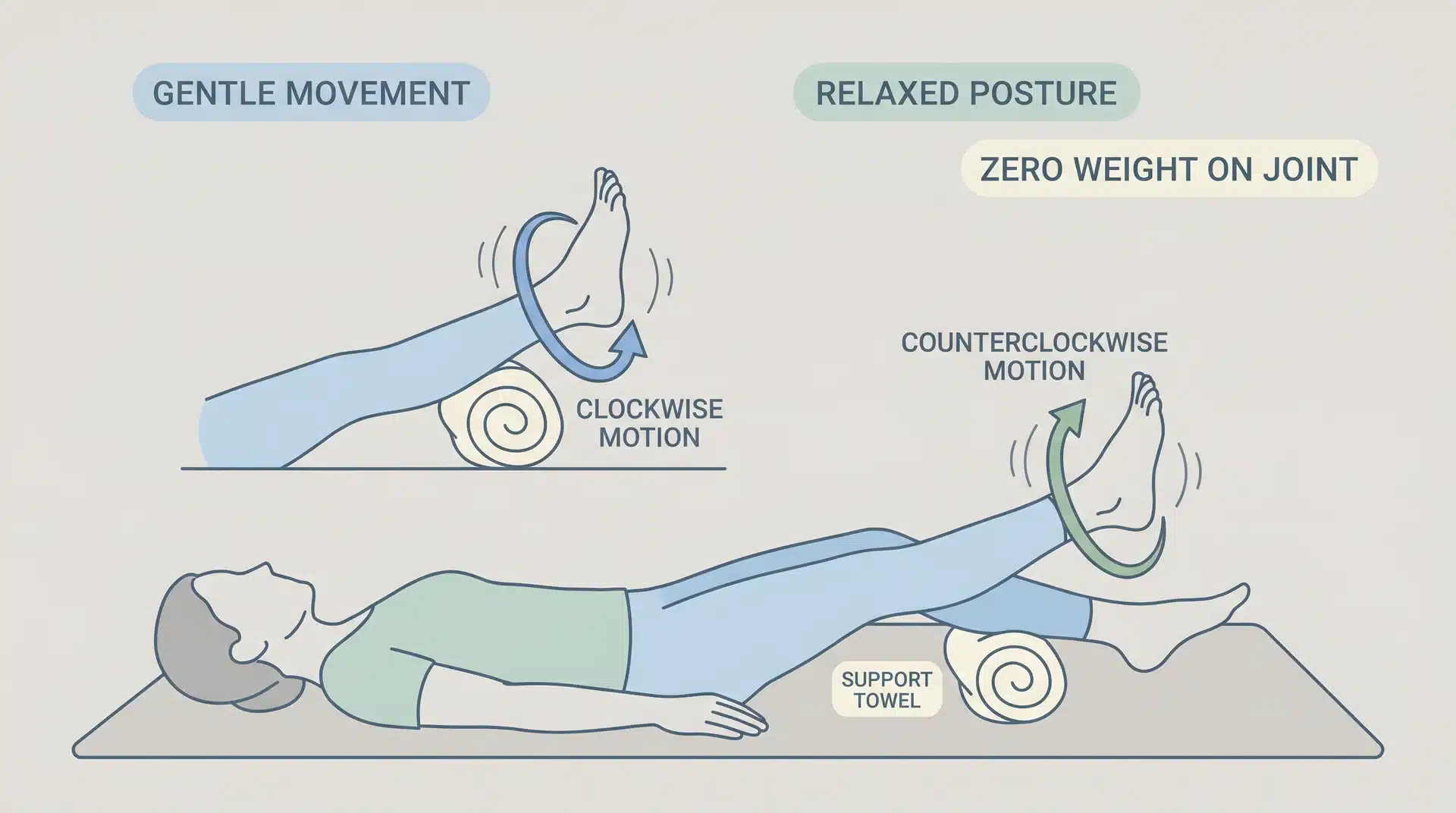
Purpose: Best for post-surgical patients or anyone who cannot yet sit or stand comfortably.
- Lie flat on your back with both legs extended on the floor.
- Raise one leg slightly, or rest it on a rolled towel for support.
- Let your foot relax, then slowly rotate your ankle clockwise.
- Complete 10 to 15 clockwise circles, then 10 to 15 counterclockwise.
- Lower the leg and repeat on the opposite side.
Key tip: This variation puts zero weight on the joint. It is the gentlest option and the one most commonly used in early post-injury rehab.
How Many Ankle Circles Should You Do Per Day?
For general mobility, do 10 to 15 circles in each direction per ankle, once or twice daily. During active rehabilitation, aim for 2 to 3 short sessions per day under the guidance of a physical therapist or doctor.
Seniors or those new to the exercise should start with 10 reps per direction. Build up to 20 reps over two to three weeks. The full routine takes under five minutes.
Ankle circles work well at the end of a warm-up before lower-body training. They also work as a stand-alone break during long sitting sessions.
Ankle Circle Variations for Every Level
The standard ankle circle is just the starting point. These variations let you adjust the challenge or focus depending on where you are in your training or recovery.
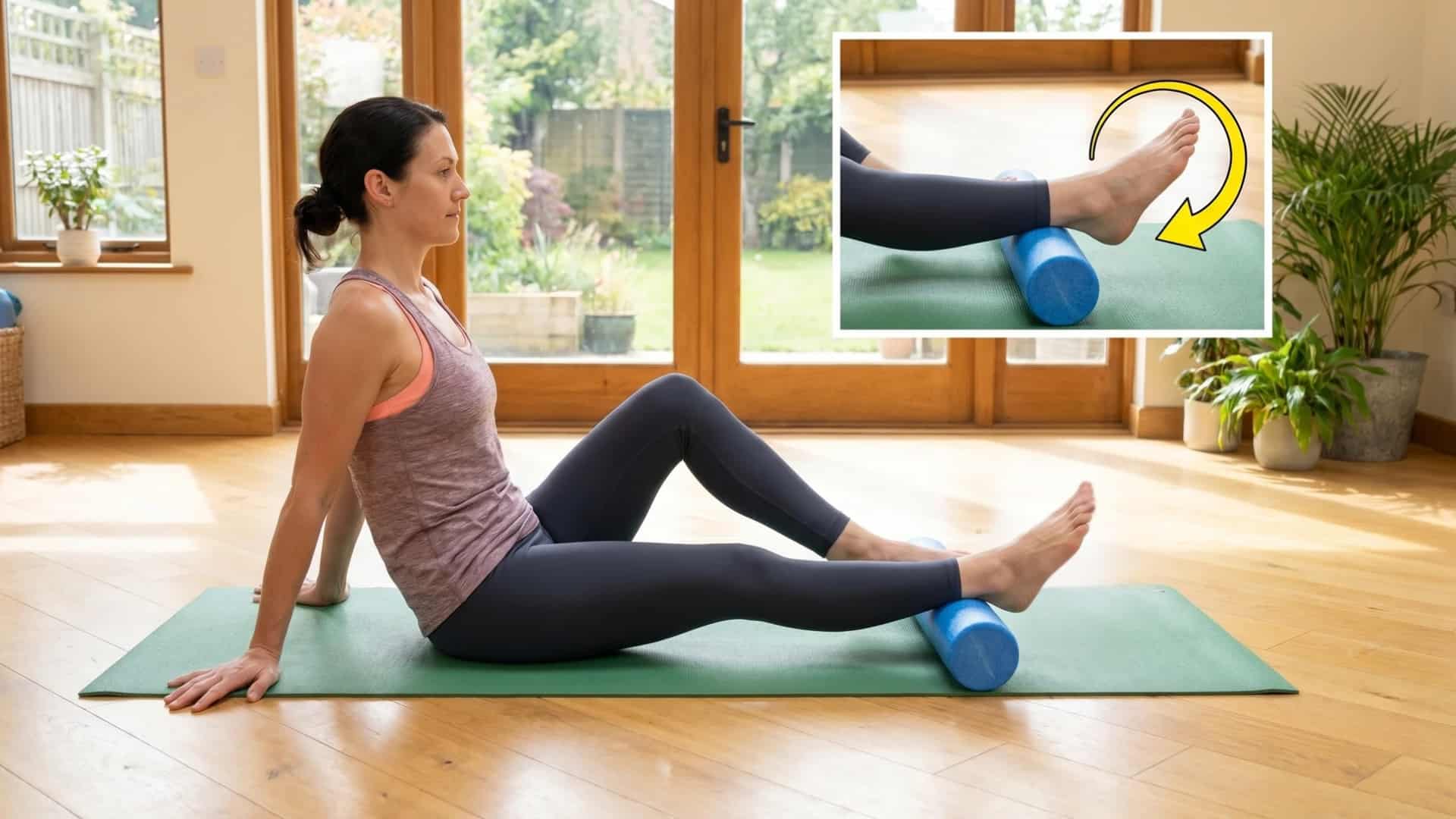
1. Resistance Band Ankle Circles
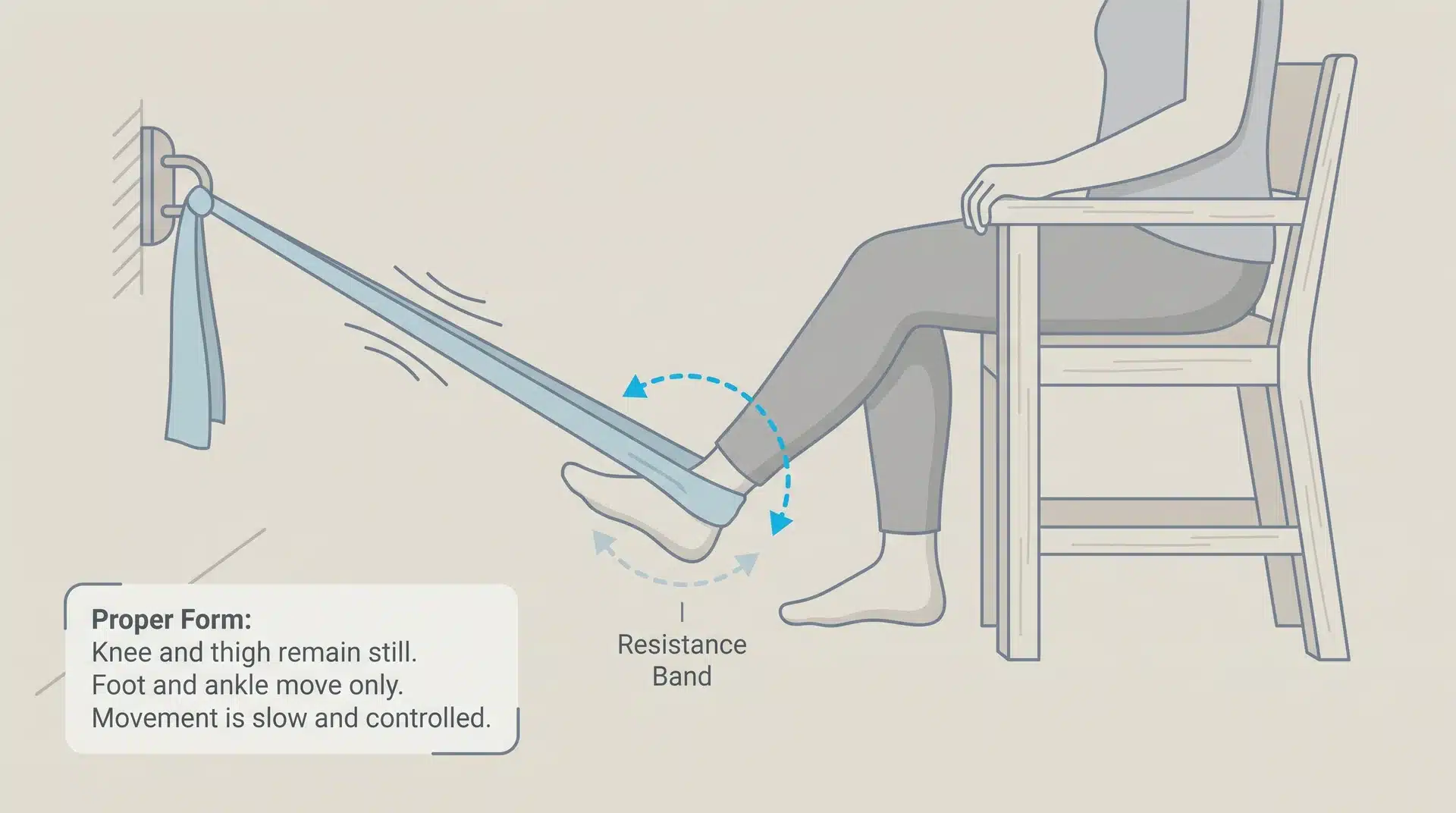
Secure a light resistance band around a fixed anchor point and loop the other end around your foot. From a seated or lying position, perform the same clockwise and counterclockwise rotations against the band’s resistance.
This variation targets the small stabilizing muscles around the ankle joint. It is a strong next step for athletes returning from a sprain who want more challenge from the exercise.
2. Alphabet Ankle Circles
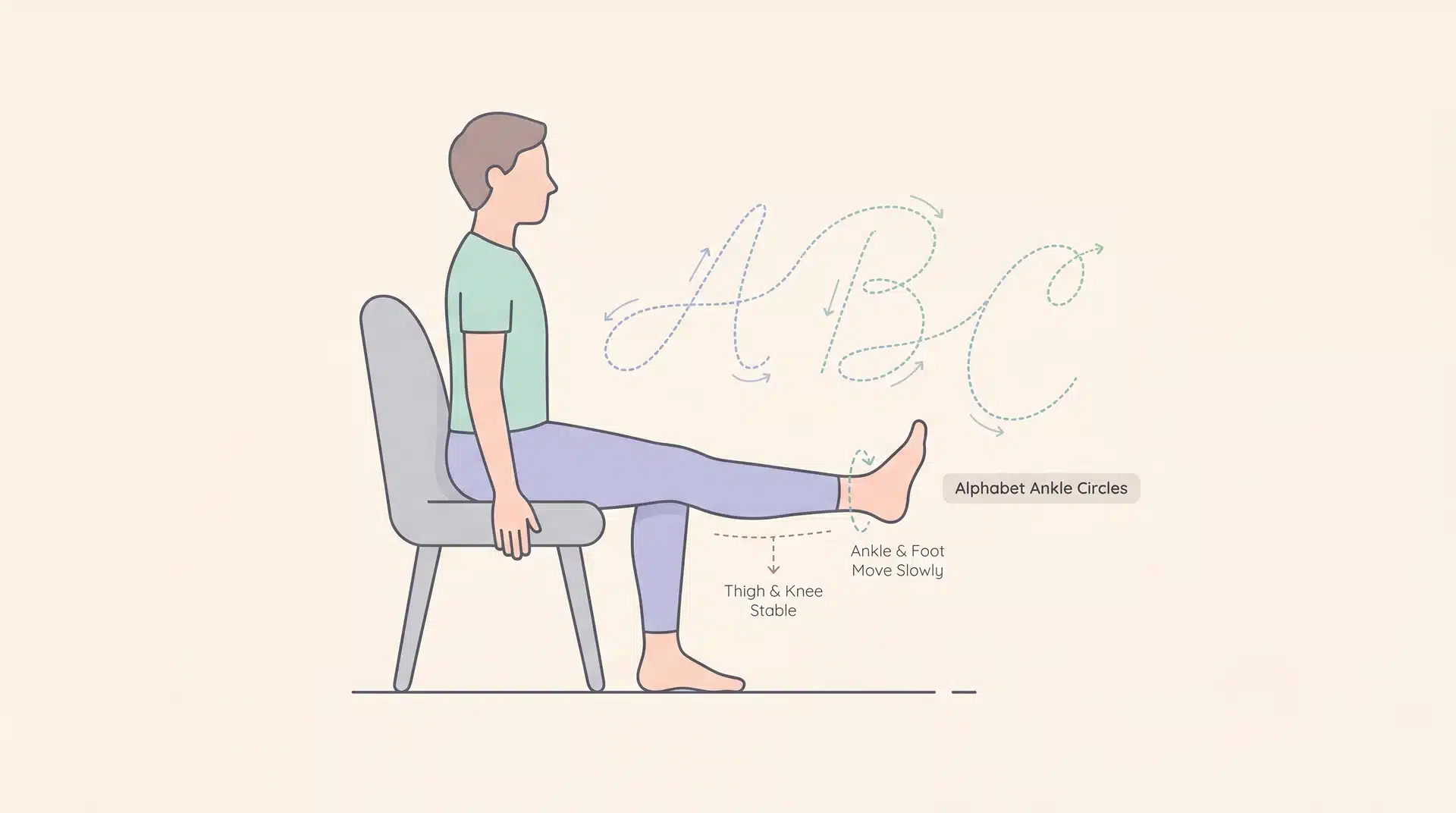
Instead of tracing perfect circles, use your ankle to spell out the letters of the alphabet in the air. This covers every direction the ankle can move in a single session.
Physical therapists often use alphabet ankle circles in ankle sprain recovery because the varied movement works the joint in multiple planes without repetitive stress. Try it seated with your leg extended, tracing each letter slowly and with control.
3. Water Ankle Circles
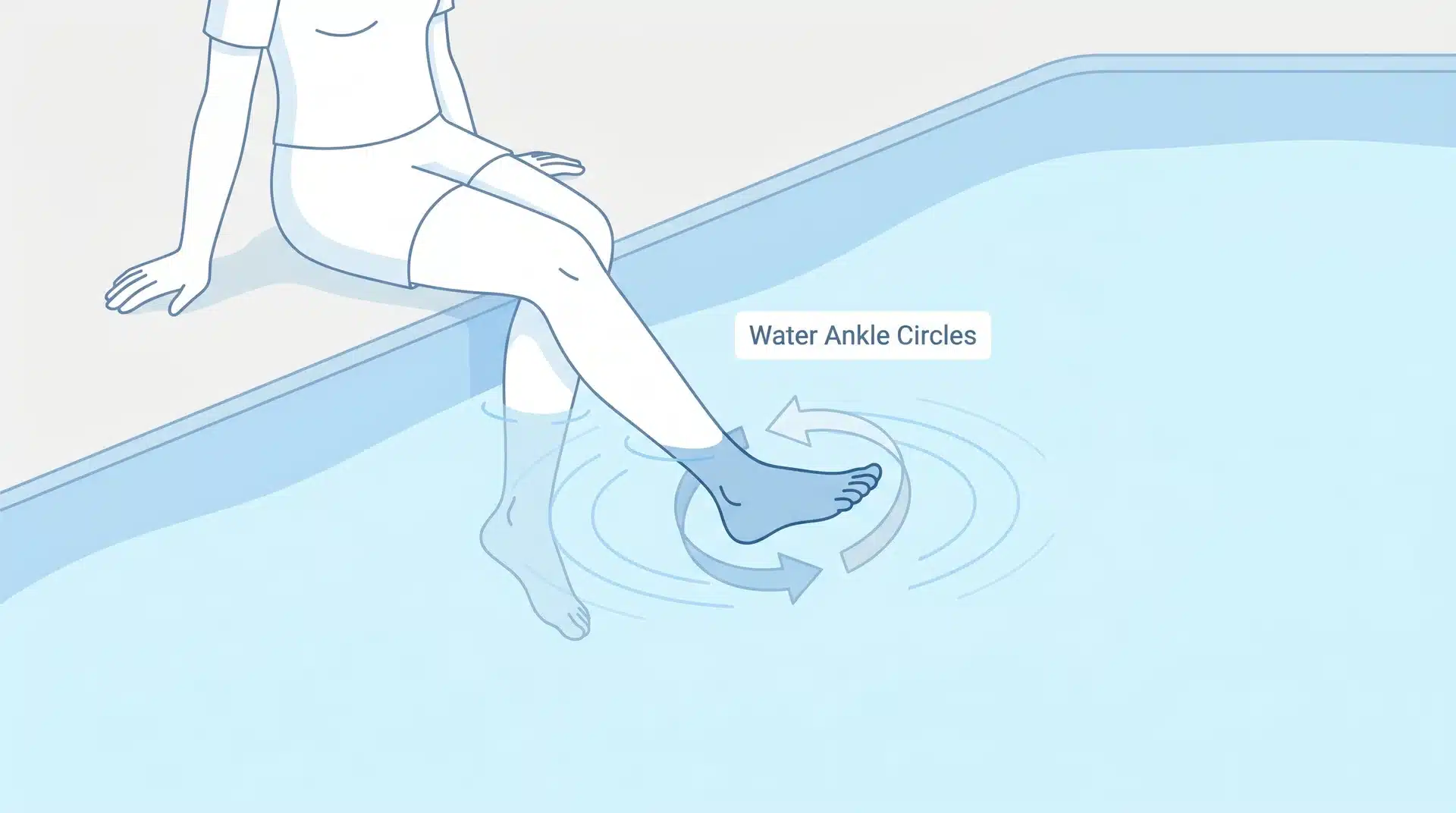
Ankle circles performed in water reduce joint load while adding gentle resistance from the water pressure. Sit on the pool edge with your feet submerged and perform the standard clockwise and counterclockwise rotation pattern.
This is a good option for people with arthritis, post-injury swelling, or those who find dry land movement uncomfortable at this stage of recovery.
Ankle Circles vs. Ankle Pumps: What Is the Difference?
Ankle circles and ankle pumps often appear together in physical therapy and post-surgical rehab programs. They are not the same exercise, and knowing when to use each one matters.
| Feature | Ankle Circles | Ankle Pumps |
|---|---|---|
| Movement pattern | Full circular rotation | Up and down only (flexion and extension) |
| Directions covered | All four: dorsiflexion, plantarflexion, inversion, eversion | Dorsiflexion and plantarflexion only |
| Primary use | Mobility, warm-up, and rehabilitation | Early post-surgical recovery and circulation |
| Difficulty level | Moderate | Very beginner-friendly |
| When to start | Once basic movement is comfortable | Often, the very first exercise after surgery or injury |
| Equipment | None | None |
Who Should Do Ankle Circles
Ankle circles are not just for people recovering from injuries. Several groups benefit from them for entirely different reasons.
- Seniors: Seated ankle circles are a safe, low-impact way to maintain ankle flexibility and reduce fall risk during daily activities.
- Athletes: Ankle circles belong in every lower-body warm-up, particularly for runners, soccer players, and basketball players who train on variable surfaces.
- Desk Workers and Travelers: Ankle circles during long flights or extended desk sessions reduce the swelling and stiffness that come from prolonged sitting.
When to Avoid Ankle Circles
Avoid ankle circles immediately after a severe ankle fracture or surgery without clearance from your doctor. Stop if you feel sharp or shooting pain, not just the mild stiffness of a tight joint.
Cracking and popping sounds are usually normal, but pain that accompanies them is not. If you have had recent reconstructive ankle surgery, get your surgeon’s clearance before starting any range-of-motion work. This information is for general educational purposes only.
Consult a licensed physical therapist or physician before starting any rehabilitation exercise program.
Wrapping It Up
Ankle circles will not fix everything. But they will fix more than you think. This small, quiet exercise keeps a hardworking joint mobile, stable, and less likely to let you down mid-run or mid-squat.
Add these ankle circles to your warm-up routine. Do them at your work desk. Do them before bed. The form itself is easy.
The time commitment is really minimal. The payoff builds slowly and holds up well over time. Try other ankle mobility exercises too.
Calf stretches and resistance-band work pair well with ankle circles to build stronger, more resilient lower legs. Start today. Start small.
Frequently asked questions
How long should you do ankle circles?
You should perform ankle circles for 1–2 minutes per session, repeating several times a day. Doing them after long periods of sitting or standing helps improve circulation and prevent stiffness.
Why do I have circles on my ankles?
Circles or dark discoloration around the ankles can result from bruising, poor circulation, fluid buildup, or natural pigmentation. Persistent or painful discoloration may require a medical check.
Do ankle circles help with swelling?
Yes, ankle circles promote blood flow and lymphatic drainage, which can reduce mild swelling in the feet and ankles.
What is the fastest way to drastically reduce swelling in the feet?
Elevate your feet above heart level, stay hydrated, gently move your ankles, wear compression socks, and reduce salt intake to quickly ease swelling.