

Family conversations can fall apart faster than anyone wants to admit. A simple disagreement turns into silence. A child shuts down. A parent reacts before really listening. When that keeps happening, the distance within a family widens over time.
Family therapy activities give every member a structured way to talk, listen, and work through what is hard. They are used by licensed therapists and parents to rebuild trust and connection.
This post covers family therapy activities your family can start using today. You will also find clear guidance on choosing the right one and running it at home.
19 Family Therapy Activities for Kids, Teens, and Family
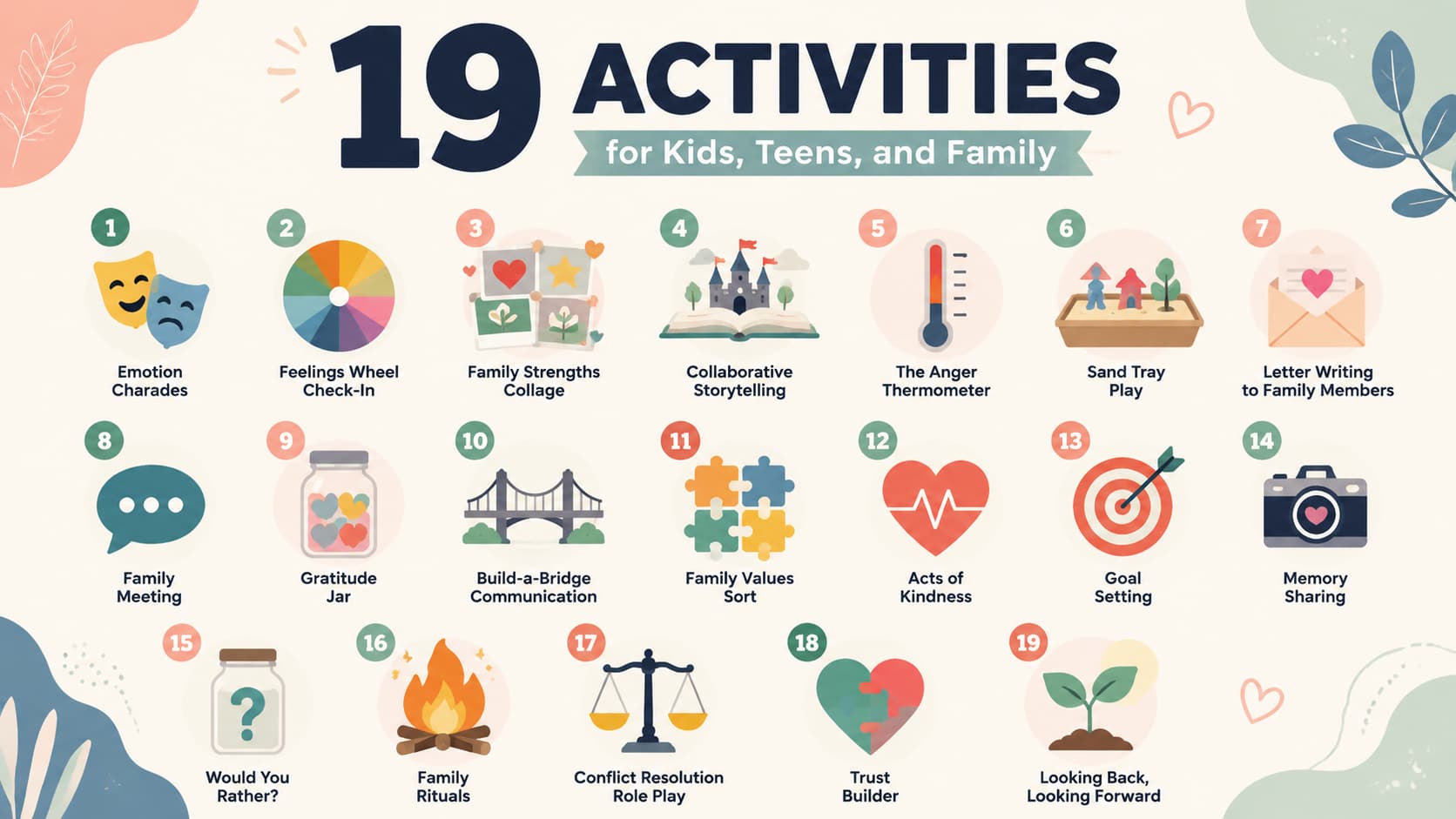
These family therapy activities cover a range of goals, settings, and needs. Each one includes its purpose, what you will need, steps for running it, and a debrief question to close with. Use the debrief question every time. That conversation is where the real work happens.
1. Emotion Charades
Purpose: Help family members identify, name, and physically express a range of specific emotions.
Materials: A set of emotion cards. Write or print words on index cards: happy, scared, angry, sad, embarrassed, excited, nervous, confused, worried, proud.
Steps:
- Shuffle the cards face down in a pile.
- One family member draws a card and acts out that emotion without speaking.
- Everyone guesses the emotion.
- The person who guesses correctly shares one time they felt that way.
Debrief: “When do you feel this way at home? What helps when you feel like this?”
This activity works across a wide age range. It also brings emotions to the surface that family members never knew others in the home carried.
2. Feelings Wheel Check-In
Purpose: Move family members past default words like “fine” or “okay” toward more specific and honest emotional language.
Materials: A printable feelings wheel. Free versions are available through school counseling and child psychology resource sites.
Steps:
- Display or distribute the feelings wheel before the session begins.
- Each person points to or names their current feeling.
- Go around without commenting on anyone else’s response.
- Each person adds one sentence: “I feel ___ because ___.”
Debrief: “Is that feeling different from yesterday? What changed?”
Use this as a recurring opener for every session. Families who use it consistently report that members become more comfortable naming emotions over time.
3. Family Strengths Collage
Purpose: Shift the family’s attention from problems to shared identity, positive qualities, and what is already working.
Materials: Old magazines, scissors, glue, one large poster board for the group.
Steps:
- Each person finds images and words that represent a strength their family has.
- Everyone adds their pieces to a single shared board.
- When the collage is complete, each person explains one item they added.
Debrief: “Which of these strengths do you want to use more this week? What would that look like?”
This works well as a first- or second-session activity. Starting with strengths builds the emotional safety needed before addressing harder topics.
4. Collaborative Storytelling
Purpose: Let family members process emotions and experiences through a character’s story rather than their own.
Materials: None required. Puppets or stuffed animals are helpful for younger children.
Steps:
- One person starts a story with a character who faces a challenge. Keep the character fictional.
- Each family member adds a sentence or short paragraph to continue the story.
- The group must bring the story to a resolution before ending.
- The therapist or parent observes recurring themes: fear, conflict, isolation, or loss.
Debrief: “How do you think the main character felt by the end? Did that ending feel right to you?”
Pay close attention to how younger children end the story. Abrupt endings and unresolved conflicts often reflect what children carry inside but have not yet said out loud.
5. The Anger Thermometer
Purpose: Teach family members to recognize anger as it builds, before it reaches a point where someone says or does something harmful.
Materials: A thermometer worksheet numbered 0 (calm) to 10 (explosive). Free printable versions are available through school counseling and CBT resource libraries online.
Steps:
- Draw or print the thermometer together as a group.
- At each level, each person labels what their body feels: tight chest, clenched jaw, raised voice.
- At each level, note what behavior tends to show up.
- At each level, identify one thing that helps bring the number down.
- Practice together by naming current numbers and sharing strategies.
Debrief: “What number are you at right now? What would bring it down by two?”
6. Sand Tray Play
Purpose: Give family members a non-verbal way to express emotions, relationships, and inner experiences through symbolic arrangement.
Materials: A shallow tray filled with sand. A collection of small figures including people, animals, buildings, and natural objects.
Steps:
- Place the tray and figures within reach of the person.
- Invite them to arrange the figures in any way they choose. There are no rules.
- Observe without directing or commenting on meaning.
- When they signal they are done, ask them to describe what they created.
- Do not interpret the symbols. Let the person assign their own meaning.
Debrief: “Tell me about what you made. Who are the different figures in it?”
Important: This activity should be led by a trained therapist. It can surface strong emotional material quickly. Do not use it as a standalone home activity without professional guidance.
7. Letter Writing to Family Members
Purpose: Give family members a low-pressure way to say things they struggle to express face to face.
Materials: Paper and pen. Letters can be typed if that feels more comfortable.
Steps:
- Each person writes a letter to another family member.
- Use this simple structure: one thing I appreciate about you, one thing I wish you understood about me, one thing I need from you.
- Sharing is optional. The therapist or parent helps decide if and how letters are read aloud.
- If shared, the listener stays quiet and does not respond immediately.
Debrief: “Was there anything that surprised you about what you wrote or what you heard?”
8. Emotion Journal Sharing
Purpose: Build the daily habit of recognizing, naming, and reflecting on emotional experiences outside of sessions.
Materials: A personal journal or notebook for each family member.
Steps:
- Between sessions, each person writes about one moment in the week when they felt a strong emotion.
- They note: what triggered it, how the body felt, what they did next, and whether that helped.
- In the session, each person shares key points from their entry. Not the full text.
- Others listen without judging or trying to fix anything.
Debrief: “What did writing it out feel like compared to just keeping it in your head?”
A regular emotion journal also builds a personal record of patterns and triggers. That record becomes useful in therapy over time.
9. Two Truths and a Therapeutic Lie
Purpose: Build openness and family understanding through a game format that lowers emotional guard.
Materials: None.
Steps:
- Each person prepares two true statements about how they feel in the family and one false statement.
- Each person reads all three aloud.
- The group guesses which one is false.
- After the reveal, the person expands on both true statements.
- The therapist or parent guides the conversation toward the feelings behind the truths.
Debrief: “Which of your truths felt hardest to say? Why do you think that is?”
The game format makes this feel lighter than direct emotional discussion. That lightness is what gets people to participate honestly.
10. Role-Play Conflict Scenarios
Purpose: Let family members practice healthier responses to real conflicts in a safe setting before those conflicts come up again in real life.
Materials: Written scenario cards or verbal prompts. Common topics include curfews, household responsibilities, phone use, or privacy.
Steps:
- The therapist or parent presents a conflict scenario.
- Family members act it out using their typical responses.
- The person leading pauses the role-play to name the communication patterns showing up.
- Family members switch roles and try the scenario again with a different approach.
- The group discusses what felt fair and what felt dismissive.
Debrief: “How did it feel to be on the other side of that conversation?”
For teens who resist discussion-based therapy, this activity often produces more honest responses because it feels like practice rather than emotional processing.
11. Personal Boundary Mapping
Purpose: Help family members identify their personal limits and communicate them in a clear, respectful way.
Materials: One large sheet of paper per person, markers.
Steps:
- Each person draws a large circle in the center of their page representing themselves.
- Inside the circle, they write or draw what feels comfortable and acceptable.
- Outside the circle, they note what feels uncomfortable or crosses a line.
- Each person shares their map and explains two or three items.
- The family identifies one boundary they can actively respect going forward.
Debrief: “Which boundary feels most important to you right now? How can your family support that?”
12. The Coping Strategies Toolkit
Purpose: Help family members build a personal set of healthy strategies for managing stress and strong emotions outside of therapy.
Materials: Index cards or a one-page printed template.
Steps:
- Each person lists their current go-to responses when stressed or overwhelmed. Include both helpful and unhelpful ones.
- For each unhelpful response, identify a healthier replacement together.
- Add concrete options: slow breathing, the 5-4-3-2-1 grounding method, movement, journaling, or calling a trusted person.
- Each person keeps their card somewhere visible between sessions.
- At the next session, the family reviews which strategies were tried and how they worked.
Debrief: “Which strategy felt most realistic to use this week? What made the others harder to try?”
Building coping strategies through family therapy activities gives each member something practical to use the next time a difficult moment comes up outside the session.
13. The Miracle Question Discussion
Purpose: Help family members picture what a healthy, respectful home life looks like to each of them.
Materials: None.
Steps:
- Pose this question: “If you woke up tomorrow and everything in your family was better, what would be different? What would you notice first?”
- Each person answers without being interrupted.
- The rest of the family listens for shared goals and overlooked needs.
- Identify one realistic step toward the picture each person described.
Debrief: “What is one small thing you could do this week that moves toward that picture?”
This technique comes from Solution-Focused Brief Therapy (SFBT), developed by Steve de Shazer and Insoo Kim Berg. Research on SFBT shows it helps families shift from problem-focused thinking to goal-directed action relatively quickly.
14. Family Genogram Drawing
Purpose: Map family relationships across generations to identify recurring patterns such as conflict, emotional distance, or unresolved grief.
Materials: Large paper or whiteboard, colored markers.
Steps:
- Start with the current family unit. Draw squares for males and circles for females.
- Add parents, grandparents, and siblings using standard genogram notation.
- Draw relationship lines between people: solid for close, zigzag for conflicted, dashed for distant.
- Each person adds short notes to their own relationships.
- The group reviews the full picture together.
Debrief: “Which patterns do you want to change in your own home? What would that take?”
Important: This activity can surface long-standing pain and emotional history. Use with a trained therapist, especially the first time.
15. Communication Ball Toss
Purpose: Practice the habit of taking turns speaking and fully listening without cutting in before the other person finishes.
Materials: One soft ball. A beach ball or foam ball works well.
Steps:
- Only the person holding the ball speaks. Everyone else listens without jumping in.
- The speaker shares one feeling or observation in two to three sentences.
- When finished, they toss the ball to someone else.
- The new speaker begins: “I heard you say… and I want to add…”
- Repeat until everyone has spoken at least twice.
Debrief: “Was it hard to hold back and just listen? What did you do with the urge to respond?”
The physical object makes the rule concrete. Younger children especially benefit from having something tangible that signals whose turn it is to speak.
16. Family Vision Board
Purpose: Align family members around shared goals and what they want the home to feel like together.
Materials: Old magazines, scissors, glue, one large shared poster board.
Steps:
- Each person finds images and words that represent what they want their family life to feel like or to work toward.
- Everyone adds pieces to the shared board.
- Each person explains what they added and why.
- The group identifies two goals that appear across multiple people’s contributions.
Debrief: “Which goal feels most important to start working on? What would that look like this week?”
This works well as a goal-setting exercise at the start of a new therapy phase or after a major family change.
17. Trust Walk
Purpose: Build physical and emotional trust between family members through structured reliance on one another.
Materials: One blindfold or sleep mask. An open, safe indoor space.
Steps:
- One person puts on the blindfold.
- A family member guides them through a simple path using only verbal directions.
- The blindfolded person must trust those directions completely.
- After reaching the endpoint, roles switch.
- Every family member takes a turn as both guide and guided.
Debrief: “What did it feel like to rely completely on someone else? What did it feel like to be responsible for someone?”
Adults often find this more emotionally powerful than they expect. The physical experience of being led blindly mirrors what it feels like to trust someone with something emotionally heavy.
18. Family Timeline
Purpose: Build a shared family story that includes both hard times and moments of recovery, not only painful memories.
Materials: A long paper roll or whiteboard. Markers in multiple colors.
Steps:
- Draw a horizontal line across the paper. Mark the current year at the right end.
- Each family member adds key events: births, moves, losses, achievements, conflicts, and repairs.
- Use different colors for different types of events.
- The group reviews the full timeline together.
- Each person names one moment they feel the family handled well.
Debrief: “What has your family gotten through together that you did not expect to? What did that take?”
19. Check-In Circle
Purpose: Create a consistent opening ritual that gives every person a voice and sets an honest emotional tone before harder conversations begin.
Materials: None. An optional talking object such as a small stone or a meaningful household item can help with turn-taking.
Steps:
- Go around the group at the start of each session or family meeting.
- Each person shares one word or one sentence: “Right now I feel ___ because ___.”
- No one comments, questions, or responds during the check-in itself.
- After everyone has shared, the session or conversation opens.
Debrief: “Is there anything from someone’s check-in that you want to ask about or respond to?”
Families can adopt this as a five-minute dinner routine or bedtime practice. It is one of the most repeatable and low-pressure activities in this entire list.
How to Use These Activities at Home
Start with the simplest activities first, such as the Check-In Circle, the Feelings Wheel, or the Family Vision Board, and hold them at a consistent time each week in a space with no phones or screens.
Always close with a debrief question, even a short one, because that reflection is what turns an exercise into a learning moment.
Let family members take turns choosing the activity when possible, since ownership increases the chance that everyone shows up and participates honestly.
If a particular activity brings up something your family cannot work through on its own, that is a clear signal to involve a licensed therapist rather than push through without proper support.
Conclusion
Family therapy activities give families far more than just conversation topics. They give families a clear, structured process to follow together.
The activities in this post cover communication, trust, emotional regulation, grief, and connection. Start with the ones that feel least threatening to your family. Build from there.
Families that practice these skills consistently do better than those who only talk about their problems. The exercises create shared experiences that words alone rarely produce.
If you want professional support, a licensed family therapist can guide the whole process. The AAMFT therapist locator is a good place to find one.