

Emotional strengths in a child are the skills that help a child understand feelings, respond to challenges, and interact with others in a steady way. These strengths shape how a child reacts to stress, success, and setbacks in daily life. They also influence relationships at school and at home.
This article explains what emotional strengths are, how they differ from traits and behaviors, and how they manifest in real-world situations.
It also covers signs parents can notice and ways adults can support growth through everyday interactions and consistent guidance across childhood stages in a simple, clear way today
What Are Emotional Strengths in a Child?
Emotional strengths in a child are the inner abilities that help them recognize emotions, manage their reactions, and respond to situations with balance.
These skills are not about staying calm all the time, but about managing feelings in ways that support learning and relationships. A child with strong emotional skills can pause before reacting, express what they feel, and recover after setbacks.
These strengths grow through daily experiences at home, school, and with peers, shaping how a child understands both their own emotions and the emotions of others.
Emotional Strengths vs Personality Traits vs Behavior
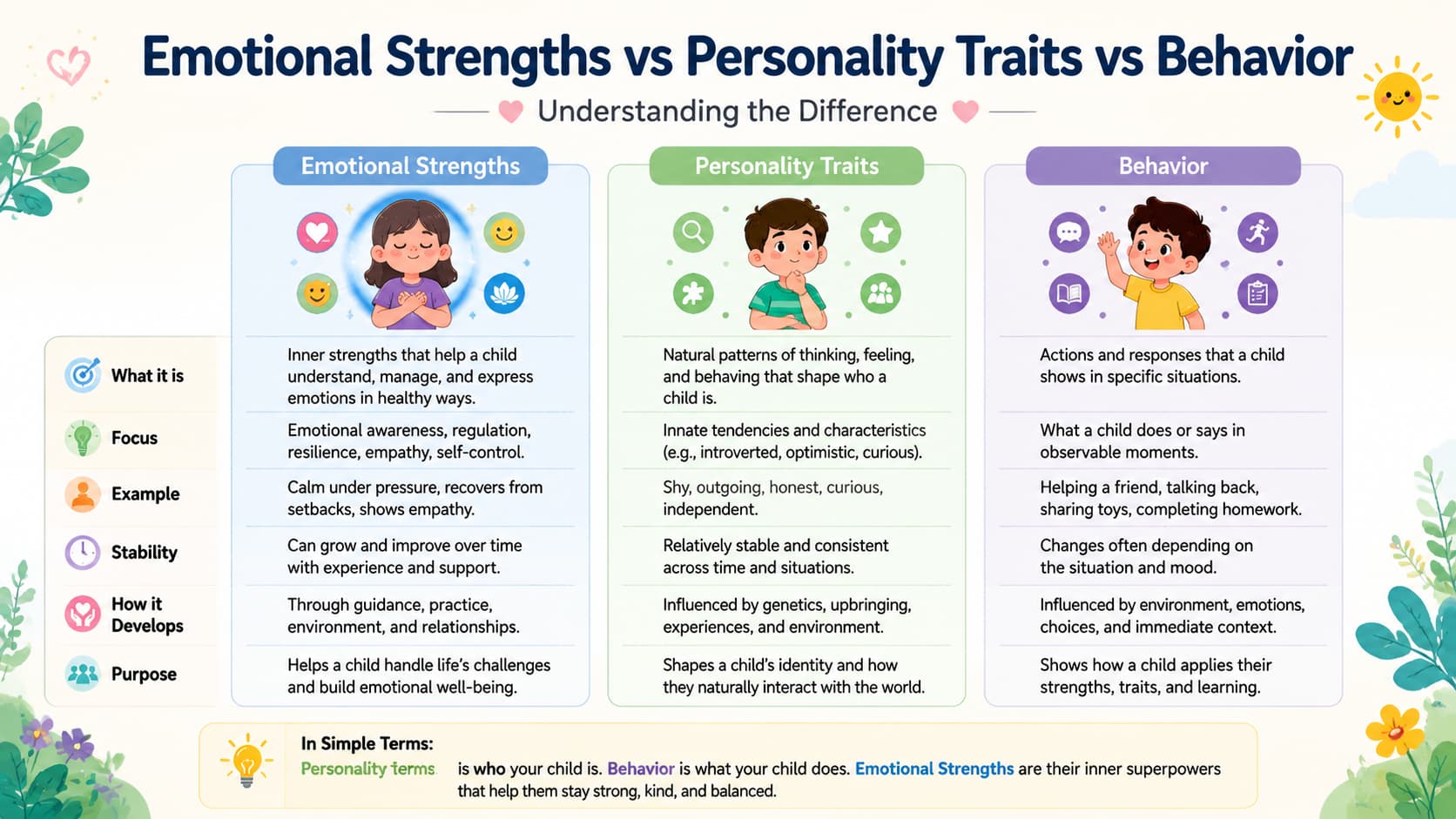
Emotional strengths in a child are often conflated with personality traits and behavior, but each has distinct meaning and impact. Emotional strengths are skills that can develop; personality traits are stable patterns, and behavior is what we observe in specific moments.
| Category | Meaning | Example |
|---|---|---|
| Emotional strengths | Skills for managing emotions | Calming down after frustration |
| Personality traits | Long-term tendencies | Naturally quiet or outgoing child |
| Behavior | Immediate actions | Crying during conflict |
Understanding this difference helps adults respond with more clarity and patience.
Core Emotional Strengths Every Child Develops
Children develop a set of emotional abilities that shape how they handle life situations. These skills build step by step through experience and guidance.
- Emotional Awareness: The ability of a child to recognize and understand their own feelings in different situations.
- Emotional Regulation: The skill that helps a child manage strong emotions and respond calmly instead of reacting impulsively.
- Empathy: The capacity of a child to understand and share the feelings of others in social situations.
- Resilience: The ability of a child to recover emotionally after setbacks, disappointment, or failure.
- Self-Confidence: A child’s belief in their own abilities helps them try new things without fear of failure.
- Impulse Control: The ability of a child to pause and think before acting on strong emotions or urges.
- Adaptability: The skill that allows a child to adjust smoothly to changes in the environment, routine, or expectations.
How Emotional Strengths Develop Over Time
A child’s emotional strengths grow in stages as the brain and social awareness develop. In early years, children depend heavily on adults to name and manage feelings.
As they grow, they begin to recognize emotions on their own and respond with more control. School years bring more peer interaction, which helps them learn to share, handle conflict, and be patient.
Teen years add deeper emotional awareness and identity shaping. Experiences, relationships, and daily communication all shape how strong these emotional skills become over time.
Signs a Child Has Strong Emotional Strengths
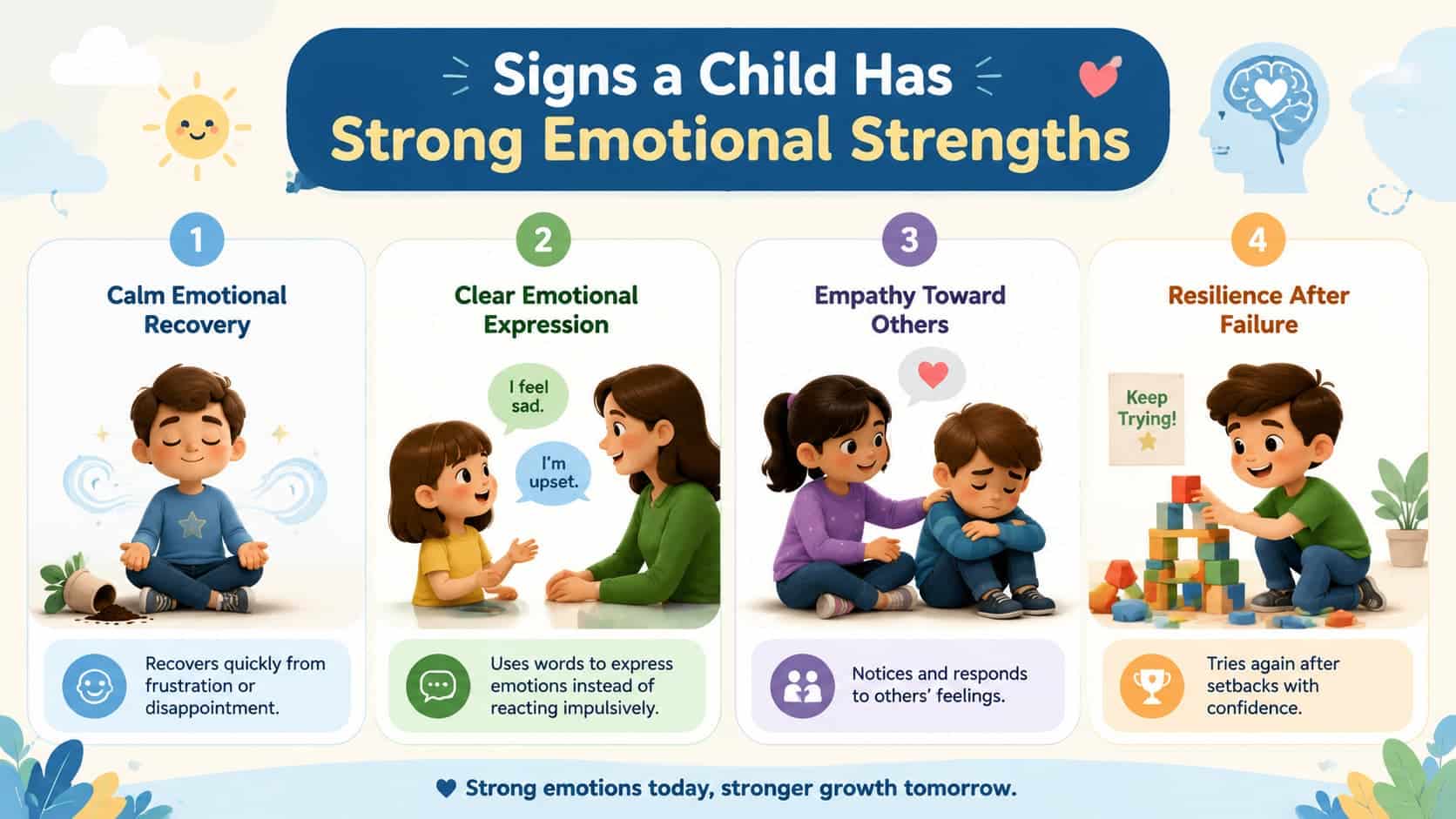
A child’s emotional strengths can be noticed in everyday actions rather than in big events. These signs show how a child handles emotions in real situations.
1. Handles Frustration with Calm Recovery
A child with strong emotional resilience may still feel upset or frustrated when things do not go their way, but the key difference lies in how quickly they recover.
Instead of staying stuck in anger or sadness, they gradually calm down, reflect on what happened, and return to a balanced emotional state. This shows growing control over emotional responses and the ability to cope with setbacks in a healthy way.
2. Expresses Feelings Through Words
Children with emotional strength can communicate their feelings rather what reacting only through behavior. When they are upset, disappointed, or confused, they try to use words to explain their emotions.
This helps reduce misunderstandings and shows that the child is becoming more aware of their internal emotional state and learning to express it constructively.
3. Shows Empathy Toward Others
A child who has developed emotional strengths is often sensitive to how others feel. They may notice when a friend is sad, hurt, or left out and respond with care or support.
This does not always need to be taught directly, as it often develops through observation and emotional connection in daily life. It reflects an ability to step outside their own feelings and understand someone else’s experience.
4. Learns from Mistakes and Moves Forward
Instead of seeing failure as permanent, a child with emotional strengths can understand mistakes as part of learning. When they face setbacks, they may feel disappointed, but they do not give up easily.
Over time, they reflect on what went wrong and try again with improved confidence. This ability to recover and continue is a strong sign of emotional resilience.
Emotional Strengths in Real-Life Situations
Emotional strengths of a child become most visible when they are placed in everyday situations where emotions naturally rise, such as school tasks, peer interactions, or changes in routine. These moments reveal how a child manages pressure, relationships, and expectations in practical settings.
School Environment
In a classroom setting, a child with emotional strengths can handle challenges like a low grade, correction from a teacher, or difficulty in understanding a topic without shutting down emotionally. Instead of giving up or becoming overwhelmed, they ask questions, try again, or accept feedback with a willingness to improve. This shows emotional balance and a healthy response to learning pressure.
Peer Interactions
When dealing with friends, disagreements or misunderstandings are common. A child with strong emotional skills is able to listen to the other person’s perspective, express their own feelings calmly, and look for a fair solution. Rather than reacting with anger or exclusion, they focus on resolving the situation and maintaining the relationship.
Home Environment
At home, emotional strengths are reflected in how a child responds to rules, boundaries, or correction. Even when they feel disappointed or frustrated, they are able to express their feelings in words and gradually accept guidance. This shows growing emotional maturity and trust in communication with caregivers.
New or Unfamiliar Situations
When faced with change, such as a new school routine, activity, or environment, a child with emotional strengths may feel nervous at first but slowly adapts. They rely on curiosity and reassurance rather than fear, which helps them adjust more smoothly over time.
How Parents and Educators Can Support Emotional Strengths
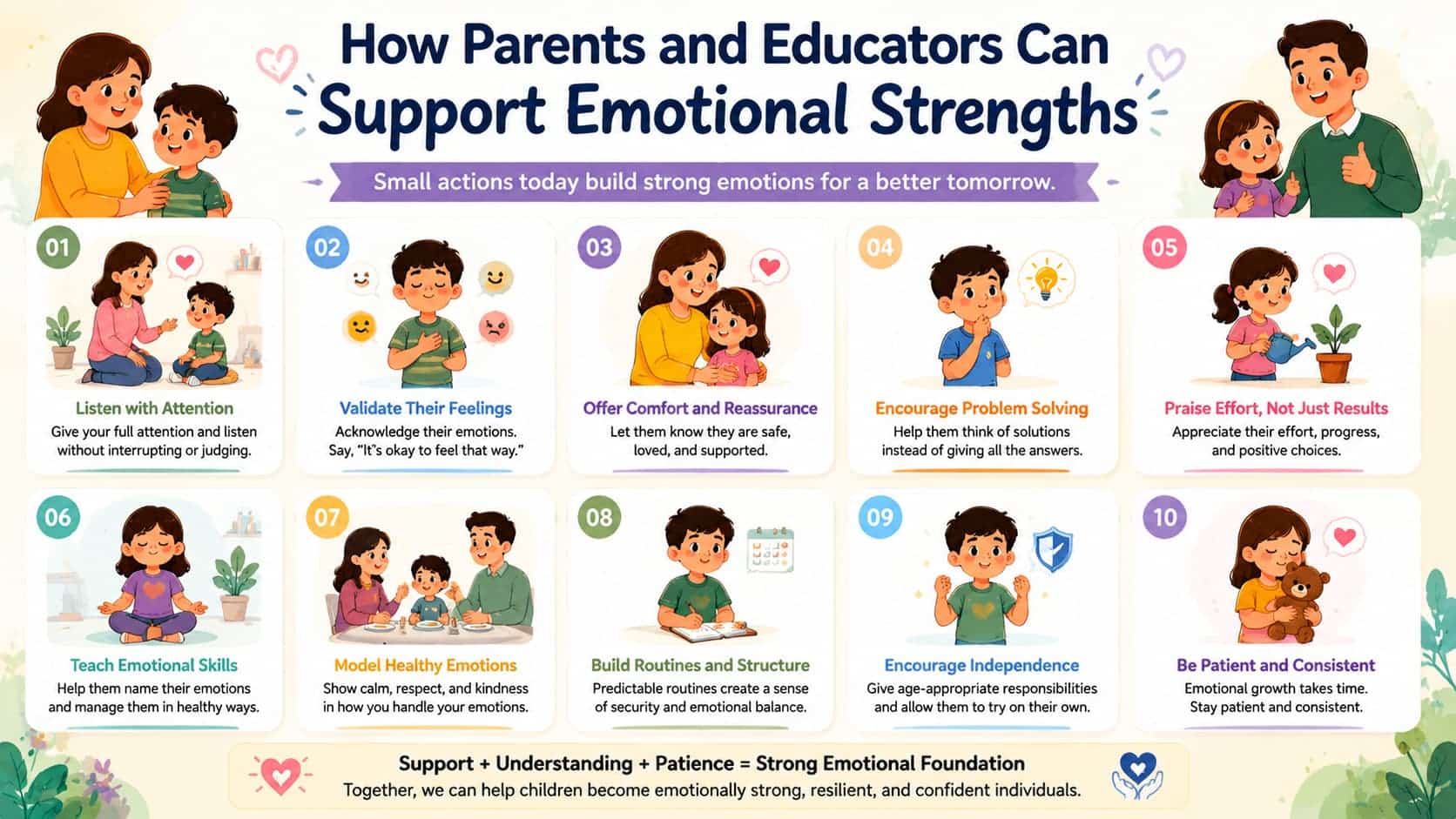
A child’s emotional strengths grow best when adults provide steady support in daily life. This includes showing calm responses during stressful moments, naming emotions during conversations, and allowing children space to express how they feel.
Encouraging problem-solving instead of giving immediate answers also helps children think through situations. Simple routines like talking about the day or reading stories with emotional themes can also support growth.
The goal is to provide children with a safe environment where their feelings are acknowledged and managed with guidance.
Mistakes Adults Make When Interpreting Emotional Behavior
A child’s emotional strengths are sometimes misunderstood when behavior is judged without context. These mistakes can affect how adults respond.
| Mistake | Brief Explanation |
|---|---|
| Confusing emotions with bad behavior | Normal feelings like crying are often seen as misbehavior. |
| Labeling after one incident | One reaction is wrongly used to define the child. |
| Ignoring age differences | Expectations do not match the developmental stage. |
| Suppressing emotions | Children are told to stop their feelings rather than understand them. |
| Overreacting to small emotions | Normal feelings are treated as serious problems. |
| Compared to other children | Emotional responses are judged unfairly against peers. |
| Misreading silence | Quiet behavior is assumed to mean emotional strength. |
| Emotional adult reactions | Adults react with anger instead of calm guidance. |
| Over-control | Children are not allowed to process emotions naturally. |
| Ignoring emotional needs | Feelings are left unaddressed, hoping they disappear. |
Expert Insights from Child Development Psychology
Research in child development shows that a child’s emotional strengths are closely linked to early relationships and daily interaction patterns.
Children learn emotional regulation through repeated experiences of being understood and supported during stress. Studies on attachment also show that secure caregiver bonds help children develop better emotional control.
Schools and caregivers who model calm behavior and clear communication equip children with stronger tools to manage their feelings in social and learning environments.
Conclusion
Emotional strengths of a child shape how they understand feelings, respond to challenges, and build relationships throughout life.
These strengths are not fixed traits but skills that grow with time, experience, and steady support from adults. Children learn emotional balance through daily moments such as solving problems, handling conflict, and expressing feelings in safe ways.
When parents and educators pay attention to these patterns, they can guide children toward healthier responses.
Over time, this support helps children become more aware, steady, and confident in handling emotional situations across different stages of growth.