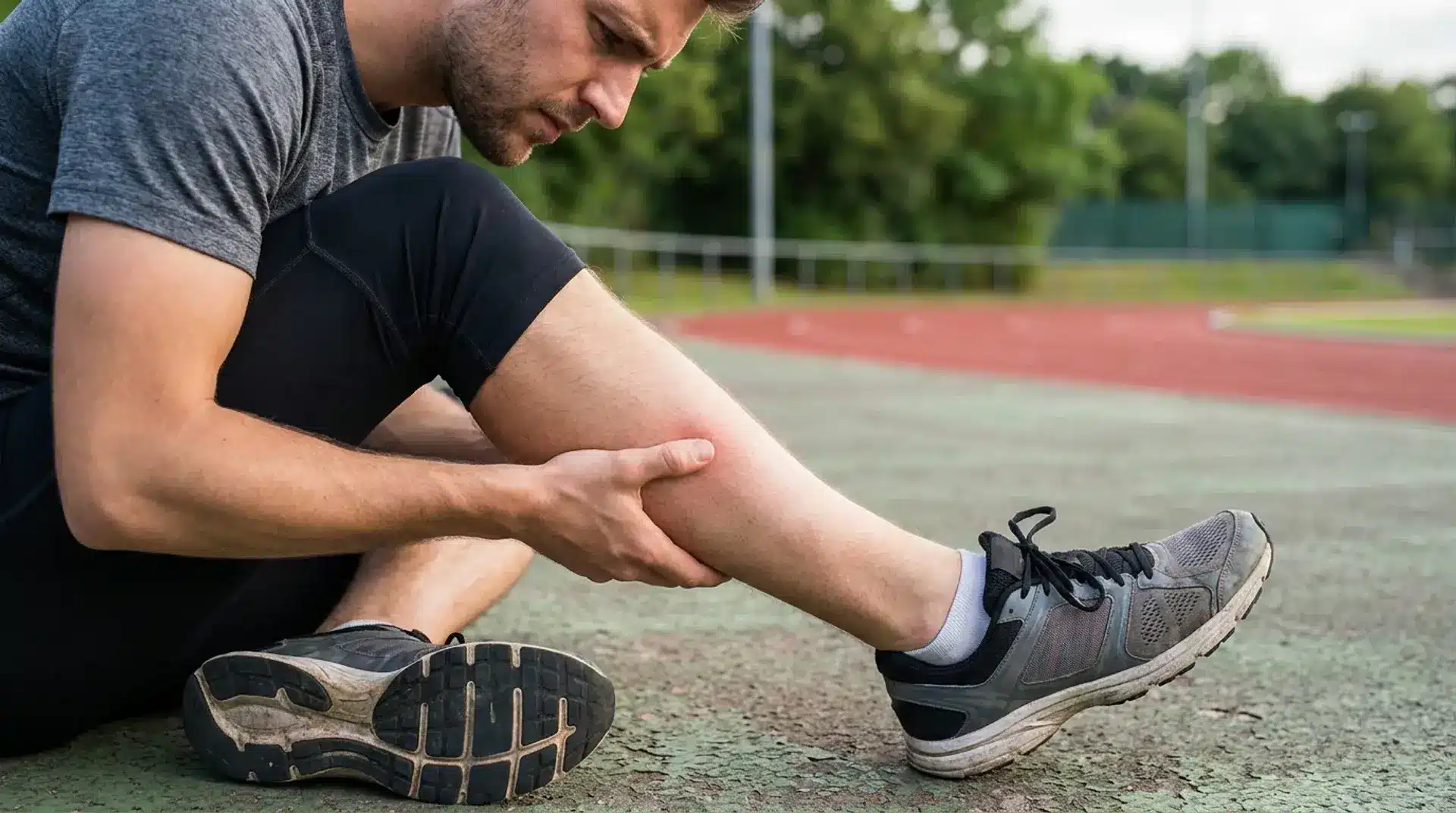
Your shin has been aching for weeks. It hurts during your run. It lingers long after you stop. You may still feel it when you lie down at night.
That kind of pain often points to a tibia stress fracture. The tibia accounts for nearly 24% of all stress fractures in athletes. That makes it the bone most often affected by repeated impact.
Catching this injury early can prevent it from worsening. This post covers the symptoms, causes, types, diagnosis, treatment options, and recovery timeline for tibia stress fractures.
You will also find clear tips for returning to running safely.
What Is a Tibia Stress Fracture?
A tibia stress fracture is a small crack in the shinbone. It forms from repeated stress on the bone, not from a single fall or accident. This is what separates it from a typical fracture.
It develops when bone cannot repair itself fast enough to keep up with the damage. Every run or jump creates tiny microcracks in the bone. Healthy bones fix those cracks during rest. When training load rises faster than the bone can adapt, the cracks grow.
Think of bending a paperclip back and forth repeatedly. It does not snap right away. Over time, the metal weakens and gives way.
Your tibia at a glance:
- The larger of the two bones in your lower leg
- Bears most of your body weight when you stand and run
- Connects your knee to your ankle
- Absorbs impact with every step
Stress reaction vs. true stress fracture
Not every bone stress injury is a true fracture. Doctors grade these injuries from 1 to 4 using MRI findings. Grades 1 through 3 are stress reactions. The bone is irritated but shows no visible crack. Grade 4 is a true stress fracture. A visible fracture line is present.
What Are the Symptoms of a Tibia Stress Fracture?
Catching this injury early matters. The signs are specific enough to recognize if you know what to look for.
Most common symptoms:
- Localized shin pain is the most telling sign. The pain sits at one small spot, usually along the inner lower shin. It does not spread widely.
- Pain that does not warm up. Muscle soreness often eases after a few minutes of movement. A tibia stress fracture does not ease up. It hurts during the run and continues after you stop. It may also ache at rest.
- Nighttime pain is common. If your shin aches while you are lying down, take that seriously.
- Tenderness to touch. Press one finger along your shinbone. Pressing a small spot that causes sharp pain is called focal tenderness.
- Mild swelling may appear over the painful area.
- Bruising can develop in some cases.
- Limping or difficulty walking in moderate-to-severe cases.
Pain builds gradually over days or weeks. It does not start suddenly like a sprain or muscle pull.
Tibia Stress Fracture vs. Shin Splints
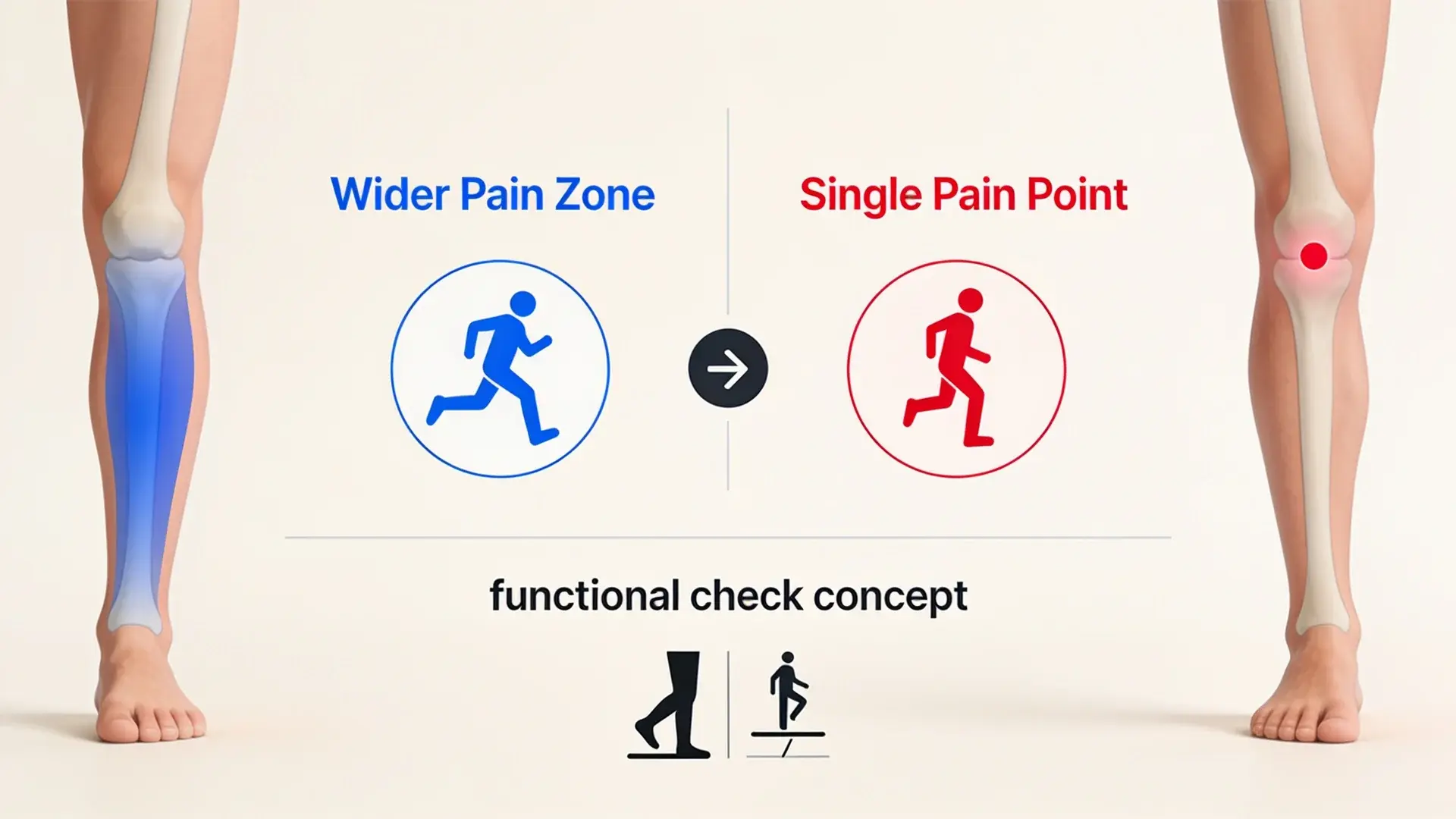
These two injuries are often confused. That confusion leads people to keep training through something that needs rest.
| Feature | Tibia Stress Fracture | Shin Splints |
|---|---|---|
| Pain spread | Less than 5 cm | More than 5 cm |
| Pain with warm-up | Does not ease up | Often eases |
| Touch test | Sharp focal pain | Diffuse soreness |
| One-leg hop test | Usually painful | Usually tolerated |
A clinical test called the one-leg hop test helps distinguish them. Someone with a stress reaction can usually hop repeatedly. Someone with a stress fracture typically cannot hop without pain. Do not try this test aggressively on your own. Use it as a reference when speaking with a doctor.
What Causes a Tibia Stress Fracture?
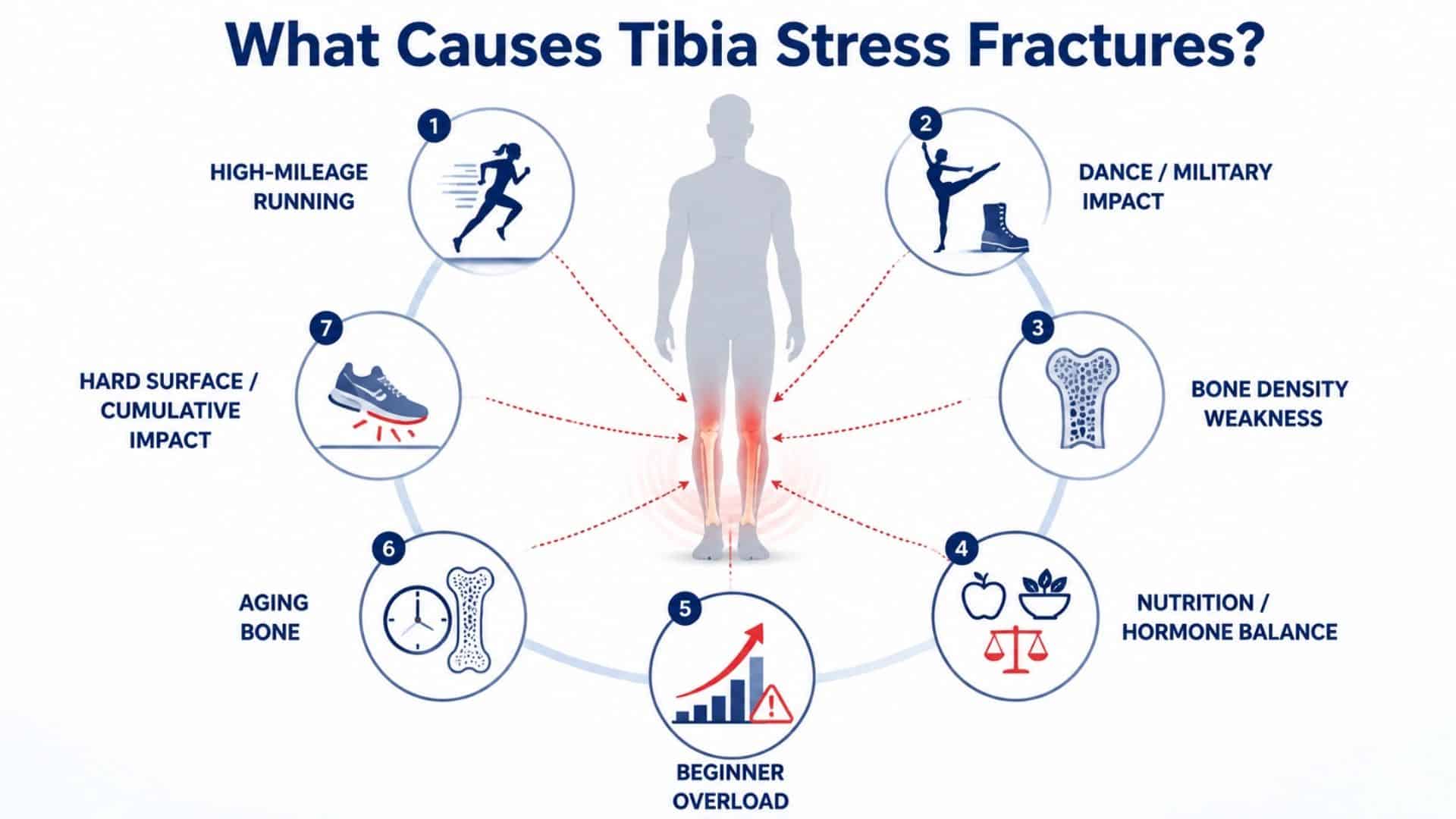
Certain groups carry more risk than others.
Who is most at risk:
- Runners logging more than 64 kilometers per week
- Dancers and military recruits due to repeated high-impact loading
- Female athletes, whose stress fracture rates are roughly double those of male athletes
- People with low bone density
- Athletes with poor nutrition or disrupted menstrual cycles
- Beginners who increase training volume too quickly
- Older adults, whose bone density and repair rate slow with age
Biomechanical and lifestyle factors
How you move matters as much as how much you move. Overpronation causes the foot to roll inward beyond its normal range. This creates uneven loading along the tibia. Over time, stress concentrates at specific points on the bone.
Sleep and nutrition play a direct role in bone repair. Among female runners with high-risk bone injuries, 80% slept fewer than seven hours per night. More than half had iron deficiency. Both factors affect how well bone repairs itself between training sessions.
High-Risk vs. Low-Risk Tibia Stress Fractures
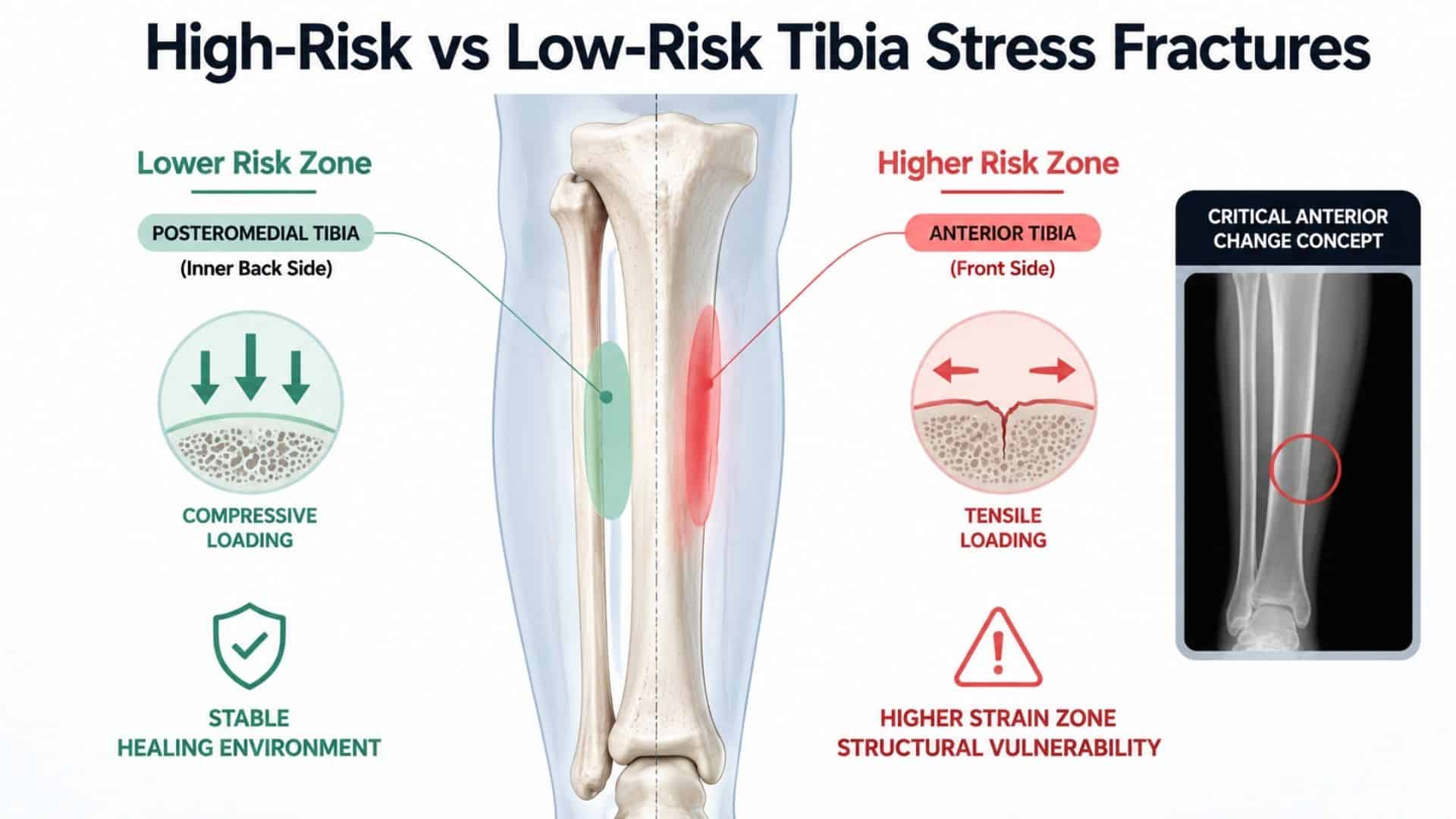
Location on the bone determines how serious the injury is. It also determines how it should be treated.
Low-Risk: Posteromedial Tibial Stress Fractures
The posteromedial tibia is the inner back surface of the shinbone. This is the most common fracture site in runners. These fractures are classified as low-risk. The bone is under compression forces here, which supports healing. Most cases respond well to rest and a gradual return to activity.
High-Risk: Anterior Tibial Stress Fractures
The front of the tibia faces much higher tensile forces. Blood supply to this area is also relatively poor. This combination raises the risk of the fracture not healing properly. It can also progress to a complete break.
On a lateral X-ray, a high-risk anterior fracture may show what doctors call the “dreaded black line.” This is a visible gap at the front of the tibia. It suggests that surgery may be needed. Intramedullary nailing is the standard surgical approach when this finding is present.
If you have front-of-shin pain that does not improve with rest, see a doctor. Anterior fractures need medical assessment without delay.
How Is a Tibia Stress Fracture Diagnosed?
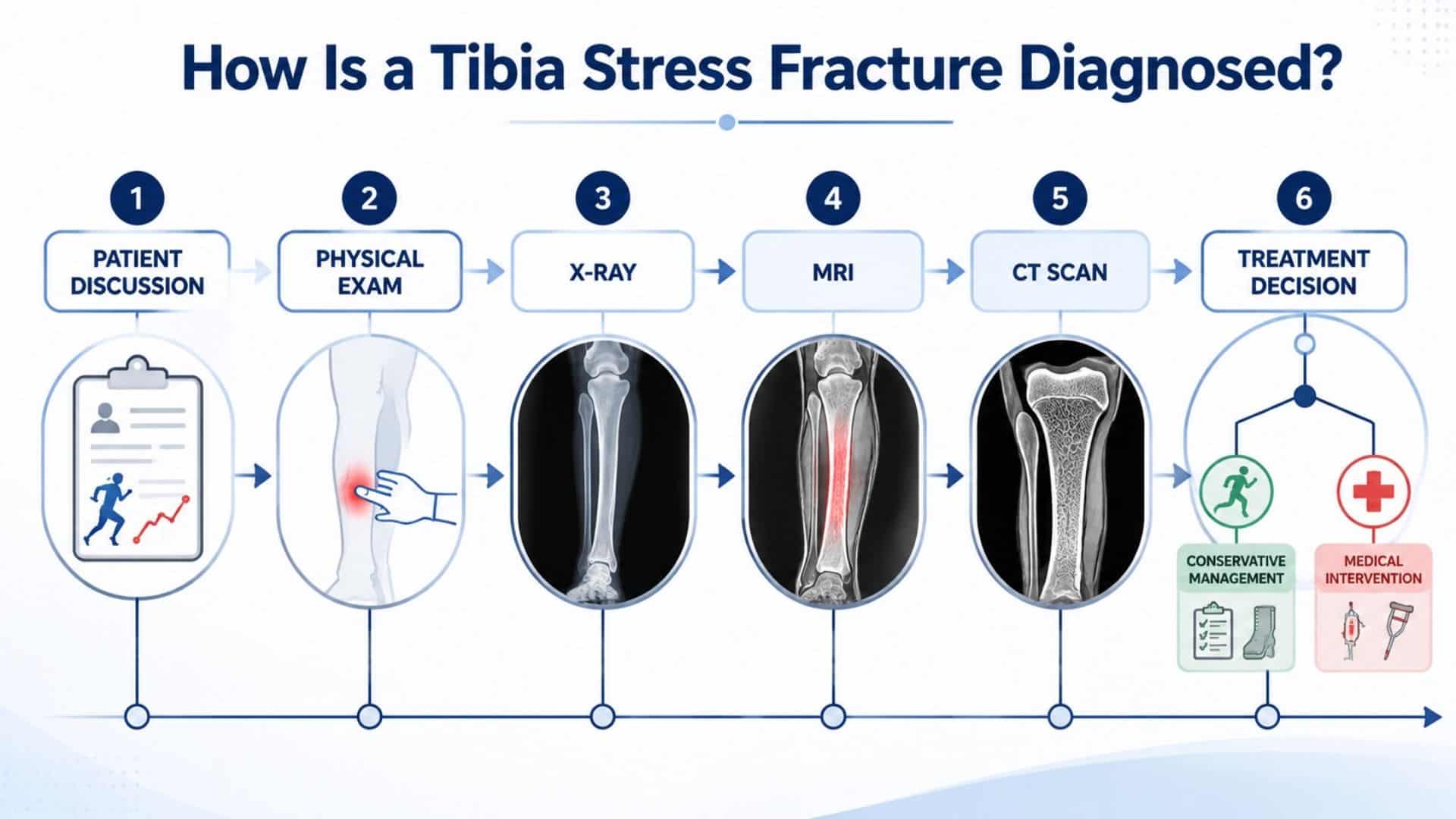
Diagnosis starts with your history and a physical exam. A doctor will ask about your training load, any recent changes in activity, and where exactly the pain sits.
1. Clinical History (Understanding Your Symptoms)
Diagnosis begins with a detailed discussion of your pain and activity pattern. A doctor will ask about recent increases in running, jumping, or training intensity.
A sudden jump in mileage or frequency is a common trigger. Pain that starts during activity and gradually becomes more persistent, even at rest, is an important warning sign.
2. Physical Examination (Pinpointing the Pain)
The next step is a hands-on exam. The doctor will press along the tibia to identify focal tenderness, which is a key sign of a stress injury.
Unlike muscle soreness, stress fracture pain is usually very localized; you can often point to a specific spot. Mild swelling or discomfort with hopping or weight-bearing may also be present.
3. Initial Imaging with X-ray
An X-ray is typically ordered first because it is widely available and helps rule out other conditions. However, in early stress fractures, X-rays are often completely normal.
This happens because bone changes take time to appear. A normal X-ray, therefore, does not exclude a stress fracture.
4. MRI for Confirmation and Grading (Gold Standard)
If suspicion remains high, an MRI is the most reliable next step. It detects early bone stress reactions before an actual fracture line develops.
MRI also helps classify the severity of the injury and determine whether it is in a low-risk or high-risk location, which directly influences treatment and return-to-activity decisions.
5. CT Scan for Complex or Unclear Cases
A CT scan may be used when MRI results are inconclusive or when a more detailed view of bone structure is needed.
It is particularly helpful for identifying subtle or linear fracture patterns that may not be clearly visible on MRI, especially in anatomically complex or high-stress areas.
6. Final Diagnosis and Treatment Planning
Once imaging and clinical findings are combined, the doctor confirms whether it is a stress reaction or a stress fracture and assesses severity.
This final step determines the treatment plan, which may include activity modification, rest, protective weight-bearing, or, in some cases, immobilization.
Tibia Stress Fracture Treatment
Treatment depends directly on where the fracture sits and how severe it is. Most cases are managed without surgery.
Conservative Treatment for Low-Risk Fractures
The first step is stopping the activity that caused the injury. For low-risk posteromedial fractures, treatment includes:
- Pain management
- Modified weight-bearing
- Low-impact cross-training such as swimming, cycling, or pool running
These options keep your fitness up without loading the healing bone. If walking is painful, a boot or crutches may be used temporarily. The goal is to reduce stress on the bone while it heals.
Surgical Treatment for High-Risk Fractures
When the dreaded black line is visible, or when a low-risk fracture fails to heal after four to six months of conservative care, surgery becomes the appropriate option.
Intramedullary nailing stabilizes the bone and allows earlier weight-bearing.
Surgery for a tibial stress fracture is not common, but it is important to know it exists. Ignoring a high-risk fracture and returning to running prematurely can turn a manageable injury into one that requires a much longer recovery.
How Long Does Recovery Take?
Recovery time varies based on fracture location and grade.
| Fracture Type | Estimated Recovery |
|---|---|
| Low-risk posteromedial | 6 to 8 weeks |
| High-risk anterior | 7 to 9 months |
| College athletes (all types, average) | About 13 weeks |
Returning too soon is the most common mistake.
Return-to-running criteria:
- Pain-free walking for at least 1 mile
- 75 to 85% limb-symmetry on strength testing
- A walk-run progression starting at 30 to 50% of pre-injury pace
For low-risk fractures, X-ray evidence of healing is not required before starting a return program. The absence of pain during walking and daily activities guides that decision. For high-risk fractures, imaging confirmation of healing is recommended before resuming running.
How to Prevent a Tibia Stress Fracture
Prevention is straightforward if you take it seriously before an injury forces you to.
- Increase weekly training volume by no more than 10% at a time.
- Run on softer surfaces, such as grass or a synthetic track, where possible.
- Wear supportive, well-fitted footwear appropriate for your gait.
- Get adequate calcium and vitamin D through diet or supplementation.
- Sleep at least seven hours per night to support bone repair.
- Address menstrual irregularities with a doctor; they directly affect bone health.
- Include lower leg strength work in your training routine.
- Stop training when localized shin pain appears; do not push through it.
When to See a Doctor
Most shin pain is not serious. But certain signs call for a medical assessment sooner rather than later.
See a doctor if:
- Pain does not improve after two to three days of rest.
- Pain wakes you at night or is present when you are not weight-bearing.
- You have visible swelling or bruising without a clear cause.
- Walking is painful or causes you to change your gait.
- Mild pain has become constant or is worsening.
Conclusion
A tibia stress fracture is a real injury that needs real rest. The shinbone is under load every time you take a step. That is why it does not heal while you keep pushing through the pain.
The good news is worth holding onto. More than 90% of athletes return to their pre-injury activity level when these injuries are managed properly. You can get back to running.
If you are working through a tibia stress fracture right now, drop a comment below. What helped you most? Your experience could be exactly what another runner needs to read today.
Frequently Asked Questions
What Does a Tibia Stress Fracture Feel Like?
A tibia stress fracture usually causes localized shin pain that worsens during running, jumping, or other weight-bearing activities and improves with rest.
Can You Walk on a Tibia Stress Fracture?
While you may still be able to walk, it is generally not recommended because continued weight-bearing can worsen the fracture and delay healing.
How Long Does a Tibia Stress Fracture Take to Heal?
Most tibia stress fractures heal within 6 to 8 weeks with appropriate rest and activity modification. More severe or high-risk fractures may require a longer recovery period before returning to sports.
How Do You Know if You Have a Tibia Stress Fracture?
Common signs include persistent shin pain, tenderness over one specific spot, swelling, and pain that worsens with activity.
Is a Tibia Stress Fracture the Same as Shin Splints?
No. Shin splint pain spreads over more than 5 cm of the shin. Tibia stress fracture pain is focused at one small point and does not ease as you warm up.