
You train through the soreness. You stretch the tight spots. You tell yourself it is just a pulled muscle.
Weeks pass. The ache does not go away.
That is how most femoral stress fractures start. Not with a sudden snap. Not with a fall. They begin with a dull throb that fades just enough to keep you moving.
The problem is that the early signs of a femoral stress fracture are easy to write off. A deep groin ache after a long run. A thigh that never quite feels normal. A slight limp toward the end of your session. None of those feel serious enough to stop training.
That is exactly why so many athletes miss this injury until the damage is already done.
This post covers what these warning signs look like and what causes them. It also tells you when to stop training and get it checked.
What Is a Femoral Stress Fracture?
A femoral stress fracture is a small crack in the femur. The femur is the long thigh bone that runs from your hip down to your knee. It is the strongest bone in the body. When repeated stress builds up faster than the bone can repair itself, tiny cracks form inside it.
This is different from a standard broken bone. There is no single impact, no obvious moment of injury. The damage builds slowly, one loading cycle at a time. Femoral stress fractures most commonly occur in two locations:
- The femoral neck: The short section connecting the femur to the hip joint. Fractures here carry the highest risk. If this fracture displaces, it can cut off the blood supply to the femoral head. That can lead to avascular necrosis, a condition where bone tissue begins to die.
- The femoral shaft: The long middle section of the bone. Pain here tends to be vaguer and harder to pinpoint than neck fractures.
Femoral stress fractures make up 5 to 7 percent of all stress fractures in runners. They are not the most common type, but they are among the most serious when missed.
What Are the Early Signs of a Femoral Stress Fracture?
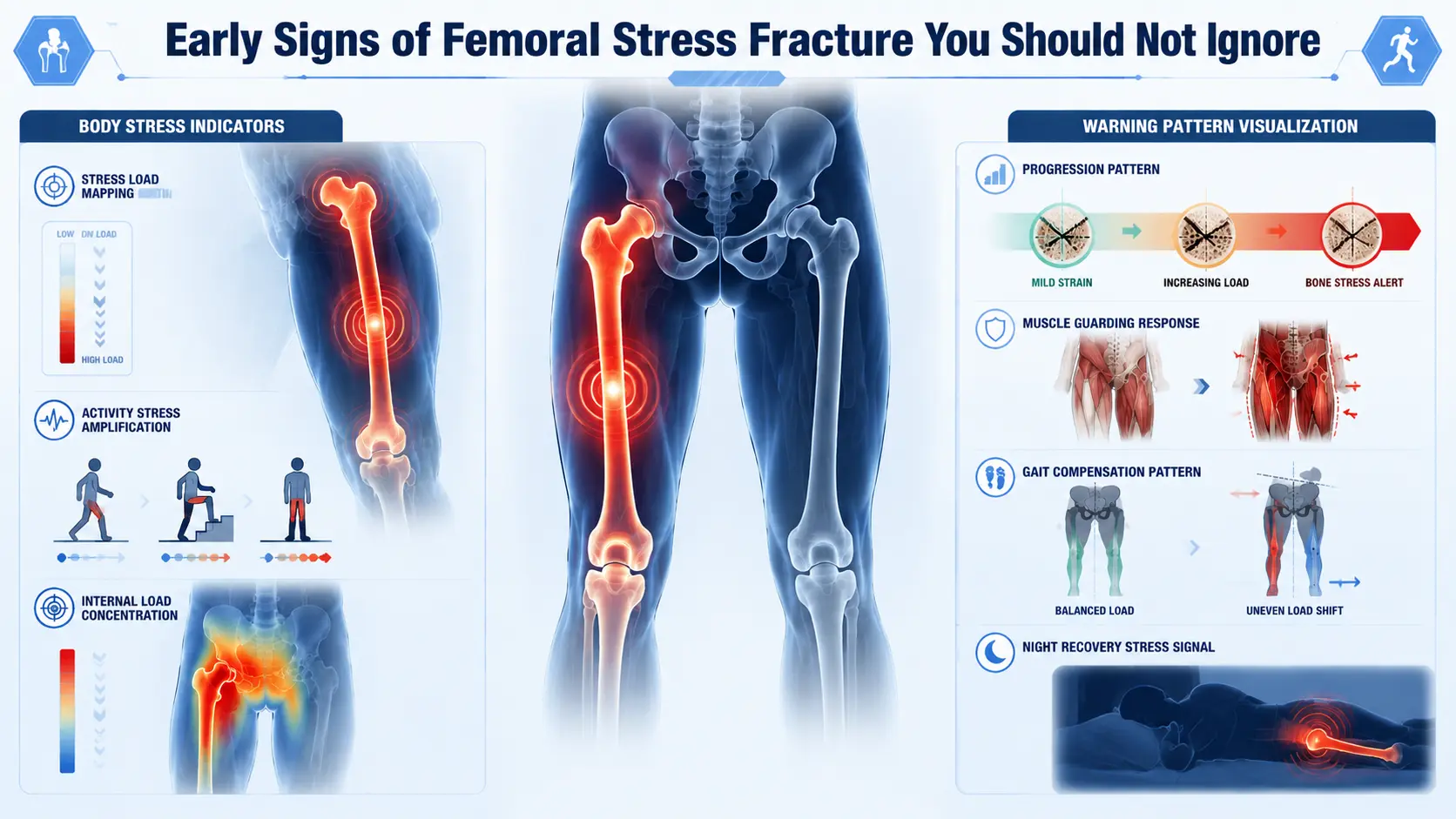
The early signs of a femoral stress fracture are subtle enough to be mistaken for something far less serious. That is what makes them so easy to miss and so important to know.
1. A Dull, Deep Ache in the Groin or Thigh
This is usually the first thing people notice. With femoral neck fractures, the pain sits deep in the groin. It can spread along the inner thigh and sometimes reach toward the knee.
With femoral shaft fractures, the pain runs along the front or inner thigh. It is often vague and hard to find with your fingers. Runners frequently describe it as a deep bruise they cannot locate.
At first, this pain appears during runs and fades with rest. That makes it easy to ignore. Over time, the window of relief gets shorter and the pain returns sooner after each session.
2. Pain That Gets Worse With Weight Bearing
Walking, climbing stairs, or getting up from a chair can all trigger the ache. If your groin or thigh hurts during these everyday movements, the bone is struggling under normal daily load.
This is not a sign of general muscle fatigue. It points to something structural under stress.
3. Night Pain and Throbbing at Rest
This symptom rarely appears in mainstream resources, but it is real. Some people with early femoral stress fractures report a dull, throbbing ache at night, even while lying still.
A bone under repeated mechanical stress keeps sending pain signals after you stop moving. Finish a hard training week and wake up with a nagging ache in your groin? That is not a signal to push through.
4. Tight Hamstrings or Hip Flexors That Will Not Release
Tight hamstrings that do not respond to stretching can be an early indicator of a femoral shaft stress fracture. This is especially true when hip flexor tension appears on the same side.
Your body tightens the surrounding muscles to protect an injured bone. Many athletes spend weeks treating this as a flexibility problem before learning what is actually happening beneath the surface.
5. Pain When Lifting Your Leg From a Seated Position
Sit in a chair and try to lift one knee. If this produces a sharp or deep pain in the groin, that is worth paying attention to.
Lifting the thigh at the hip can load the femoral neck in a way that exposes an existing fracture. This is not a formal clinical test, but it is a useful signal to report to a doctor.
6. A Gradual Limp
By the time you notice you are favoring one leg, the injury has usually been building for some time. Your body shifts weight automatically to protect a painful area. This is called an antalgic gait.
Sometimes the people around you spot the limp before you do. If someone mentions it and you have also had groin or thigh soreness, do not dismiss either signal.
Femoral Neck vs. Femoral Shaft: How Do They Feel Different?
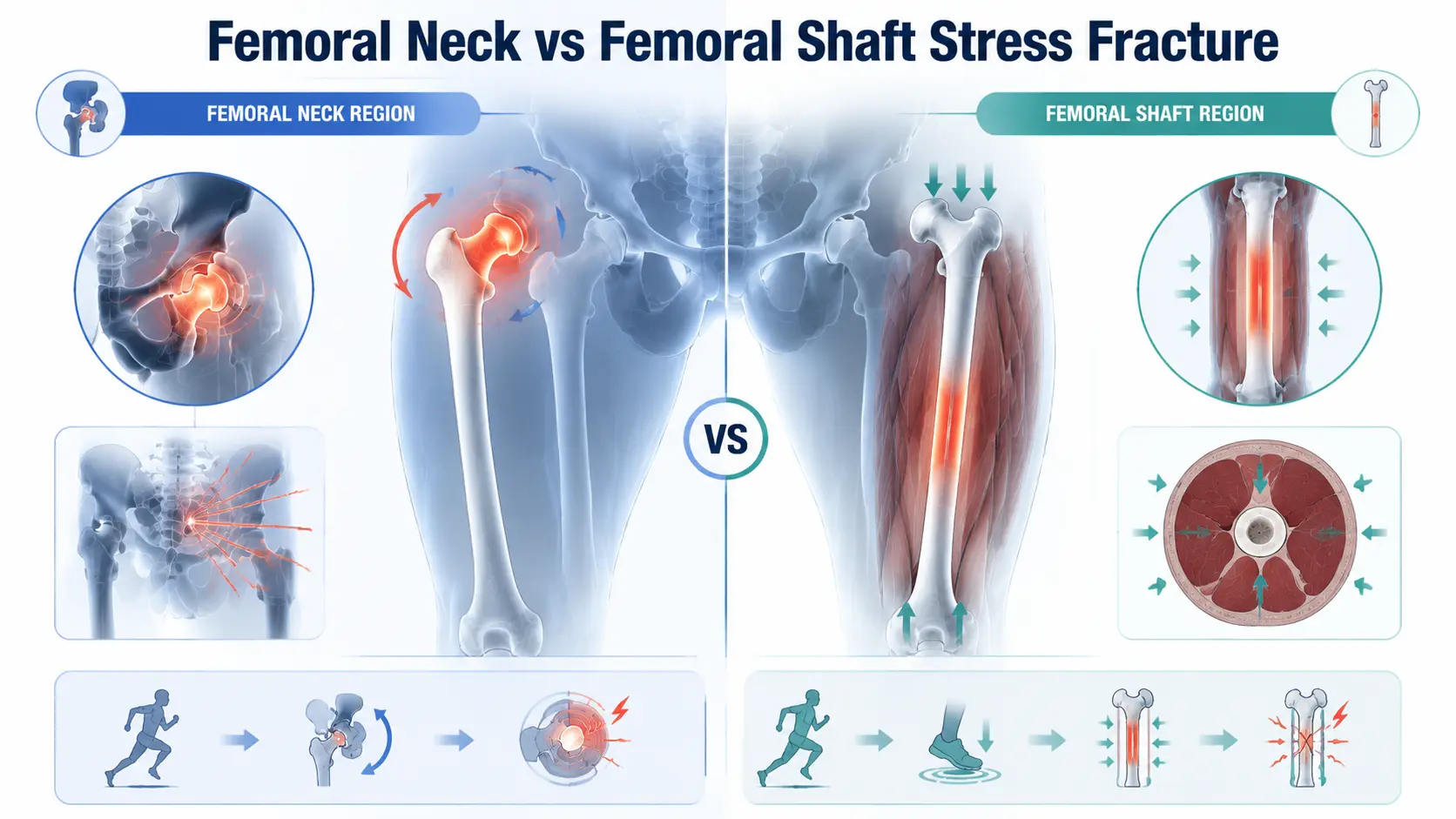
The two fracture locations produce different symptoms. Knowing the difference helps you describe what you are feeling more accurately to a doctor.
The table below compares the key features side by side. Use it as a reference, not a diagnostic tool.
| Feature | Femoral Neck Fracture | Femoral Shaft Fracture |
|---|---|---|
| Pain location | Deep in the groin, wrapping toward the hip | Front or inner thigh, sometimes mid-thigh |
| Pain type | Sharp and deep | Vague, ache-like |
| Aggravated by | Hip rotation, leg swing | Running and weight-bearing activity |
| Most common site | Near the hip joint | Upper-to-middle third of the shaft |
| Risk if displaced | High. Risk of avascular necrosis if displaced. | Lower when caught early |
Both fracture types get worse with activity and improve briefly with rest. The key pattern to track: the pain comes back sooner and sooner after each training session, and the gap of relief keeps shrinking.
What Causes a Femoral Stress Fracture?
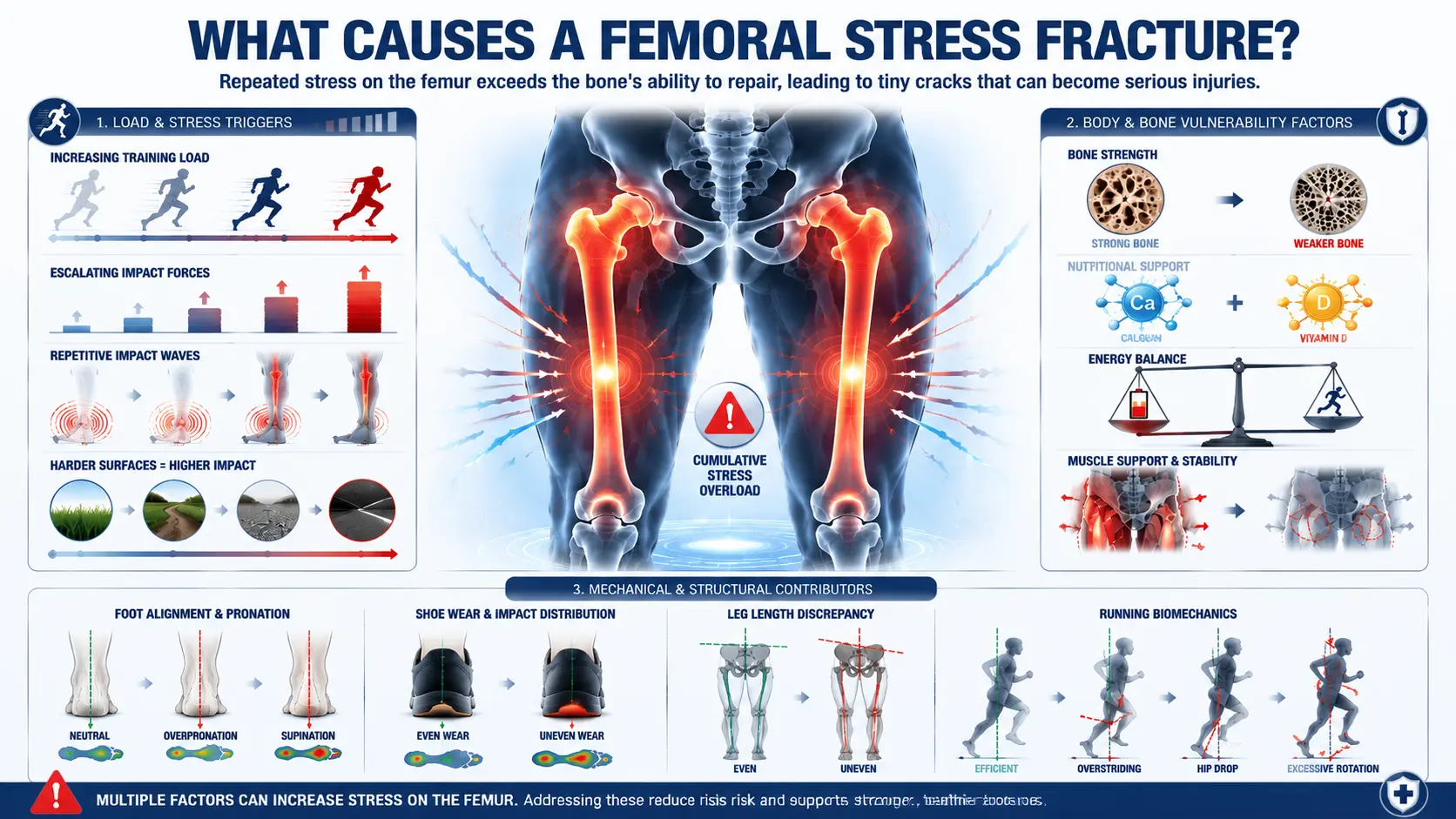
A femoral stress fracture develops when repeated stress on the thigh bone exceeds its ability to repair itself. Several training, nutritional, and biomechanical factors can increase this risk.
- Sudden Increase in Training: Rapidly increasing mileage or adding intensity too fast gives the femur too little time to adapt. The bone absorbs more stress per session than it can repair overnight.
- Poor Nutrition and Low Bone Density: Low calcium intake, inadequate vitamin D, and calorie restriction weaken bones over time. Athletes who eat less than their training demands place themselves at higher risk of stress fractures.
- Female Athlete Triad: This condition involves three connected problems: low energy availability, menstrual irregularities, and reduced bone density. Each factor raises fracture risk on its own. Together, they considerably increase the risk of a femoral injury. Female athletes dealing with any one of these three issues should treat it as a warning sign.
- Biomechanical Issues: Overpronation, leg length differences, weak hip muscles, poor running mechanics, worn-out shoes, and hard training surfaces all add stress on the femur over time. These factors do not cause a fracture overnight. They compound the load with every session.
Addressing these risk factors early can help reduce the likelihood of a femoral stress fracture and support long-term bone health.
What Happens If You Keep Training Through a Femoral Stress Fracture?
A femoral stress fracture does not stay small when you keep loading it. The injury moves through clear stages.
It begins with bone marrow swelling, then develops into a stress reaction. From there, it can progress to an incomplete fracture. If loading continues, it can become a complete break.
A complete femoral neck fracture can displace. When that happens, blood supply to the femoral head can be interrupted. This can lead to avascular necrosis, where the bone tissue begins to die. In severe cases, surgical repair involving screws or hip replacement may be needed.
The recovery timelines are very different depending on when you stop:
- Caught early: 6 to 14 weeks of restricted activity
- Caught late (displaced fracture): 6 to 12 months, possible surgery, and a long road back to sport
The injury is the same either way. The outcome depends entirely on when you stop.
Treatment of Femoral Stress Fractures
Treatment depends on where the fracture sits and how far it has progressed. The two biggest factors are fracture location and how long the injury has been loading before you stopped.
1. Stop All High-Impact Activity Immediately
The first step is to stop running, jumping, and any weight-bearing exercise that loads the femur. This is non-negotiable. Every session you push through adds more stress to a bone that is already struggling to repair itself.
Continuing to train through this injury accelerates the damage and moves the fracture toward more serious stages.
2. Rest and Restricted Activity
Femoral stress fractures caught early require 6 to 14 weeks of restricted activity. During this period, the bone needs enough time to repair the micro-damage. Returning too soon resets that process.
The exact timeline depends on the fracture location, its severity, and the athlete’s overall bone health. A sports medicine doctor will set the specific restrictions based on imaging results.
3. Surgery for Displaced Fractures
Femoral neck fractures that displace require surgical repair. This may involve fixation with screws. In the most severe cases, a hip replacement may be needed.
Recovery from a displaced fracture can take 6 to 12 months. Return to sport is not guaranteed to look the same as before. This is why early detection makes such a significant difference in outcomes.
4. The Risk of Delayed Treatment
Delayed treatment of a femoral neck fracture carries the risk of avascular necrosis. This is a condition where interrupted blood supply causes bone tissue to die. It is one of the most serious complications linked to this injury. Catching and treating the fracture before it displaces removes that risk.
| Fracture Stage | Treatment Approach | Expected Recovery |
|---|---|---|
| Early (stress reaction) | Stop high-impact activity, rest | 6 to 14 weeks |
| Incomplete fracture | Full activity restriction, medical supervision | Several months |
| Displaced fracture | Surgery: screws or hip replacement | 6 to 12 months or longer |
When to See a Doctor
Stop high-impact activity and book an appointment with a sports medicine doctor or orthopedist if you notice any of the following:
- Groin or thigh pain that returns with every training session and does not fully clear with rest
- Pain now present during walking or stair climbing
- A dull ache at night after heavy training days
- Any sensation of giving way, or a sudden sharp pain during a run
- A gradual limp that you or someone else has noticed
Do not wait for the pain to become severe. By the time it reaches that level, the fracture has often already progressed.
How Is a Femoral Stress Fracture Diagnosed?
Diagnosis starts with a physical examination. X-rays may appear completely normal in the early stages of this injury. An MRI is the most accurate imaging test for detecting a femoral stress fracture, and a doctor will typically order one if symptoms strongly point to this diagnosis.
Disclaimer: This article is for informational purposes only. It is not a substitute for medical advice, diagnosis, or treatment. If you suspect a femoral stress fracture or any bone injury, stop high-impact activity immediately and consult a qualified sports medicine physician or orthopedist.
Conclusion
The early signs of a femoral stress fracture start as quiet signals. A deep groin ache after a long run. A thigh that stays sore no matter how much you stretch. A limp that shows up late in your sessions.
None of those feel serious enough to stop training. That is the problem. This injury does not get better on its own if you keep pushing through it. It gets worse, and the later it is caught, the longer the recovery.
If any of the signs in this post sound familiar, stop high-impact training and see a sports medicine doctor.
Catching a femoral stress fracture early is the difference between a few weeks of rest and a recovery measured in months. Your long-term training future is worth one appointment.
Frequently Asked Questions
Can You Walk With a Femoral Stress Fracture?
Some people can still walk in the early stages, but continuing to bear weight can worsen the fracture.
How Long Does a Femoral Stress Fracture Take to Heal?
Most femoral stress fractures require 6 to 12 weeks to heal with proper rest and treatment. Severe fractures or those requiring surgery may take several months to fully return to sports.
How Is a Femoral Stress Fracture Diagnosed?
Diagnosis begins with a physical examination and usually includes imaging. While X-rays may appear normal early on, an MRI is the most accurate test for detecting a femoral stress fracture.
Who Is Most at Risk for A Femoral Stress Fracture?
Distance runners, female athletes with low energy intake or menstrual irregularities, and athletes who rapidly increase their training load are at the highest risk. Poor nutrition, low bone density, weak hip muscles, and biomechanical issues such as overpronation also raise the risk over time.
Can You Walk with A Stress Fracture in The Foot?
Yes, you can often walk with a stress fracture in the foot, but it may worsen the injury and delay healing. Pain usually increases with activity and improves with rest.