

When your back hurts, your knee stops cooperating, or an injury makes everyday movements difficult, physical therapy is often the next step toward getting back on track. But it is not a one-size-fits-all treatment.
A runner recovering from a torn ligament, an older adult improving balance, and someone managing chronic pain may all need different approaches.
From orthopedic and sports therapy to neurological and pediatric care, each type focuses on specific challenges and recovery goals.
This article explains the different types of physical therapy, what they treat, and who can benefit from each approach so you can understand which option may be right for you.
What Are the Main Types of Physical Therapy?
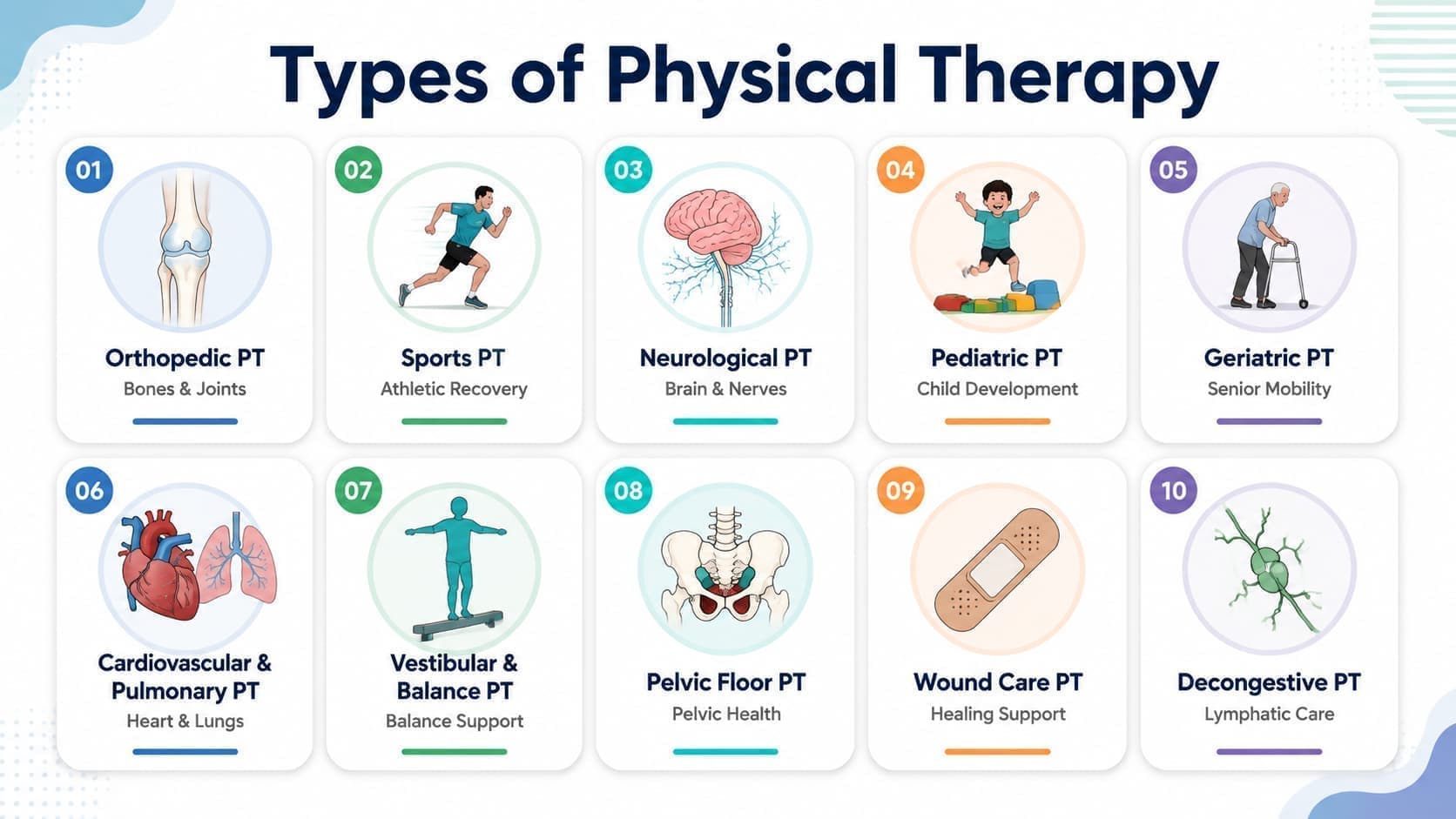
Physical therapy is a healthcare treatment that helps you move better and feel less pain. It uses exercises, hands-on techniques, and physical tools like heat or electrical stimulation. The goal is always to restore function and reduce discomfort.
There are several recognized specialty types of physical therapy. Each one focuses on a different body system, condition, or age group. Here is a quick overview before we go into detail:
1. Orthopedic Physical Therapy
Orthopedic physical therapy is the most common type of physical therapy in the United States. It focuses on the musculoskeletal system. That includes your bones, muscles, joints, ligaments, and tendons.
As of June 2023, orthopedics had 21,401 board-certified specialists in the US alone. That number tells you how much demand exists for this type of care.
What Does Orthopedic PT Treat?
- Acute injuries like fractures and sprains
- Chronic pain, such as lower back pain or knee arthritis
- Post-surgical recovery (knee replacement, rotator cuff repair)
- Tendon and ligament damage
- Musculoskeletal disorders like arthritis
What Happens in a Session?
Your therapist assesses your injury first. They then build a plan that may include stretching, strengthening exercises, and manual therapy. Progress is tracked closely, and the plan changes as you improve.
Most sessions are fast-paced. Patients often go back to back. Sessions usually run between 30 and 60 minutes.
Who benefits most: Anyone recovering from a bone or joint injury, or managing chronic musculoskeletal pain.
2. Sports Physical Therapy
Sports physical therapy helps athletes and active people recover from injuries. It also helps prevent future injuries and supports peak physical performance. This is one of the most sought-after types of physical therapy today.
What Does Sports PT Treat?
- ACL and ligament tears
- Tendinitis and overuse injuries
- Muscle strains and sprains
- Stress fractures
- Shoulder impingement and rotator cuff issues
- Runner’s knee and shin splints
How Is Sports PT Different from Orthopedic PT?
The two types share some overlap. Both treat musculoskeletal injuries. Sports PT goes further by adding performance goals. A sports therapist helps you return to your sport at full strength. They also train you to reduce the risk of reinjury.
Sports physical therapists often work with high school teams, professional athletes, and recreational gym-goers alike.
Who benefits most: Runners, team sport athletes, gym members, and anyone returning to physical activity after an injury.
3. Neurological Physical Therapy
Neurological physical therapy treats conditions that affect the brain, spinal cord, and nervous system. These conditions often cause severe muscle weakness, loss of coordination, and reduced mobility.
As of June 2023, 4,557 physical therapists in the US held a formal neurology specialization.
What Does Neurological PT Treat?
- Stroke and brain injury recovery
- Parkinson’s disease
- Multiple sclerosis (MS)
- Cerebral palsy
- Spinal cord injuries
- Alzheimer’s disease (mobility support)
- Sciatica and nerve-related pain
What Happens in a Session?
Sessions involve intense movement and targeted physical exercises. The therapist works to restore voluntary muscle control. They also focus on balance, coordination, and basic daily movements such as walking and standing.
Recovery with neurological conditions often takes longer. It requires patience from both the patient and the therapist. Progress may feel slow, but small gains carry a major impact on daily life.
Who benefits most: People recovering from strokes, brain injuries, or living with a progressive neurological condition.
4. Pediatric Physical Therapy
Pediatric physical therapy works with infants, toddlers, children, and teenagers. The goal is to help young patients move freely and without pain. It also addresses delays in reaching physical milestones.
What Does Pediatric PT Treat?
- Cerebral palsy
- Birth defects affecting movement
- Delayed physical development (crawling, walking, grasping)
- Genetic conditions affecting mobility
- Acute injuries in children and teens
- Muscle weakness and coordination problems
What Makes It Different from Adult PT?
Working with children requires a different approach. Therapists often use play-based methods to keep children engaged. Sessions are built around fun activities that still build strength and coordination.
Parents usually seek out pediatric PT when a child does not hit expected physical milestones. A therapist evaluates the child and designs a plan around their specific needs and age group.
Who benefits most: Infants and children with developmental delays, genetic conditions, or movement-related injuries.
5. Geriatric Physical Therapy
Geriatric physical therapy supports adults aged 65 and older. As people live longer and stay more active, injuries and age-related conditions become more common. This type of PT helps older adults stay mobile and maintain independence.
What Does Geriatric PT Treat?
- Arthritis pain and stiffness
- Osteoporosis and bone fragility
- Balance problems and fall risk
- Post-hip or knee replacement recovery
- Alzheimer’s-related mobility decline
- General muscle weakness from aging
What to Expect in Sessions
Geriatric PT includes targeted exercises for weakened muscles and stiff joints. It also includes balance training to prevent falls. This is critical because falls are a leading cause of injury in older adults.
Therapists build plans around each patient’s mobility level. The focus is always on what makes daily life easier and safer.
Who benefits most: Adults over 65 managing chronic conditions, recovering from surgery, or struggling with balance and strength.
6. Cardiovascular and Pulmonary Physical Therapy
Cardiovascular and pulmonary physical therapy helps people with heart and lung conditions. It is one of the oldest recognized PT specialties. The American Physical Therapy Association first board-certified this specialty in 1981.
What Does Cardiovascular and Pulmonary PT Treat?
- Recovery after heart attacks
- Post-open-heart surgery rehabilitation
- Chronic obstructive pulmonary disease (COPD)
- Asthma management
- Heart failure and cardiac conditions
- Pulmonary fibrosis
What Happens in Sessions?
This type of PT uses exercise training and breathing techniques. The goal is to improve physical endurance for people whose heart or lungs limit their activity. Therapists track oxygen levels and heart rate during sessions.
Cardiac rehabilitation programs guide patients through safe exercise progressions after a heart event. Pulmonary rehabilitation does the same for patients with lung disease.
Who benefits most: People recovering from heart attacks or surgery, and those managing lung diseases like COPD or asthma.
7. Vestibular and Balance Therapy
Vestibular and balance therapy treats dizziness, vertigo, and balance disorders. This is a highly specialized type of physical therapy. Many people who struggle with dizziness do not know PT can help them.
What Does Vestibular PT Treat?
- Benign paroxysmal positional vertigo (BPPV)
- Inner ear disorders
- Persistent dizziness and lightheadedness
- Balance problems after a head injury
- Meniere’s disease
How Does It Work?
Therapists use specific repositioning exercises to correct inner ear issues. They also use gaze stabilization exercises to train the eyes and brain to work together. Balance retraining helps patients feel steady on their feet again.
Results can be fast with this type of therapy. Some patients experience major improvement in just a few sessions.
Who benefits most: People with frequent dizziness, vertigo episodes, or balance problems that make daily activity difficult.
8. Pelvic Floor Physical Therapy
Pelvic floor physical therapy treats the muscles in the pelvic region. These muscles support the bladder, bowel, and uterus. When they are weak or too tight, they cause real problems in daily life.
What Does Pelvic Floor PT Treat?
- Urinary incontinence (leaking urine)
- Pelvic pain
- Postpartum muscle recovery
- Prolapse symptoms
- Pain during sexual activity
- Bowel control issues
What Happens in a Session?
A pelvic floor therapist evaluates the strength and coordination of the pelvic muscles. They then guide patients through specific exercises to improve function. Electrical muscle stimulation is sometimes used to support muscle recovery.
This type of PT is for both women and men. While postpartum care is a common reason women seek it out, men dealing with prostate surgery recovery also benefit.
Who benefits most: Women postpartum, people with urinary incontinence, and men recovering from prostate-related procedures.
9. Wound Care Physical Therapy
Wound care physical therapy supports healing after surgery or injury. Not many people know that PT plays a role in wound recovery. But it is a real and valuable specialty.
What Does Wound Care PT Treat?
- Post-surgical wounds
- Diabetic foot ulcers
- Pressure ulcers (bedsores)
- Burns and skin grafts
- Slow-healing wounds from poor circulation
How Does It Work?
Wound care therapists help the wound heal properly. They also work to restore normal movement in the area around the wound. This prevents scar tissue from limiting your range of motion after healing.
Techniques include specialized dressings, compression therapy, and movement exercises. The aim is to speed up healing while preserving function.
Who benefits most: Patients recovering from surgery, people with diabetic ulcers, or anyone with a slow-healing wound.
10. Decongestive Physical Therapy
Decongestive physical therapy, also called complete decongestive therapy (CDT), treats lymphedema. Lymphedema is swelling caused by damage to the lymph nodes. It often occurs after cancer treatment.
What Does Decongestive PT Treat?
- Lymphedema from cancer treatment (especially breast cancer)
- Swelling in the arms or legs from lymph node removal
- Chronic swelling from injury or infection
What Happens in Sessions?
The therapist uses a technique called manual lymph drainage. This is a gentle form of massage that moves fluid out of swollen areas. Compression bandaging and specific exercises are also part of the treatment.
Patients also learn how to manage swelling at home between sessions. This self-care component is a key part of long-term results.
Who benefits most: Cancer survivors dealing with lymphedema and people with chronic limb swelling.
Common Techniques Used Across All Types of Physical Therapy
Each type of physical therapy has its own focus. But many of the techniques they use overlap. Here are the most common methods you will find across most PT specialties:
| Technique | What It Does | Used In |
|---|---|---|
| Therapeutic Exercise | Builds strength, flexibility, endurance, and coordination | Almost all types of PT |
| Manual Therapy | Hands-on joint mobilization and soft tissue work | Orthopedic, sports, geriatric PT |
| Electrotherapy (TENS / E-Stim) | Uses electrical stimulation to reduce pain and support muscle function | Orthopedic, pelvic floor, neurological PT |
| Ultrasound Therapy | Uses sound waves to promote tissue healing and reduce muscle spasms | Orthopedic and sports PT |
| Heat and Cold Therapy | Reduces pain, swelling, and muscle tension | Most PT types |
| Manual Lymph Drainage | Moves excess fluid to reduce swelling | Decongestive PT |
Your therapist will choose the right mix of these techniques based on your specific condition. No two treatment plans look exactly the same.
How Do You Know Which Type of Physical Therapy You Need?

Your doctor will usually refer you to the right type of PT. They consider your diagnosis, medical history, and recovery goals. But it helps to understand your options before your first appointment.
Here are some simple guidelines:
- Bone, joint, or muscle pain? Start with orthopedic PT.
- Sports-related injury? Look for a sports physical therapist.
- Stroke or neurological condition? Neurological PT is the right fit.
- Child with delayed movement? Pediatric PT can help.
- Senior with balance issues? Geriatric PT covers this well.
- Heart or lung condition? Cardiovascular and pulmonary PT is designed for you.
- Frequent dizziness or vertigo? Vestibular therapy is worth trying.
- Pelvic pain or bladder leaks? Pelvic floor PT addresses this directly.
- Slow-healing wound? Ask about wound care PT.
- Swollen limbs after cancer treatment? Decongestive PT is the option to ask about.
You can also search the American Physical Therapy Association’s “Find a PT” tool at choosept.com to locate specialists near you.
Medical Disclaimer: This article is for informational purposes only. It does not replace professional medical advice, diagnosis, or treatment. Always talk to a licensed healthcare provider before starting any physical therapy program. If you have a specific condition or injury, consult your doctor for guidance.
Finding the Right Type of Physical Therapy for Your Needs
Physical therapy is not a one-size-fits-all treatment. There The many types of physical therapy because different conditions require different approaches. Orthopedic PT helps with joint and muscle injuries. Neurological PT supports stroke recovery. Sports PT helps athletes get back to full strength. And that is only the start.
The best outcome comes when you match your condition to the right specialty. Talk to your doctor or ask for a referral to a licensed physical therapist. They will assess your situation and build a plan that fits your specific needs and goals.
Your body deserves the right kind of care. Knowing your options is the first step to getting it.
Frequently Asked Questions
How many types of physical therapy are there?
There are at least 10 major recognized types of physical therapy, from orthopedic and sports PT to pelvic floor and neurological therapy. Some sources identify over 26 specialty areas when career paths are included.
Can physical therapy replace surgery?
In some cases, yes. Physical therapy can reduce or eliminate the need for surgery, especially for conditions like lower back pain, mild knee damage, and rotator cuff injuries. Your doctor will determine if PT is a suitable alternative based on the severity of your condition.
How long does physical therapy usually last?
Most PT programs run between 4 and 12 weeks. The exact length depends on your condition, how quickly you progress, and your overall health. Some chronic conditions require ongoing therapy over several months.
Do I need a doctor’s referral to see a physical therapist?
In many US states, you can see a physical therapist without a referral. This is called direct access. Check your state’s rules and your insurance plan, since coverage requirements vary by provider.
Is physical therapy painful?
Some discomfort is normal, especially in early sessions. A good therapist will always stay within your tolerance level. If pain is severe or gets worse after sessions, tell your therapist right away so they can adjust your plan.
Can physical therapy help with chronic pain?
Yes. Physical therapy is one of the most effective long-term treatments for chronic pain. It builds strength, improves mobility, and teaches pain management strategies. It works well for conditions like arthritis, fibromyalgia, and lower back pain.









One Response