
Runners chasing more speed usually reach for the same fix. They push harder on every run instead of fixing how they move.
Speed is not just about effort. It comes from the pattern your body follows with every stride. That pattern can be trained on its own, away from a sprint.
A skips and b skips are two of the most widely used drills for this kind of training. Coaches use them with sprinters, football players, soccer players, and everyday runners who want a cleaner stride.
Both drills work on posture, knee drive, and foot placement. These are the pieces that make a stride efficient instead of wasted.
What Are A Skips and B Skips?
Both are technique drills, not conditioning exercises. Their purpose is to train specific parts of the running stride at a controlled speed. The nervous system can then learn the pattern before repeating it at sprint speed.
What Are A Skips?
An A skip is a skipping drill built around a strong, controlled knee lift. Each rep pairs a hop with a knee drive toward hip height.
This trains the front side of the running stride. That is the part of the gait cycle where the leg lifts and moves forward before it strikes the ground.
Key focus areas of the A skip:
- Knee lift to hip height, without overreaching
- Ankle stiffness, keeping the foot flexed rather than floppy
- Quick ground contact, landing under the hips rather than out in front
- Arm-leg coordination, so the opposite arm drives forward as the knee lifts
What Are B Skips?
A B skip starts the same way as an A skip, then adds one more piece. The lower leg extends forward, and then the foot pulls back down in a pawing motion. The foot sweeps back and under the body rather than just dropping.
This extra step trains the back half of the stride cycle. That is the part where the leg cycles down and pulls the body forward.
Focus areas of the B skip:
- Hamstring coordination, since the extension and paw-back rely on hamstring timing
- Foot recovery, cycling the leg back under the body instead of reaching out
- Full sprint stride cycle, connecting the front-side and back-side mechanics into one motion
Coaches treat both drills as neuromuscular training rather than fitness conditioning. The goal on every rep is clean movement, not fatigue.
A biomechanical review published by Athletics Coach Australia found real differences between the drills and actual sprinting. The leg moves at noticeably slower velocities in both drills. Knee bend and straighten angles also differ from true sprint mechanics.
This does not make the drills useless. They are coordination and rhythm tools that support sprinting. They are not a literal rehearsal of a sprint stride.
Benefits of A Skips and B Skips
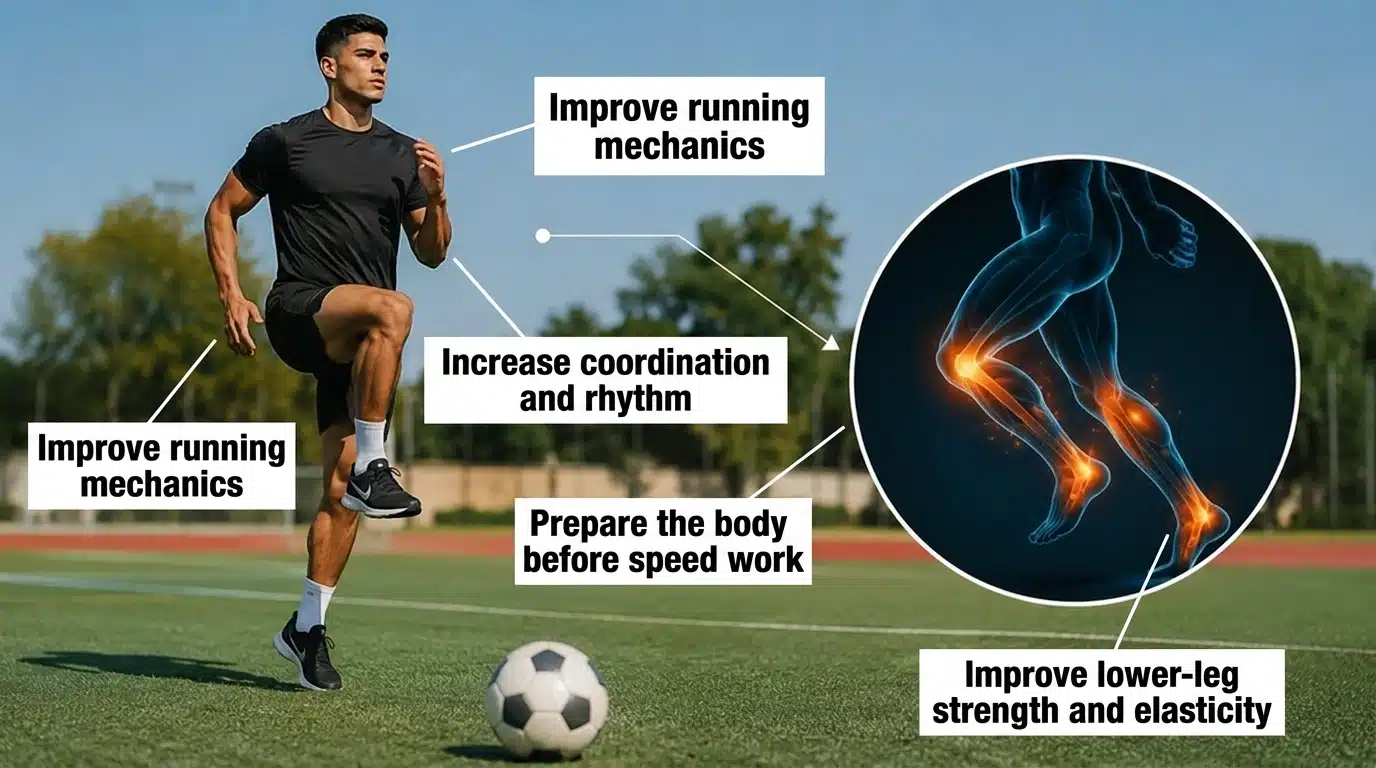
Both drills offer more than a warm-up bump. Here is what consistent practice builds.
- Better running mechanics: Slowing the stride down helps you feel foot placement and posture. This carries over into cleaner mechanics at full speed.
- More coordination and rhythm: Training the arms and legs on the same timing builds the connection every efficient stride depends on.
- Readiness before speed work: As an active warm-up, both drills raise heart rate and activate the exact muscles used in sprinting.
- Lower-leg strength and elasticity: Repeated quick ground contacts build ankle stiffness, so less energy is lost on every step. Dorsiflexing the foot during knee drive also strengthens the tibialis anterior, the shin muscle most linked to shin splint development in runners.
How to Perform A Skips
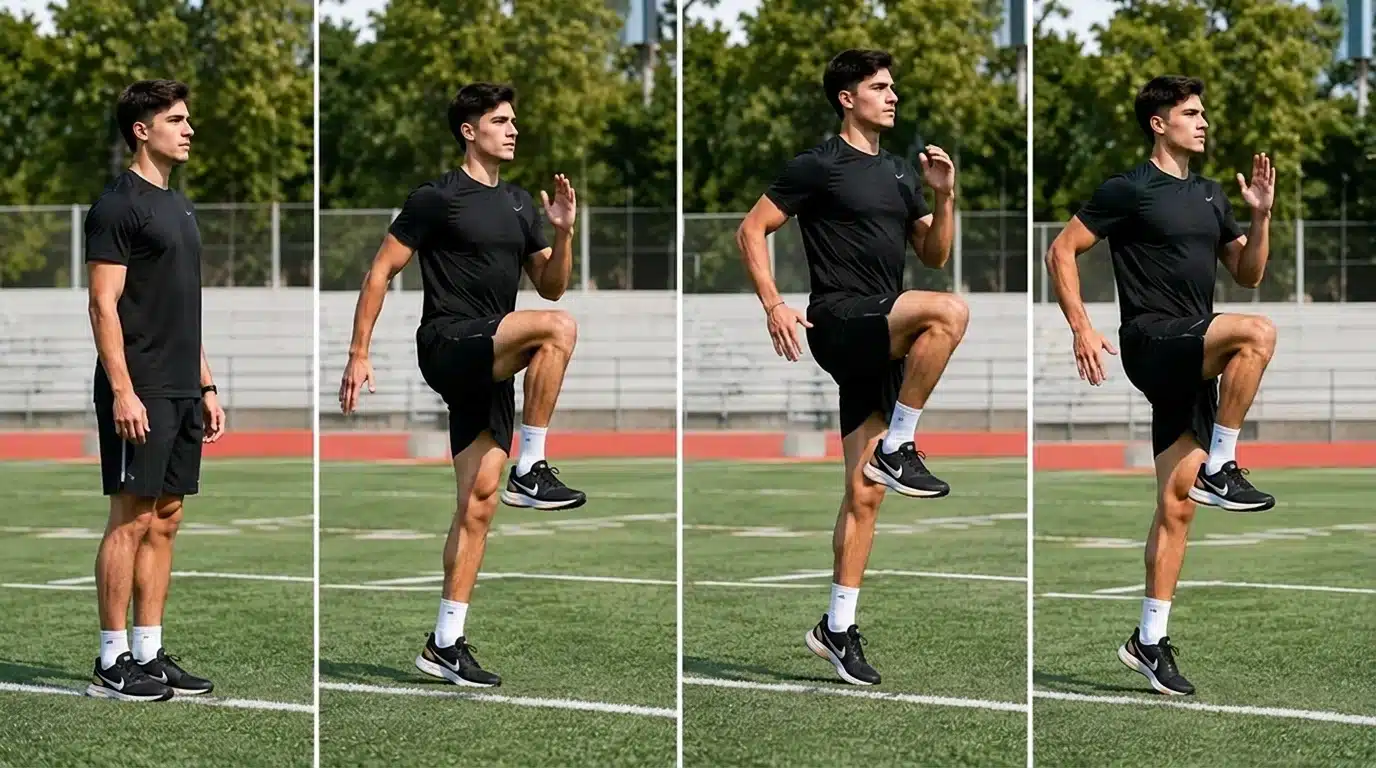
Start tall with relaxed shoulders. Drive one knee to hip height while hopping on the opposite foot. Land under your hips with a quick, light step. Repeat in a smooth, rhythmic pattern rather than a series of separate jumps.
Step 1: Start With Proper Posture
- Stand tall with shoulders relaxed
- Keep the pelvis neutral, not tucked or overly arched
- Look forward, not down at your feet
Step 2: Drive the Knee Up
- Raise the knee to about hip height
- Keep the ankle flexed, toes pulled up
- Avoid leaning backward to help the knee up
Step 3: Create Quick Ground Contact
- Land under the hips, not out in front
- Stay light on the feet
- Let the opposite arm drive forward as the knee lifts
Step 4: Maintain Rhythm
- Focus on a smooth, skipping cadence
- Avoid turning the drill into a series of tall jumps
Beginner modification: Practice the movement as a slow march first, without the hop, until the knee drive and arm timing feel natural. Add speed only once the coordination is consistent.
How to Perform B Skips
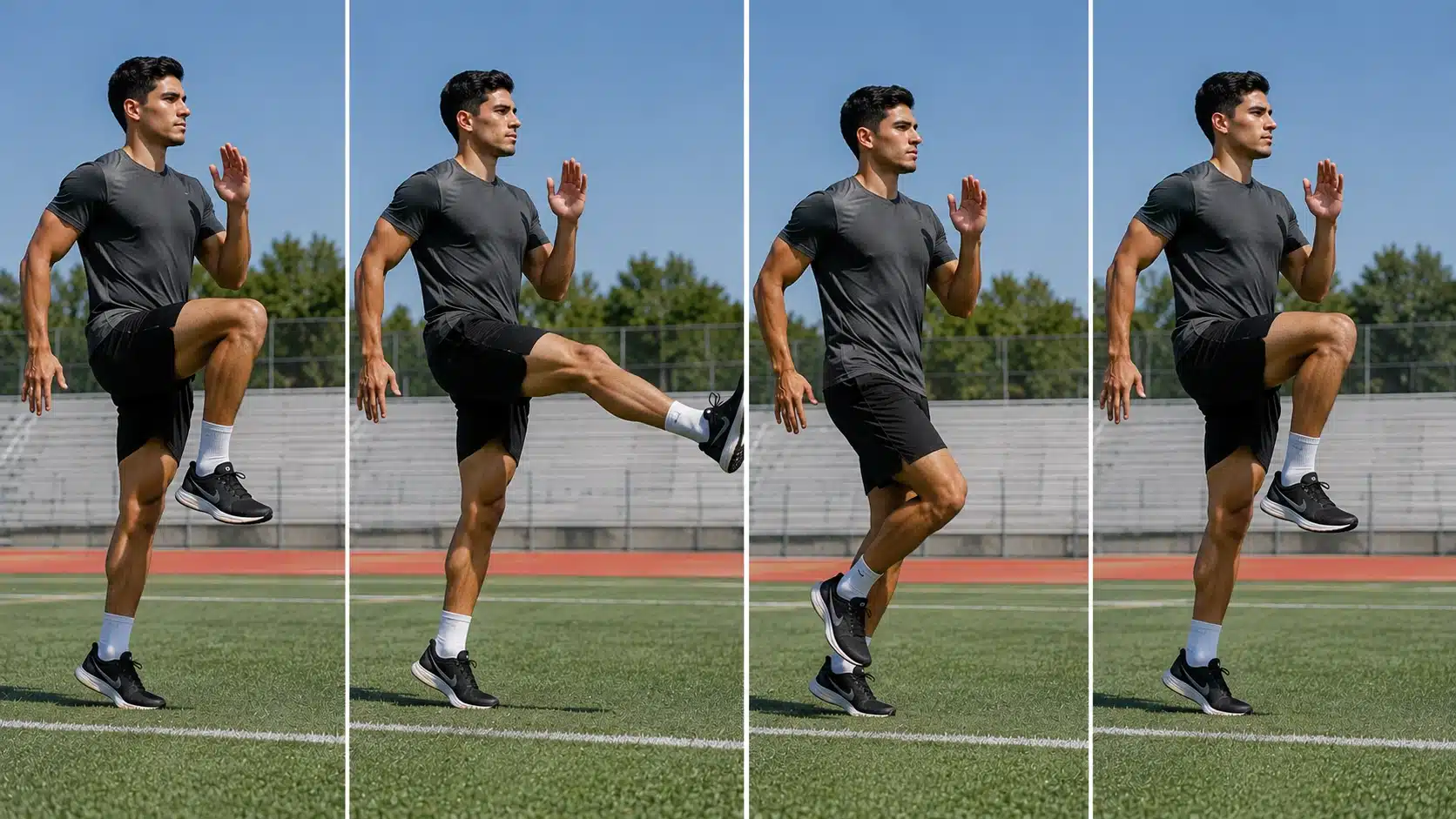
Begin with the same knee drive used in an A skip. Extend the lower leg forward without kicking hard. Then pull the foot back and down in a pawing motion so it lands beneath your center of mass. Keep the whole movement controlled rather than fast.
Step 1: Begin With the A Skip Motion
Start every rep with the same knee drive and hop used in the A skip. This is the base the B skip builds on.
Step 2: Add the Extension Motion
Extend the lower leg forward once the knee reaches hip height. This should look like a controlled unfolding of the leg, not an aggressive kick.
Step 3: Pull the Foot Back Under the Body
Pull the foot back down and under the center of mass in a pawing motion. The foot should land beneath your hips, not out in front. Let it fall passively, and you lose the whole benefit of the drill.
Step 4: Keep the Movement Controlled
- Maintain the same tall posture used in the A skip
- Avoid overstriding by reaching the foot out too far
- Slow down if the pattern starts to break apart
A Skips vs B Skips: What Is the Difference?
The table below compares the two drills side by side. It shows why coaches usually sequence them in a specific order.
| Feature | A Skips | B Skips |
|---|---|---|
| Main focus | Knee drive and rhythm | Leg cycling and foot recovery |
| Difficulty | Beginner-friendly | More advanced |
| Movement | Lift knee and skip | Lift, extend, and paw back |
| Sprint phase trained | Front-side mechanics | Full stride cycle |
| Best use | Learning mechanics | Building advanced coordination |
A skips usually come first in a training progression. They build the base of knee drive and posture without the added complexity of the leg extension.
B skips are introduced once an athlete has that base. The paw-back motion is harder to control and easier to perform poorly if the basics are not solid yet.
Errors That Undermine These Drills
These are the most common form breakdowns coaches see. Each one cancels out exactly what the drill is trying to build.
- Lifting the knee too high: An exaggerated knee drive does not mean going as high as possible. Past hip height, the upper body gets pulled out of position and rhythm breaks down.
- Landing too far in front: Landing ahead of the hips creates a braking effect on every step. This is the exact inefficiency the drill is meant to train out.
- Turning the drill into a workout: Rushing through reps for fatigue misses the point. The goal is clean movement, not conditioning.
- Losing posture: Leaning backward or collapsing at the hips is one of the most common breakdowns as longer sets progress.
- Skipping the A skip before attempting B skips: Running coach Chris Johnson recommends mastering the A and B march before progressing to the full skipping versions. Skipping that step leads to sloppy movement.
- Letting the arm swing drift: Arms crossing the body or swinging loosely throw off the timing that ties the whole drill together.
- Rushing straight to full speed: Starting at top effort before the pattern is grooved locks in bad habits faster than it builds good ones.
How to Add These Drills Into a Training Routine
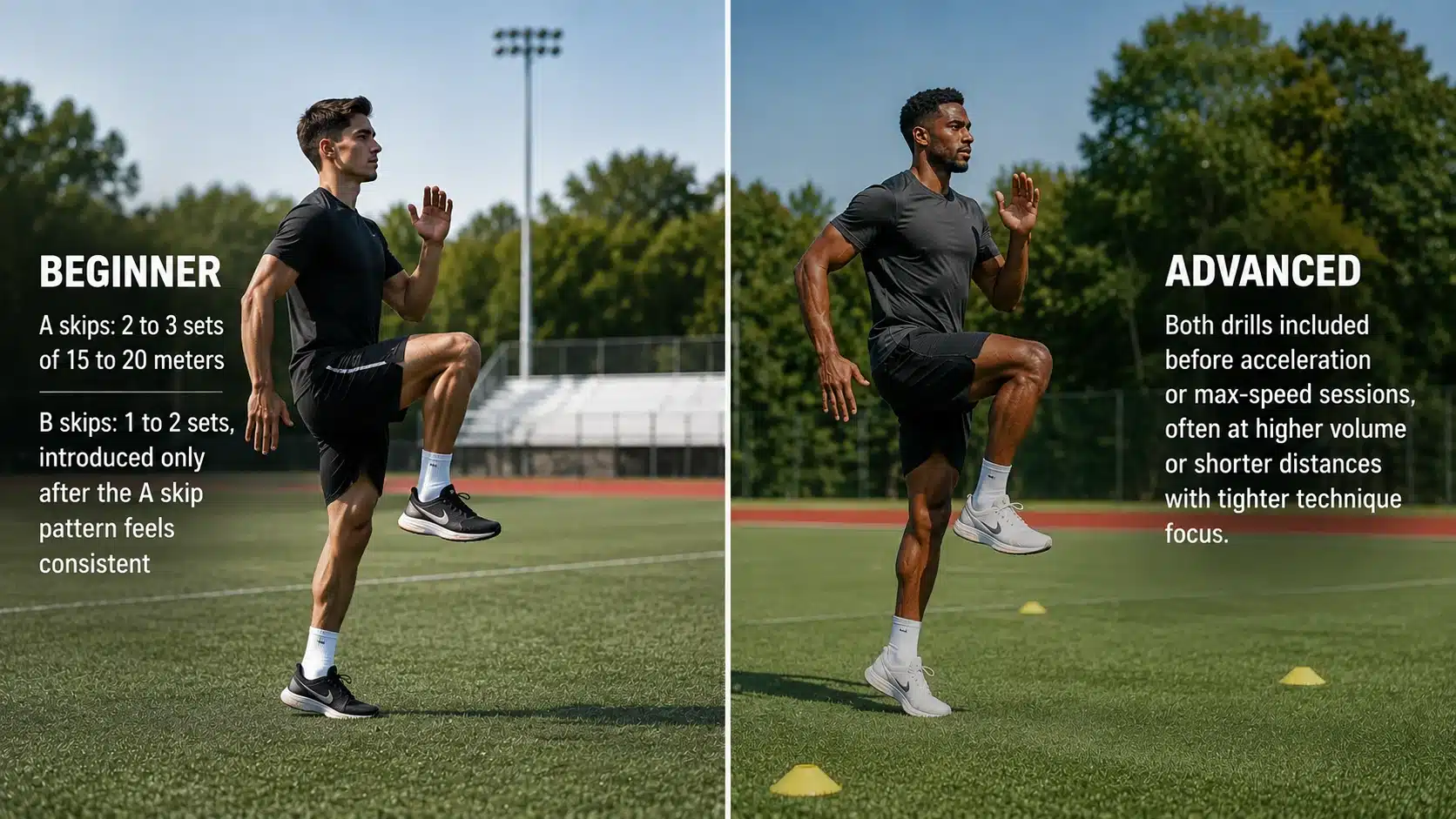
These drills work best as part of a warm-up. Do them before the body is fatigued and while attention to detail is still close.
Good placements:
- Before sprint workouts
- Before agility training sessions
- As part of an active warm-up on any running day
Suggested starting routine:
Beginner:
- A skips: 2 to 3 sets of 15 to 20 meters
- B skips: 1 to 2 sets, introduced only after the A skip pattern feels consistent
Advanced athletes:
- Both drills included before acceleration or max-speed sessions
- Often at higher volume or shorter distances with tighter technique focus
Quality matters far more than volume with these drills. A few clean, controlled reps train the nervous system more effectively than a long set performed poorly.
Who Should Use A Skips and B Skips?
- Runners: Both drills sharpen sprint mechanics and stride efficiency. They carry over into distance running as well as sprinting.
- Football, soccer, and basketball athletes: The coordination and knee drive trained here translate directly into faster acceleration and more efficient change-of-direction movement.
- Beginners: These drills are a low-impact way to build body control and coordination before adding more demanding speed work.
- Youth athletes: With proper coaching, A skips and B skips help young athletes learn foundational movement patterns early, before bad habits set in.
Do A Skips and B Skips Make You Faster?
No, not on their own. Neither drill replaces sprint training. They build the coordination and mechanics that help a runner apply force more effectively once they do sprint.
Some coaches caution against overstating how much these drills carry over. The same biomechanical review found that joint angles differ noticeably between skip drills and a true maximal sprint. Knee drive patterns differ too. The movement pattern is not a direct match.
The key takeaway: both drills work best as a supplement to sprint training, not a substitute for it. Speed improves when drills like these are combined with actual sprinting, strength work, and a structured program.
Disclaimer: This article is for general fitness education and is not a substitute for individualized coaching or medical advice. Athletes recovering from an injury or managing a chronic condition should check with a physical therapist or physician before adding new speed drills to their routine.
Frequently Asked Questions
What are C skips?
C skips follow the same rhythm as A skips but add a lateral leg swing. They train hip flexor strength and the gait mechanics used in hurdling. C skips are more advanced than A or B skips.
Are A skips or B skips better for beginners?
A skips are better for beginners since they focus on a single skill, knee drive, without the added complexity of the leg extension used in B skips. Most coaches introduce A skips first and only add B skips once that pattern is consistent.
How often should you do these drills?
Two to four times per week works well for most runners and athletes, typically as part of a warm-up before sprint or agility sessions. Daily use is fine as long as technique stays clean and volume stays low.
Can beginners do B skips?
Beginners can attempt B skips, but it is usually better to master A skips and the basic A and B march first. Rushing into B skips without that foundation often leads to sloppy foot placement and wasted reps.
Are these drills good before running?
Yes, both drills work well as part of a dynamic warm-up. They raise heart rate, activate the muscles used in running, and rehearse the exact coordination patterns needed for an efficient stride.
What muscles do these drills work?
Both drills engage the hip flexors, glutes, hamstrings, calves, and core. The hip flexors and glutes drive the knee lift, the hamstrings control the extension and pull-back in B skips, and the calves and core support balance and rhythm throughout.
The Bottom Line on A Skips and B Skips
A skips and B skips are built to sharpen the mechanics behind every stride, not shortcuts to raw speed. A skips train knee drive and rhythm at the front of the stride. B skips add the leg extension and paw-back that complete the full running cycle.
Used correctly, both drills build coordination, posture, and foot placement that carry over into faster, more efficient running. Follow us on [social channel] for more training tips, or subscribe to the newsletter for weekly workout breakdowns.
Start with the a skip. Progress to the b skip once that pattern feels natural. Keep your focus on rhythm, posture, and controlled foot contact over speed.