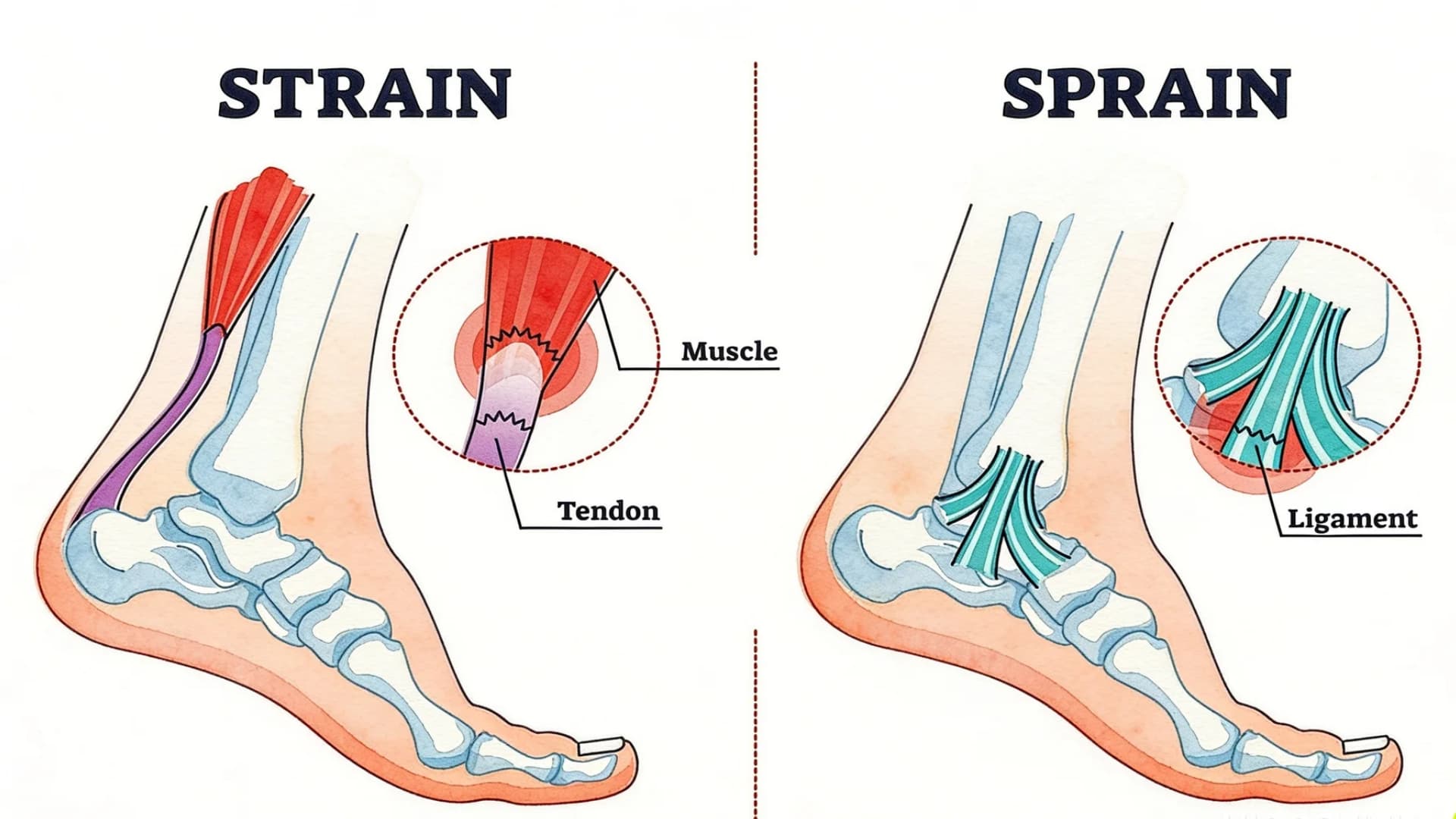
A sprained ankle and a strained hamstring can feel similar, but they affect different tissues and need different care. A sprain affects ligaments around a joint, while a strain affects muscles or tendons. Knowing the difference helps you choose the right treatment and recover safely.
This article explains how to spot sprain vs strain symptoms, treat both at home, and know when to seek medical care.
Sprain vs Strain: Quick Difference Explained
A sprain is a ligament injury caused by twisting or overstretching a joint. A strain is a muscle or tendon injury caused by overstretching or overexertion during movement.
The easiest way to remember it: sprains happen at joints; strains happen in muscles.
| Feature | Sprain | Strain |
|---|---|---|
| Affects | Ligaments | Muscles or tendons |
| Common locations | Ankles, knees, wrists | Hamstrings, lower back, shoulders |
| Cause | Twisting or overstretching a joint | Overuse, lifting, sudden muscle force |
| Main symptom | Joint pain and swelling | Muscle pain and stiffness |
| Key distinguishing sign | Bruising around the joint | Muscle spasms or cramping |
| Common in | Falls and sports injuries | Exercise and repetitive movements |
Ligaments connect bone to bone and stabilize your joints. Tendons connect muscle to bone. Muscles do the actual moving. Damage to any of these tissues, and you will feel pain. But where the pain shows up and what triggered it usually tells you which structure is involved.
What Is a Sprain?
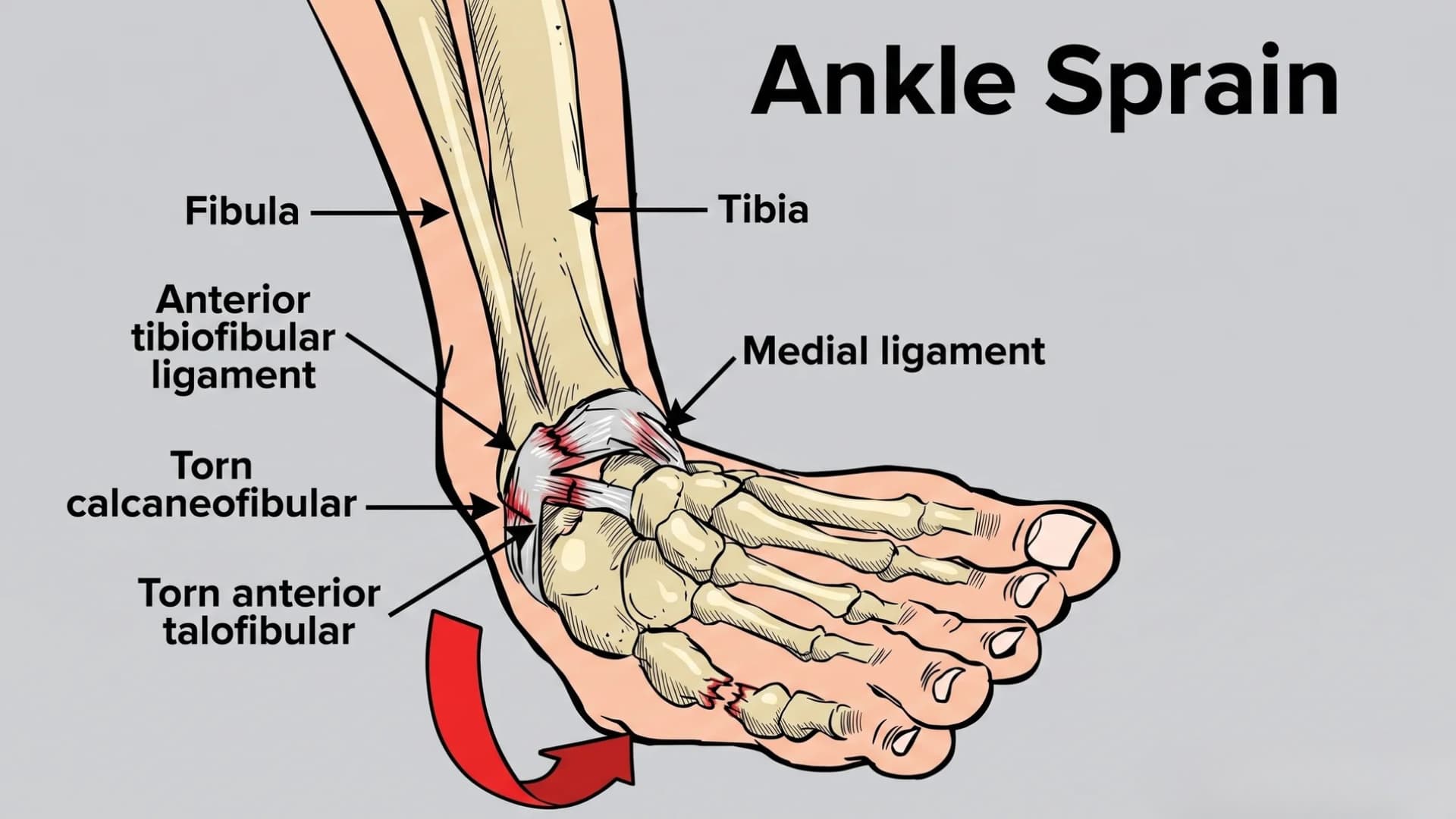
A sprain is damage to a ligament, ranging from a mild overstretch to a complete tear. It happens when a joint moves beyond its normal range during a sudden twist, impact, or awkward landing.
How Sprains Happen
Ligament injuries follow a predictable pattern based on how much force the joint absorbed. They move through three stages of increasing severity.
- Overstretching: the ligament fibers stretch past their normal limit without tearing
- Partial tear: some fibers tear while the ligament stays mostly intact
- Complete tear: the ligament fully ruptures, often leaving the joint unstable
These injuries typically happen when you roll an ankle on uneven ground, fall onto an outstretched hand, or twist a knee while changing direction quickly.
Symptoms of a Sprain
Sprain symptoms center on the affected joint. How bad they get depends on how much of the ligament tore. A mild ankle sprain may feel tender and stiff. A severe one can leave the joint feeling like it will give out under pressure.
| Symptom | What It Feels Like |
|---|---|
| Pain | Concentrated around the joint, sharpest right at the moment of injury |
| Swelling | Develops quickly as fluid builds up around the ligament |
| Bruising | Can take a day or two to surface, often spreading beyond the joint |
| Limited range of motion | Hard to fully bend, rotate, or flex the joint without pain |
| Instability | Feels like the joint might buckle when bearing weight |
| Tenderness | Pain when the joint is touched, especially over the injured ligament |
| Popping sensation | Felt at the moment of injury, more common with moderate to severe sprains |
| Warmth | Sets in around the joint as inflammation builds over the following hours |
| Difficulty weight-bearing | Sometimes requires a limp or external support to walk |
What Is a Strain?
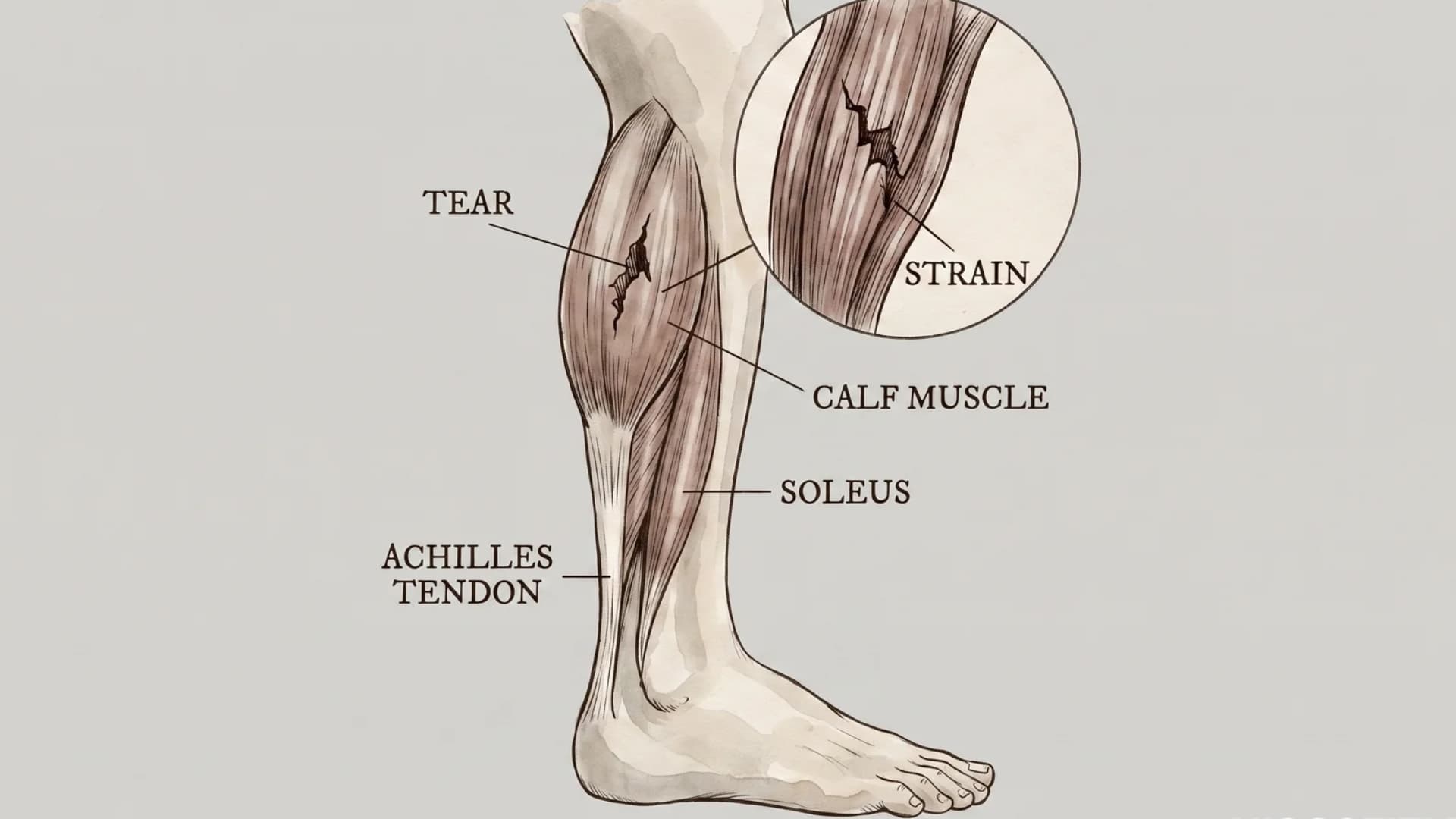
A strain is damage to a muscle or tendon. It happens when the muscle stretches or contracts with more force than the fibers can handle at that moment.
How Strains Happen
Muscle or tendon fibers tear when the demand placed on them exceeds what they can safely absorb. This usually happens during a single forceful movement rather than gradual wear.
- Lifting with poor form: shifts the load onto muscles not positioned to handle it
- Sudden acceleration: asks a muscle to contract faster than it is conditioned for
- Skipping a warm-up: leaves muscle fibers cold, stiff, and more prone to tearing
- Repetitive movements: fatigue the muscle over time, wearing down its ability to absorb force
Symptoms of a Strain
Strain symptoms appear within the muscle itself rather than around a joint. They range from mild tightness to sharp, sudden pain depending on how much tissue was affected.
| Symptom | What It Feels Like |
|---|---|
| Localized pain | A sharp pull or ache in a specific muscle, worse when you contract or stretch it |
| Cramping or spasms | Surrounding muscle fibers tighten in response to the injury |
| Weakness | Difficulty generating the same force as before in that muscle group |
| Stiffness | Worse after rest or first thing in the morning; loosens slightly with movement |
| Reduced range of motion | Stretching the injured muscle fully can trigger pain |
| Swelling | Usually less noticeable than with a sprain, unless the tear is large |
A severe strain can make the muscle feel noticeably weaker for days, even after the initial pain starts to fade.
How to Tell a Sprain from a Strain
Location and the nature of your symptoms give the clearest clues. You often cannot know for certain without a medical exam, but these signs point in the right direction.
- Pain around a joint (ankle, knee, wrist) points toward a sprain
- Pain in the belly of a muscle (hamstring, calf, lower back) points toward a strain
- Bruising near a joint is more common with sprains, since blood pools around the ligament
- Muscle spasms or cramping are more characteristic of strains
- A sprain often follows a sudden twist, awkward landing, or fall
- A strain more often follows a forceful muscle contraction or repetitive overuse
If you are unsure, treat the injury with the PRICE method (see the treatment section below) and get it evaluated if symptoms are not improving after 48 to 72 hours.
Sprain vs Strain Severity Levels
Both injuries are graded on the same three-tier scale based on the extent of tissue damage. The grade drives your treatment plan and recovery timeline.
| Grade | Severity | What It Looks Like |
|---|---|---|
| Grade 1 | Mild | Slight stretching of fibers, minor pain, movement mostly still possible |
| Grade 2 | Moderate | Partial tearing, noticeable swelling, limited movement or weight-bearing |
| Grade 3 | Severe | Complete tear, marked instability, possible need for surgery |
Who Is Most at Risk for a Sprain or Strain?
Some people are more likely to get these injuries than others. Knowing your risk factors helps you take the right steps before you get hurt.
- Previous injury history: tissue that has been injured before often heals slightly weaker. This makes re-injury more likely in the same area.
- Age: ligaments and muscles naturally lose elasticity over time. This makes older adults more prone to sprains. Growing athletes are more prone to strains during rapid growth spurts.
- Poor conditioning: weak or deconditioned muscles fatigue faster, leaving joints with less support during activity
- Certain sports: activities involving quick direction changes, jumping, or heavy lifting carry a higher risk of both injury types
- Inadequate footwear: shoes without proper support or grip increase the odds of rolling an ankle or losing balance
- Fatigue: tired muscles react more slowly and absorb force less efficiently, raising the risk of both sprains and strains late in a workout
How to Treat a Sprain or Strain at Home
For mild to moderate sprains and strains, the standard first-aid approach follows the PRICE method. This five-step framework is widely used by physical therapists and sports medicine professionals to limit damage and support healing.
- Protection: Keep the injured area from further damage using a brace, splint, or wrap. Avoid situations where it could be knocked or twisted again.
- Rest: Stop activities that cause pain, even if that means sitting out sports or workouts for a few days. Pushing through pain nearly always makes the underlying damage worse.
- Ice: Apply cold therapy for 15 to 20 minutes at a time during the first 24 to 48 hours. This reduces swelling, numbs the pain, and slows inflammation around the injured tissue.
- Compression: Wrap the area with an elastic bandage, snug but not so tight it cuts off circulation. This limits swelling and provides extra support.
- Elevation: Raise the injured limb above heart level when resting. This helps gravity drain excess fluid and reduce swelling faster.
Do not rush back to full activity once the pain starts to ease. The tissue is often still healing beneath the surface even when it feels better. A gradual return to movement gives the ligament, muscle, or tendon time to rebuild its strength properly.
Sprain vs Strain Recovery Time
Recovery depends more on the grade of your injury than on whether it is a sprain or a strain. The grade determines how much tissue was damaged and how long the body needs to repair it.
| Injury Severity | Sprain (Ligament) | Strain (Muscle) |
|---|---|---|
| Mild (Grade 1) | 2 to 8 weeks | 2 to 6 weeks |
| Moderate (Grade 2) | Several weeks to 3 months | Several weeks |
| Severe (Grade 3) | Several months, possible surgery | Several months, possible surgery |
Strains often heal faster than sprains at the same grade level. This is because muscle tissue has a richer blood supply than ligament tissue. Better blood flow means oxygen and nutrients reach the injury more quickly, which speeds up repair.
A few other factors affect your recovery timeline. These include which joint or muscle is involved and how much tissue was damaged. How quickly you started treatment also matters. So does following through on rehab rather than stopping once the pain fades.
When Should You See a Doctor for a Sprain or Strain?
See a doctor if you cannot put weight on the injured area. Also go if there is visible deformity, or if symptoms are not improving after 48 to 72 hours.
Other warning signs worth getting checked out:
- Severe pain that does not respond to rest or ice
- Numbness or tingling around the injury
- Swelling that keeps getting worse over 24 to 48 hours
- A popping sound at the moment of injury, followed by instability
- An inability to move the joint or muscle at all
A doctor or physical therapist will typically start with a physical exam. They may order an X-ray or MRI if they suspect a fracture or complete tear.
How to Prevent Sprains and Strains
A few consistent habits go a long way toward keeping your joints and muscles out of trouble. These apply during exercise and daily activity alike.
- Warm Up Before Exercise: A proper warm-up raises muscle temperature and prepares joints for load. This lowers the risk of overstretching cold tissue.
- Build Strength and Flexibility: Stronger muscles and more mobile joints absorb more force before something gives.
- Use Proper Technique: Poor form under load, especially during lifting or sprinting, is one of the most common causes of both injury types.
- Wear Suitable Footwear: Shoes with the right support and grip reduce the chance of rolling an ankle on uneven ground.
- Listen to Pain Signals: Pain during activity is a warning. Continuing through it often turns a minor issue into a more serious injury.
- Avoid Overtraining: Give muscles and joints time to recover between hard sessions. Fatigued tissue is more prone to injury.
Mistakes That Slow Down Sprain and Strain Recovery
Even a mild injury can become a long-term problem if these errors go unchecked in the first few weeks.
- Returning to sports or workouts before the tissue has actually healed
- Ignoring swelling instead of managing it early with ice and elevation
- Skipping rehab exercises once the pain fades
- Applying heat too early, which can increase swelling in the first 48 hours
- Using pain medication to keep pushing through activity rather than resting
Disclaimer: This article is for general information only and is not a substitute for professional medical advice. If you are dealing with a serious injury or symptoms that concern you, see a doctor or physical therapist.
Know the Difference Between Sprain vs Strain and Treat the Right Injury
Knowing the difference between sprain vs strain helps you treat the right injury from day one. Sprains affect the ligaments around your joints.
Strains affect the muscles or tendons that power movement. Both respond well to the PRICE method early on, and both need a gradual return to activity to heal fully. The grade of your injury matters more than which type you have.
Start with proper home care, monitor your symptoms each day, and see a doctor if things aren’t improving. The sooner you act on the right information, the better your chances of a full recovery.
Frequently Asked Questions
How do you know if you have a strain or a sprain?
A sprain usually causes pain, swelling, and bruising around a joint. A strain causes muscle pain, stiffness, weakness, or cramping in the affected area.
Is a torn ligament a sprain?
Yes. A torn ligament is a severe sprain, often classified as a Grade 3 sprain when the ligament fully ruptures.
Is it OK to massage a sprain?
Avoid massage during the first 48 to 72 hours, as it may increase swelling. Gentle massage may help later during recovery if approved.
What speeds up ankle sprain recovery?
Protection, rest, ice, compression, and elevation can support early healing. Gradual movement and rehab exercises help restore strength.
What are four signs an ankle sprain is bad?
Severe swelling, inability to bear weight, joint instability, and intense pain are signs of a serious ankle sprain that needs evaluation.
Can I walk on my sprained ankle after 3 days?
You can walk if pain and swelling have improved, but avoid pushing through discomfort. If you have severe pain or instability, wait and seek advice.