
Your foot has been sore for two weeks. You keep training. Then one morning, standing up hurts.
That slow, building bone pain is one of the clearest signs of a stress fracture.
People often mistake it for regular soreness and push through. By the time they stop, the injury is much worse than it needed to be.
This post covers what a stress fracture is, what causes it, how to spot the symptoms early, how doctors confirm the diagnosis, and what actually speeds up recovery.
If you have bone pain that keeps getting worse with every training session, this is where you get answers.
What Is a Stress Fracture?
A stress fracture is a small crack in a bone caused by repeated loading over time. The bone does not snap all at once. It slowly breaks down under a load it cannot support.
Bones are living tissue. They constantly break down and rebuild. When loading happens faster than the bone can rebuild itself, small cracks begin to form. Left untreated, those cracks can grow into a complete fracture.
Stress fractures most commonly develop in the lower limbs because those bones carry body weight with every step. They show up most often in runners, military recruits, dancers, and anyone who increases physical activity too quickly.
What Causes a Stress Fracture?
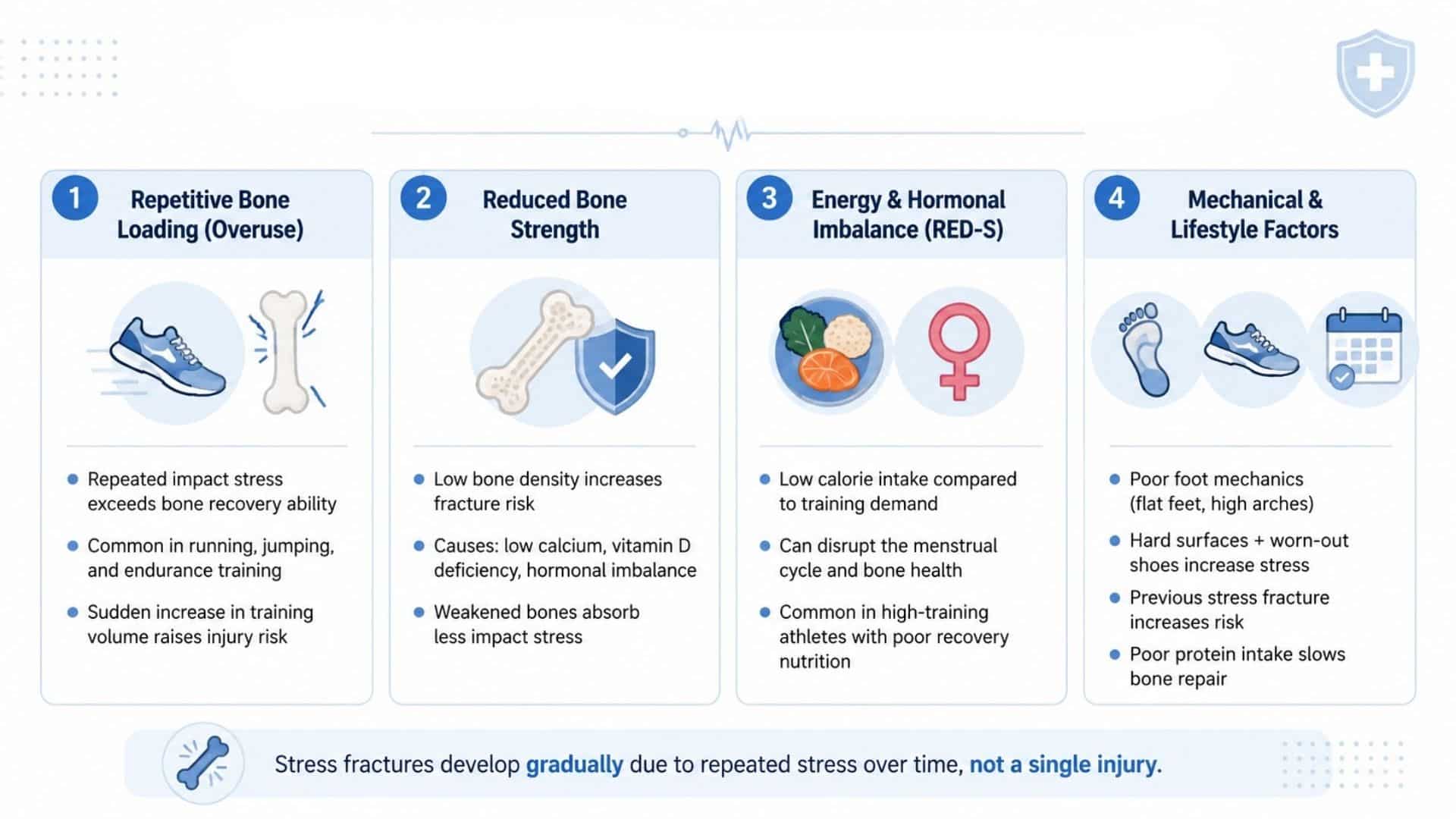
A stress fracture develops when repetitive force places more strain on a bone than it can repair. Small cracks build up gradually over time.
1. Overuse and Rapid Load Increases
The most common cause is doing too much, too fast. Increasing running mileage by 30% in a single week gives your bones no time to adapt.
Bones need recovery time between sessions to rebuild. When training load rises faster than the bone can handle, cracks begin to form.
2. Low Bone Density
Bones that are already weakened fracture more easily under load. Osteoporosis, low calcium intake, low vitamin D, and hormonal imbalances all reduce bone density over time.
3. The Female Athlete Triad and RED-S
Some female athletes develop three connected problems at once:
- Low energy from not eating enough to support their training
- Irregular or absent periods
- Low bone density
This combination raises the risk of a stress fracture significantly. The condition, known as the Female Athlete Triad, is a serious clinical concern, not just a training problem.
4. Other Contributing Factors
Several other factors can increase your risk:
- Running on hard surfaces with worn-out footwear
- Flat feet or high arches that change how force travels through the leg
- A prior stress fracture, which raises the risk of another one
- Low protein intake, which slows bone repair
Stress Fracture Symptoms: What Does It Feel Like?
Stress fracture symptoms often start subtly. Many people mistake them for regular muscle soreness. Catching the early signs can prevent the injury from worsening.
The Main Warning Signs
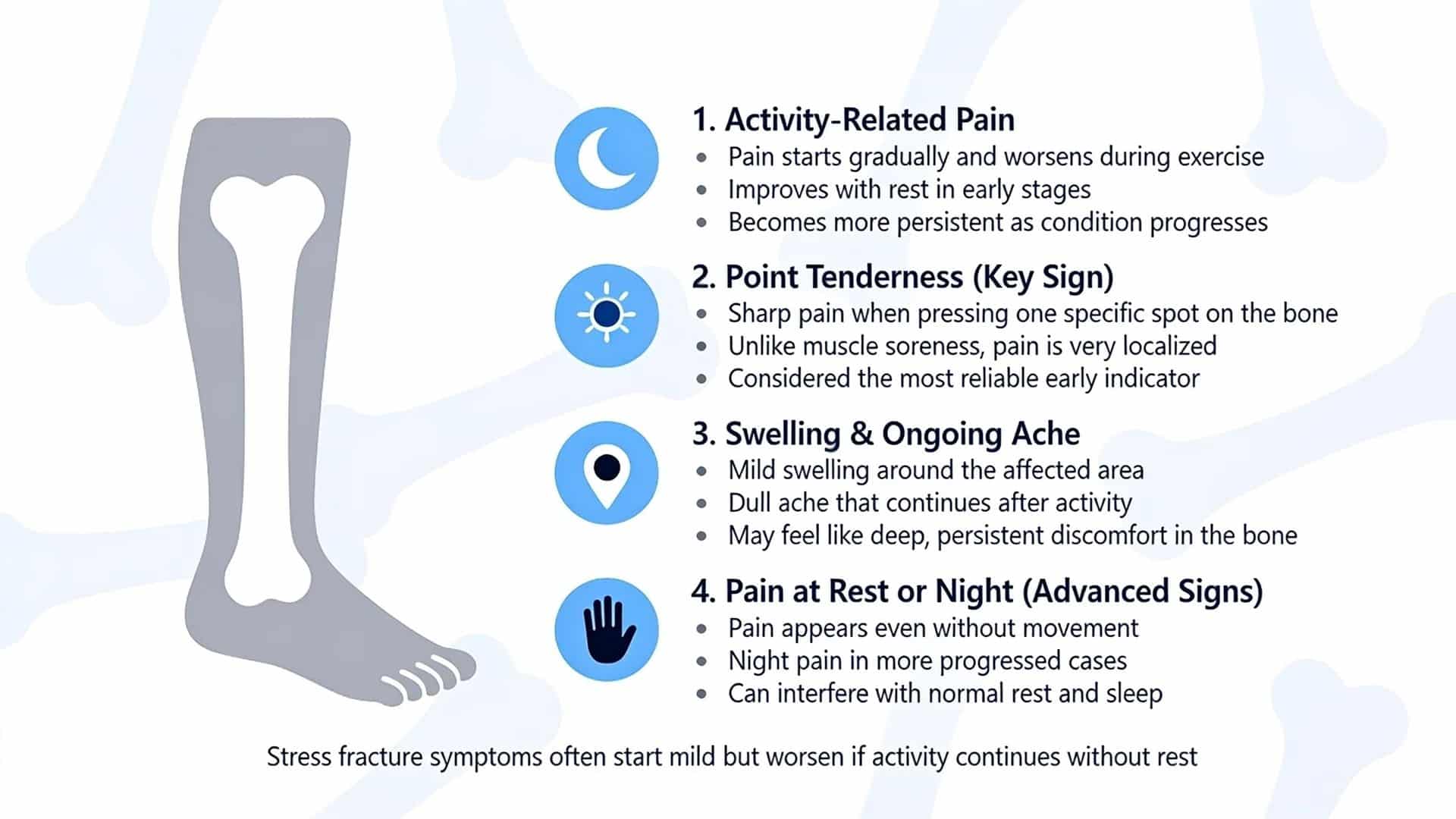
The defining feature of a stress fracture is pain that builds gradually and links directly to activity. It worsens during exercise and often eases with rest, at least in the early stages.
As the fracture worsens, pain can appear even when you are not moving.
The most telling physical sign is point tenderness. Pressing on one very specific, small spot on the bone causes sharp pain. This differs from the broader soreness of muscle fatigue or shin splints.
Other symptoms include:
- Mild swelling around the affected area
- Aching that lingers after you stop exercising
- Pain at night in more advanced cases
- A dull bruising sensation, even without visible bruising
Symptoms by Location
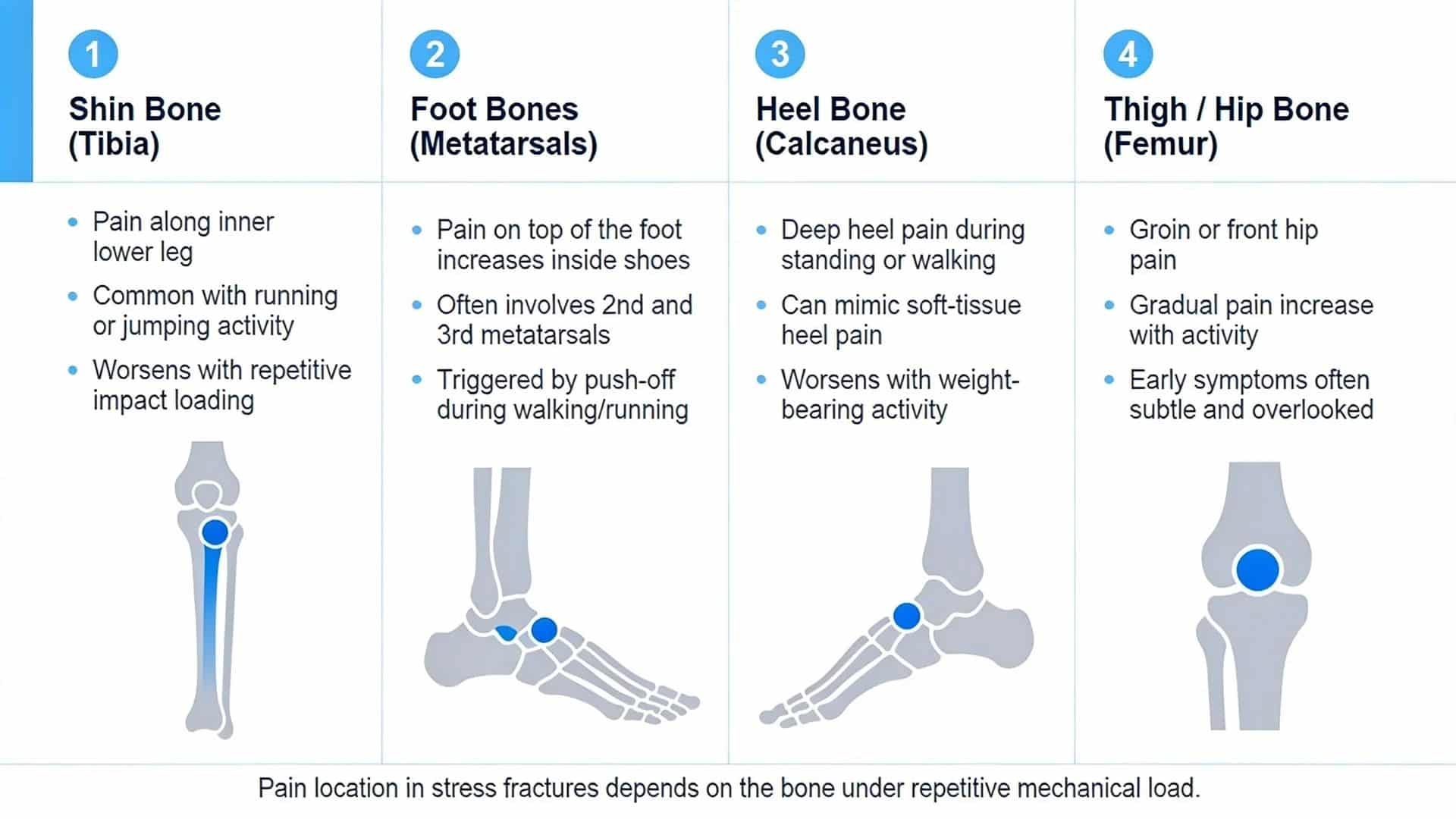
Where you feel pain depends on which bone is affected. Each location has its own pattern.
1. Shin Bone (tibia)
Pain along the inner edge of the lower leg is the most common pattern in runners and jumpers. A tibia stress fracture usually develops when training load increases too fast. The shin becomes overloaded before it can adapt. The pain sits at one sharp spot, not spread across the shin.
2. Foot Bones (metatarsals)
Aching or sharp discomfort across the top of the foot that worsens in shoes often points to the metatarsals. A metatarsal stress fracture most often involves the second or third metatarsal. These bones take the highest force during the push-off phase of each step. The second and third are most vulnerable because they have less muscular support than the others.
3. Heel Bone (calcaneus)
Deep heel pain that increases with standing or walking can signal a calcaneal stress fracture. This injury is often confused with soft-tissue problems because both cause weight-bearing pain. The key difference is a specific, sharp point of tenderness directly on the heel bone rather than diffuse soreness around the heel.
4. Thigh bone (femur)
Pain in the groin or the front of the hip that gradually worsens with activity can indicate bone stress in the femur. Recognizing the early signs of a femoral stress fracture matters more here than anywhere else. This is a high-risk location. Left untreated, it can progress to a complete break, which is a serious medical situation.
Stress Reaction vs Stress Fracture: What Is the Difference?
A stress reaction and a stress fracture sit on the same injury spectrum. They represent different stages of the same problem.
A stress reaction is the bone’s early warning signal. At this point, the bone is under excessive load and begins to show internal strain and inflammation. There is no visible crack yet. It often reflects a gap between training demand and the bone’s ability to keep up.
A stress fracture occurs when stress continues without enough recovery. At this stage, a true structural crack exists in the bone. It is no longer just a biological response to overload. It is an actual mechanical failure of bone tissue.
| Feature | Stress Reaction | Stress Fracture |
|---|---|---|
| Structure | Intact, but inflamed | Crack present |
| Pain | Dull ache during activity | Sharper, often constant |
| X-ray | Usually normal | Sometimes visible |
| Recovery | 2 to 6 weeks | 6 to 12+ weeks |
| Risk if ignored | Progresses to fracture | Can become a complete break |
Catching a stress reaction early is the best outcome. With prompt rest, many people avoid developing a full fracture. An MRI is the most reliable tool for identifying a stress reaction before it progresses to something more serious.
How Is a Stress Fracture Diagnosed?
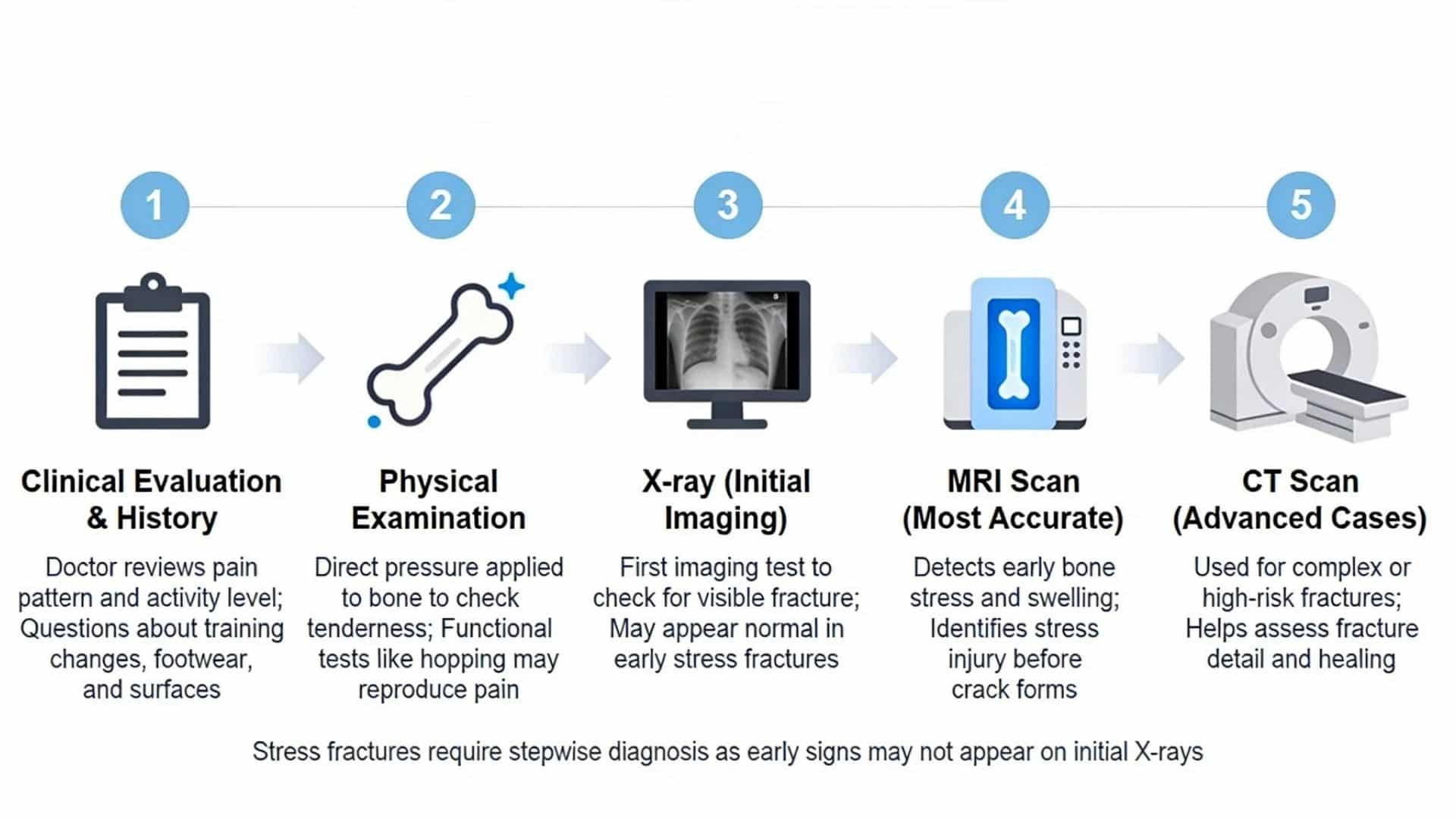
Diagnosing a stress fracture requires a step-by-step clinical approach. Early symptoms often overlap with other overuse injuries, which makes this process necessary.
1. Clinical Evaluation and History
A sports medicine or orthopedic specialist will ask about your pain pattern and training history. They want to know when the pain started, what makes it worse, and whether anything changed recently, such as training load, footwear, or running surface.
2. Physical Examination
The doctor will press directly on the bone to check for localized tenderness. They may also ask you to hop on the affected leg. Sharp pain during this movement strongly points to a stress-related bone injury.
3. X-ray
An X-ray is usually ordered first. In early stages, X-rays often appear normal. Stress fractures can be too small to detect in the first two weeks.
4. MRI
If symptoms continue despite a normal X-ray, an MRI is the next step. MRI is the most accurate test available. It can detect early bone stress, swelling, and stress reactions before any visible crack forms.
5. CT Scan
In some cases, a CT scan is used for complex or high-risk fractures. It helps assess the exact fracture pattern and track healing progress over time.
High-Risk vs Low-Risk Stress Fractures
Not all stress fractures carry the same level of concern. The location of the fracture largely determines how it is treated and how long recovery takes.
High-risk sites have poor blood supply or face very high mechanical stress. These include:
- The femoral neck (hip area)
- The navicular bone in the foot
- The fifth metatarsal base, known as a Jones fracture
- The front surface of the tibia
These fractures heal slowly, carry a higher risk of becoming complete breaks, and often need specialist care. Surgery is sometimes required.
Low-risk sites heal well with rest and a gradual return to activity. These include:
- The back surface of the tibia
- The second through fourth metatarsals
- The calcaneus
- The fibula
Knowing which category your fracture falls into changes everything about how to manage it. Do not assume all stress fractures follow the same recovery path.
How Is a Stress Fracture Treated?
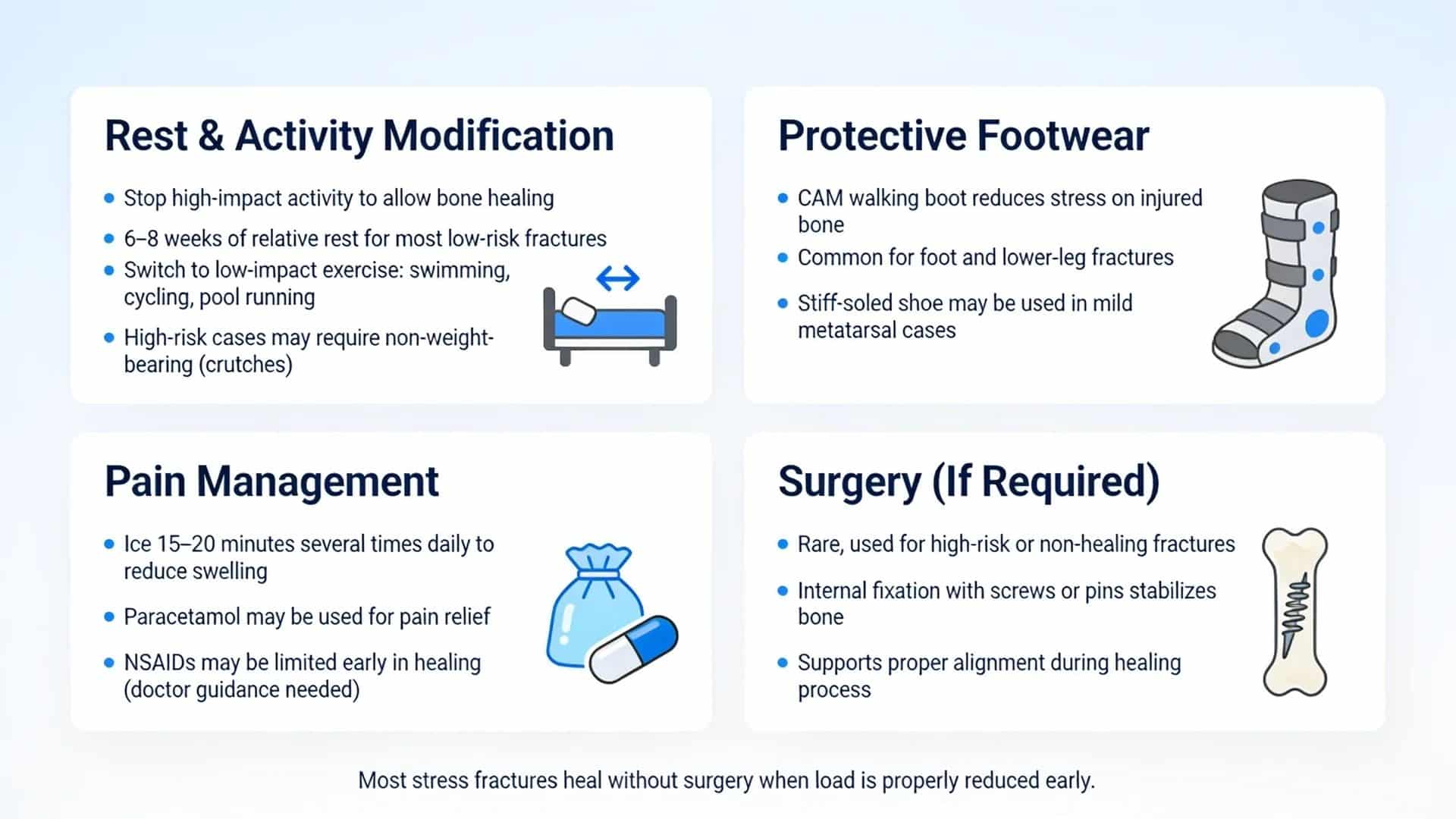
Treatment focuses on reducing stress on the affected bone so it can heal.
1. Rest and Activity Modification
Stopping the activity that caused the injury is the single most important step. For most low-risk fractures, six to eight weeks of relative rest is enough.
Relative rest means switching to non-impact exercise, such as swimming, cycling, or pool running, rather than stopping all movement entirely.
High-risk fractures require complete non-weight-bearing. This means crutches and a strict no-impact plan until a doctor clears you.
2. Protective Footwear
A walking boot, also called a CAM boot, reduces the load on the injured bone. It is commonly prescribed for foot and lower-leg fractures. For mild metatarsal fractures, a stiff-soled shoe may be enough.
3. Pain Management
Ice applied for 15 to 20 minutes several times a day helps with swelling and discomfort. Paracetamol is generally safe for pain relief.
NSAIDs like ibuprofen are sometimes avoided in the early healing period. Some research suggests they may slow bone repair. Talk to your doctor before using them regularly.
4. Surgery
Most stress fractures do not need surgery. It becomes necessary when a high-risk fracture fails to heal or when the risk of displacement is too high to manage without it. Surgical fixation uses screws or pins to hold the bone in place while it heals.
What Is the Fastest Way to Heal a Stress Fracture?
There is no shortcut. But these steps give your body the best chance to heal on schedule.
Stop loading the bone immediately. Training through a stress fracture makes it consistently worse. Resting as soon as you recognize the symptoms is the most effective thing you can do.
Eat to support bone repair. Aim for 1,000 to 1,200 mg of calcium per day through food or supplements. Vitamin D supports calcium absorption, and many active people have low levels without knowing it. Protein also plays a role in bone remodeling. Do not undereat during recovery.
Sleep more. Bone repairs itself primarily during sleep. Fewer than seven to eight hours per night slows the healing process. Recovery happens around the clock.
Follow a structured return plan. A physiotherapist or sports medicine doctor can build a gradual loading program for you. Pain-free walking comes before jogging. Jogging comes before running. Running comes before full training.
Skipping stages is the most common way people re-injure themselves.
Things that slow healing include:
- Smoking
- Long-term NSAID use
- Low vitamin D
- Returning to impact exercise too early
How to Prevent Stress Fractures
Preventing stress fractures comes down to managing training load and giving bones enough time to adapt.
- Follow the 10% rule. Increase the weekly training load by no more than 10%.
- Build in rest days. Bones need recovery time between sessions, not just your muscles.
- Replace footwear regularly. Running shoes lose shock absorption after 300 to 500 miles.
- Fix nutritional gaps. Low calcium and vitamin D levels can be corrected before they lead to bone problems.
- Get a bone density check. This is worth doing if you have had more than one stress fracture or have known risk factors.
- Take hormonal issues seriously. Irregular periods in female athletes are a clinical warning sign, not a minor training issue.
Conclusion
A stress fracture forms when bone breaks down faster than it rebuilds, and it sends warning signals before things get serious. Most people ignore those signals until the pain forces a complete stop.
Now you know what a stress fracture is, what drives it, and what the recovery process actually looks like. Acting early, resting on time, and eating to support bone repair are the three factors that change the outcome the most.
If you have pain in your shin, foot, heel, or hip that keeps getting worse with training, do not wait on it. A proper diagnosis is the only way to know what you are dealing with.
Getting that diagnosis early keeps your recovery timeline short and protects the bone from further damage.
Frequently Asked Questions
Can You Walk on A Stress Fracture?
It depends on the bone and severity. Low-risk fractures in the fibula or mid-shaft metatarsals may allow walking in a boot. High-risk sites, such as the femoral neck or navicular, require non-weight-bearing.
Will a Stress Fracture Show on An X-Ray?
Not always, particularly in the first two weeks. X-rays miss a large proportion of early stress fractures. An MRI is far more reliable and can detect a stress reaction before a crack forms.
How to Tell the Difference Between a Stress Fracture and Shin Splints?
Shin splints cause a broad, diffuse ache along a wider area of the shin. A stress fracture causes sharp pain at one very specific spot.
Are Stress Fractures More Common in Women?
Yes. Women, particularly athletes with low energy availability, irregular periods, or low bone density, face a higher risk. Postmenopausal women are also more vulnerable due to lower estrogen levels.
How Long Does a Stress Fracture Take to Heal?
Low-risk stress fractures typically heal in six to eight weeks with proper rest. High-risk fractures, such as those at the femoral neck or navicular, can take 12 weeks or longer and may need specialist management.