

People do not notice the moment a metatarsal stress fracture begins. There is no dramatic fall. No loud crack. No single moment can you point to and say, “That is when it happened.”
Instead, there is just a dull ache in the front of the foot that builds slowly over days. You push through it. You assume it is soreness.
Then one morning you step out of bed, and the pain stops you mid-stride. This injury forms over time from repeated force.
This post covers what causes it and how to recognize it early. It also explains what treatment looks like, from a walking boot to the rarer cases that need surgery.
What Is a Metatarsal Stress Fracture?
A metatarsal stress fracture is a small crack in one of the five long bones of your foot. These bones connect your ankle to your toes.
Your foot contains five metatarsal bones. Each bone has three parts. The base sits near the ankle, the shaft runs through the middle, and the head is closest to the toe.
A stress fracture forms when repeated load on the bone outpaces its ability to repair itself. When the muscles around the foot get tired, they stop absorbing shock as well. That force transfers directly to the bone. Over time, the bone develops a tiny crack.
These fractures are among the most common foot injuries in runners, dancers, and military recruits. Ninety percent occur in the 2nd, 3rd, and 4th metatarsals, with the 2nd being the most frequently affected.
These were historically called “march fractures.” They were first described in 1855 among military recruits who developed them after long marches in hard boots.
Not All Metatarsal Stress Fractures Heal the Same Way
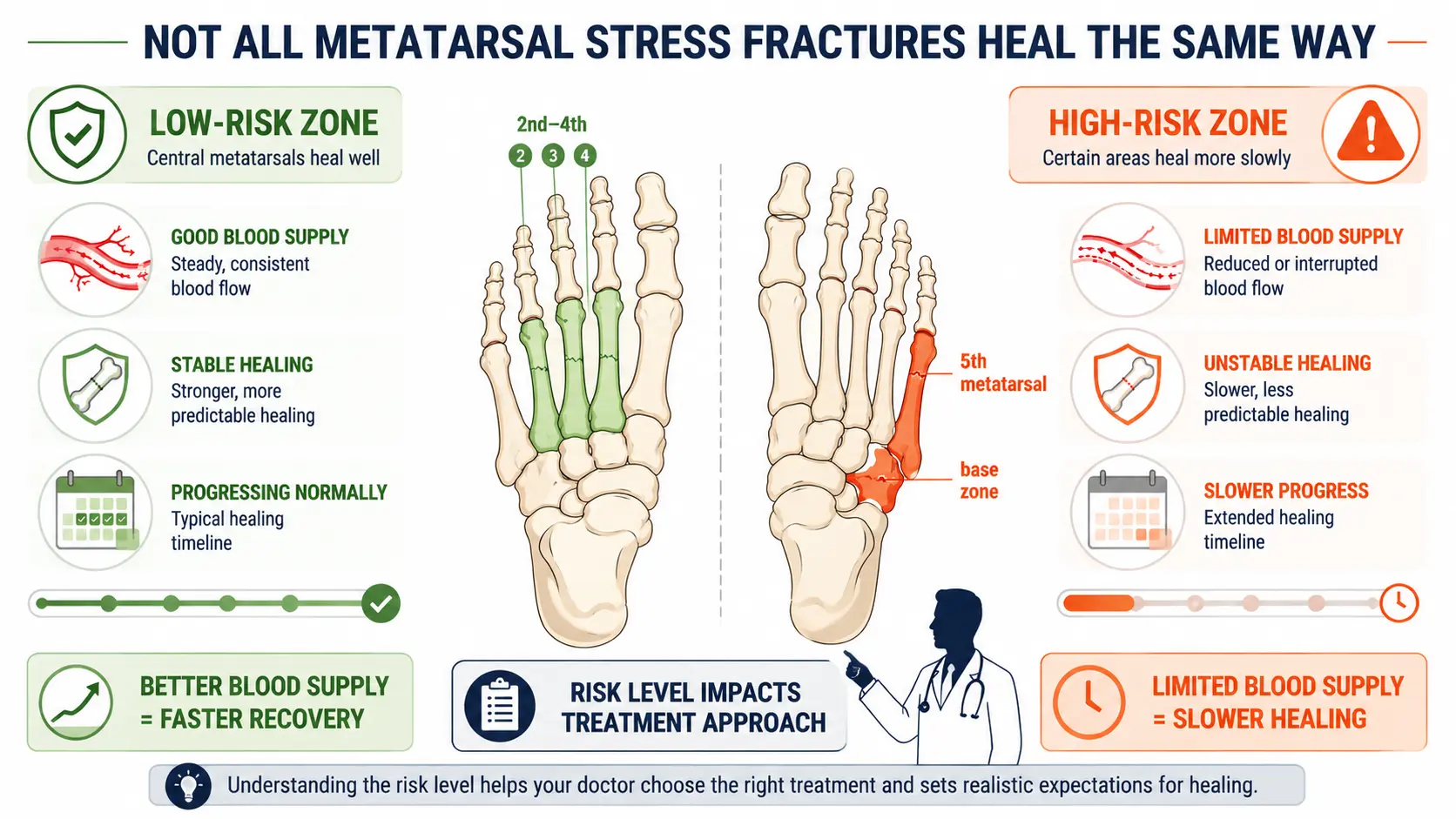
After a diagnosis, your doctor will tell you whether your fracture is low-risk or high-risk. This classification directly affects how long healing takes and whether you need surgery.
- Low-risk fractures occur in the shaft of the 2nd, 3rd, or 4th metatarsal. These bones receive a reliable blood supply, so they heal well with rest and protected weight-bearing.
- High-risk fractures occur in the 5th metatarsal, the bone running along the outer edge of your foot. The 5th metatarsal has a naturally limited blood supply, particularly in the area where Jones fractures occur. The base of any metatarsal is also considered high-risk.
For fractures in these zones, your doctor will take a more aggressive treatment approach from the start.
What Causes a Metatarsal Stress Fracture?
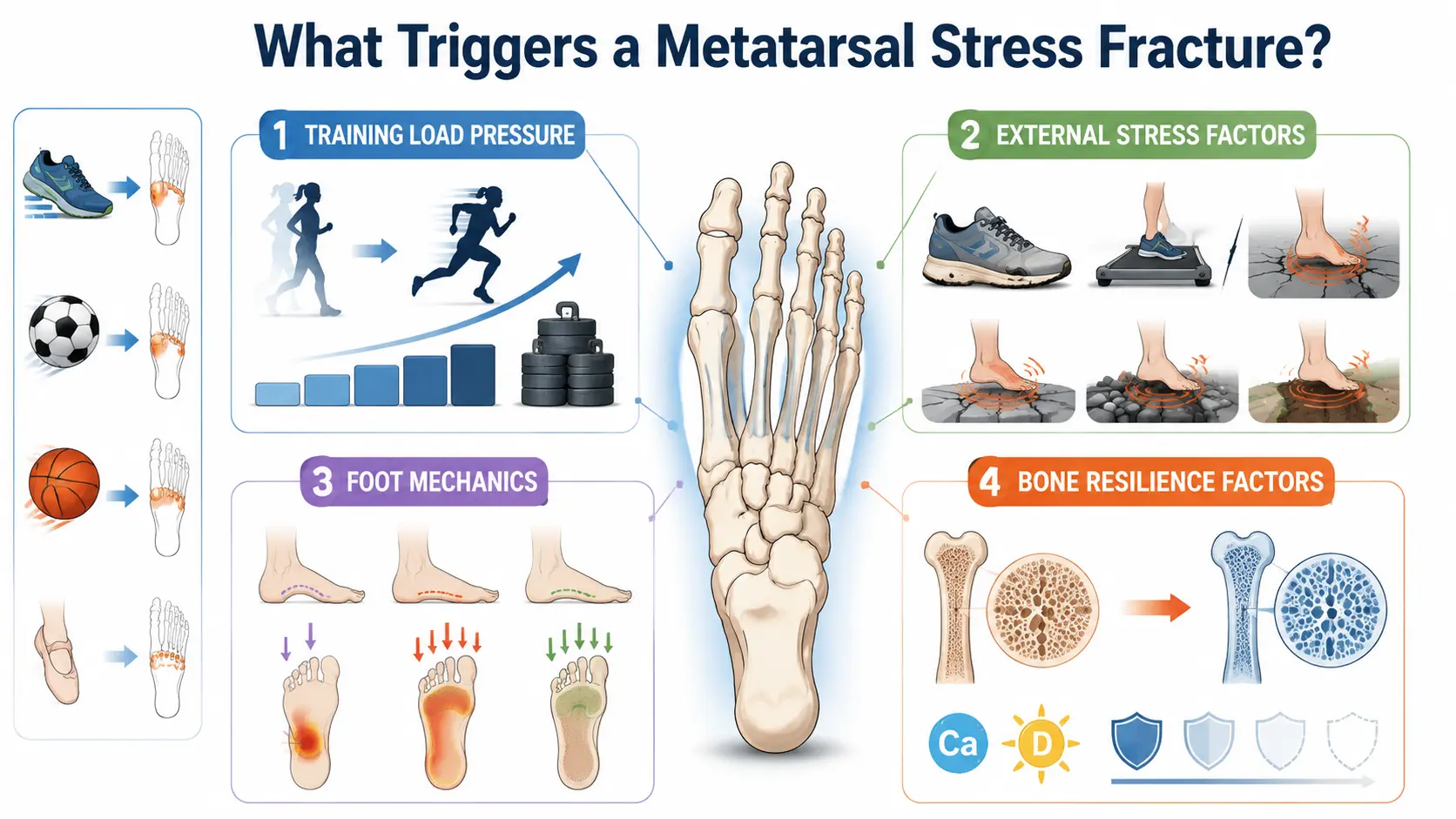
Overloading the bone is the root cause. But the reasons that overload happens vary more than most people expect.
- Sudden increases in training: Rapidly increasing running mileage or starting high-impact exercise without gradual progression places excessive stress on the metatarsal bones.
- Surface and footwear: Frequent running on hard surfaces, worn-out shoes, or switching to minimalist footwear too quickly can increase pressure on the metatarsals.
- Foot structure: High arches, flat feet, longer metatarsals, or abnormal foot mechanics can concentrate force on certain areas. This raises fracture risk in those areas more than neutral foot mechanics do.
- Bone health: Low calcium or vitamin D levels, poor nutrition, and conditions like the Female Athlete Triad can weaken bones. The Female Athlete Triad refers to the combination of low energy availability, irregular menstrual cycles, and low bone density. It is most common in female athletes who maintain high training loads without adequate caloric intake.
Long-distance running, soccer, basketball, and dance have the highest rates of this injury. Soccer is closely associated with 5th metatarsal fractures. Distance running and military recruit training tend to cause 2nd- and 3rd-metatarsal injuries.
Metatarsal Stress Fracture Symptoms to Watch For
The main symptom is a deep, aching pain in the forefoot that worsens with exercise and eases with rest.
Early on, you may be able to finish a run and feel fine afterward. That recovery window narrows as the fracture progresses.
Point tenderness is the most reliable physical sign. Sharp pain when pressing one specific spot along the bone is a strong indicator of a stress fracture. This differs from general soreness or soft-tissue irritation, which tends to spread rather than concentrate on one point.
Other symptoms include:
- Swelling on the top of the foot, often mild at first
- Bruising in some cases, though not always
- Pain that lingers longer after activity as the injury worsens
- Discomfort when bearing full weight on the foot
The key difference between this fracture and conditions such as plantar fasciitis or metatarsalgia is their location. The pain stays at one specific point on the bone. It does not spread across the arch or ball of the foot.
If you can press a single point and reproduce the exact pain you feel when running, that warrants medical attention.
How Doctors Diagnose a Metatarsal Stress Fracture
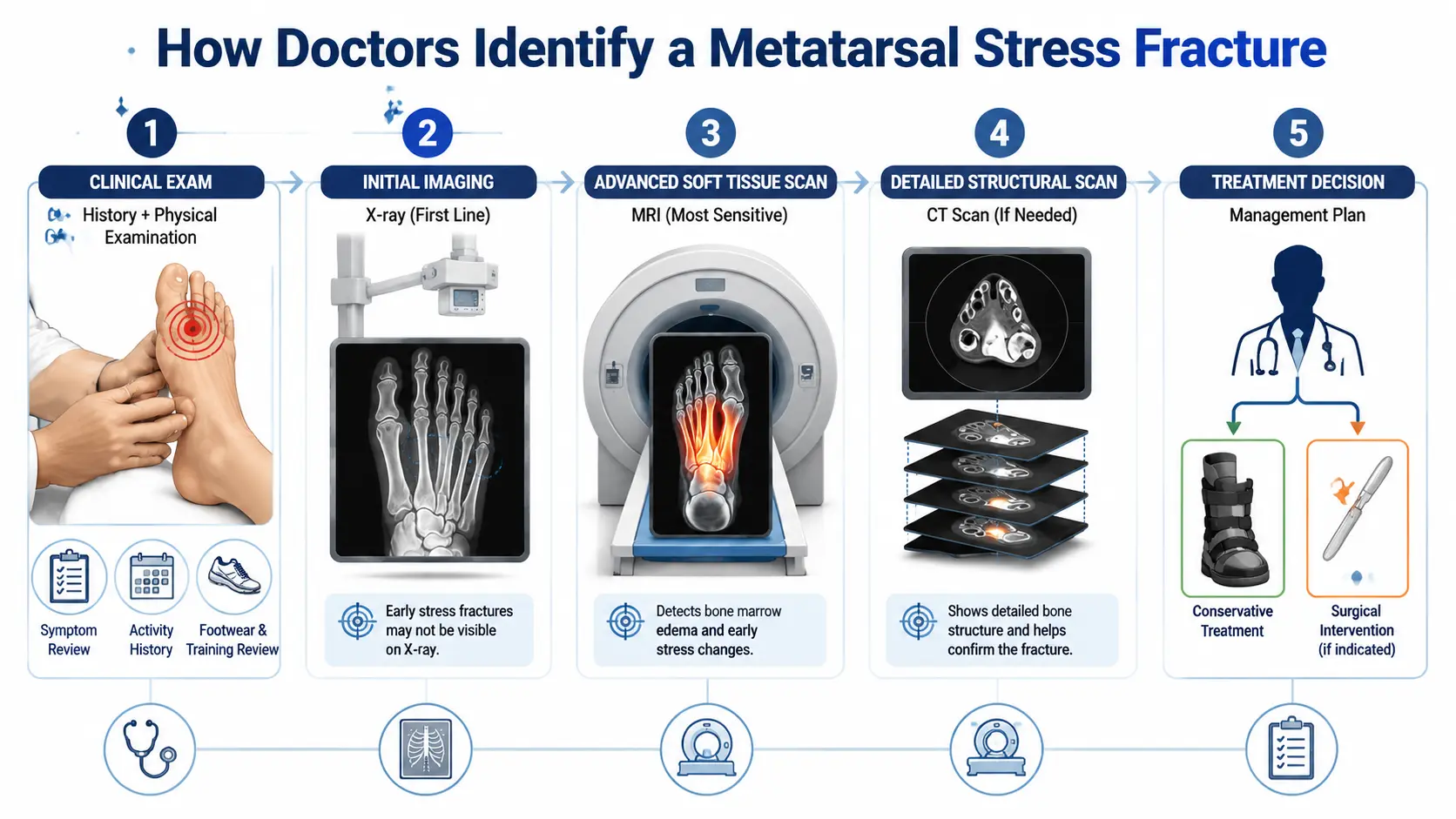
Diagnosing a metatarsal stress fracture involves more than just a single scan, as early signs are often subtle and require a combination of clinical evaluation and imaging.
1. Physical Examination
Your doctor checks for tenderness along the metatarsal bone and asks about your symptoms, activity level, training routine, footwear, and when the pain began.
2. X-Ray Evaluation
An X-ray is usually the first imaging test, but it may not detect a stress fracture during the first two to three weeks because the crack is often too small to be visible.
3. MRI for Early Detection
If symptoms strongly suggest a stress fracture despite a normal X-ray, an MRI may be recommended. It can identify bone changes within days of injury, making it the most accurate test for early diagnosis.
4. CT Scan in Selected Cases
A CT scan is typically reserved for complex or high-risk fractures and helps doctors evaluate the extent of the injury when surgical planning is needed.
5. Clinical Diagnosis and Early Treatment
If you have localized tenderness and pain that worsens with activity, your doctor may begin treatment even before imaging confirms the fracture to prevent further bone damage and speed recovery.
Early recognition of symptoms and timely medical assessment can help initiate treatment sooner and prevent the fracture from worsening.
Metatarsal Stress Fracture Treatment: What Actually Works
Most cases heal without surgery when diagnosed early. Treatment focuses on reducing stress on the injured bone, relieving pain, supporting healing, and gradually returning to normal activities.
- Rest and activity modification: Stopping the sport or activity that caused the fracture is the treatment itself. Continuing to load the bone can turn a stress fracture into a complete break.
- Ice and elevation: Apply ice for 15 to 20 minutes several times daily during the first 48 to 72 hours. Keep the foot raised when sitting or resting.
- A walking boot for four to six weeks: This is the standard approach for most low-risk fractures. It protects the bone while still allowing mobility. Severe cases or high-risk fractures may require crutches and a period of non-weight-bearing rest.
- Nutrition during recovery: For most adults, 1,000 mg of calcium per day supports bone repair. Those aged 9 to 18 need 1,300 mg. Vitamin D is equally important because the body cannot absorb calcium without it. If low bone density or poor nutrition contributed to the fracture, a doctor may recommend a nutritional review.
- Physical therapy: It helps restore strength and flexibility in the foot and lower leg. It also corrects movement patterns that overloaded the metatarsals in the first place.
- Surgery: For high-risk fractures, particularly Jones fractures in athletes, surgery leads to better outcomes than non-surgical treatment alone. [Source: Nationwide Children’s Hospital, nationwidechildrens.org] The most widely used procedure is intramedullary screw fixation. A screw is placed inside the bone to maintain stability while it heals.
With timely treatment and a gradual return to activity, most of these fractures heal completely.
How Long Does a Metatarsal Stress Fracture Take to Heal?
Recovery time depends heavily on which bone is fractured and how quickly treatment begins. The table below provides realistic timelines by fracture type.
| Fracture Type | Protected Rest Period | Return to Sport |
|---|---|---|
| Low-risk: 2nd, 3rd, 4th metatarsal shaft | 6 to 8 weeks | 8 to 12 weeks |
| High-risk: 5th metatarsal, non-surgical | Up to 20 weeks | Beyond 12 weeks post-injury |
| High-risk: 5th metatarsal, surgical | Bone union around 13 weeks | 3 to 4 months |
The longer you wait before starting treatment, the longer recovery takes. Return to sport is determined by how your body heals, not by a fixed number of weeks on a calendar.
Your doctor will confirm readiness based on resolved pain and a normal clinical examination, sometimes supported by follow-up imaging.
When you do return to activity, load must be reintroduced gradually. Going back to your previous training volume immediately is how re-fractures happen.
Can You Walk on a Metatarsal Stress Fracture?
For low-risk fractures, walking in a boot is generally permitted. For high-risk fractures, your doctor may recommend crutches and a period of keeping weight off the foot entirely.
Walking through pain without any protection can push a partial crack into a full break. That changes recovery from weeks to months and may make surgery necessary when it was not needed before.
How to Prevent a Metatarsal Stress Fracture
Prevention comes down to giving your bones enough time to adapt to the demands you place on them.
- Increase training volume by no more than ten percent per week.
- Replace running shoes every 300 to 500 miles and wear sport-specific footwear.
- Build strong calf and foot muscles through exercises like calf raises and single-leg balance work. Muscles that absorb shock well protect the bones beneath them.
- Eat enough to support your training load. Underfueling is a risk factor that many active people overlook.
- Vary your training surfaces and include low-impact cross-training, such as cycling or swimming, to reduce repetitive stress on your bones.
- If you have flat feet, a high arch, or a history of stress fractures, have your gait assessed. An orthotic fitted to your foot mechanics can make a real difference.
Conclusion
A metatarsal stress fracture builds quietly, but ignoring it does not make it smaller. The earlier you act on persistent forefoot pain, the faster and more fully you will recover.
Location matters. A low-risk fracture in the middle metatarsals responds well to rest and a boot.
A high-risk fracture, especially in the 5th metatarsal, needs medical attention quickly to avoid months of complicated recovery or an avoidable surgery.
People who treat this injury properly get back to full activity, while those who push through it end up on the longer, harder path. Your foot is telling you something right now. The question is whether you are listening.
Have you dealt with a metatarsal stress fracture? Share what helped you recover in the comments below.
Frequently Asked Questions
How Do You Know if You Have a Metatarsal Stress Fracture?
A metatarsal stress fracture typically causes pain that worsens with walking or running, along with tenderness and mild swelling over the affected bone.
Can You Walk on a Metatarsal Stress Fracture?
Many people can still walk, but continuing to bear weight may delay healing or worsen the injury. Your healthcare provider may recommend a walking boot, supportive shoe, or crutches depending on the severity.
What Does a Metatarsal Stress Fracture Feel Like?
It often begins as a dull ache in the forefoot that becomes sharper with activity and eases with rest. As the fracture progresses, the pain may become more constant and localized.
Is a Metatarsal Stress Fracture the Same as a Jones Fracture?
No. A Jones fracture is a specific type that occurs at the base of the 5th metatarsal. It is high-risk and more likely to require surgery than other metatarsal fractures.