
You can train legs for months and still not build that lifted shape at the top of your glutes.
The problem is not how hard you train. It is which muscle you are actually training. Most standard leg-day routines skip the gluteus medius entirely. That is the muscle most responsible for upper glute shape.
This upper glute workout guide covers the anatomy behind the shelf and the best top glute exercises. You will also find three weekly plans for every level. That includes common mistakes that slow progress and recovery tips that make the work pay off.
Pick your plan and get to work.
What Are the Upper Glutes? (Anatomy That Matters)
The upper glutes are the top portion of the glute muscle group. They shape your hips and stabilize your pelvis during movement.
The shape at the top of your glutes comes mainly from one muscle: the gluteus medius.
It sits on the outer side of your hip, just above the gluteus maximus. Its two main jobs are:
- Hip abduction: moving the leg out to the side
- Pelvic stability: keeping the pelvis level when you walk, run, or stand on one leg
Underneath the medius sits the gluteus minimus. It is smaller but adds width and fullness to the upper hip area.
The upper fibers of the gluteus maximus also contribute. They respond well to hip extension exercises. Using a resistance band above the knees forces the legs apart and increases upper glute activation.
Here is what most gym guides miss: Squats, deadlifts, and standard lunges heavily load the gluteus maximus. They barely challenge the gluteus medius.
A lifted, rounded upper glute requires a specific approach. You need movements that train hip abduction and lateral hip stability, not just hip extension.
Signs Your Upper Glutes Are Weak
Before starting any upper glute workout program, check whether your gluteus medius is already under-performing.
Common signs of weak upper glutes include:
- Knees cave inward during squats or lunges
- The lower back takes over on hip thrusts or deadlifts
- One hip drops when you walk or run
- Hip or knee pain during single-leg exercises
- No visible curve or projection above the lower glutes
If any of these apply, your upper glutes are likely under-trained. The good news is that targeted training corrects these issues faster than most people expect.
8 Best Upper Glute Exercises With Form Tips
These eight top glute exercises cover hip abduction, lateral stability, and hip extension with a focus on the gluteus medius. Structure your sessions by starting with compound movements and moving to isolation work.
1. Barbell Hip Thrust
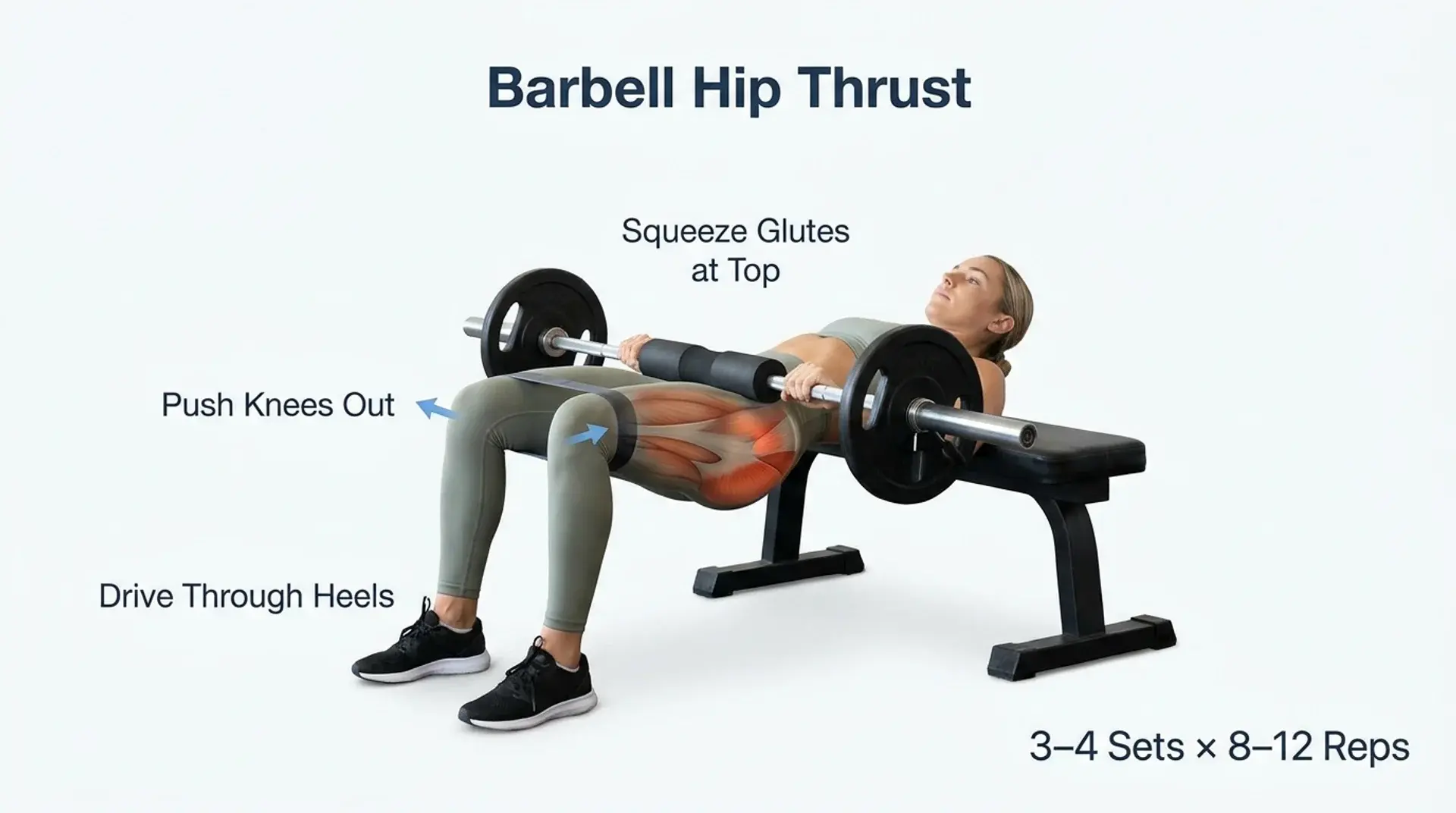
The barbell hip thrust is one of the most effective top glute exercises. It targets the upper gluteus maximus and the gluteus medius. Pairing it with a resistance band above the knees makes it even more targeted.
How to do it:
- Place your upper back against a bench
- Drive through both heels and push your hips up
- Form a straight line from knees to shoulders at the top
- Squeeze at the top and lower back down slowly
Sets and reps: 3 to 4 sets of 8 to 12 reps
Form tip: Add a light resistance band just above your knees. Pushing your knees outward against the band throughout the movement greatly increases gluteus medius activation.
2. Lateral Band Walk
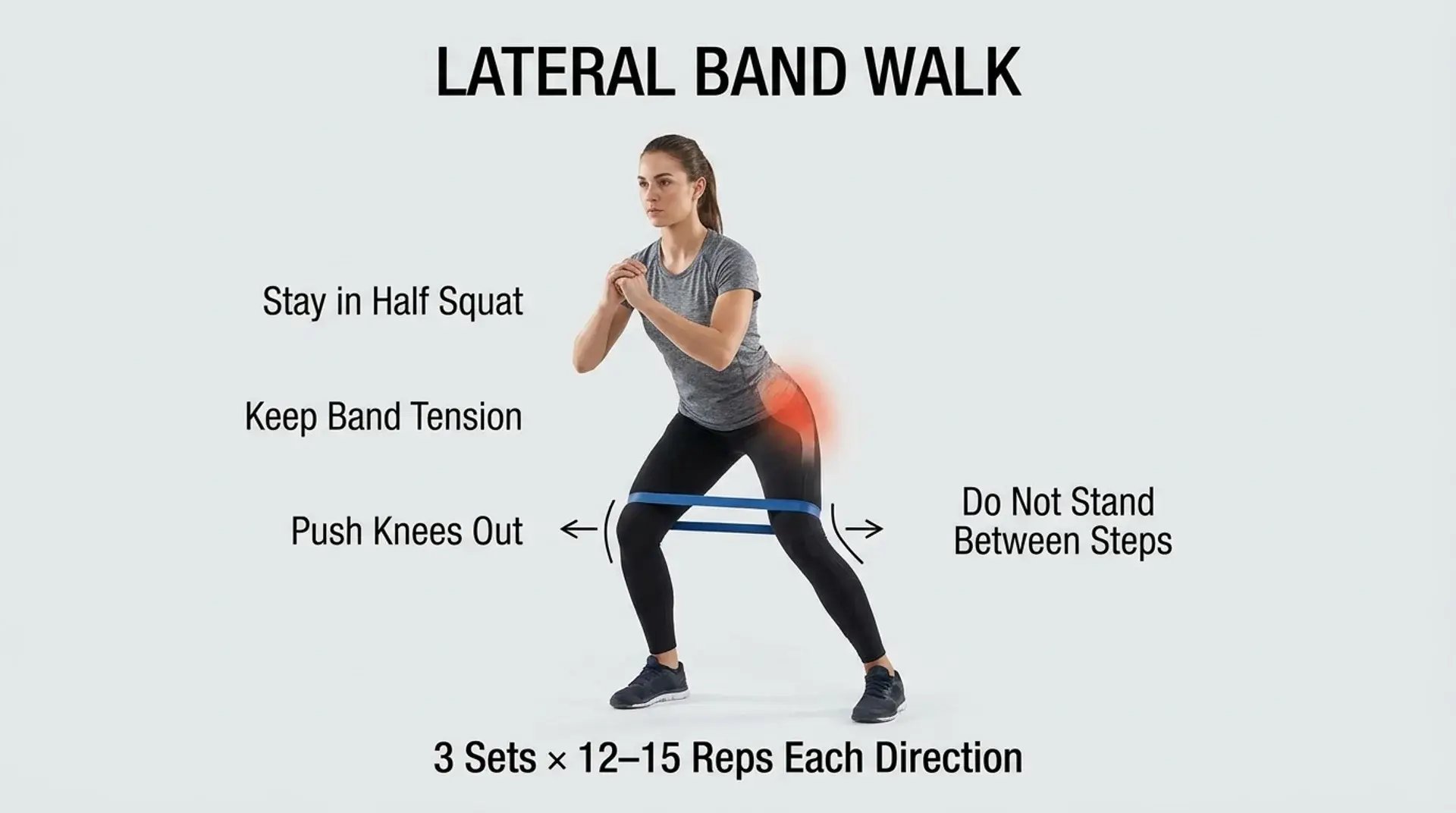
Lateral band walks are one of the most direct ways to train the gluteus medius. Research has consistently shown this exercise produces high activation in the upper glute region.
How to do it:
- Place a resistance band just above your knees
- Sit into a half-squat position
- Step to the side, keeping tension on the band the entire time
- Do not let your feet fully come together between steps
Sets and reps: 3 sets of 12 to 15 reps in each direction
Form tip: Stay low in the squat the whole way through. Standing upright between steps reduces the challenge on the upper glutes.
3. Cable Hip Abduction
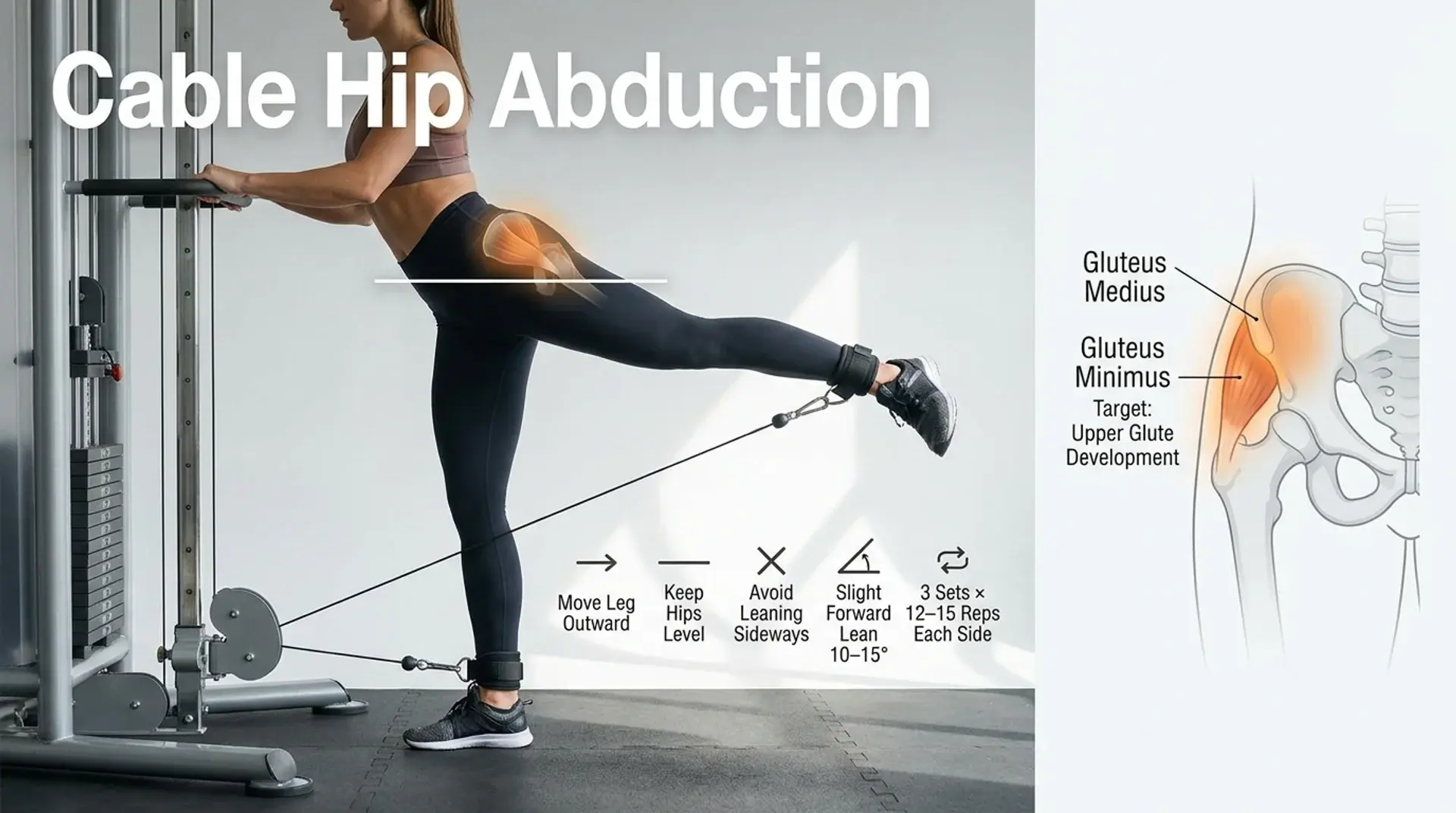
This exercise isolates the gluteus medius and minimus through their primary function: moving the leg away from the midline of the body.
How to do it:
- Attach an ankle strap to a low cable machine
- Stand sideways to the machine
- Lift the outside leg directly to the side
- Keep your torso upright and avoid leaning to the opposite side
Sets and reps: 3 sets of 12 to 15 reps on each side
Form tip: Lean forward very slightly, about 10 to 15 degrees. This small shift better aligns the line of pull with the upper glute fibers and increases the muscle stretch at the bottom of each rep.
4. Bulgarian Split Squat
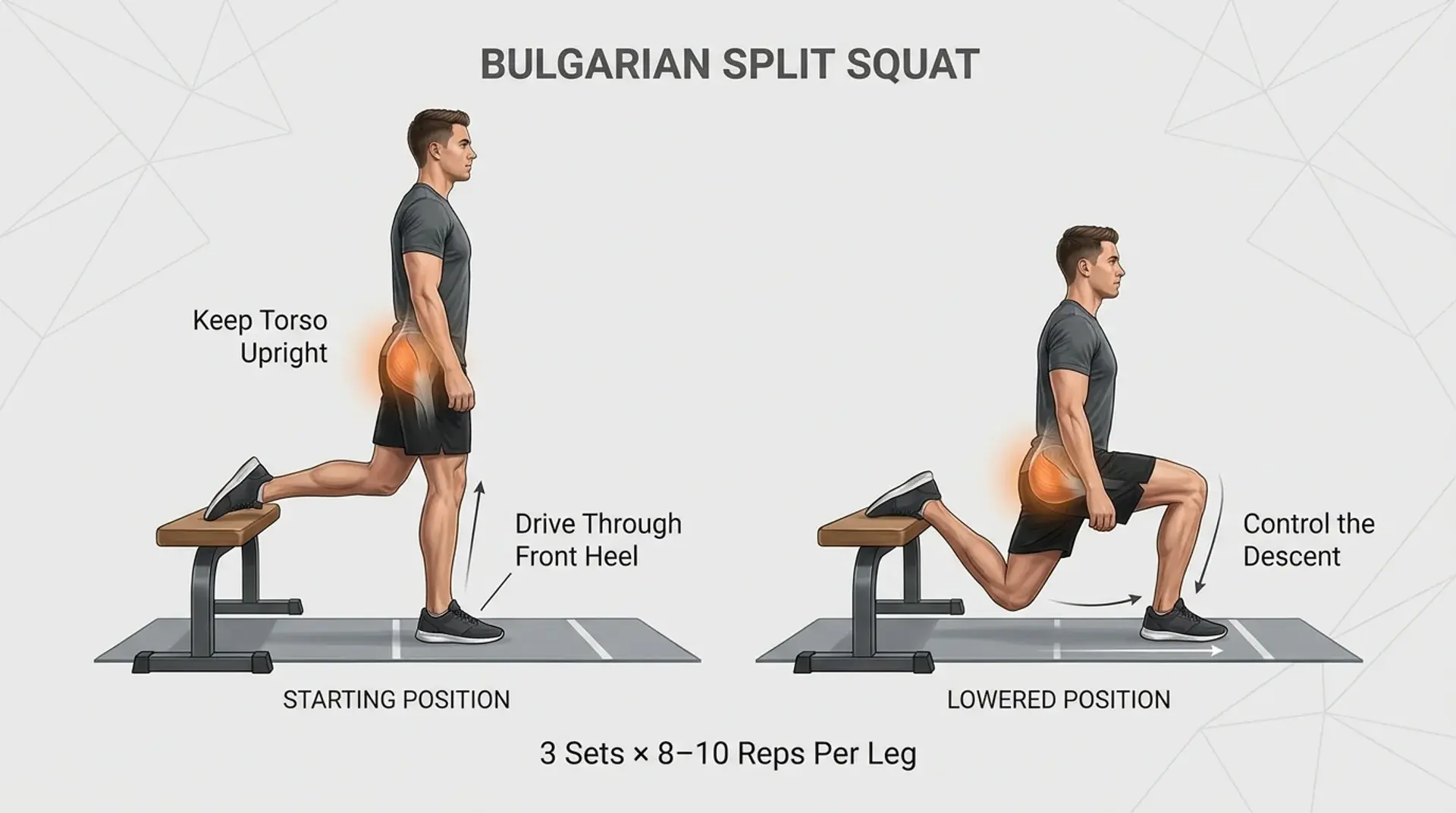
The Bulgarian split squat targets the upper glutes through single-leg hip extension and hip stability. Training one leg at a time also corrects left-to-right imbalances.
How to do it:
- Place one foot on a bench behind you
- Lower your body until the front thigh is roughly parallel to the floor
- Drive through the front heel to return to the start
Sets and reps: 3 sets of 8 to 10 reps per leg
Form tip: Keep your torso upright throughout the movement. Leaning too far forward shifts the load toward the quads and reduces glute engagement.
5. Romanian Deadlift
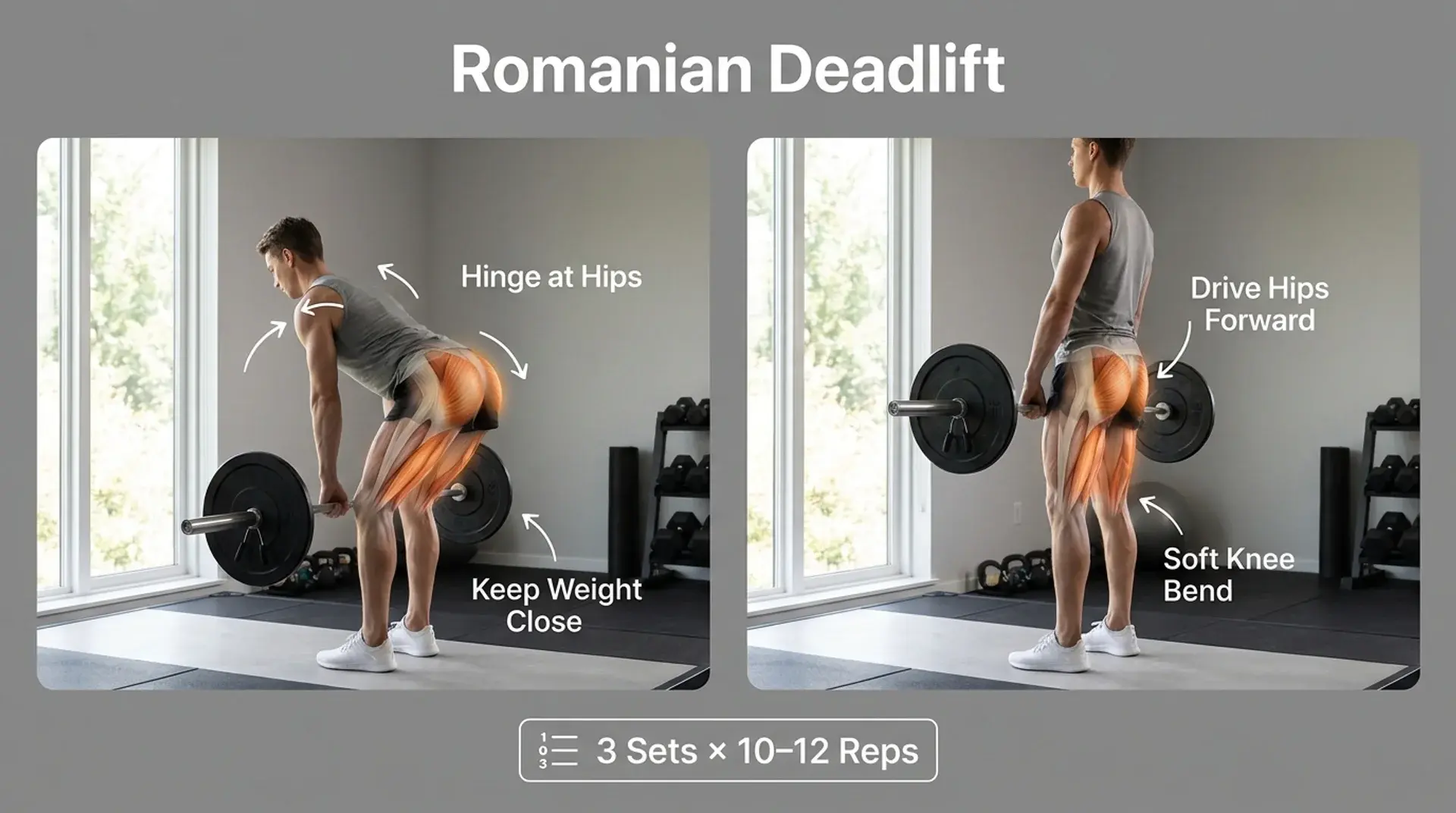
Romanian deadlifts target the upper glutes during the hip extension phase, along with the hamstrings. They make a strong compound addition to any upper glute workout plan.
How to do it:
- Hold a barbell or dumbbells in front of your thighs
- Hinge at the hips, keeping the weight close to your legs
- Feel the stretch in your hamstrings at the bottom
- Drive your hips forward to return to standing
Sets and reps: 3 sets of 10 to 12 reps
Form tip: Keep a soft bend in your knees throughout. Locking them out redirects tension away from the glutes and toward the hamstring tendons.
6. Clamshell
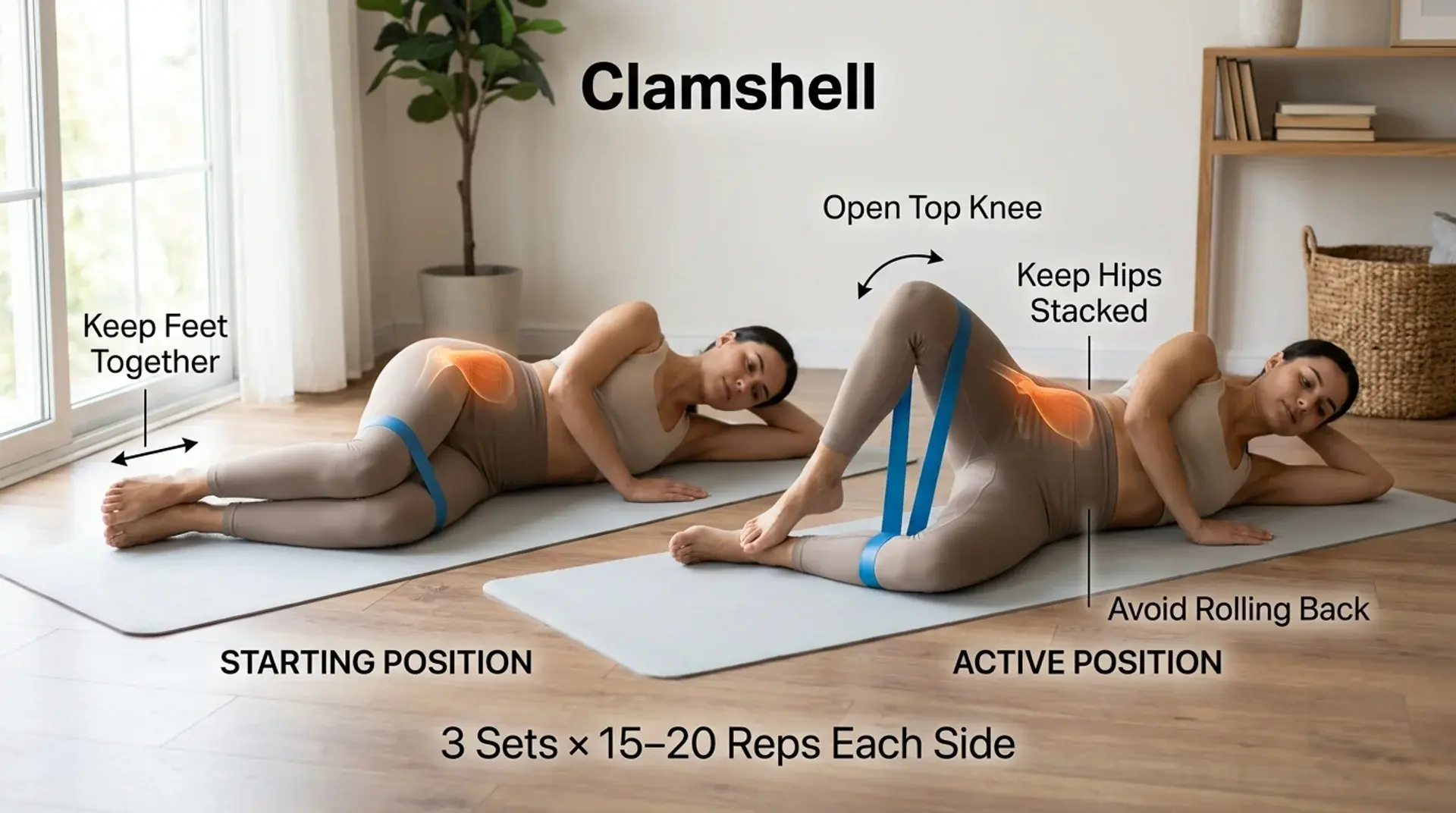
The clamshell is a simple isolation exercise for the gluteus medius. It works well as a warm-up activator or as a high-rep finisher at the end of a session.
How to do it:
- Lie on your side with your knees bent and a resistance band above your knees
- Keep your feet stacked together
- Open the top knee upward as far as your hip allows
- Lower it back slowly
Sets and reps: 3 sets of 15 to 20 reps on each side
Form tip: Keep your hips stacked directly on top of each other. Rolling the top hip backward is a common error that shifts the challenge away from the gluteus medius.
7. Cable Kickback (External Rotation Variation)
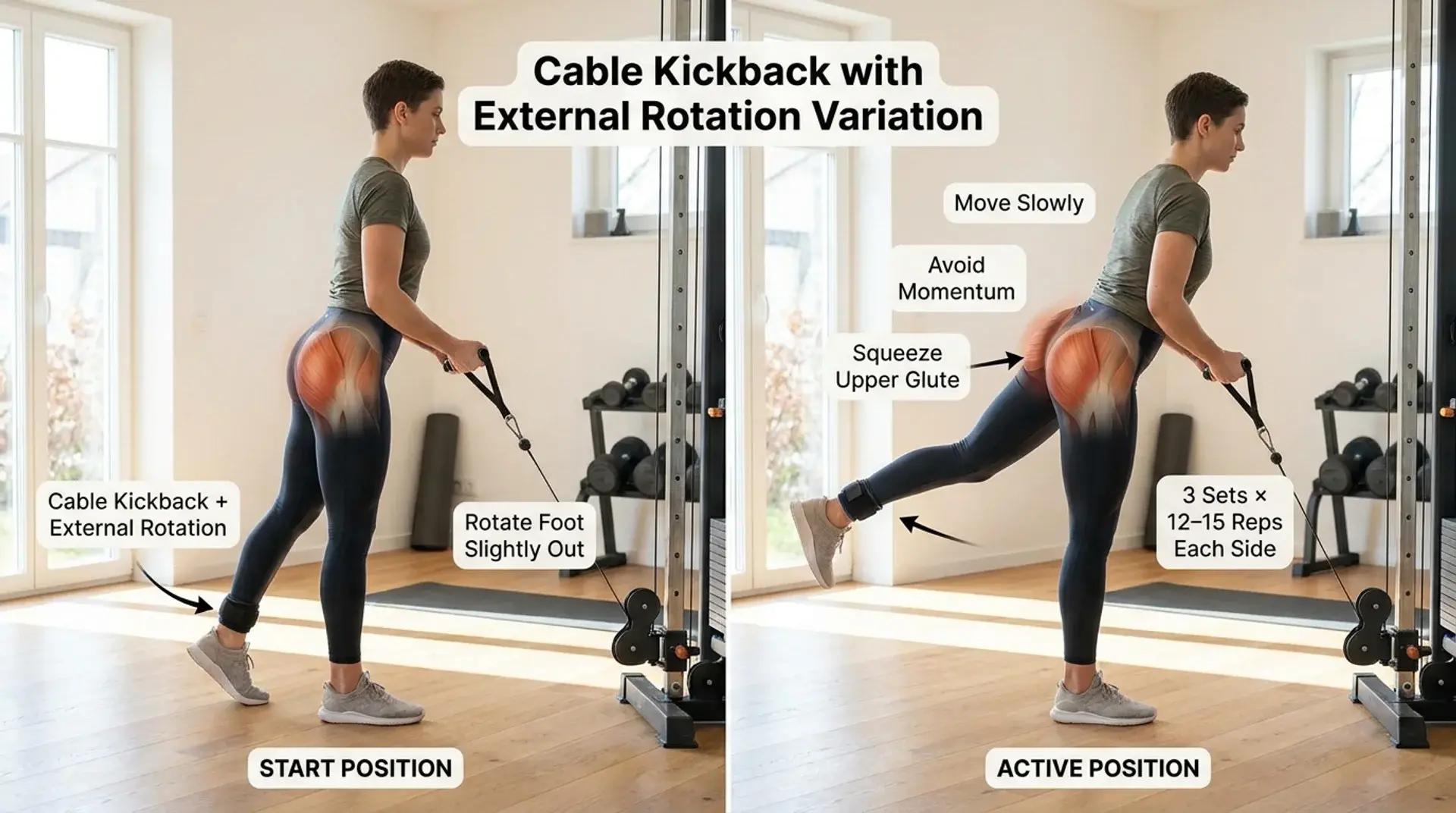
This cable kickback variation targets the gluteus medius through external rotation. It is a movement pattern most people never train directly.
How to do it:
- Attach an ankle strap to a low cable
- Stand facing the machine
- Slightly rotate your foot outward before you kick back
- Squeeze hard at the top and return slowly
Sets and reps: 3 sets of 12 to 15 reps on each side
Form tip: Do not use momentum. A slow, controlled rep where you genuinely feel the upper glute contract does far more than a fast rep with heavier weight.
8. Curtsy Lunge
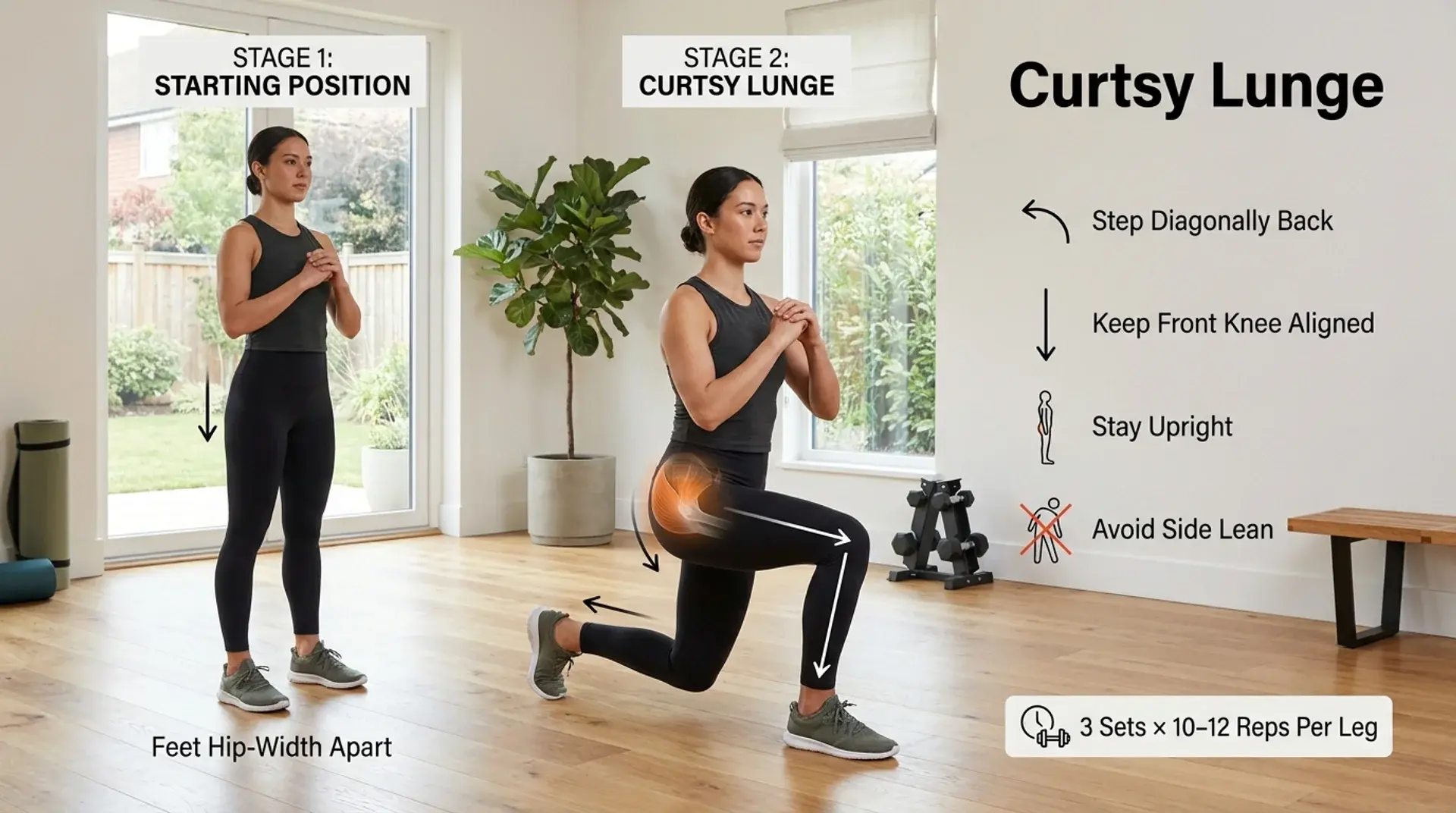
The curtsy lunge targets the lateral glutes and gluteus medius more directly than a standard forward or reverse lunge. It adds a transverse plane challenge that most lunge variations miss.
How to do it:
- Stand with feet hip-width apart
- Step one foot diagonally behind the other
- Lower your back knee toward the ground
- Keep the front knee tracking over your toes
- Return to the start
Sets and reps: 3 sets of 10 to 12 reps per leg
Form tip: Keep your torso upright and avoid leaning sideways. A lateral lean shifts tension away from the glutes and onto the lower back.
Sample Upper Glute Workout Plans by Level
The best upper glute workout depends on your experience level. Use these sample plans as a starting point and adjust as you progress.
The table below shows how each level differs in training frequency and emphasis.
| Level | Days Per Week | Main Focus |
|---|---|---|
| Beginner | 2 | Bodyweight and band basics |
| Intermediate | 3 | Compound and isolation combo |
| Advanced | 3 to 4 | Progressive overload and burnout set |
Beginner Plan (2 Days Per Week)
Rest at least two days between sessions.
Day 1:
- Clamshells: 3 sets x 15 reps each side
- Lateral band walks: 3 sets x 12 reps each direction
- Bodyweight hip thrust: 3 sets x 15 reps
- Step-up: 3 sets x 10 reps each leg
Day 2:
- Glute bridge: 3 sets x 15 reps
- Side-lying hip abduction: 3 sets x 15 reps
- Curtsy lunge: 3 sets x 10 reps each leg
- Clamshell: 3 sets x 12 reps each side
Intermediate Plan (3 Days Per Week)
Day 1:
- Barbell hip thrust: 4 sets x 10 reps
- Bulgarian split squat: 3 sets x 10 reps
- Lateral band walks: 3 sets x 12 reps
- Cable kickback: 3 sets x 12 reps
Day 3:
- Romanian deadlift: 3 sets x 10 reps
- Clamshells: 3 sets x 15 reps
- Cable hip abduction: 3 sets x 12 reps
- Curtsy lunge: 3 sets x 10 reps
Day 5:
- Single-leg hip thrust: 3 sets x 10 reps
- Lateral band walks: 3 sets x 12 reps
- Cable hip abduction: 3 sets x 12 reps
Advanced Plan (3 to 4 Days Per Week)
- Start each session with your heaviest compound movement first
- Move to isolation work next
- Finish with a high-rep burnout set using bands or cables
- Add weight, reps, or sets every one to two weeks
If you cannot progress the load, slow down the lowering phase of each rep. This increases the challenge without adding weight.
3 Key Principles for Building Stronger Upper Glutes
Following a few core training principles can make your upper glute workouts more effective and help you see better results over time.
- Progressive overload: It is the foundation. Your upper glutes will not grow if the workout never gets harder. Track your numbers and push a little further each week, whether that means more weight, more reps, or a slower tempo.
- Mind-muscle connection: It matters more for the glutes than for most muscle groups. Before each working set, do a quick activation movement (clamshells or lateral band walks) and concentrate on feeling the upper glute contract during every rep.
- Training in multiple planes: It is what separates an upper glute workout from a standard leg session. Most programs only work in the sagittal plane (forward and backward). The gluteus medius responds to lateral movement. Add at least one side-to-side exercise every session.
Apply these principles consistently alongside the right exercises, and you’ll create the foundation for stronger, more defined upper glutes.
5 Mistakes That Slow Upper Glute Progress
Even with the right exercises, a few common mistakes can limit upper glute growth and make your workouts less effective.
Mistake 1: Training Only Forward and Backward
Squats, deadlifts, and hip thrusts are useful. But they do not fully train the gluteus medius. Add lateral band walks and cable abductions to every session.
Mistake 2: Skipping the Activation Warm-Up
Without warming up the glutes first, the hip flexors and quads take over during your main lifts. The glutes stay quiet. Spend five minutes activating them before you lift.
Mistake 3: Using Too Wide a Stance
A slightly narrower stance for squats and Romanian deadlifts increases gluteus medius engagement. It alters how the pelvis functions during these movements and places more load on the upper glutes.
Mistake 4: Relying Only on Resistance Bands
Bands are great teaching tools and warm-up aids. But they cannot replicate the tension of heavy compound lifting. Use them alongside weighted exercises, not instead of them.
Mistake 5: Not Resting Enough
Muscles grow during rest, not during training. Give your glutes at least 48 hours between intense sessions. Training sore glutes before they recover slows progress instead of speeding it up.
Nutrition and Recovery for Upper Glute Growth
No upper glute workout plan works if your body does not have the raw material to build muscle. Four factors matter most.
| Factor | Target | Why It Matters |
|---|---|---|
| Protein | 1.6 to 2.2 g per kg of bodyweight per day | Repairs and rebuilds muscle fibers after training |
| Calories | 200 to 300 surplus above maintenance | Gives the body energy to add muscle tissue |
| Sleep | 7 to 9 hours per night | Reduces soreness and supports recovery |
| Active Recovery | 20-minute walks or foam rolling on rest days | Keeps blood flowing without adding training stress |
Eating at a calorie deficit while expecting real muscle growth rarely works for most people. You need enough fuel to build.
Every four to six weeks, take a lighter training week. Reduce your volume by about 40 percent. This allows your body to fully adapt to the training load you have built up. You will come back to your next training block stronger.
How Long Does It Take to See Upper Glute Results?
Beginners often notice changes in shape within 8 to 12 weeks of consistent training.
Visible muscle development takes 3 to 6 months for most people following a structured program.
Your results depend on four things:
- How consistently you train
- Whether you apply progressive overload week to week
- How well you sleep
- Whether you eat enough protein
All four need to be in place at the same time.
Progress is not always visible in a mirror first. Strength gains, better movement, and reduced knee or hip discomfort are early signs that the program is working.
How to Get a Shelf on The Upper Glutes?
To get a “shelf” on your upper glutes, focus on building the upper glute muscles, especially the gluteus medius and the upper gluteus maximus.
This comes from a combination of progressive resistance training, proper nutrition, and consistency. Exercises like hip thrusts, glute bridges, Bulgarian split squats, cable kickbacks, lateral band walks, and hip abductions can help target the area.
Train glutes 2–3 times per week, gradually increasing weight or resistance over time. Eating enough protein and calories also supports muscle growth, while maintaining proper form ensures the glutes do the work rather than the lower back or thighs.
A defined upper glute shelf takes time, as muscle shape is influenced by genetics, but targeted training can improve fullness and definition.
Disclaimer: The exercises and recommendations in this article are for general fitness purposes only. If you have a pre-existing injury, joint condition, or chronic pain, consult a qualified healthcare provider or physical therapist before starting a new training program.
Final Thoughts on Your Upper Glute Workout
Building stronger upper glutes comes down to training the right muscle with the right exercises. The gluteus medius drives that lifted shape at the top of your hips. Most people never train it directly. That is why progress stalls.
Start with the plan that fits your current fitness level. Add at least one lateral movement to every session. Apply progressive overload each week. Eat enough protein, sleep well, and give your body time to adapt.
Strong upper glutes do more than change your shape. They protect your knees, support your lower back, and improve nearly every lower-body movement you perform in and out of the gym.
Stay consistent for 8 to 12 weeks. The results from this upper glute workout approach will speak for themselves.
Frequently Asked Questions
Why Are My Upper Glutes Not Growing?
Common reasons include insufficient training intensity, poor exercise selection, lack of progressive overload, inadequate protein intake, or inconsistent workouts.
Should You Train Upper Glutes Separately From Lower Glutes?
Not necessarily. Most glute exercises work the entire glute complex, but adding movements that emphasize hip abduction can place greater focus on the upper glutes.
Can Walking or Running Build Upper Glutes?
Walking and running improve endurance and general lower-body fitness, but they usually don’t provide enough resistance to significantly grow the upper glutes.
Are Resistance Bands Effective for Upper Glute Workouts?
Yes. Resistance bands increase tension during hip abduction exercises, making them a great tool for activating and strengthening the upper glutes.




One Response