
Your knees hurt after every run. The treadmill bores you to tears. And the results you want- stronger legs, a firmer backside, and real cardio progress- feel far away.
The stairmaster workout fixes all three problems at once.
It burns serious calories, builds your glutes, quads, and hamstrings, and puts far less stress on your joints than running does.
This blog covers the muscles targeted by the StairMaster and calories burned. It also explains form mistakes and four workout plans from beginner to advanced HIIT.
What Is a Stairmaster?
The StairMaster is a stationary fitness machine with a set of rotating steps that descend as you climb.
Think of it as a treadmill for stairs. You set the speed and duration, and the machine keeps you climbing for as long as you choose.
It has been a gym staple since the 1980s. Modern versions include heart rate monitors, calorie counters, and built-in screens that simulate climbing famous structures like the Eiffel Tower.
One practical advantage worth knowing: unlike climbing real stairs, the StairMaster never requires you to walk back down. That matters because descending stairs puts far more stress on the knee joint than going up.
The machine removes that strain entirely. That makes it a smarter long-term option for anyone protecting their joints.
The StairMaster fits every fitness level. Beginners can set it to Level 3 and focus on form. Advanced athletes can push into HIIT intervals that spike the heart rate fast and keep it there.
Muscles Targeted by the StairMaster Workout
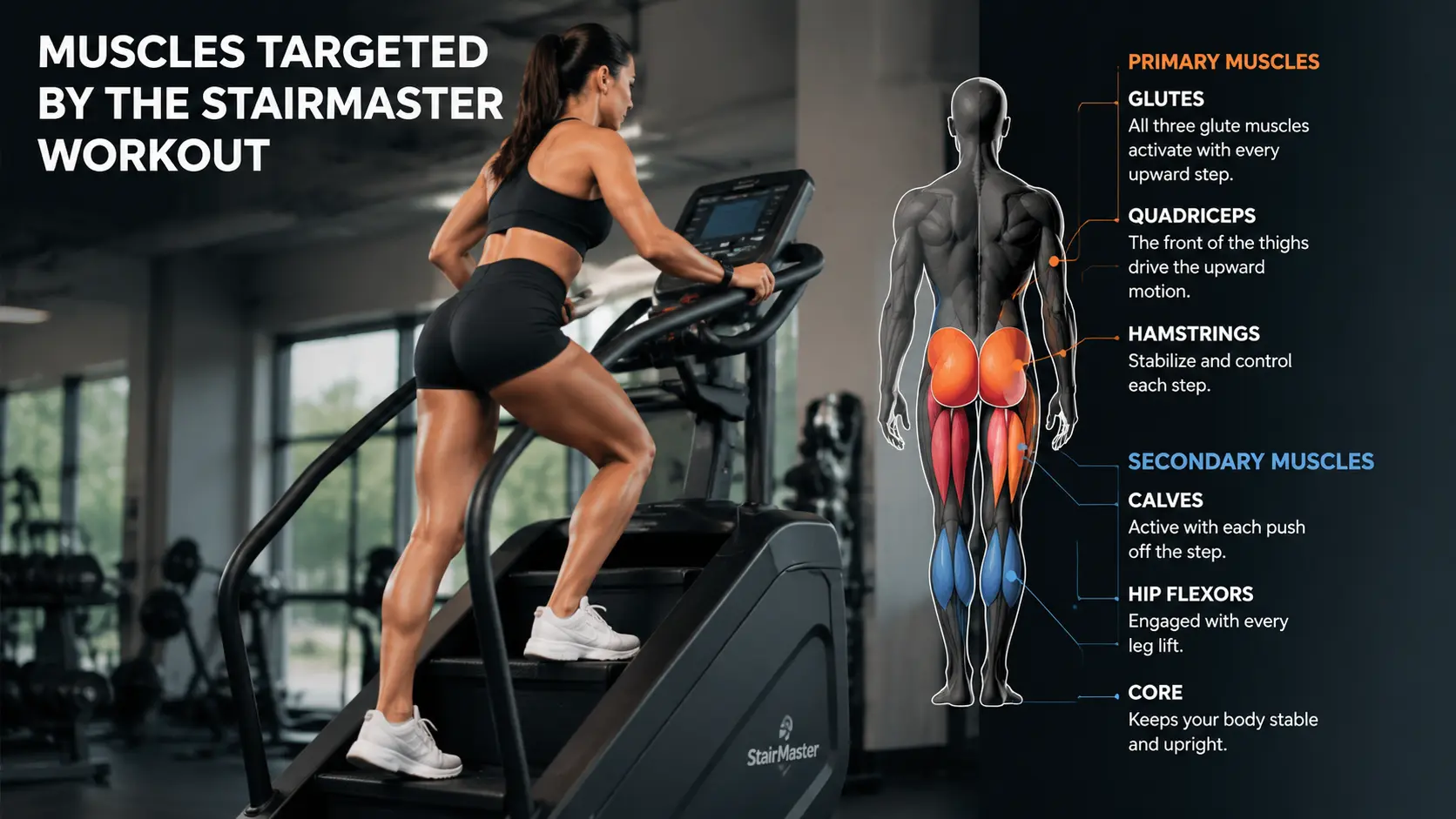
The stairmaster workout targets the biggest muscles in your lower body. It also pulls your core into the work with every step.
If you have wondered whether the StairMaster builds glutes, the answer is yes. It activates the glutes more directly than most cardio machines, and in more depth.
Here is exactly what fires with each step.
Primary muscles:
- Glutes (gluteus maximus, medius, minimus): Every upward push activates all three layers. Pushing through your heel on each step increases glute activation compared to stepping on your toes.
- Quadriceps: The front of your thighs powers the upward motion with each step. This is especially true when you maintain an upright posture rather than leaning forward.
- Hamstrings: These work to stabilize and control each step. Stair climbing targets them more consistently than most cardio machines.
Secondary muscles:
- Calves (gastrocnemius and soleus): Place your full foot flat on each step. Using only your toes overloads the calves and takes the load away from the glutes.
- Hip flexors: Active with every leg lift throughout the session.
- Core (abs, obliques, spinal stabilizers): Releasing the handrails forces your core to balance your entire body weight. That engagement improves posture and reduces back pain over time.
The machine’s range of muscle activation is one reason fitness professionals recommend it for lower-body conditioning alongside cardio training.
Key Benefits of a Stairmaster Workout
The stairmaster delivers results across several areas of fitness at the same time, which is rare for a single cardio machine.
- Burns Calories Efficiently: A150-pound person burns about 446 calories per hour, while 30 minutes of activity burns 180 to 252 calories, depending on body weight and intensity.
- Boosts Heart and Lung Health: Regular StairMaster sessions improve cardiovascular fitness, increase endurance, and can raiseVO₂ max, helping your body use oxygen more efficiently.
- Low Impact on Joints: Unlike running, your feet stay on the pedals throughout the movement, reducing stress on the knees, ankles, and hips while still providing an effective cardio workout.
- Strengthens Balance and Core: Climbing without leaning on the handrails engages your core, improves stability, and enhances coordination for better everyday movement.
- Supports Mental Well-Being: Aerobic exercise on the StairMaster helps release endorphins, reducing stress and supporting long-term mood and mental health.
Together, these benefits make the StairMaster one of the most effective machines for improving fitness, burning calories, and building endurance.
StairMaster vs Treadmill: Which One Is Better?
Both machines build cardiovascular fitness, but they work differently. Here is a direct comparison across the factors that matter most.
| Factor | StairMaster | Treadmill |
|---|---|---|
| Joint Impact | Lower. No downward pounding on descent. | Higher. Each stride lands with impact. |
| Calories Burned | ~446/hr at steady pace (150 lb) | ~400 to 600/hr depending on speed and incline |
| Glute and Leg Activation | High. Every step loads the lower body. | Moderate. Improves with incline. |
| Core Engagement | High when hands are off the rails. | Lower at flat pace. Improves with incline. |
| Best For | Toning lower body, joint-friendly cardio | Speed training, long-distance endurance |
The StairMaster wins for lower-body conditioning and joint protection. The treadmill wins for speed work and running-specific training.
If knee pain is a recurring issue, the StairMaster is the better default. It removes the downward impact that aggravates most knee problems. You still get a high-calorie, high-effort session without the joint cost.
How to Use the StairMaster Properly
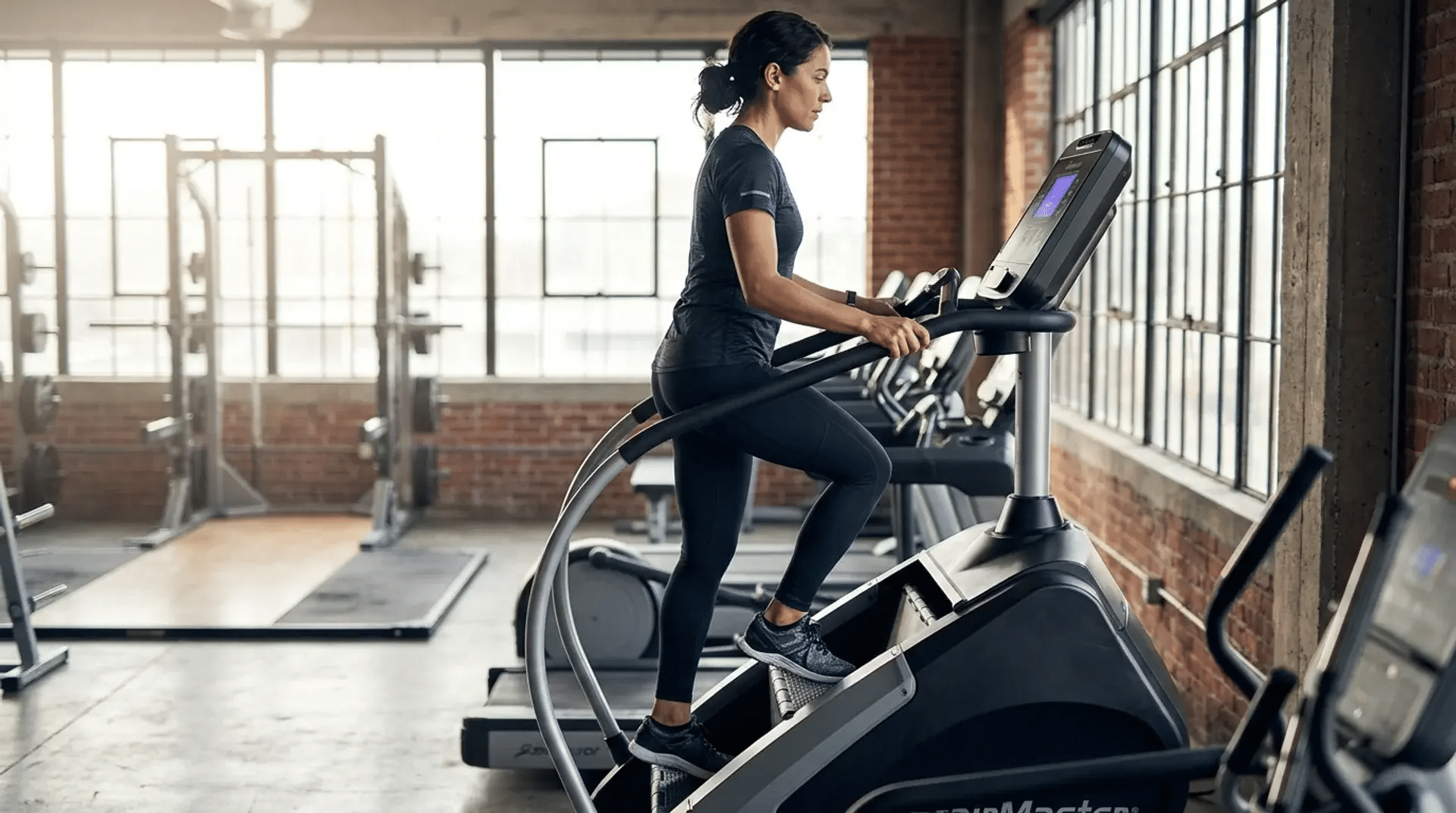
Good form on the StairMaster is not optional. Poor technique cuts your calorie burn, reduces muscle activation, and puts unnecessary stress on your lower back and knees.
Follow these steps every session:
- Warm up first: Spend five to ten minutes at half your target intensity. This raises your body temperature and prepares your hip and leg muscles for the climb ahead.
- Stand tall: Keep your chest up and your shoulders back. A slight forward lean is fine, but never slouch over the machine or rest your forearms on the console.
- Use your full foot: Place the entire foot flat on each step. Stepping on only the toes overloads the calves, reduces glute engagement, and increases the risk of knee strain.
- Keep a light grip on the rails: Leaning your body weight into the rails transfers load from your legs to your arms, and fitness research estimates this can cut calorie burn by up to 25%.
- Set a steady pace: A consistent 60-80 steps per minute is effective for most people. Adding resistance is more productive than chasing speed.
- Cool down: Finish with five minutes at low intensity to gradually bring your heart rate down.
One safety note: always tie your shoelaces in tight double knots before stepping on. Loose laces can catch in the rotating steps.
The Best Stairmaster Workout Plans for Every Level
These four plans are built for different goals and fitness levels. Start where your body is today, not where you want to be.
1. Beginner-Friendly 25-7-2 StairMaster Workout
The 25-7-2 workout went popular on TikTok and remains one of the most practical entry points for new StairMaster users. The name is the plan: 25 minutes at Level 7, two times per week.
Build toward it over four weeks:
- Week 1-2: 15 minutes at Level 4-5. Focus entirely on form and balance. Release the rails for short stretches as you grow confident.
- Week 3-4: 20 minutes at Level 5-6. Work toward completing the session without holding the rails.
- Goal: Complete 25 minutes at Level 7 with hands off the rails.
If you burn out in the first five minutes, drop to Level 3. There is no benefit to starting too high and quitting early. Add no more than two to three minutes per week to avoid excessive soreness or injury.
2. Intermediate Plan of Steady-State Cardio
Steady-state cardio on the stairmaster builds cardiovascular endurance and works well as an active recovery session on non-strength-training days.
- Warm up for five minutes at Level 4.
- Climb for 25 minutes at Level 6-9. Find the level where you can maintain proper form and avoid the rails.
- Add a double-step variation: skip one step at a time to increase glute and hamstring activation.
- Cool down for five minutes at Level 3-4.
- Frequency: three times per week.
3. Advanced Plan of 20-Minute HIIT Protocol
High-Intensity Interval Training on the stairmaster creates an afterburn effect that keeps calorie burn elevated long after the session ends.
Research published in the Journal of Strength and Conditioning Research confirms that HIIT elevates EPOC (Excess Post-Exercise Oxygen Consumption) for hours after training concludes.
| Phase | Duration | Intensity |
|---|---|---|
| Warm-up | 4 minutes | 50-65 steps/min, Level 5-6 |
| Work interval | 40 seconds | Level 10-15 (maximum effort) |
| Rest interval | 20 seconds | Level 4 (easy pace) |
| Cool-down | 3 minutes | Level 3 |
Track your steps per minute each session. Aim to increase by five steps per minute every two weeks to keep progressing.
4. Weight Loss Plan
For fat loss, the stairmaster works best as part of a broader plan that includes strength training and a calorie deficit through diet.
- Moderate-intensity option: 40 minutes at a pace you can sustain without breaks.
- Interval option: Eight seconds at high intensity followed by 12 seconds at a low pace, repeated for 20 minutes.
- Frequency: three to five sessions per week, 20 to 45 minutes each. Pair with strength training for the best body composition results.
For a practical overview of how calorie deficits work alongside cardio, the American Heart Association’s physical activity guidelines offer a clear and reliable starting point.
Common Stairmaster Mistakes to Avoid
These six errors are widespread in gyms, and each one reduces your results.
| Mistake | Why It Hurts | Fix |
|---|---|---|
| Leaning on the handrails | Cuts calorie burn by up to 25% | Use fingertips for balance only |
| Starting at too high a level | Leads to burnout or injury | Begin at Level 3-4 and build |
| Using only your toes | Overworks calves, reduces glute activation | Full foot flat on the step |
| Skipping the warm-up | Raises injury risk | Five to ten minutes at low intensity first |
| Slouching over the console | Causes back pain, reduces core engagement | Chest up, core lightly braced |
| Adding time too fast | Increases soreness and fatigue risk | Add two to three minutes per week at most |
Fixing just one or two of these habits can produce a noticeable difference in how hard each session feels and how much your body changes.
How Often Should You Do StairMaster?
Based on exercise guidelines, the recommended StairMaster frequency depends on your training goal and current fitness level.
For general cardiovascular health, adults should aim for at least 150 minutes of moderate-intensity aerobic activity or 75 minutes of vigorous activity per week, which can include StairMaster sessions. Beginners can start with 2 to 3 sessions per week of 10 to 20 minutes and gradually build up.
For improving endurance or supporting fat loss, 3 to 5 sessions per week lasting 20 to 45 minutes is a common approach when combined with strength training and adequate recovery. High-intensity StairMaster workouts should be limited to allow muscle repair and avoid overuse fatigue.
Stairmaster Workout: What You Need to Know
A stairmaster workout gives you calorie burn, lower-body strength, joint protection, and cardiovascular conditioning in a single session. That combination is hard to find in one machine.
The results do not come from one tough session or chasing the highest level on your first day.
They come from showing up consistently, keeping your form clean, and building intensity gradually over months.
Pair your stairmaster sessions with strength training, quality nutrition, and enough rest. The changes in your fitness will be real and lasting.
Ready to start? Save this guide, pick the plan that matches your level today, and tag us on Instagram with your first session.
Frequently Asked Questions
Is the StairMaster better than walking?
The StairMaster generally burns more calories per minute and places greater demands on your glutes, quads, and cardiovascular system than walking, while remaining relatively low-impact.
Can you lose belly fat with a StairMaster workout?
The StairMaster can help reduce overall body fat by increasing calorie expenditure, but it cannot specifically target belly fat. Fat loss comes from maintaining a consistent calorie deficit.
Does the StairMaster build glutes?
Yes. The StairMaster activates the glutes along with the quads, hamstrings, and calves. Increasing the resistance and avoiding the handrails improves muscle engagement on every step.
How long should I stay on the StairMaster?
Beginners should start at 10 to 15 minutes. For most fitness goals, 20 to 45 minutes three to five times per week is the right range. Longer sessions are not always better.
Is the StairMaster good for beginners?
Yes. Start at Level 3 to 4 and focus on form first. The 25-7-2 plan is a proven starting point. It builds the habit without overloading your legs too early.