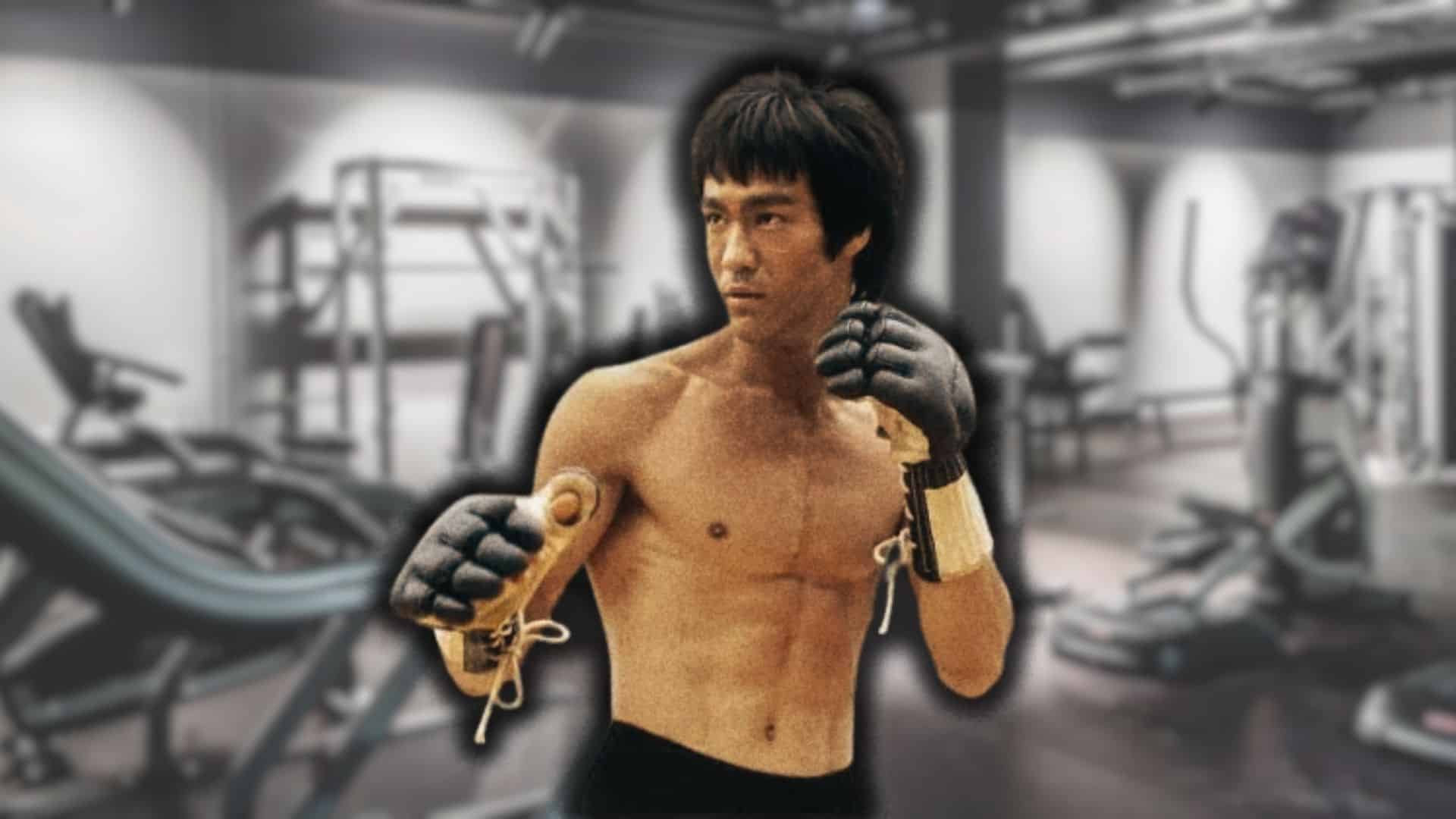
Bruce Lee stood between 5’7” and 5’8”, weighed around 130–145 lbs depending on his training phase, and maintained a body fat percentage of just 6–8%.
He was not a bodybuilder. He was not a powerlifter. He was a martial artist who treated his own body like a scientific instrument, constantly testing, adjusting, and refining what worked.
His wife, Linda, confirmed that he trained nearly every day.
His training notes, compiled by John Little in The Art of Expressing the Human Body, remain the most reliable window into what the Bruce Lee workout actually looked like.
This article covers everything: his cardio schedule, flexibility work, weight training, isometric training, ab routine, forearm work, diet, and the philosophy that tied it all together.
Why the Bruce Lee Workout Still Gets Attention
The combination of physical obsession and intellectual curiosity is exactly why the Bruce Lee workout continues to draw serious attention from athletes, trainers, and martial artists today.
The physique was a byproduct, not the goal. That one fact separates Bruce Lee from nearly every fitness icon who came after him. He did not train to look a certain way.
He trained to become faster, stronger, and more capable as a martial artist. The ripped abs and defined arms were simply the result of training that way for years.
At 130 lbs, he could perform two-finger push-ups. He could hold a 75-pound barbell extended straight out from his chest and lock it there for several seconds.
His punch speed from three feet away was clocked at roughly 5/100ths of a second. These were not movie tricks. They were the result of a specific, well-documented training system.
Bruce Lee’s Daily Workout Schedule
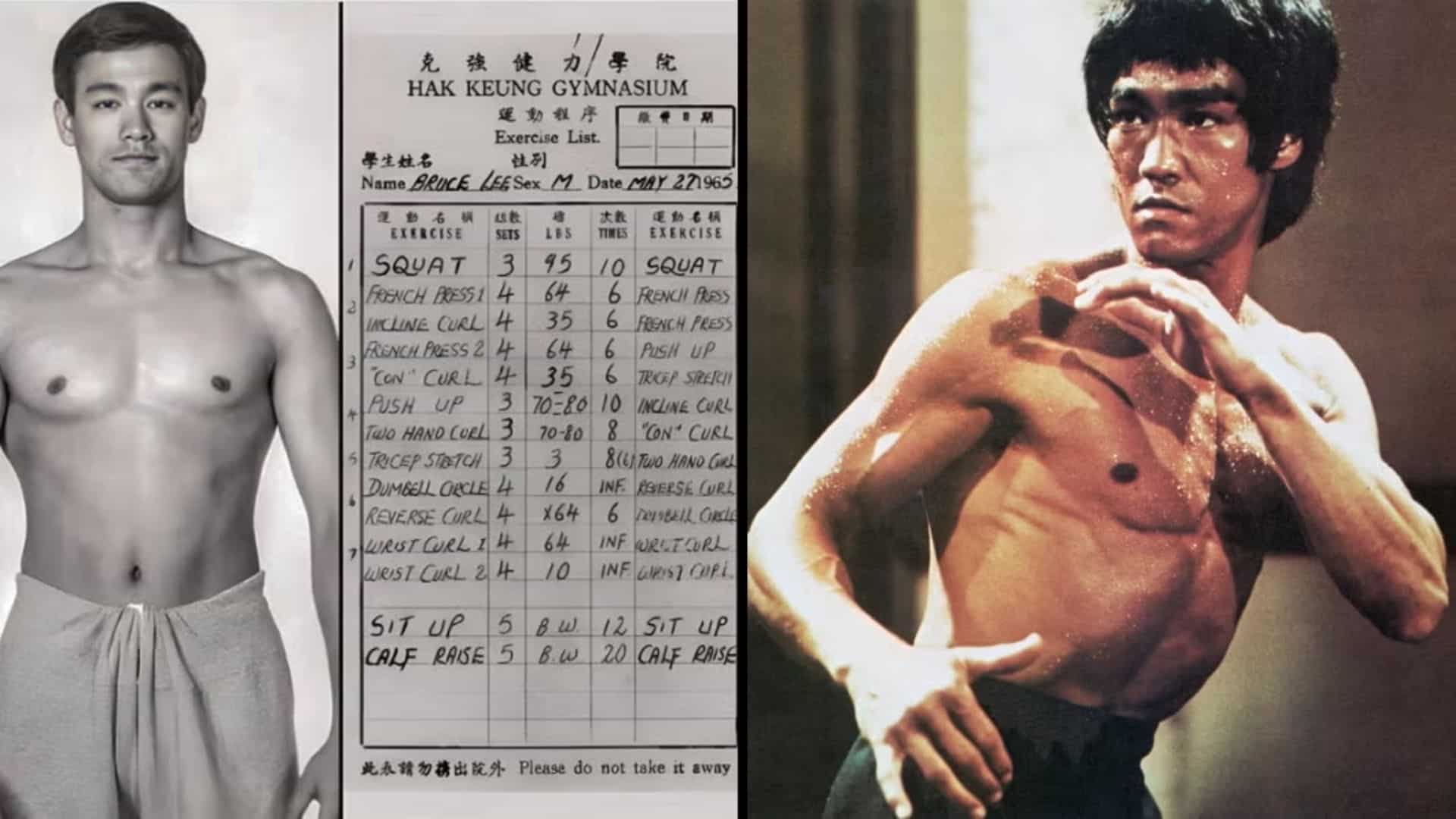
Image Source: Men’s Health
According to his documented 1970 training schedule, Bruce Lee split his sessions across the morning, afternoon, and evening.
A typical day included a run in the morning, weight training in the afternoon, and martial arts practice in the evening. Total daily training time spread across roughly three hours, though not all at once.
| Day | Morning | Afternoon | Evening |
|---|---|---|---|
| Monday | Run 2–6 miles | Weights (full body) | Punch drills / JKD |
| Tuesday | Cycle 10 mi + jump rope | Stretching | Kick drills / JKD |
| Wednesday | Run 2–6 miles | Weights (full body) | Punch drills / JKD |
| Thursday | Cycle 10 mi + jump rope | Stretching | Kick drills / JKD |
| Friday | Run 2–6 miles | Weights (full body) | Punch drills / JKD |
| Saturday | Cycle 10 mi + jump rope | Flexibility work | Light martial arts |
| Sunday | Rest or light walk | — | — |
He trained six to seven days a week, adjusting the schedule based on film production demands and personal goals.
What he did during those sessions evolved over time as he absorbed new information about strength, conditioning, and recovery.
One thing that remained consistent was his habit of documenting. He tracked everything: sets, reps, miles, punches thrown, weights used. When something stopped producing results, he changed it.
Bruce Lee’s Cardio Routine
He jogged two to six miles on Monday, Wednesday, and Friday. On Tuesday, Thursday, and Saturday, he cycled approximately ten miles and followed that with twenty minutes of jump rope.
He also deliberately varied his running style. He mixed sprinting, walking, jogging, and even running backward.
This type of varied-intensity running is now common in endurance training and is known to build both aerobic and anaerobic capacity at the same time.
Alternating between running and cycling on separate days was also a smart structural choice. It kept cardiovascular volume high while reducing the repetitive joint stress that comes from running every day. The Bruce Lee cardio routine was built for fighters, not for appearance.
Bruce Lee’s Flexibility Training
Lee stretched every single day. He was not naturally flexible, so he built it deliberately through a fixed daily routine.
His stretches included:
- Standing leg raises: One leg raised onto a bar, similar to a ballet barre stretch. This targeted the hamstrings and hip flexors, both critical for high kicks.
- Side splits: Full side splits work, holding the position to open the hips and inner thighs.
- Standing toe touches: Straight-leg forward bend, held for duration.
- High kicks to a target: He used a makiwara or a held pad to practice kicking at head height, combining flexibility work with skill training.
- Hurdle stretches: One leg extended forward, the other folded. Modern trainers modify this: the sole of the folded foot rests against the inner thigh, which reduces knee stress.
He was often spotted stretching between takes on film sets. He would hoist one leg onto a chair while reviewing dailies, treating flexibility as a background activity rather than a scheduled block.
The kicks only work if the flexibility work comes first. That was his logic, and the footage of him kicking above his own head confirms it.
Bruce Lee’s Weight Training Routine
His weight-training program changed three times, but most articles show only one version.
1. Early routine (1965, Hak Keung Gymnasium)
This gym card, filled out by Lee himself, included squats, French press, incline curls, concentration curls, reverse curls, and wrist curls, done three times per week.
2. Mid-period routine
This evolved into a fuller program documented in Muscle & Fitness and Lee’s own notes.
| Exercise | Sets × Reps |
|---|---|
| Clean & Press | 2 × 8–12 |
| Barbell Curls | 2 × 8–12 |
| Behind-the-Neck Press | 2 × 8–12 |
| Upright Rows | 2 × 8–12 |
| Barbell Squats | 2 × 12–20 |
| Barbell Row | 2 × 8–12 |
| Bench Press | 2 × 8–12 |
| Barbell Pullover | 2 × 8–12 |
3. Refined routine (used during The Big Boss and Way of the Dragon)
This was pared back to six movements, done three days per week in roughly twenty minutes.
| Exercise | Sets × Reps |
|---|---|
| Clean & Press | 2 × 8 |
| Squat | 2 × 12 |
| Barbell Pullover | 2 × 8 |
| Bench Press | 2 × 6 |
| Good Morning | 2 × 8 |
| Barbell Curl | 2 × 8 |
Throughout all three phases, the goal was the same: build strength that served a real martial arts purpose.
Bruce Lee’s Ab Workout for a Strong Core
He called the abdomen the “center or generator” of the body. In his own words, the abdominal region “coordinates all parts of the body” and drives both punch and kick power.
Because of that belief, he trained his core every single day without exception. Not twice a week. Not on rest days. Every day.
His daily ab routine included:
- Roman chair sit-ups: 4 sets to failure.
- Leg raises: 4 sets to failure.
- Side bends: 4 sets of 15–20 reps, holding dumbbells for added resistance.
- Twists: 4 sets of 50, using a stick across the shoulders and rotating toward each foot.
- Dragon Flag: His signature movement, named after his “Dragon” nickname, involves a full-body lever hold on a bench.
Daily core training at moderate volume builds the rotational power and bracing strength a fighter needs under real-world conditions. What made it work was doing it every single day.
Bruce Lee’s Forearm and Grip Training
His training partner Dan Inosanto described Lee’s wrists and fingers as “extraordinary.” Another close friend said that grabbing Bruce Lee’s forearm felt like “grabbing hold of a baseball bat.”
Lee trained his forearms every single day, regardless of his three-day weight-training schedule. His forearm exercises included:
- Wrist roller: A weighted rope attached to a thick bar rolled up and down.
- Barbell wrist curls: Done seated, in both supinated and pronated positions.
- Reverse curls: Building the brachialis and forearm extensors.
- Zottman curls: He reportedly did these one-handed while reading a book.
- Fingertip push-ups: He could reportedly perform these on just his thumb and index finger.
- Custom grip machine: A device he had designed himself.
- Tennis ball and sponge gripper: Squeezed throughout the day during downtime.
His reasoning was direct: forearm and grip strength increased the bite of every punch and chop.
Bruce Lee’s Isometric Training
In the mid-to-late 1960s, Lee added isometric training to his program. Isometrics means pushing or pulling against a fixed, immovable resistance. No movement happens. Just maximal muscular tension held for 6–12 seconds per position.
His main isometric tool was a barbell locked into a power rack at a specific height. He would press, pull, or hold at the exact joint angle he wanted to strengthen. This trained his muscles at the positions most relevant to striking, positions that standard lifts often skip entirely.
His documented isometric exercises included:
- Press lockout: Bar set 3 inches below full extension. Press up as hard as possible for 6–12 seconds.
- Press start: Bar at chin height. Press upward into the rack for 6–12 seconds.
- Deadlift hold: Bar just below the knee. Pull upward as hard as possible, holding the tension.
- Rise on toes: Push upward through the feet against a fixed bar for calf and ankle strength.
He eventually moved away from isometrics as his training evolved. But the period when he used them produced real, measurable gains in static strength, the kind that shows up when a punch lands.
One important note: isometrics build strength at the specific angle you train. They do not carry over well to other positions. Lee used them as a supplement, not a replacement for full-range lifting.
What Bruce Lee Ate to Fuel His Training
Bruce Lee ate four to five smaller meals per day rather than three large ones. His base diet was built around traditional Chinese food: rice, vegetables, fish, tofu, chicken, and beef.
He preferred Chinese cooking specifically because it combined protein and plant-based ingredients without relying on heavy, processed components.
He avoided refined flour and baked goods entirely, calling them “empty calories.” Sugary foods and processed snacks had no place in his routine.
He did not calorie count. Instead, he applied a simple filter: if a food could not be connected to a training or recovery outcome, it did not belong in his diet.
His protein shake recipe combined raw eggs, peanut butter, banana, wheat germ or wheat germ oil, brewer’s yeast, non-instant powdered milk, and lecithin and inositol supplements, all blended together.
He also drank fresh fruit and vegetable juices daily, with carrots, apples, and celery as common ingredients.
For supplements, he used vitamins C and E, bee pollen, rose hips, royal jelly, ginseng, protein tablets, and magnesium.
His preferred drinks were green tea and black tea with honey. He avoided coffee and most processed beverages.
The Training Philosophy Behind Bruce Lee’s Success
His famous instruction to “absorb what is useful, reject what is useless, and add what is specifically your own” was the operating logic behind his entire training life, not just his martial arts.
Every routine was subject to change the moment he found a better approach.
In 1970, he suffered a serious back injury while performing an unsupervised Good Morning exercise with 135 pounds on his back without a proper warm-up. Doctors told him he might never kick again.
He spent months essentially immobile, reading, writing, and rethinking every aspect of his training. When he recovered, his approach had shifted.
He became more deliberate about exercise selection and more skeptical of anything done out of habit rather than purpose.
That injury and recovery period produced some of his most important writing on training and philosophy. The Bruce Lee Foundation continues to archive and share much of this material for those interested in going further.
The Bruce Lee workout was not a product. It was a process built on self-study, honest assessment, and a refusal to stop improving.
What the Bruce Lee Workout Actually Teaches
The Bruce Lee workout consisted of daily cardio, flexibility work every morning, three days of weight training, isometric holds for striking strength, nonstop ab and forearm work, martial arts practice, and a clean whole-food diet. Every piece connected to every other piece.
What made it work was not the specific exercises. It was the mindset behind them. He documented everything, questioned everything, and never stayed comfortable long enough for progress to stop.
You do not need to train six days a week to take something useful from this.
Start with one element: the daily ab work, the forearm exercises at your desk, or the cardio structure. Build from there.
If you want to go deeper into training like Lee, subscribe to our newsletter for weekly breakdowns of how legendary athletes actually trained.
Frequently Asked Questions
Did bruce lee lift weights?
Yes. Bruce Lee regularly used weight training to build strength and explosive power, combining compound barbell exercises with bodyweight movements and martial arts practice.
How many hours a day did bruce lee train?
Bruce Lee often trained for several hours each day, frequently splitting his workouts into multiple sessions that included cardio, strength training, flexibility, skill practice, and conditioning.
Did bruce lee train his abs every day?
Yes. Bruce Lee believed a strong core was essential for speed and power, so he performed abdominal exercises almost daily, including sit-ups, leg raises, twists, and dragon flag variations.
Can you follow bruce lee’s workout today?
Yes, but most people should adapt it to their fitness level. Bruce Lee’s routine was highly demanding, so reducing the training volume and increasing intensity gradually is a safer and more sustainable approach.
How flexible was bruce lee?
He was not naturally flexible. He built it through daily stretching, including splits and high leg raises, specifically to support his kicking range in Jeet Kune Do.
Did bruce lee doiIsometric exercises?
Yes. In the late 1960s, Lee used isometrics with a power rack to build strength at specific joint angles. He later dropped them as his training evolved.