

Every person who starts a workout routine has also quit one, and that’s not a personal failing. Research shows habit formation takes longer than expected, which is why exercise motivation depends on more than willpower.
This covers why motivation fades and shares strategies from consistent exercisers, including routines, accountability, small wins, and getting back on track after a break.
The goal is to build a system that works even when motivation drops.
How Long Does It Take to Build an Exercise Habit?
Building a lasting exercise habit takes longer than most people expect. A 2024 systematic review in the journal Healthcare found that habit formation timelines vary widely. They range from a few days to nearly a year, depending on the person and the behavior.
A study published in PLOS ONE tracked 111 new gym members across 12 weeks. It found that four or more weekly sessions for six weeks was the minimum to form an exercise habit.
The popular “21-day rule” is not supported by research. That figure was repeated without evidence for decades and does not reflect how habits actually form in the real world.
The practical takeaway: give yourself at least six weeks of consistent sessions before judging whether the routine is working. The habit is forming even when progress feels invisible.
The table below shows the four stages most people go through when building a workout habit.
| Week Range | What Typically Happens | What to Focus On |
|---|---|---|
| Weeks 1-2 | High motivation, new-activity energy | Show up consistently, keep sessions short |
| Weeks 3-4 | Novelty fades, skipping feels tempting | Protect the streak, shrink sessions if needed |
| Weeks 5-6 | Going to the gym starts to feel automatic | Track small performance gains |
| Week 7+ | Habit becomes routine, missing feels wrong | Add variety, increase intensity gradually |
11 Proven Ways to Stay Motivated to Exercise
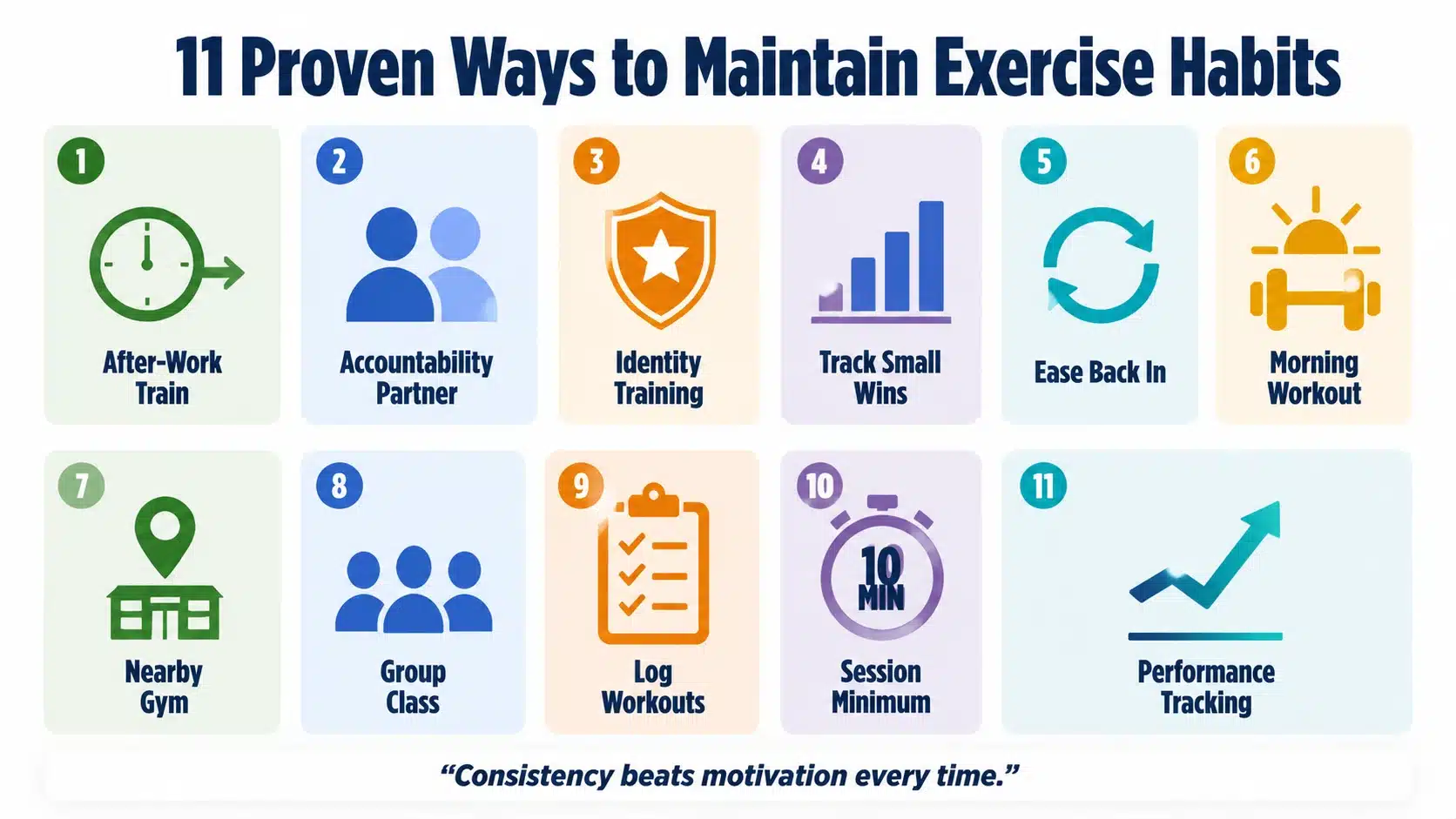
These strategies come from research on habit formation and from real patterns seen in people who train consistently for months and years. Each one solves a different sticking point.
1. Go Straight From Work to the Gym
Going home first is where the plan falls apart. The couch, the fridge, and the pull of home never lose their grip. Heading straight to the gym after work removes the hardest decision of the day. Pack your bag the night before. Change at the office or in the car. Skip home entirely until the session is done.
2. Find a Weekly Accountability Partner
Showing up for another person on a tired Tuesday is far easier than showing up for yourself. A workout partner creates a commitment that sits outside your own mood. The partner does not need to be a close friend. A coworker you barely know outside the gym works just as well. The shared schedule is what matters, not the relationship.
3. Train for Identity, Not Just Outcomes
Outcome-based goals, like a target weight or a dress size, lose their power the moment the number stalls. Identity-based training works differently. You train because this is who you are now. There is no finish line, so there is nothing to give up on. Skipping a session starts to feel wrong rather than easy.
4. Track Small Wins, Not Just Big Results
A slightly heavier kettlebell, one more rep, or faster recovery between sets does not make a good before-and-after photo. But it is genuine proof the work is doing something real. Tracking these small shifts keeps people interested far longer than waiting for dramatic changes. Proof beats hope every time motivation drops between check-ins.
5. Use the Non-Negotiable Minimum Rule
A non-negotiable minimum is not a consolation prize. It is the version of the session that still counts when energy is low. Ten minutes of movement on a hard day builds the same habit loop as sixty minutes. The goal is not the perfect workout. It is an unbroken streak that compounds week by week.
6. Train Before the Day Starts
Morning training does not require being a morning person. It requires one firm decision made the night before. Clothes laid out, alarm set, no negotiating when it goes off. Research shows that maintaining a consistent exercise schedule in the morning improves exercise adherence. The session is done before the excuses fully form.
7. Choose a Gym Close to Your Route
Distance kills consistent training more reliably than almost any other single factor. A gym 12 minutes from your route is used far more than one 35 minutes away. This holds true even when the closer gym seems less impressive. The best gym is the one you will actually reach on a low-energy Wednesday.
8. Join a Class With a Fixed Start Time
A scheduled class with a fixed start time pulls people in when solo training does not. There is already a teacher, a group, and a slot. Missing it feels different from skipping your own session. That social pull is often enough to keep attendance consistent week after week.
9. Log Every Workout
Logging what you lifted or how you felt during a session takes two minutes. The payoff is a clear record of forward movement. That record becomes what you check when progress feels slow or invisible. Most people quit because they forget exactly how far they have come since week one.
10. Switch From Weight to Performance Tracking
Bodyweight is a poor short-term measure of whether training is working. Water retention, sleep quality, and food intake shift it daily with no real connection to progress. Tracking what the body can do tells a cleaner story. Lifting more, recovering faster, and moving better are harder to dismiss than a scale reading.
11. Pair Workouts With Something You Already Want to Do
Save a podcast episode or a show for the gym only. The workout becomes the price of admission rather than the obstacle. This approach is sometimes called temptation bundling. It works because it turns a demand into a trade. You get the thing you want, and the workout gets done.
Why Does Motivation to Exercise Fade So Quickly?
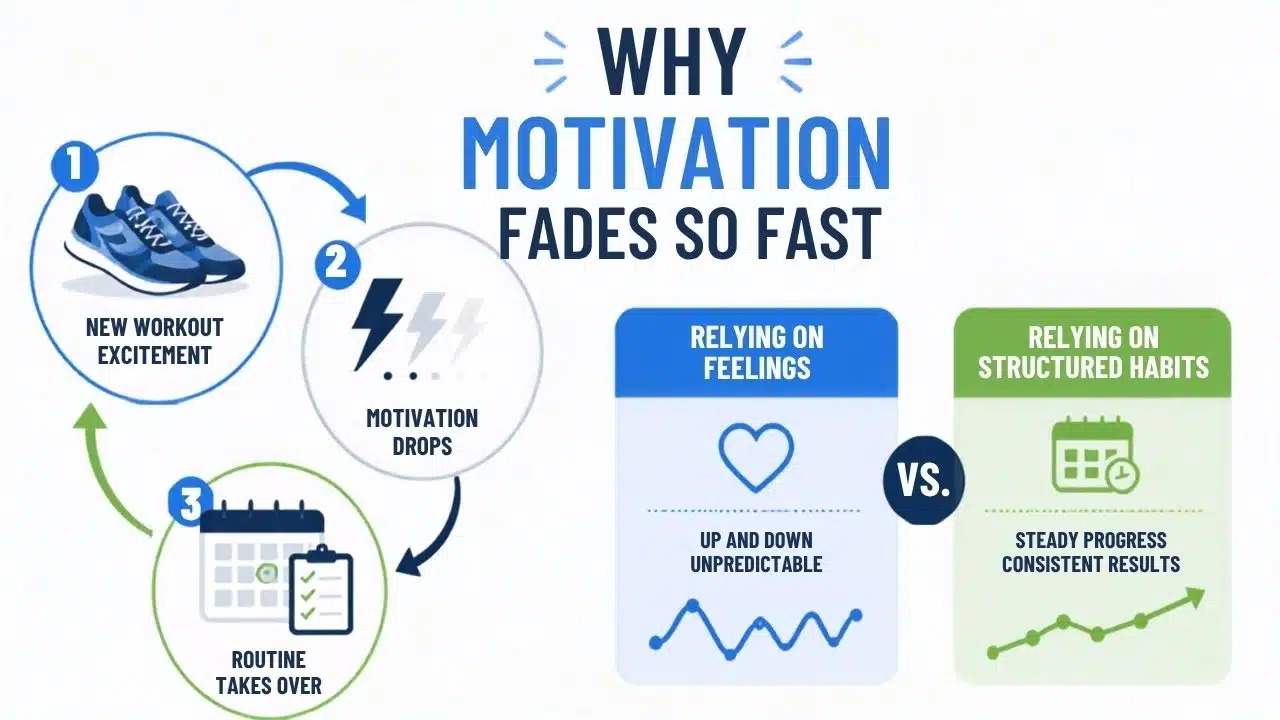
Motivation fades because it is a feeling, not a plan. It arrives strong in week one because everything is new. Once the novelty wears off, the feeling usually drops by three to six weeks in.
People read that dip as a sign they are not built for consistent training. That reading is wrong. The dip is normal and happens to almost everyone.
The real issue is that most plans have no structure for days when motivation does not show up. Waiting to feel ready before training is like waiting to feel hungry before eating on a schedule. The feeling and the habit are separate things.
Once you stop expecting motivation to carry the full load, the actual habit gets room to take over. That shift is where consistent training begins.
Small Changes That Make Working Out Easier
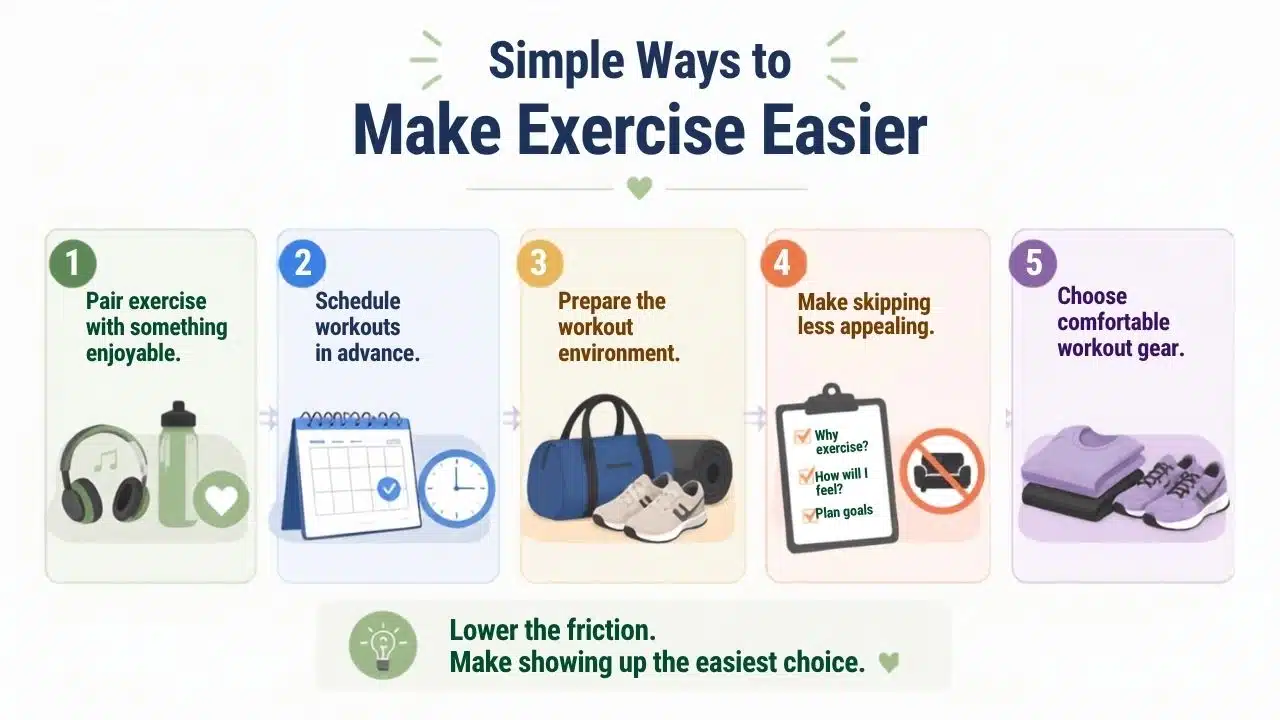
None of these require much effort. The goal is to reduce friction between deciding to work out and actually doing it.
- Put the workout on your calendar. People rarely skip a scheduled meeting. Treat your training block the same way, and it stops feeling optional.
- Set up your environment the night before. Clothes out, shoes by the door, gym bag in the car. Every extra step between deciding to go and going is a chance for the plan to fall apart.
- Wear gear that actually fits well. Shoes that pinch or a shirt that bunches up mid-set are friction you do not need on a low-energy day.
- Weigh the real cost of skipping. Skipping today resets the streak, weakens the habit you have been building, and makes tomorrow’s skip more likely. Continuing costs thirty minutes. Quitting costs the whole system.
- Set a realistic session length. A 25-minute session you complete beats a 90-minute session you skip. Start with what you can repeat, not what feels impressive on paper.
What to Do When Motivation Disappears
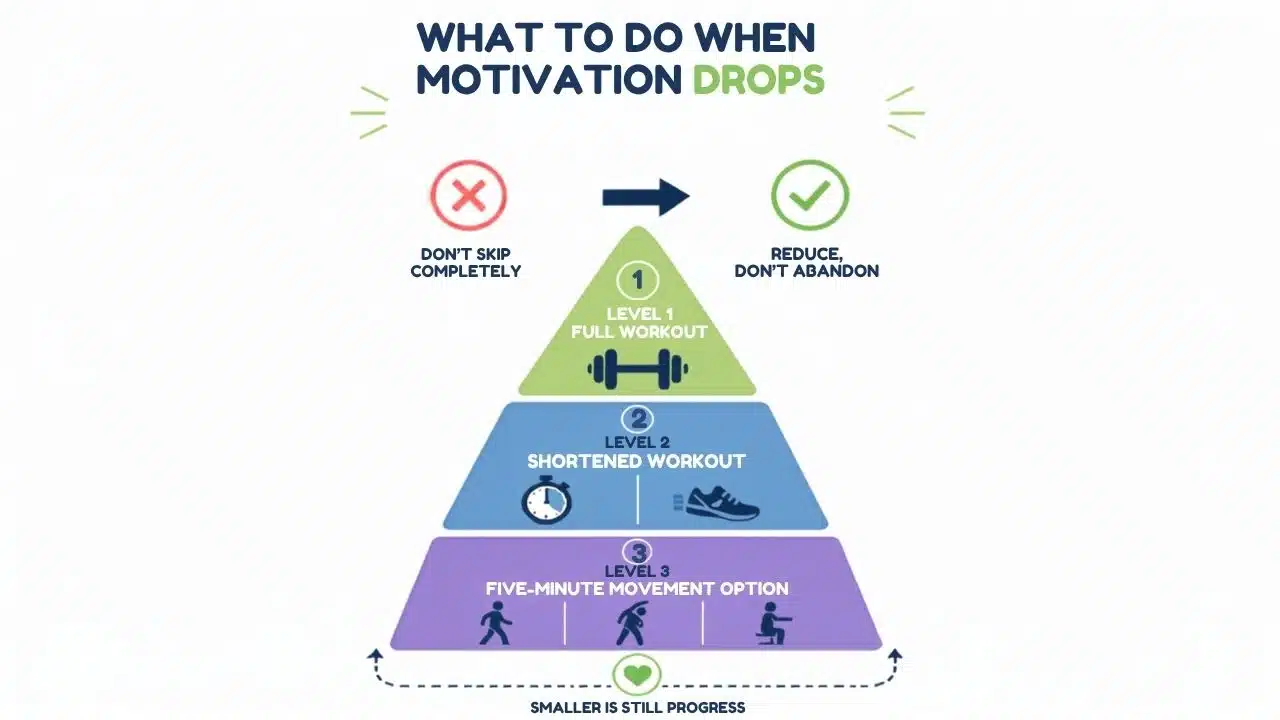
Some days, none of the above works. That is normal. Here is what to do instead of skipping entirely.
Shrink the Session Rather Than Skipping It
Commit to five minutes. Put on your shoes and walk to the end of the block. A full session often follows once you have started. If it does not, five minutes still counts. The habit loop still fires, and the streak stays alive.
Swap the Activity Instead of Forcing the Same One
If you have genuinely lost interest in the activity itself, that is useful information. Not every form of movement suits every person. Swapping running for hiking, or solo lifting for a group class, is not giving up. It is finding the version of exercise you will actually keep doing.
Get Outside Support When Low Energy Persists
Low motivation that stretches into weeks rather than days is a different problem. Ongoing fatigue, low mood, or pain that rest does not fix is a different issue. Speak with a doctor or qualified trainer rather than pushing through alone. Persistent exhaustion is a body signal worth listening to, not a motivation problem to solve with another tip.
How to Know Your Workout Routine Is Actually Working
Progress often shows up before it is visible on camera. Here are the signs worth tracking before the before-and-after photo becomes possible.
- You are lifting slightly more than you were one month ago
- You recover faster between sets than you did when you started
- A workout that left you winded now feels manageable
- You sleep better on days you train
- You show up without negotiating with yourself first
None of these make for a dramatic social media post. All of them mean the routine is doing its job. If two or three are moving in the right direction, the routine is working. The visible results are just slower to arrive.
The table below shows two types of progress you can track and which is more reliable in the short term.
| Tracking Method | What It Measures | Short-Term Reliability |
|---|---|---|
| Bodyweight/scale | Total mass, including water and food weight | Low (shifts daily without reflecting real progress) |
| Performance logs | Reps, weight lifted, session times | High (shows real fitness changes week to week) |
| Recovery rate | How quickly heart rate or breathing returns to normal | High (improves steadily with consistent training) |
| Sleep quality | How well you sleep on days you exercise | High (often improves within the first few weeks) |
Disclaimer: This article is for general informational purposes only. It is not a substitute for professional medical advice. Persistent fatigue, low mood, or pain that does not improve with rest needs professional attention. Speak with a qualified healthcare provider before changing your activity level.
Frequently Asked Questions
Why can’t I stay motivated to exercise?
Motivation is a feeling, not a structure. Without a consistent schedule, small goals, and low-friction habits, it fades fast. Building a system means the workout still happens when the feeling does not.
How do you make yourself work out when you really don’t want to?
Commit to five minutes only. Put your shoes on and start moving. A full session often follows. If it does not, five minutes still counts toward the habit.
What is the 3-3-3 rule for exercise?
The 3-3-3 rule typically means three exercises, three sets, and three reps per set. It provides a simple entry point for structuring a short, low-pressure workout session.
What is more powerful than motivation for exercise?
A reliable habit is more powerful. Routines, scheduled sessions, and a clear session minimum keep training consistent even when the feeling of motivation is completely gone.
Does working out with a partner actually help?
Yes. Showing up for someone else on a low-energy day is easier than showing up for yourself alone. Shared commitment creates external accountability that outlasts internal motivation.
Should I work out in the morning or evening?
The best time is the one you will actually keep. Morning training tends to improve consistency because sessions are done before daily demands compete for the same time slot.
Staying Consistent With Exercise: The Final Word
Staying consistent with exercise is not about having perfect days. It is about building a system that works on the hard ones. Learning how to stay motivated to exercise comes down to three things.
Remove friction, track small wins, and know what to do when the feeling disappears. You do not need willpower alone. You need a plan that does not depend on it. Start with one strategy from this guide. Try it for two weeks before adding anything else.
Small, consistent actions compound into the routine you have been building. Workouts do not have to be perfect to count.