Hamstrings face high stress during sprinting, deceleration, and changes of direction. Eccentric exercises build strength and control in these demanding positions.
This article covers eccentric hamstring exercises with sets, reps, tempo, progressions, and training tips for every level. You’ll also learn how to choose the right movements based on your goals.
What Are Eccentric Hamstring Exercises?
Eccentric hamstring exercises are movements where the hamstring muscle produces force while it lengthens. This happens during the lowering phase of a curl or the descent of a Romanian deadlift. The muscle works hardest in this lengthened position. It is also where strains most often occur.
This differs from a concentric contraction, where the muscle shortens during the lifting phase. It also differs from an isometric contraction, where muscle length stays the same during a hold like a bridge.
The hamstrings work eccentrically during running, sprinting, deceleration, and landing. They rapidly lengthen to control the lower leg and absorb force. Training this specific action builds strength that matches how the muscle actually works in sport and daily life.
Hamstring Anatomy and Function
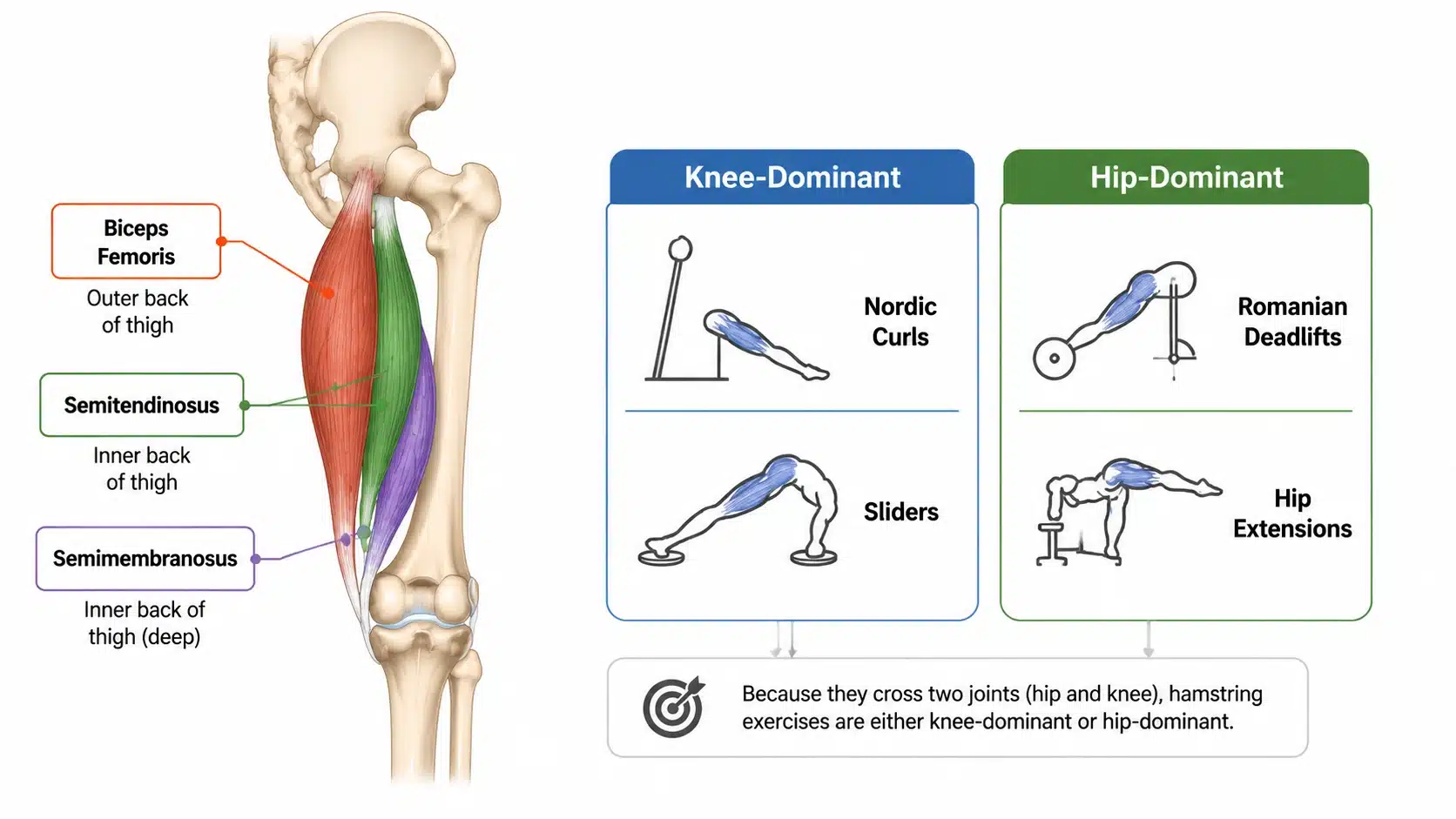
The hamstrings are a group of three muscles at the back of the thigh. They cross both the hip and the knee joint. This gives them two main roles: extending the hip and flexing the knee.
According to the National Institutes of Health, this two-joint design lets the hamstrings work together in movements like standing up. The muscle group carries its heaviest load during sprinting. This happens at the transition from slowing down knee extension to driving hip extension. That is the exact moment where strains most often occur.
The table below shows where each hamstring muscle is located and what it does.
| Muscle | Location | Main Function |
|---|---|---|
| Biceps femoris | Outer back of thigh | Knee flexion, hip extension |
| Semitendinosus | Inner back of thigh | Knee flexion, hip extension |
| Semimembranosus | Inner back of thigh (deep) | Knee flexion, hip extension, pelvic stability |
Because the hamstrings cross two joints, exercises fall into two categories. Knee-dominant movements, like Nordic curls and sliders, focus on knee flexion. Hip-dominant movements, like Romanian deadlifts and hip extensions, focus on hip extension. Training both types gives the most complete hamstring development.
14 Best Eccentric Hamstring Exercises
The exercises below cover both knee-dominant and hip-dominant movement patterns. They are organized from foundational to advanced. Use this to identify where to start and how to progress safely.
1. Nordic Hamstring Curl
Equipment: Nordic bench or a partner to hold the ankles
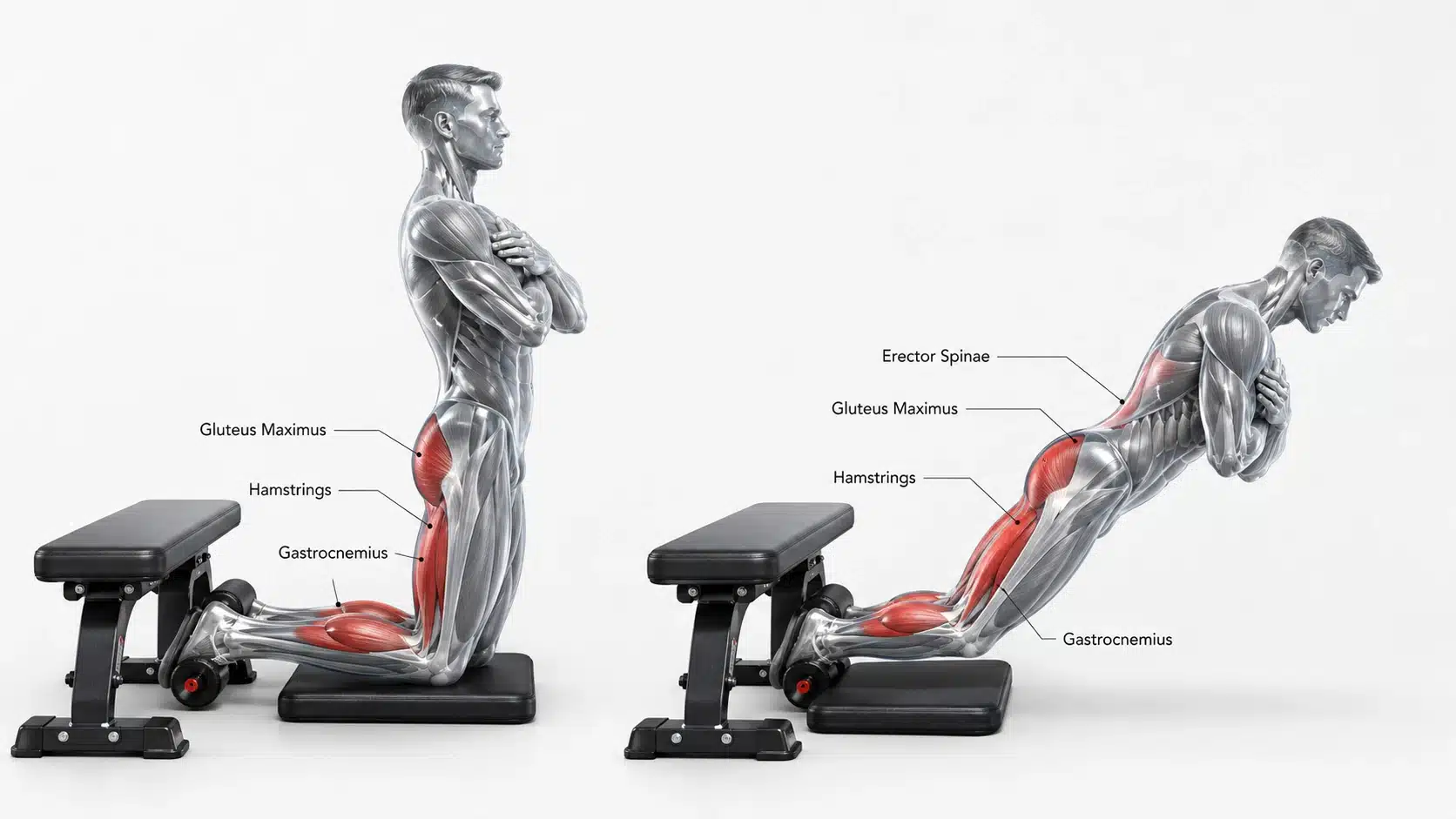
Kneel upright with your ankles secured. Slowly lower your torso toward the floor, controlling the descent with your hamstrings. Catch yourself with your hands near the bottom. Push back to the starting position to complete the rep.
- Sets and reps: 2 to 3 sets of 4 to 8 reps
- Tempo: 3 to 5 seconds lowering
- Common mistake: Letting the hips pike or rushing the descent
2. Assisted Nordic Hamstring Curl
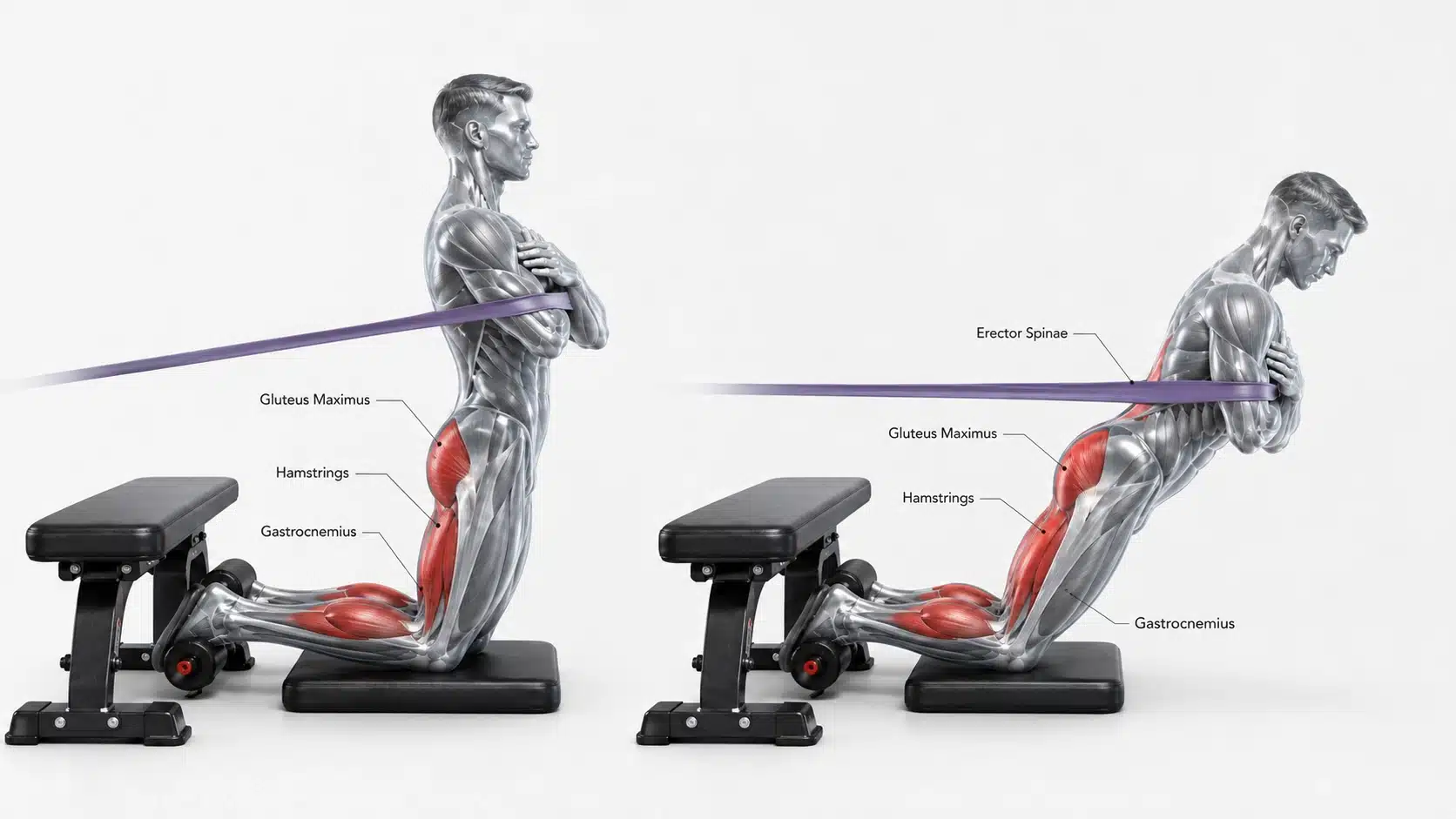
Equipment: Resistance band or training partner
Set up the same way as a standard Nordic curl. Use a band or a partner near the bottom to reduce the load. Reduce assistance gradually as strength builds. The goal is a full unassisted rep over time.
- Sets and reps: 2 to 3 sets of 6 to 10 reps
- Progression: Reduce band tension or partner support weekly
3. Romanian Deadlift
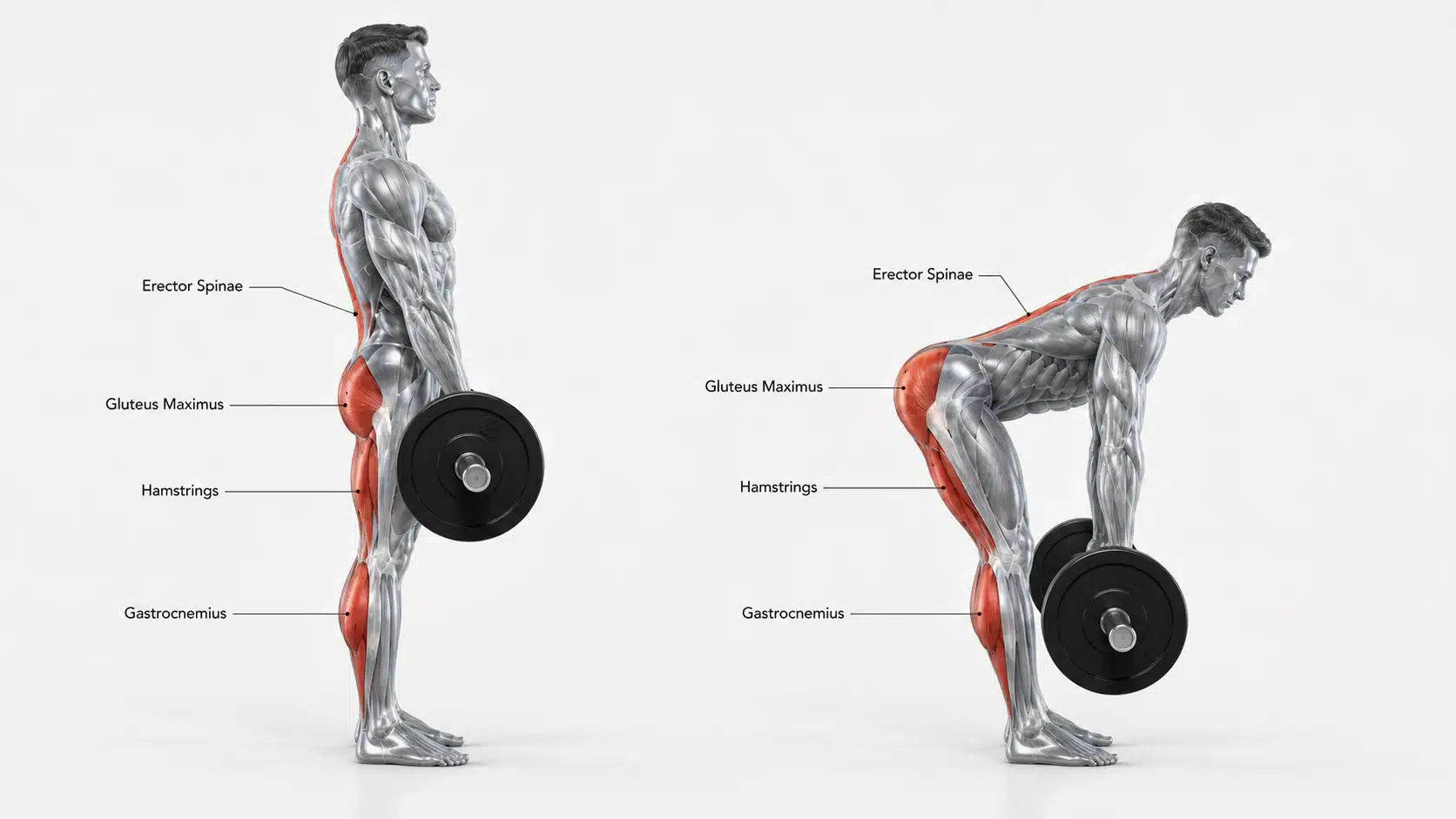
Equipment: Dumbbells or barbell
Stand with feet hip-width apart. Hinge at the hips with a slight knee bend and a neutral spine. Lower the weight along your legs until you feel a stretch in the hamstrings. Then drive your hips forward to return to standing.
- Sets and reps: 3 sets of 10 to 12 reps
- Tempo: 3 to 6 second descent
- Common mistake: Rounding the lower back as the weight drops
4. Single-Leg Romanian Deadlift
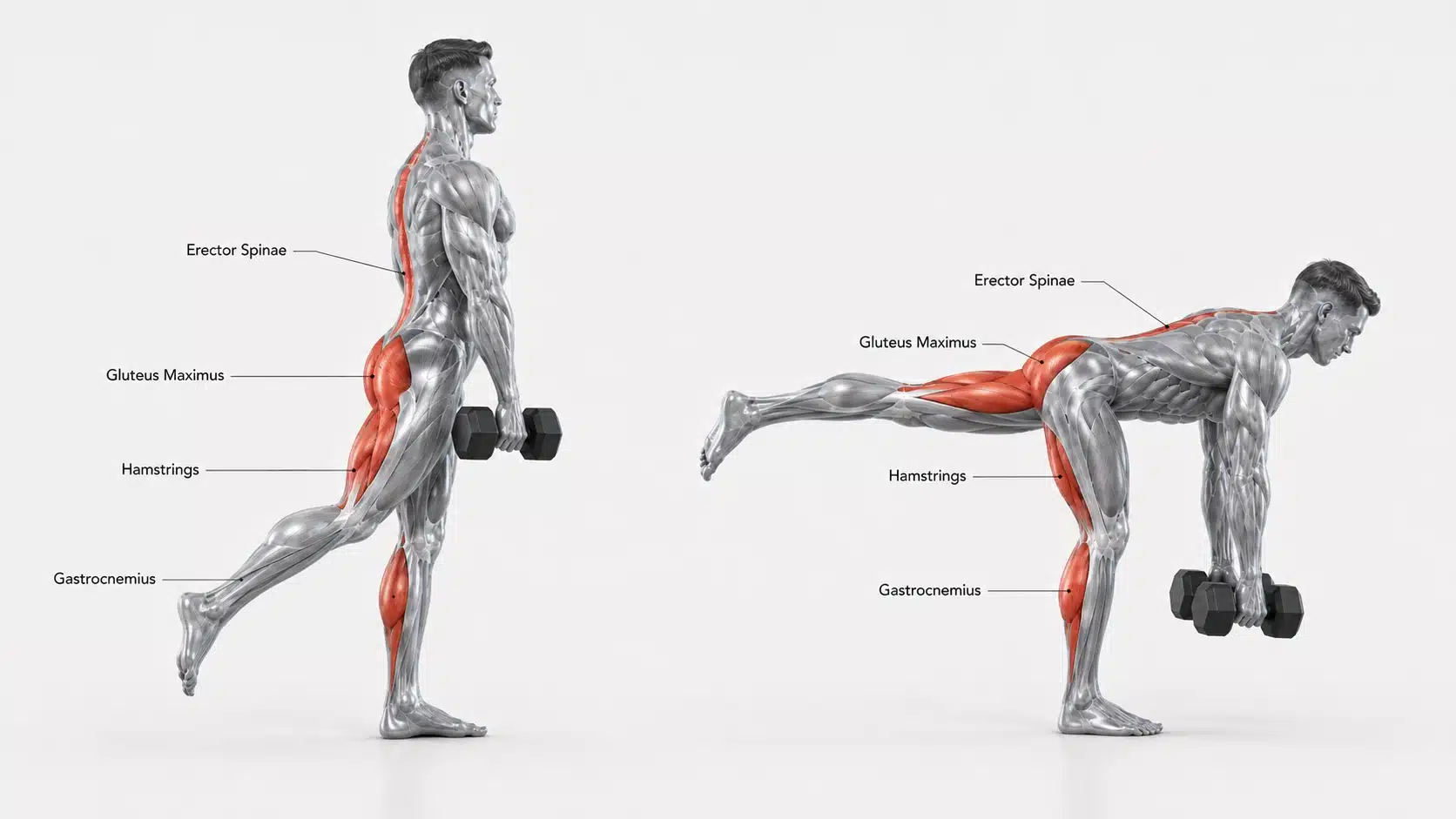
Equipment: Dumbbell or kettlebell
Stand on one leg. Hinge forward at the hip while extending the other leg behind you. Return to standing by driving through your hip. Keep your hips square throughout the movement.
- Sets and reps: 2 to 3 sets of 6 to 10 reps per leg
- Tempo: 3 to 5 seconds lowering
- Note: This exercise also challenges balance and unilateral hip stability
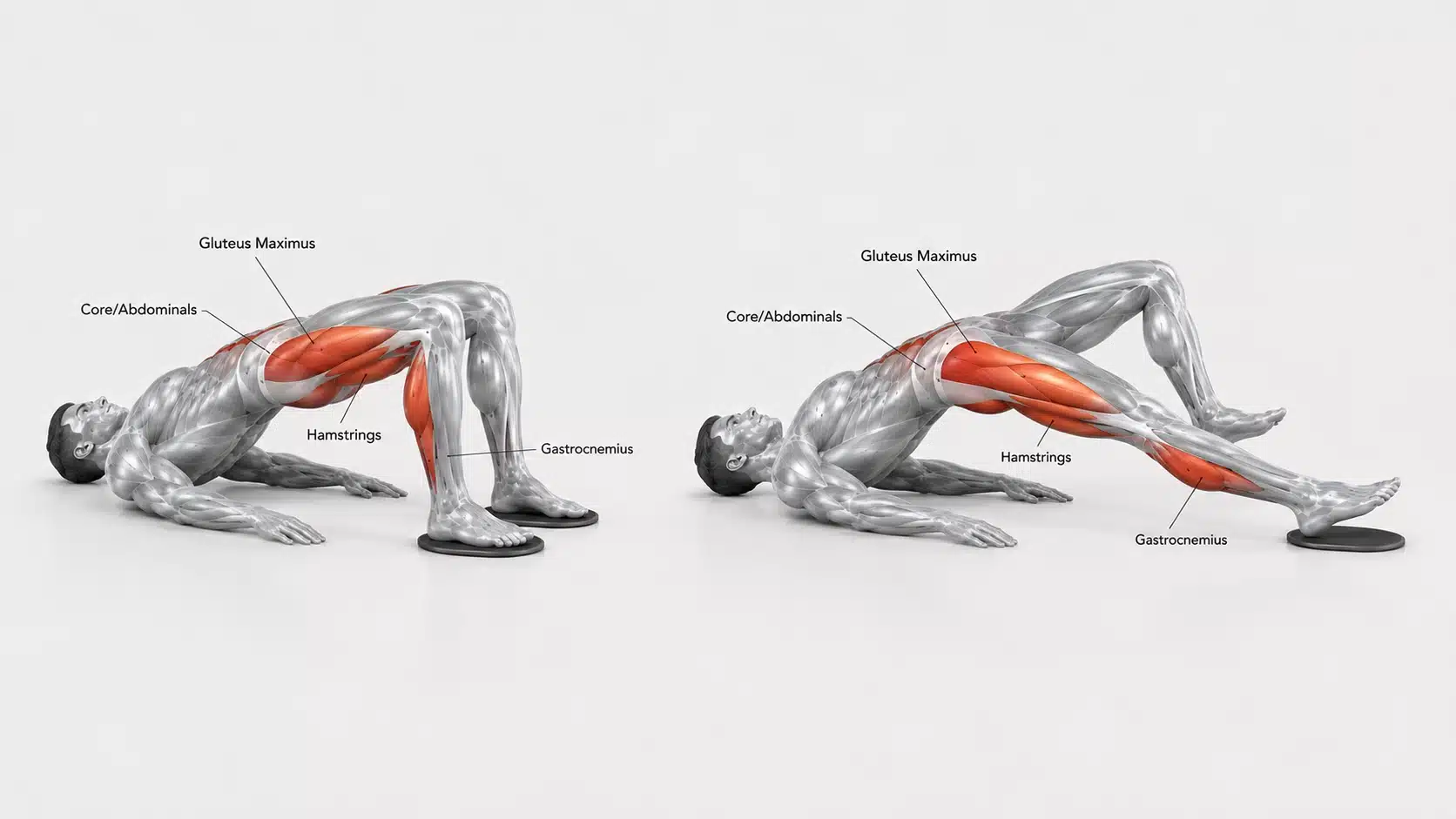
5. Sliding Hamstring Curl
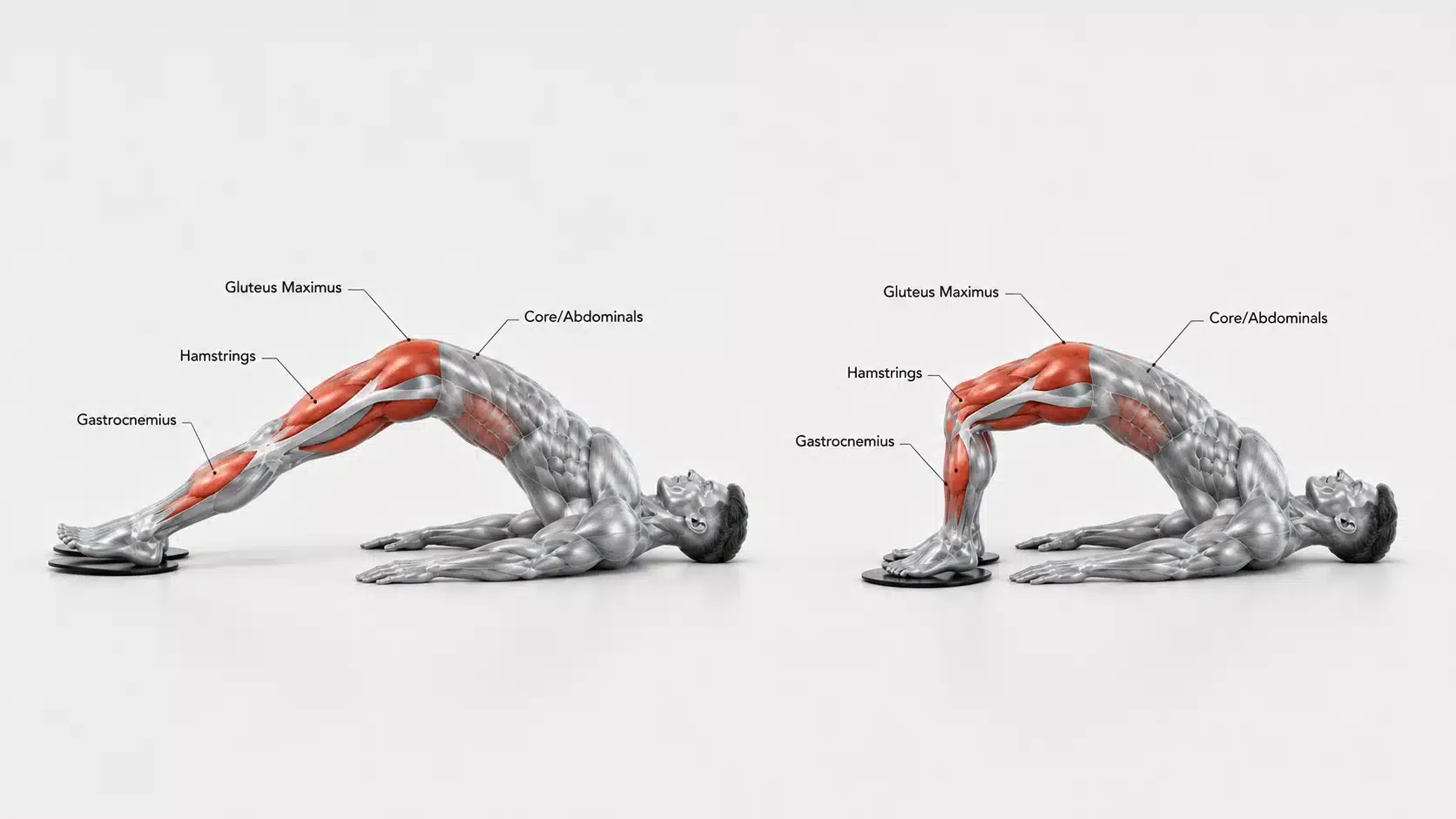
Equipment: Sliders, furniture movers, or a smooth floor surface
Lie on your back with heels on sliders and hips lifted in a bridge position. Slowly extend your legs outward. Then curl your heels back in to return. Keep your hips elevated for the entire movement.
- Sets and reps: 2 to 3 sets of 8 to 12 reps
- Tempo: 3 to 4 second extension phase
- Key point: Do not let the hips drop during the slide out
6. Stability Ball Hamstring Curl
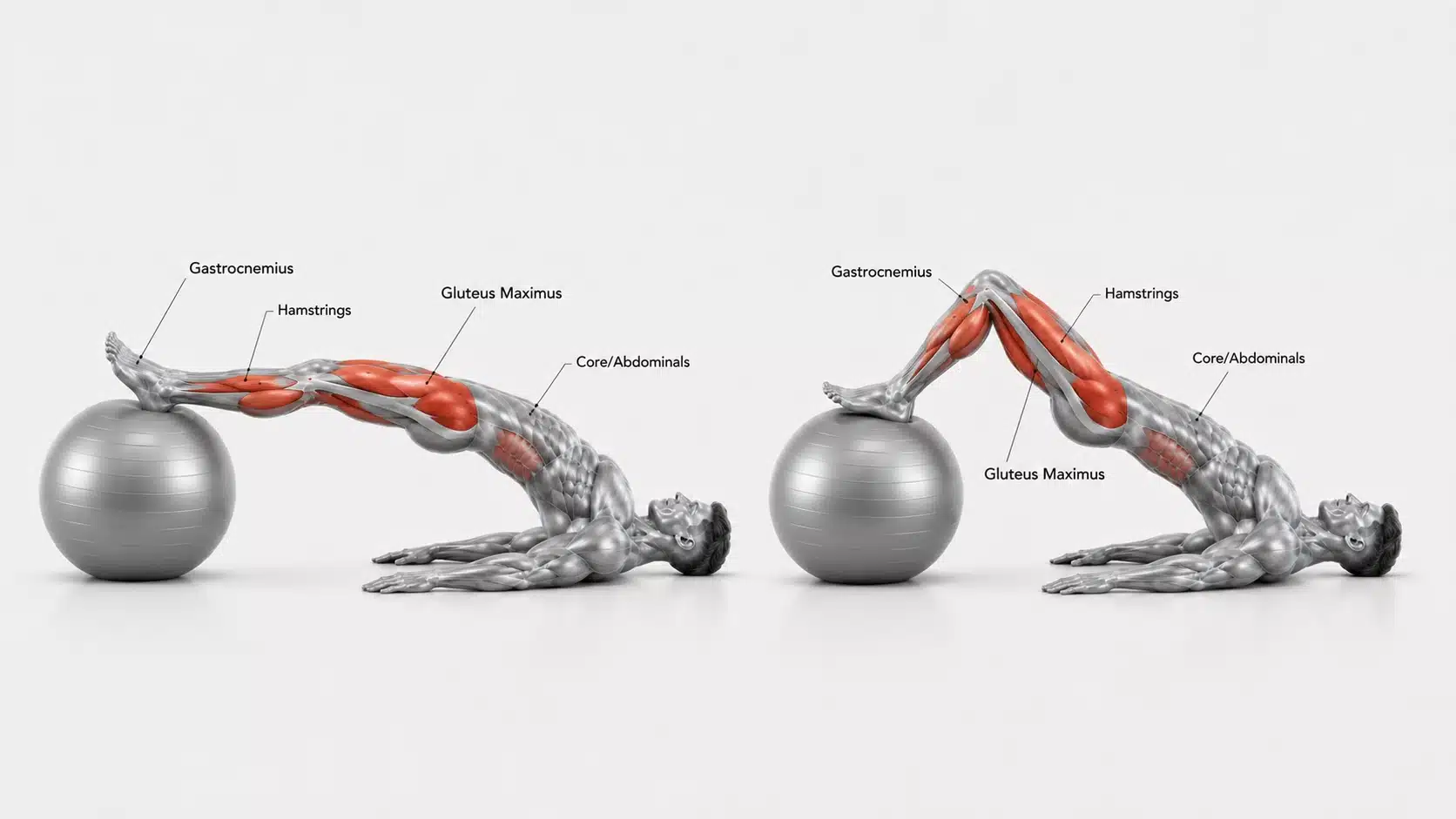
Equipment: Stability ball
Lie on your back with heels resting on a stability ball and hips lifted. Curl the ball toward your glutes. Then slowly extend it back out. Once you can control this well, progress to a single-leg version.
- Sets and reps: 2 to 3 sets of 10 to 15 reps
- Progression: Single-leg variation for additional challenge
7. Eccentric Seated Hamstring Curl
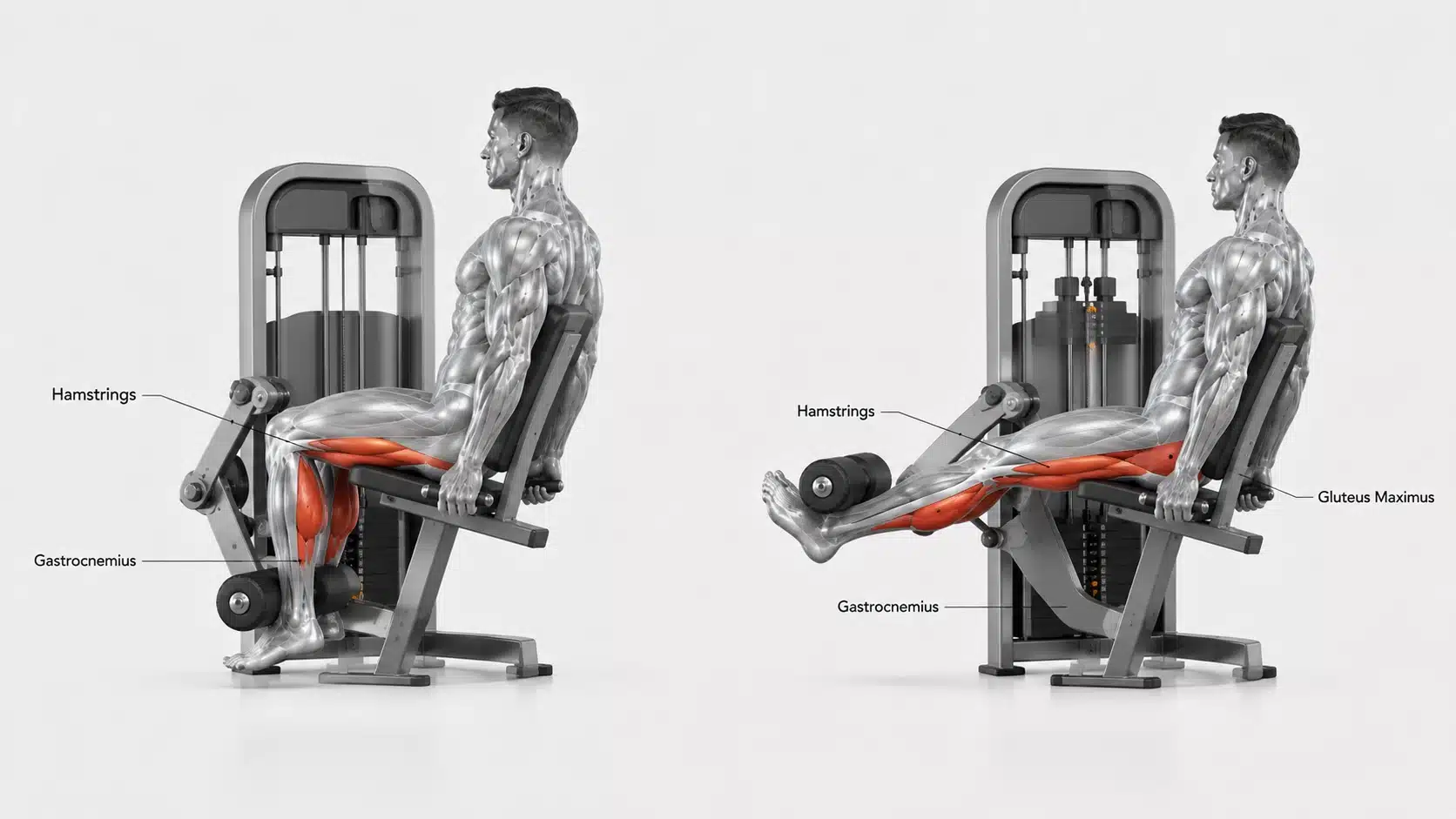
Equipment: Seated leg curl machine or resistance band
Sitting with the hips flexed places the hamstrings in a pre-stretched position. This increases the stretch compared to a lying face-down curl. Curl in to contract, then extend back out slowly.
- Sets and reps: 2 to 3 sets of 8 to 12 reps
- Tempo: 4 to 5 second extension ph
8. Two-Leg Up, One-Leg Down Curl
Equipment: Leg curl machine or sliders
Curl the weight up using both legs together. Lower it back down using only one leg at a time. This technique overloads the eccentric phase on a single limb. You do not need the same single-leg strength for the lifting phase, which makes it a good bridge exercise.
- Sets and reps: 2 to 3 sets of 6 to 10 reps per leg
- Tempo: 3 to 5 seconds lowering
- Key point: Do not rush the single-leg lowering phase
9. Banded Hamstring Curl
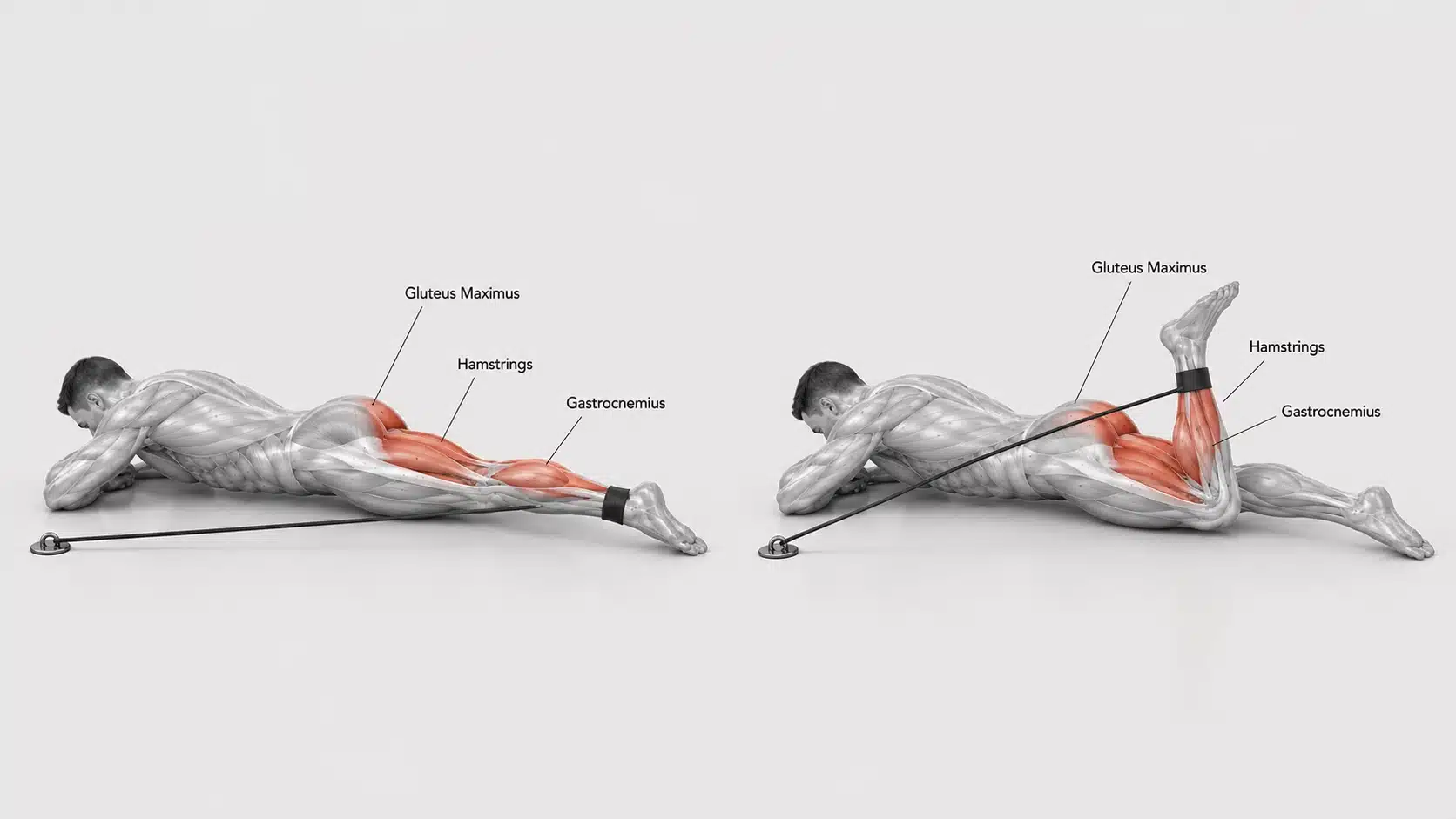
Equipment: Resistance band, fixed anchor point
Lie face down and loop a resistance band around one ankle. Curl your heel in against the band, then slowly extend your leg back out. This is a practical option for home training when a curl machine is not available.
- Sets and reps: 2 to 3 sets of 10 to 15 reps per leg
- Tempo: 3 to 4 second extension phase
10. Hamstring Bridge Walkouts
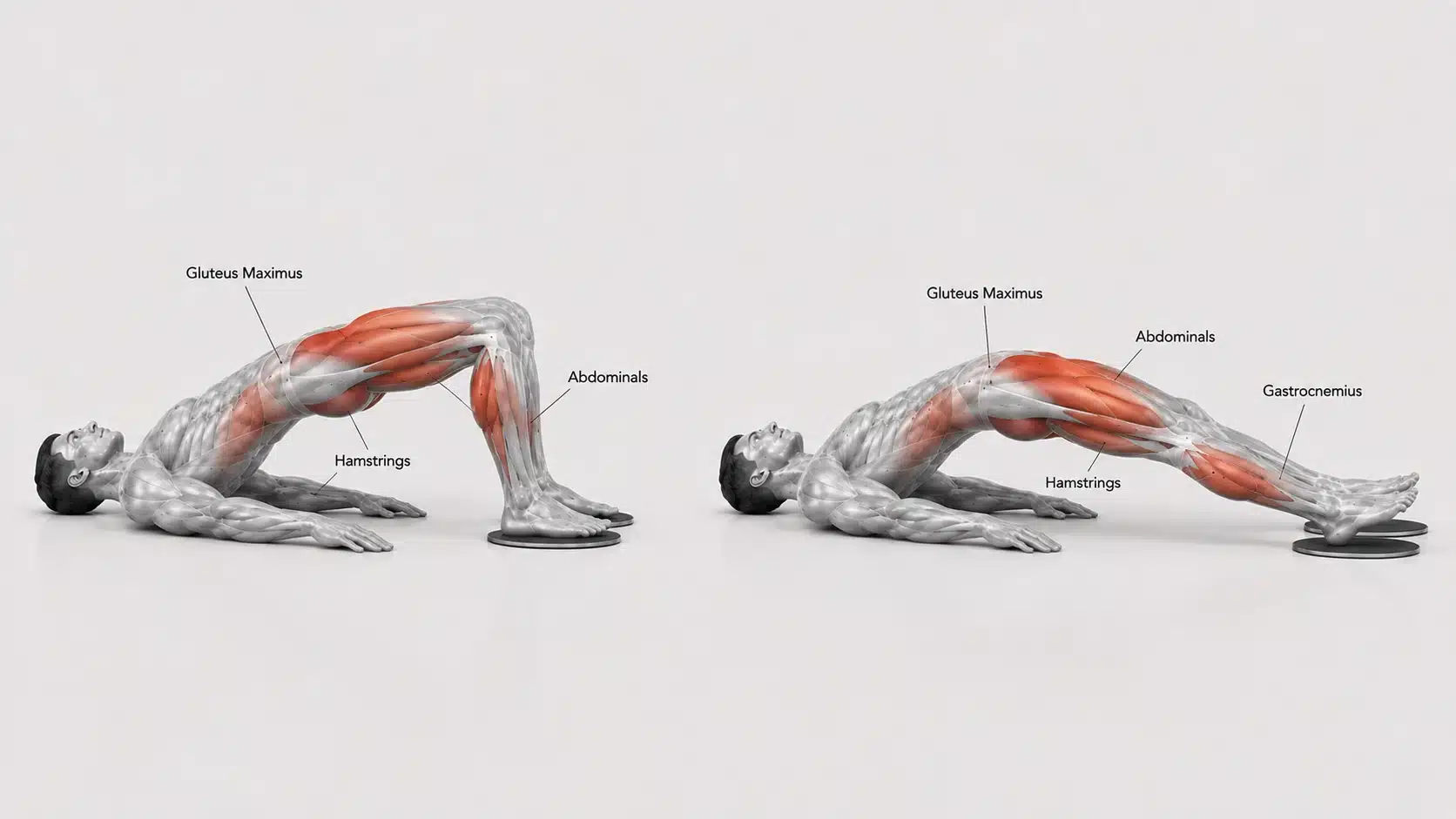
Equipment: Bodyweight only
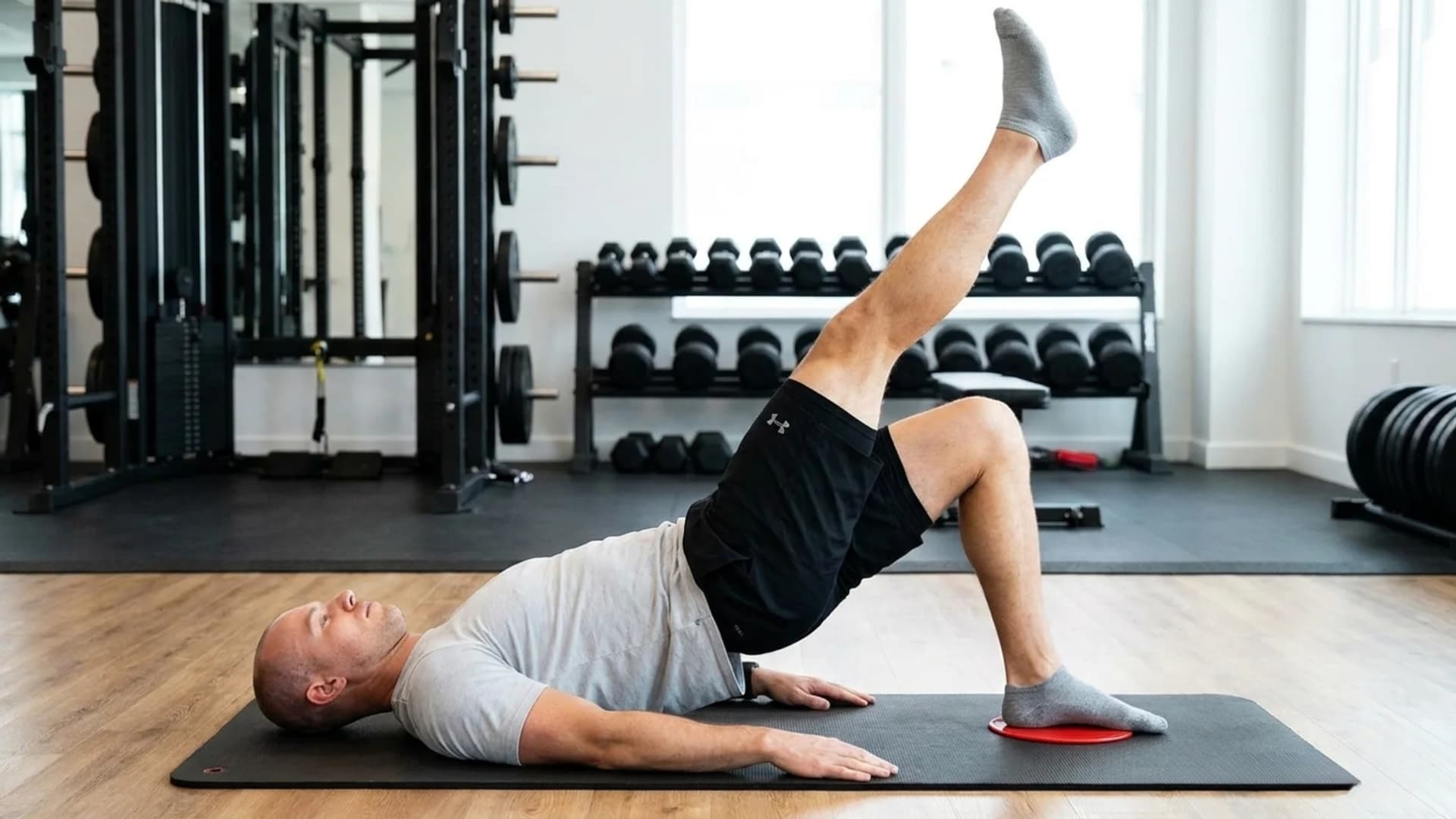
Start in a bridge position with your hips lifted off the floor. Walk your feet slowly away from your body while keeping your hips elevated. Then walk them back in. This is a low-load starting point for beginners or those returning from injury.
- Sets and reps: 2 to 3 sets of 6 to 8 walkouts per direction
- Key point: Do not let the hips drop during the walkout phase
11. 45-Degree Hip Extension
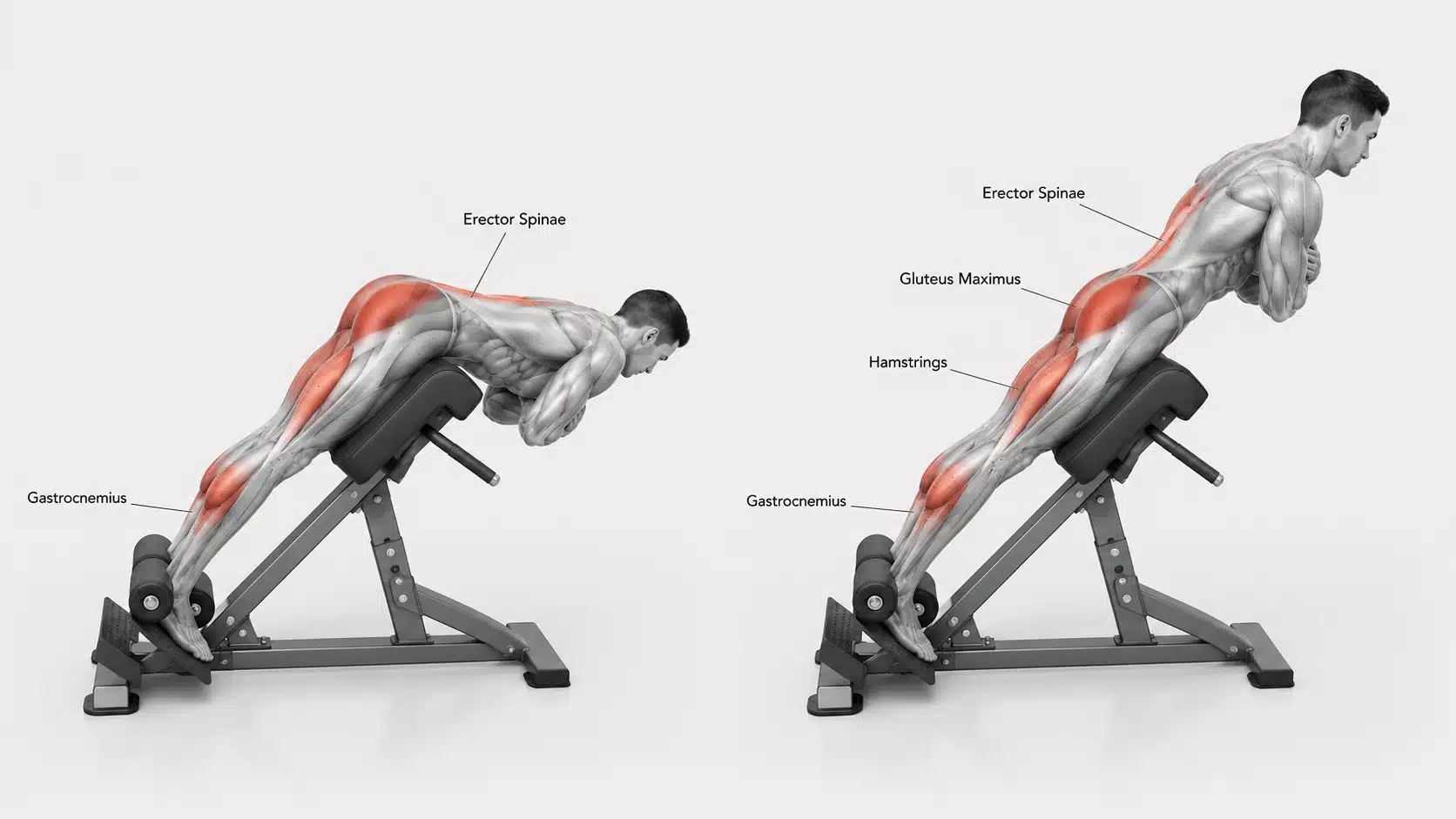
Equipment: Hip extension bench (back extension machine)
Position yourself face down on the bench with hips at the pad. Hinge forward at the hips. Then squeeze your glutes and hamstrings to return upright. Stop at parallel to avoid hyperextending the lower back at the top.
- Sets and reps: 3 sets of 10 to 15 reps
- Tempo: 3 to 4 second descent
- Common mistake: Hyperextending the lower back at the top of the rep
12. Good Morning Exercise
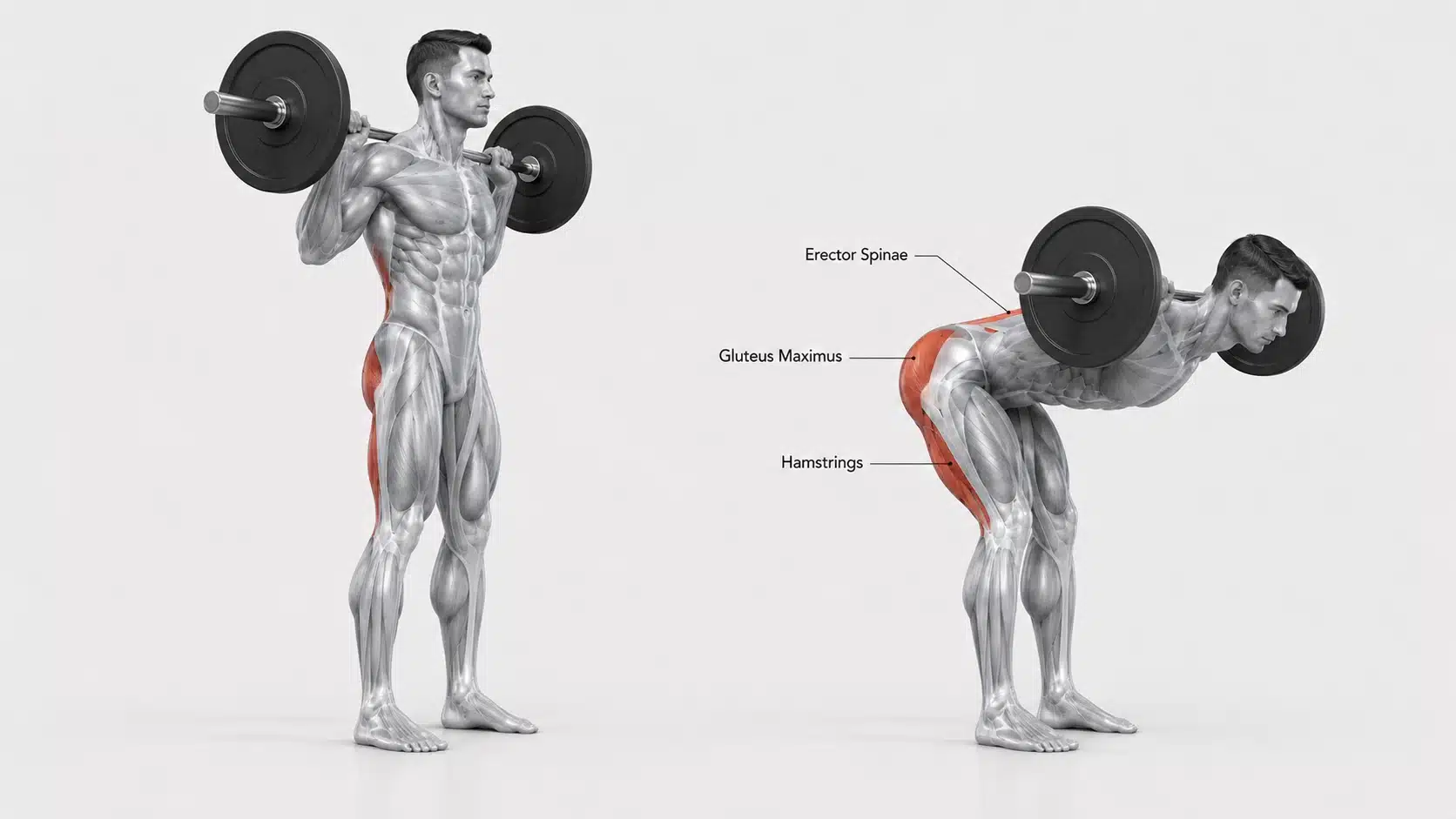
Equipment: Barbell or bodyweight
Stand with feet hip-width apart and a barbell across the upper back. Maintain a slight knee bend and a neutral spine. Hinge forward until your torso approaches parallel with the floor. Drive your hips forward to return upright.
- Sets and reps: 3 sets of 8 to 10 reps
- Tempo: 3 to 5 second descent
- Note: Start light and get comfortable with spinal position before adding load
13. Razor Curl
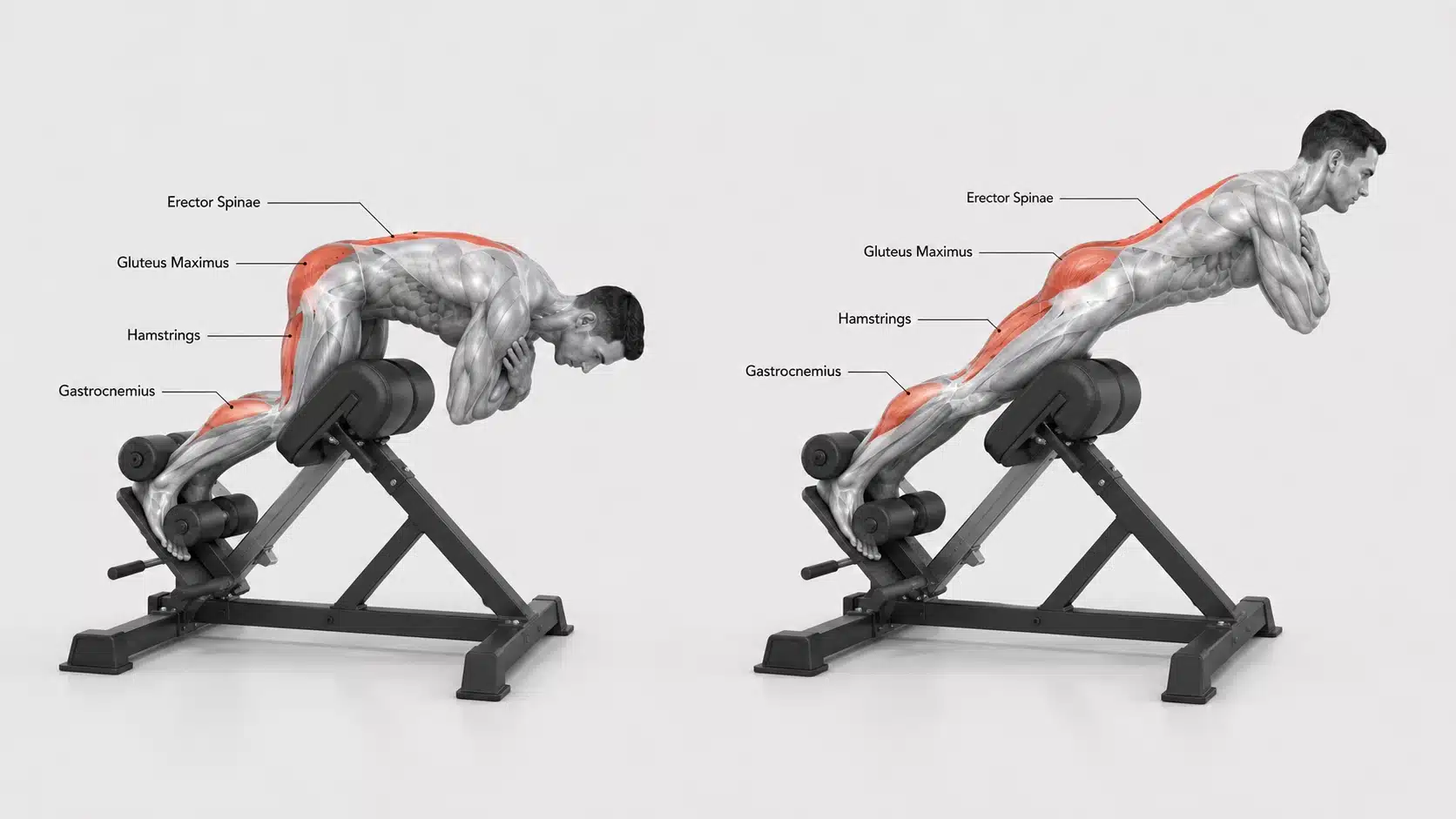
Equipment: Bodyweight or light resistance, with ankles secured
Kneel upright with your ankles anchored. Hinge forward and bend your knees at the same time in a controlled lowering motion. Use minimal hand support to return. Build a solid base with standard Nordic curls before attempting this variation.
- Sets and reps: 2 to 3 sets of 4 to 6 reps
- Level: Advanced
- Prerequisites: Comfortable with full Nordic curls first
14. Single-Leg Sliding Hamstring Curl
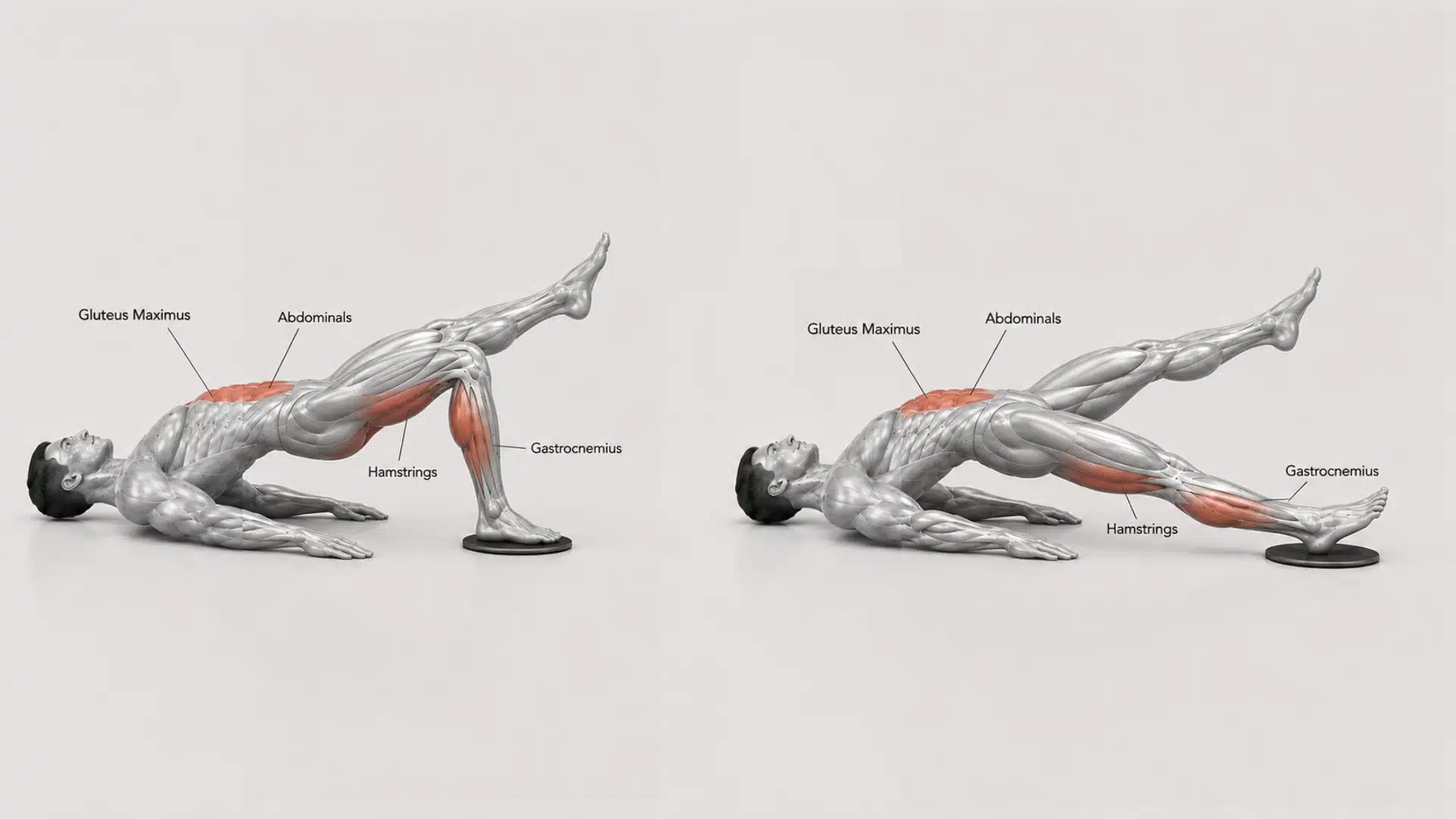
Equipment: Sliders or smooth floor surface
The same movement as the standard sliding curl, but performed on one leg at a time. Keep your hips level throughout. This increases the demand on each hamstring individually. It is a natural progression from the two-leg version.
- Sets and reps: 2 to 3 sets of 6 to 10 reps per leg
- Prerequisites: Master the two-leg sliding curl first
Benefits of Eccentric Hamstring Training
Eccentric training builds strength in ways that concentric-only exercises cannot. It targets the lengthened position where most strains occur. This makes it useful for performance, injury prevention, and rehabilitation alike.
- Strength through a longer range of motion: Eccentric training allows the hamstrings to generate more force than concentric work alone. It builds strength at the lengthened positions where injuries most often happen.
- Lower injury rates: Research published in the British Journal of Sports Medicine found that Nordic hamstring programs reduced hamstring injury rates by up to 51 percent. Programs also produced gains in sprint performance and muscle architecture.
- Faster rehabilitation: Clinical guidelines from the National Institutes of Health note that adding eccentric exercise to standard hamstring rehab significantly reduced return-to-play time after a strain.
- Better athletic performance: Sprinters, footballers, soccer players, and runners rely on eccentric hamstring strength to accelerate, decelerate, and change direction safely.
Eccentric Hamstring Exercises Sets and Reps by Goal
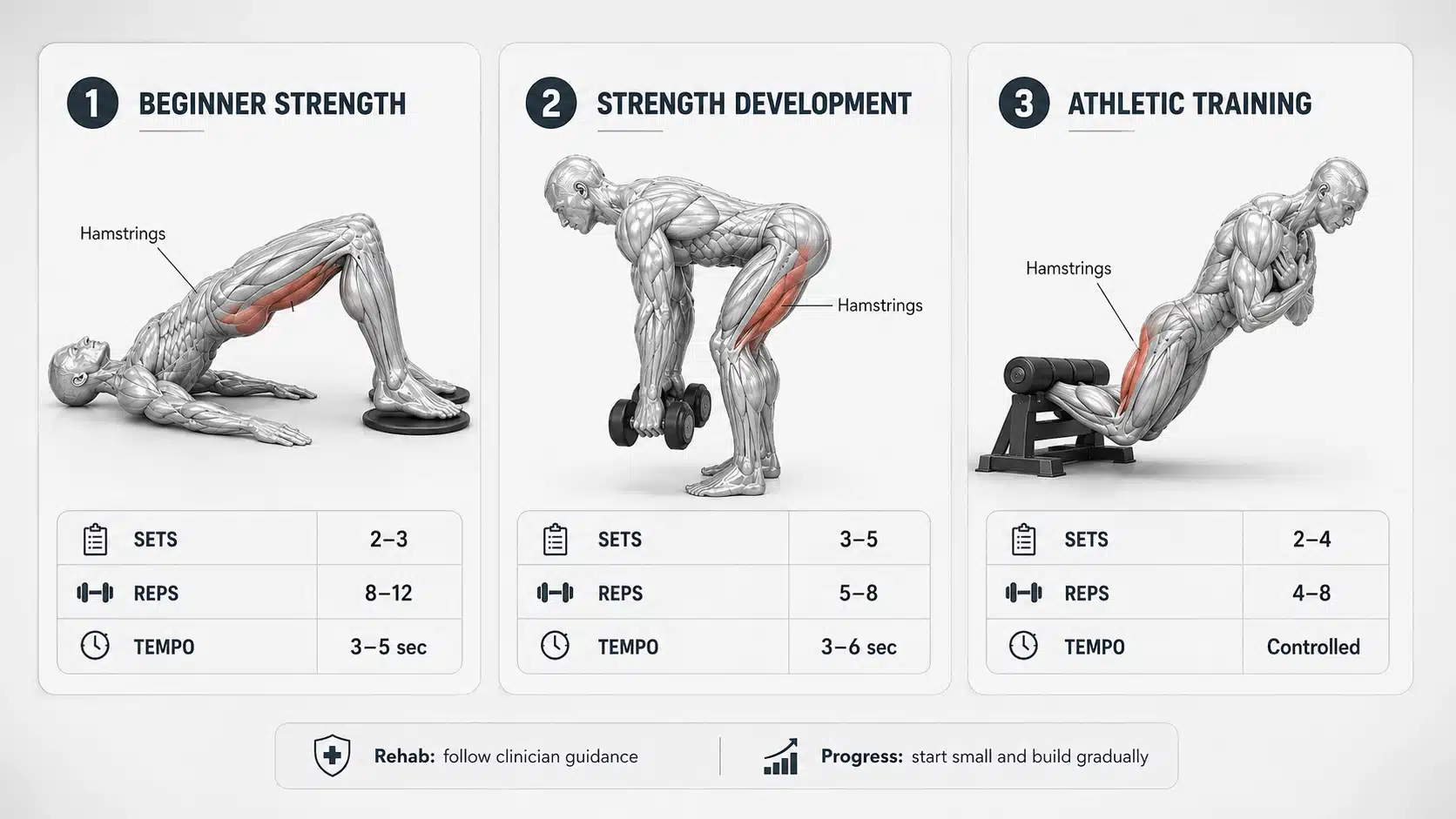
Programming should match your current training goal and experience level. A beginner building general strength needs a different approach from an athlete in-season or someone recovering from a strain.
Rehabilitation programming should always follow a physical therapist’s guidance. The right dose depends on injury severity, pain response, and healing stage, not a general template.
The table below shows sets, reps, and lowering tempo for each training goal.
| Goal | Sets | Reps | Lowering Tempo |
|---|---|---|---|
| Beginner strength | 2 to 3 | 8 to 12 | 3 to 5 seconds |
| Strength development | 3 to 5 | 5 to 8 | 3 to 6 seconds |
| Athletic training | 2 to 4 | 4 to 8 | Controlled lowering |
| Rehabilitation | Based on injury stage | Individual progression | Clinician guided |
Pro tip: Eccentric exercises tend to cause more soreness than usual when first introduced, even at low volumes. Ease in over the first one to two weeks before adding sets, reps, or load.
How Often Should You Do Eccentric Hamstring Exercises?
Frequency depends on your training goal and experience level. The guidance below covers the most common scenarios.
- Beginners: Two sessions per week is a practical starting point. This allows recovery between sessions while still building the adaptation.
- General strength training: One to three sessions per week, depending on total training volume and how much the hamstrings are being loaded elsewhere in your program.
- Athletes: Eccentric hamstring work is typically built into a broader sprint or sport-specific training plan. During the season, it often works best as a maintenance dose rather than a heavy standalone session.
- Rehabilitation: Frequency should follow a plan set by a physical therapist. Pain response and healing stage determine the right dose, not a fixed weekly schedule.
Best Exercises by Training Goal
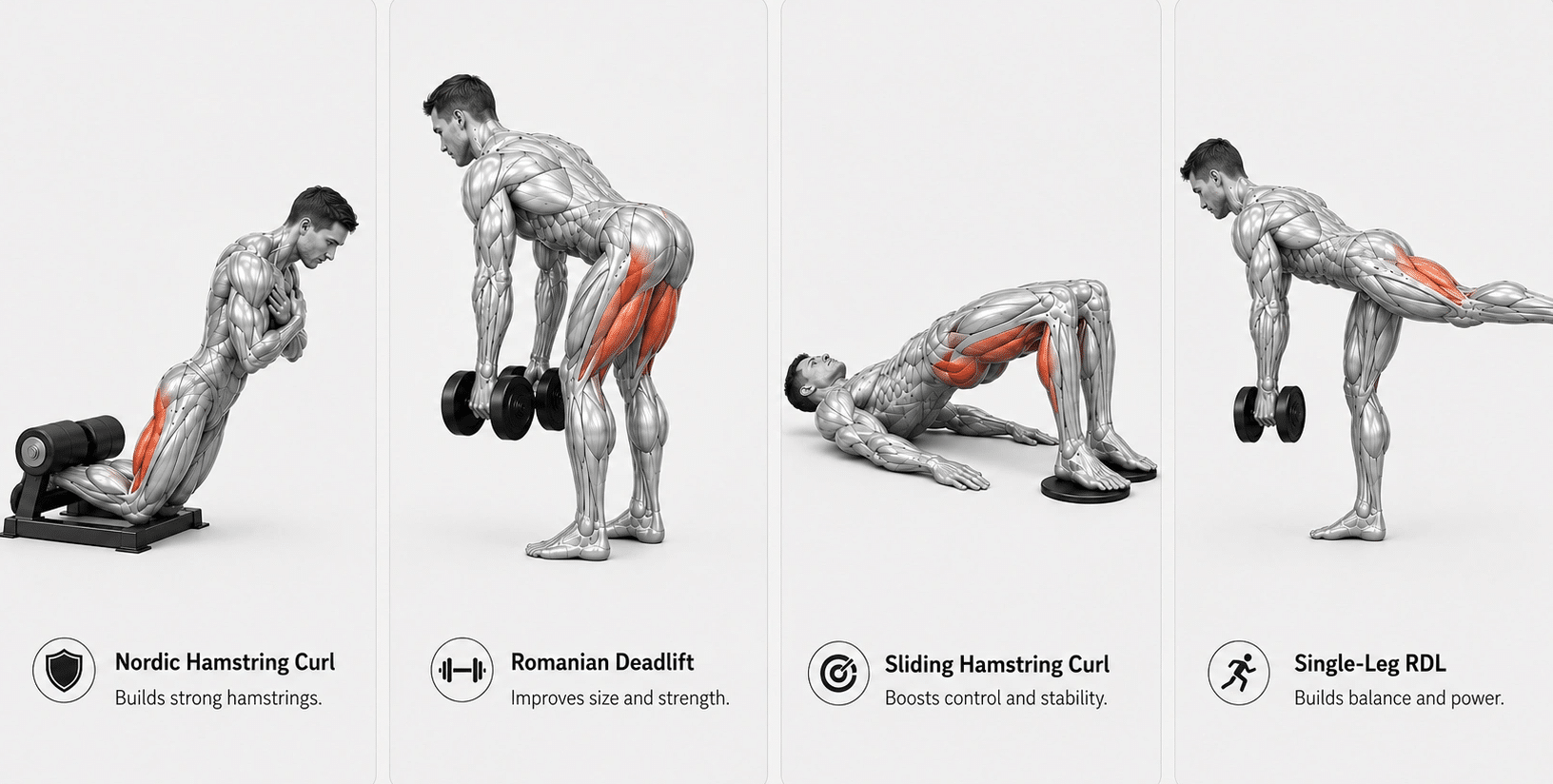
Matching your exercise selection to your training goal produces better results than following a single generic list. Use the categories below as a starting point.
- Beginners: Bridge walkouts, sliding curls, banded curls, assisted Nordic curls
- Runners: Nordic curls, Romanian deadlifts, single-leg RDLs, sliding curls
- Athletes: Nordic curls, razor curls, glute-ham developer exercises, loaded RDLs
- Home training: Towel sliders, bridge walkouts, banded curls, assisted Nordic curls
- Rehabilitation: A controlled, clinician-guided progression based on pain response and healing stage
Athletes focused on sprint performance can pair these exercises with a hamstring training program for runners to build both speed and resilience.
Mistakes to Avoid During Eccentric Hamstring Exercises
Eccentric hamstring exercises are highly effective, but poor form, excessive loading, or rushed progression can increase injury risk. The five mistakes below are the most common ones to address before they become a problem.
- Rushing the lowering phase: Speeding through the descent removes most of the eccentric benefit. The controlled lowering phase is where the training effect actually happens.
- Starting with advanced variations: Full Nordic curls and razor curls require an existing strength base. Beginners should start with bridge walkouts or assisted variations first.
- Losing hip position: Letting the hips drop or pike reduces hamstring loading and shifts stress onto the lower back.
- Adding load too quickly: Eccentric exercises can tolerate more weight than concentric training, which makes it tempting to progress fast. Overload should still be gradual to avoid setbacks.
- Not leaving enough recovery time: Eccentric work causes more muscle soreness than standard strength training, especially early on. Space sessions two to three days apart, particularly in the first few weeks.
Safety Tips for Eccentric Hamstring Exercises
Begin with easier variations such as bridge walkouts or banded curls before moving to Nordic curls or razor curls. Warm up with active leg swings, hip circles, and light glute bridges before loading the hamstrings eccentrically.
Normal training responses:
- Muscle fatigue during the set
- Mild soreness in the day or two afterward
Warning signs that need attention:
- Sudden, sharp pain during the movement
- Swelling or bruising after training
- A noticeable loss of strength or inability to bear weight
Stop immediately if any warning sign occurs. Consult a physical therapist or physician before continuing. Mild muscle fatigue and soreness are expected responses. Sharp or shooting pain is not.
Disclaimer: This article is for general informational purposes and isn’t a substitute for professional medical advice. Anyone with a hamstring injury or persistent pain should consult a physical therapist or physician before starting or modifying an exercise program.
Frequently Asked Questions
What is the best eccentric hamstring exercise?
The Nordic hamstring curl has the strongest research support, linked to up to a 51 percent reduction in injuries. Beginners may still get better results from an easier variation they can control well.
How many sets and reps should I do?
Beginners generally do 2–3 sets of 8–12 reps, while strength-focused lifters use 3–5 sets of 5–8 reps. Even low weekly volumes of Nordic curls can maintain meaningful eccentric hamstring strength over time.
How long should the eccentric phase last?
Most protocols use a 3–5 second lowering phase for general training. Some rehabilitation programs extend this to 4–8 seconds to maximize time under tension in the lengthened position.
Are these exercises appropriate after a hamstring strain?
Eccentric training is a core part of evidence-based rehab and is linked to faster return-to-play timelines. Progression should follow a physical therapist’s guidance based on pain and healing stage.
The Bottom Line
Strong hamstrings are built in the lowering phase, not the lifting phase.
Pick the variation that matches where you are now, whether that’s a bridge walkout or a full Nordic curl, control the tempo, and let difficulty build over weeks.
Coming back from a strain? Loop in a physical therapist so your progression matches your recovery, not a generic timeline.