
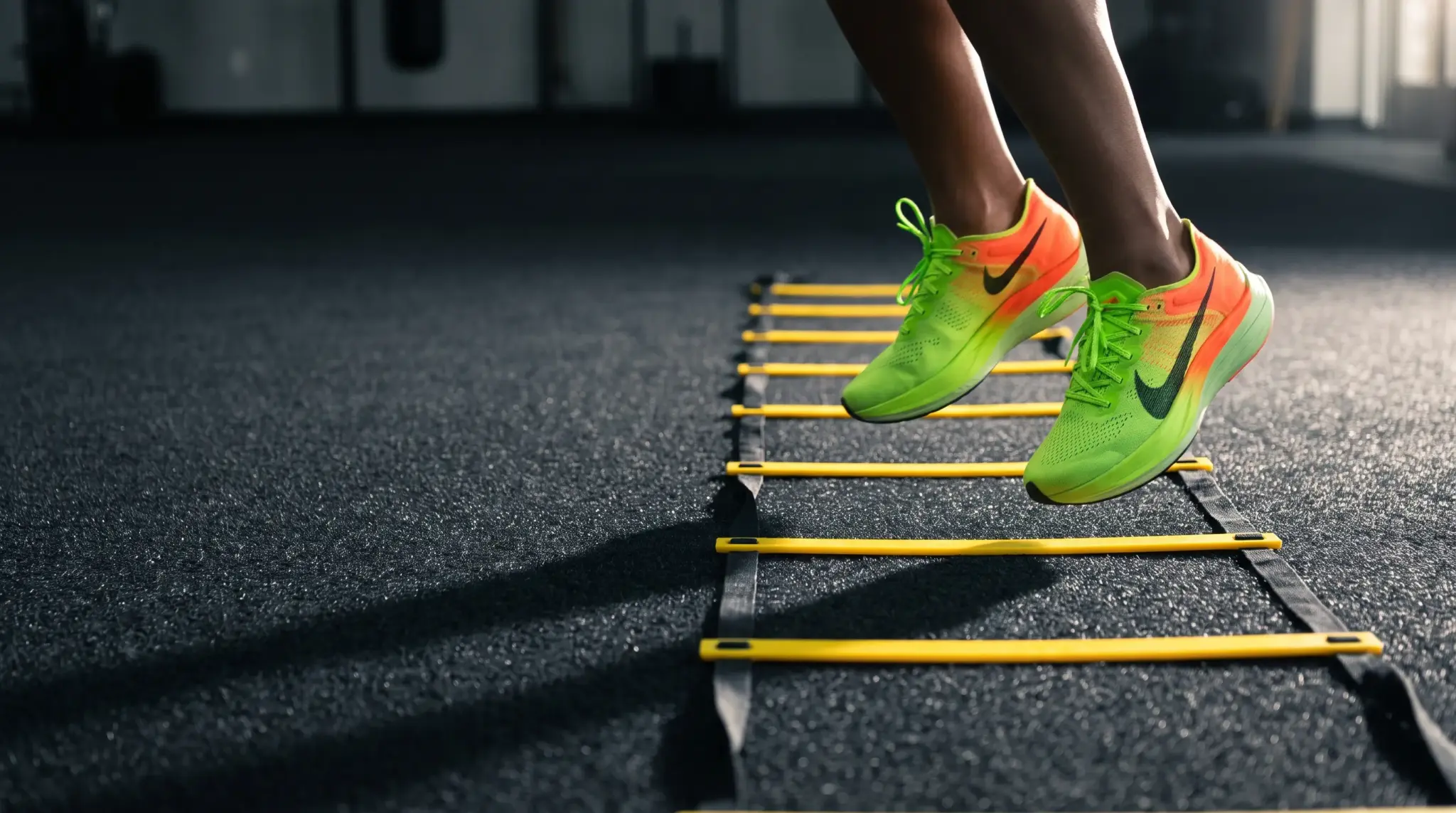
Your feet move faster than your brain can keep up. That gap costs you in every sport. Ladder drills close it. They train quick, precise footwork by making your brain and muscles work together under pressure.
You do not need a gym or a coach to start. A few squares on the ground, 10 to 15 minutes, and the right patterns are all it takes.
This article covers ladder drills across beginner, intermediate, and advanced levels, with step-by-step instructions for each.
What Is a Ladder Drill?
A ladder drill is a footwork exercise performed on a flat speed ladder laid on the ground. The ladder is typically 15 to 20 feet long with evenly spaced rungs. You move through it using quick stepping, hopping, or shuffling patterns.
The goal is not strength. Ladder drills train movement patterns, reaction time, and agility. They help you place your feet faster, change direction more cleanly, and stay in control during quick movements.
You do not need a physical ladder to start. Tape, chalk, floor tiles, or cones work just as well. The equipment is not the point. The movement patterns are.
Benefits of Ladder Drills for Speed and Agility
Ladder drills improve speed, agility, and movement control by training quick foot placement, balance, and coordination. Regular practice also builds the brain-to-muscle connection, which helps athletes react faster and move more efficiently.
Here is what consistent ladder drill training improves:
- Foot speed and placement accuracy
- Balance during fast directional changes
- Acceleration and body control
- Brain-to-muscle reaction time
Strength coach Michael Boyle notes that ladder drills build the brain-to-muscle connection. They are not a tool for raw strength.
For better results, pair ladder drills with strength training, sprint work, and sport-specific practice. Ladder work supports overall speed and agility training when used as part of a complete program.
How to Perform Ladder Drills Correctly
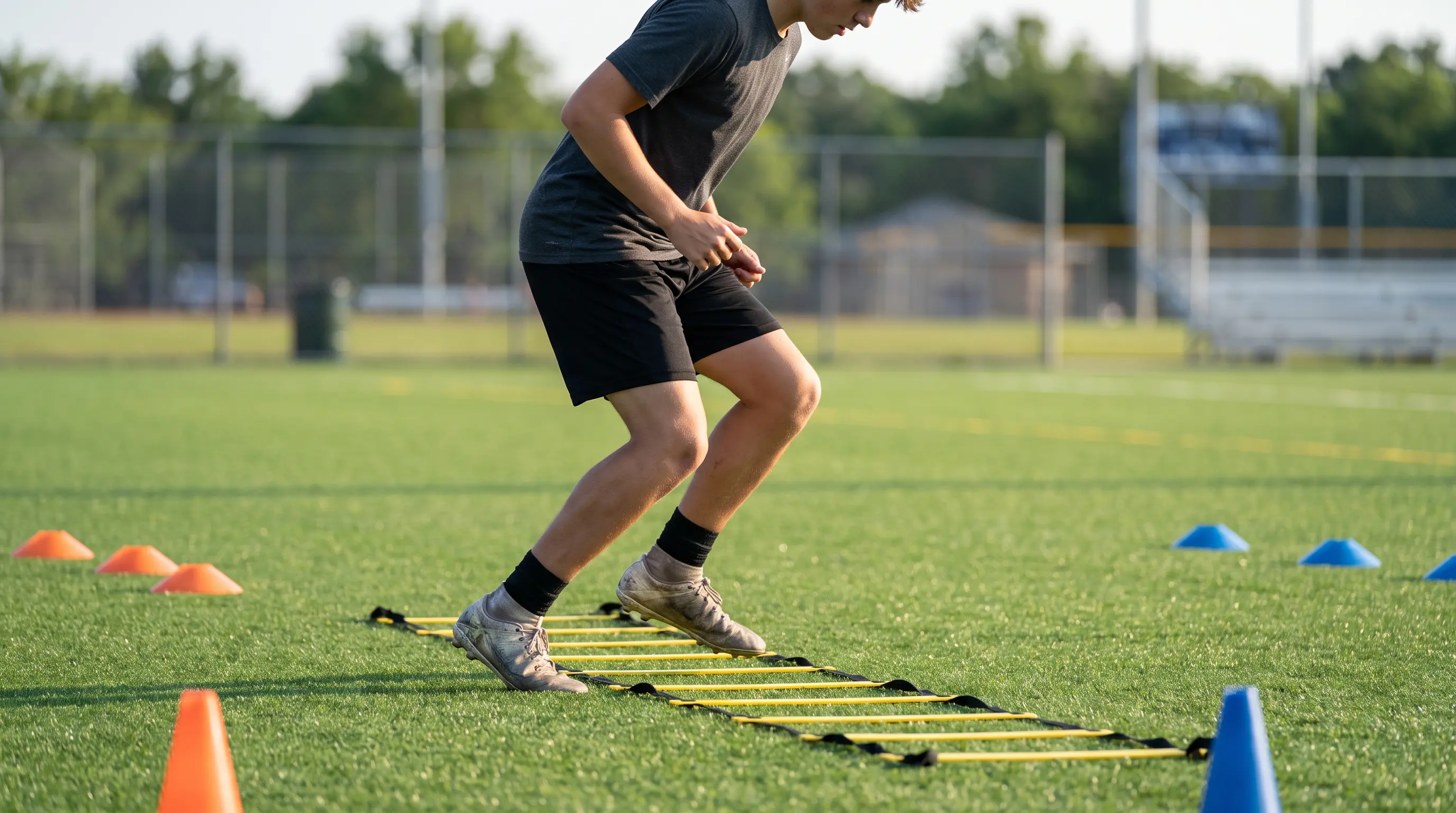
Poor technique at fast speeds builds bad habits that carry into your sport.
- Foot contact: Land on the ball of your foot. Heel-first contact kills momentum and stresses your joints.
- Arms: Keep elbows at roughly 90 degrees. Drive your arms from shoulder height down to your hips. Stiff or flapping arms slow your footwork.
- Posture: Keep a slight forward lean with weight over your toes. Leaning back means you brake with every step.
- Eyes: Keep your head up. Staring at the ladder trains you to look at the ground.
- Speed rule: Walk through the pattern first. Going fast through wrong footwork just cements wrong footwork. Learn the pattern, then build speed.
- Warm up: Spend five minutes on light jogging or quick leg swings before any session. Your muscles need to be ready before fast, precise firing.
Beginner Ladder Drills
Beginner ladder drills use simple footwork patterns to build coordination, balance, and control. Work at a slow to moderate pace. Focus on accuracy first. Speed comes later.
1. Single-Step Run
Source: King Sports
The single-step run is the first drill any beginner should learn. It trains rhythm, posture, and basic footwork.
- Place one foot in each box as you move forward
- Keep steps short and precise, just enough to clear each rung
- Hold a slight forward lean with weight over your toes
- Keep arms bent at 90 degrees and swing lightly
- Focus on smooth rhythm and body control, not speed
- Let your body weight pull you forward through the ladder
2. Lateral Side Step
Source: Coach Brian Lobo
This drill builds lateral control and hip stability.
- Begin with a shuffle from right to left, staying low and controlled
- Transition into a shuffle from left to right, maintaining balance and rhythm
- Perform a right-over-left crossover step, keeping hips stable
- Switch to a left-over-right crossover, focusing on quick foot placement
- Keep movements light, low, and steady throughout
3. In and Out (2-in, 2-Out)
Source: SKLZ
The in and out pattern builds coordination and footwork timing.
- Stand facing the ladder in an athletic stance
- Step your lead foot into the first square
- Bring your back foot into the same square (two feet in)
- Step your lead foot out to the front
- Follow with your back foot into the next square
- Repeat the two-in, two-out pattern down the ladder
- Keep movements quick, controlled, and rhythmic
- Keep hips over knees and knees over feet for stability
- Start slow to learn the pattern, then increase speed
4. Single-Leg Hops
Source: Olympian Labs
Single-leg hops build balance faster than most other beginner drills.
- Hop on one foot through each square
- Keep your other leg bent at about 90 degrees and off the ground
- When you reach the end, turn around and return on the other leg
Intermediate Ladder Drills
Intermediate ladder drills build on basic footwork and focus on speed, coordination, and sharper directional control. They challenge you to stay balanced while moving faster through more complex step patterns.
5. High Knees (Forward)
Source: Live Lean TV Daily Exercises
High knees train foot speed, hip flexor drive, and forward momentum.
- Start at the beginning of the ladder in an athletic stance
- Step one foot into the first box to begin
- Drive your opposite knee up high as you move forward
- Place each step into the next box while keeping a fast rhythm
- Pump your arms at 90 degrees to support speed and balance
- Lean slightly forward with weight over your toes
- Keep your core tight and body controlled through each box
6. Lateral High Knees
Source: Hockey Training Exercise Demonstrations
This drill builds the exact hip mechanics used in defensive slides and rapid cuts.
- Move sideways down the ladder while driving your knee high
- Step your lead leg into the square
- High-knee your trail leg in
- Step the lead out, then the trail out
- Progress to the next square and repeat
7. Carioca
Source: King Sports
Carioca trains hip rotation and lateral coordination.
- Start at the ladder in an athletic stance
- Step one foot into each box with smooth hip rotation
- Rotate your hips as you cross in front of and behind your body
- Keep one foot per box throughout
- Drive the back foot around to complete each crossover
- Keep arms bent at 90 degrees and moving across your body for balance
- Stay light, controlled, and rhythmic
- Turn around and repeat in the opposite direction
8. Ickey Shuffle
Source: SKLZ
The ickey shuffle builds forward momentum through fast, small, controlled steps.
- Start at the ladder in an athletic stance
- Step both feet in and out of each box in an Icky Shuffle pattern
- Move forward with fast, small, controlled steps
- Stay light on your feet and keep a steady rhythm
- Keep movements smooth and coordinated through each box
- Focus on balance and quick reaction, not speed alone
Advanced Ladder Drills
Advanced ladder drills focus on speed, reaction, and precision under pressure. The goal at this level is efficiency. That means clean foot placement, sharp transitions, and consistent rhythm even at high speed.
9. Backward Ickey Shuffle
Source: Northeastern
This drill trains backward movement control and footwork under pressure.
- Start at the end of the ladder, facing forward
- Move backward along the ladder instead of forward
- Step one foot into the first box, then bring the other foot in
- Step the first foot out backward, followed by the second
- Continue the in-in, out-out pattern while moving in reverse
- Keep steps quick, light, and controlled
- Stay low with a stable core and balanced posture
- Avoid crossing feet or losing alignment while moving backward
10. Single-Leg Shuffle
Source: King Sports
The single-leg shuffle trains single-leg stability at speed.
- Start facing forward beside the ladder in an athletic stance
- Move along one side of the ladder with quick, light steps
- Touch each box with only your inside foot as you progress
- Keep your outside foot moving steadily to maintain pace
- Stay low with hips square and core engaged
- Focus on fast, precise touches into each square
- Avoid crossing your feet or overstepping
- Repeat on the opposite side using the other foot
11. Skip-a-Square Patterns
Source: BPC Performance Coaching
Skip-a-square patterns challenge timing and precision at high speed.
- Start at the beginning of the ladder in an athletic stance
- Step into the first box and skip forward over the next square
- Land in the following box with light, controlled foot placement
- Continue the skip-a-square pattern down the ladder
- Keep steps rhythmic, balanced, and coordinated
- Stay light on your feet with a slight forward lean
- Keep arms active to support timing and movement
- Focus on consistency and clean foot placement
Agility Ladder Training for Kids

Ladder drills work well for children from around age 6 or 7. The approach needs to change as they get older.
- Ages 6 to 9: Keep it simple. Use single-step runs, lateral steps, and two-foot hops. Sessions should stay at 10 to 15 minutes and feel like play. Races or relay games keep kids engaged.
- Ages 10 to 13: Introduce patterns like the ickey shuffle and carioca. Teach the pattern slowly first. Then gradually increase speed as control improves.
Avoid heavy plyometric work, such as bounding or depth jumps, at younger ages. Ladder drills are safe. Heavy plyometrics should wait until the early teens.
Two sessions per week is enough. More is not needed at these ages.
Common Ladder Drill Mistakes
| Mistake | What Happens | Fix |
|---|---|---|
| Rushing before you know the pattern | Fast wrong footwork becomes a habit | Walk through each new drill at half speed first |
| Only running one direction | Creates a lateral bias to one side | Do every lateral drill both ways |
| Stepping on the rungs | Signals sloppy footwork, not speed | Slow down until accuracy improves, then rebuild |
| Doing daily sessions | Nervous system does not recover fully | Stick to 2 to 4 sessions per week |
How Often Should You Do Ladder Drills?
Two to four sessions per week is the right range for most people. Each session should run about 10 to 15 minutes.
Daily sessions do not give your nervous system time to recover and produce diminishing returns quickly.
Ladder Drills: Where to Start
Pick one drill: the single-step run. Do it three times per week for one week.
Focus on form: ball of foot, arms at 90 degrees, eyes up, slight forward lean. Do not worry about speed yet.
After one week of clean reps at a controlled pace, start pushing the pace. After two or three weeks, add a second drill. That is the full progression. You will feel the difference in your footwork faster than expected.
If you train young athletes, pair the ladder with cone drills. That gives you a complete speed development warm-up that takes under 20 minutes.
Frequently Asked Questions
What muscles do ladder drills work?
Ladder drills mainly work the calves, quads, hamstrings, glutes, and core. They also improve ankle stability and foot coordination.
What are the disadvantages of ladder drills?
Ladder drills do not build sprint speed or power on their own. Done too fast, they can reinforce sloppy footwork instead of clean movement.
How often should I do ladder drills?
Do ladder drills 2 to 4 times per week with rest days between sessions. This gives your nervous system time to recover.
Can you do ladder drills without a ladder?
Yes. Use tape, chalk, floor tiles, or imaginary grid lines. The footwork pattern matters, not the equipment.
Are ladder drills good for kids?
Yes, from around age 6 or 7. Keep sessions short, simple, and fun. Focus on coordination, not conditioning.









One Response