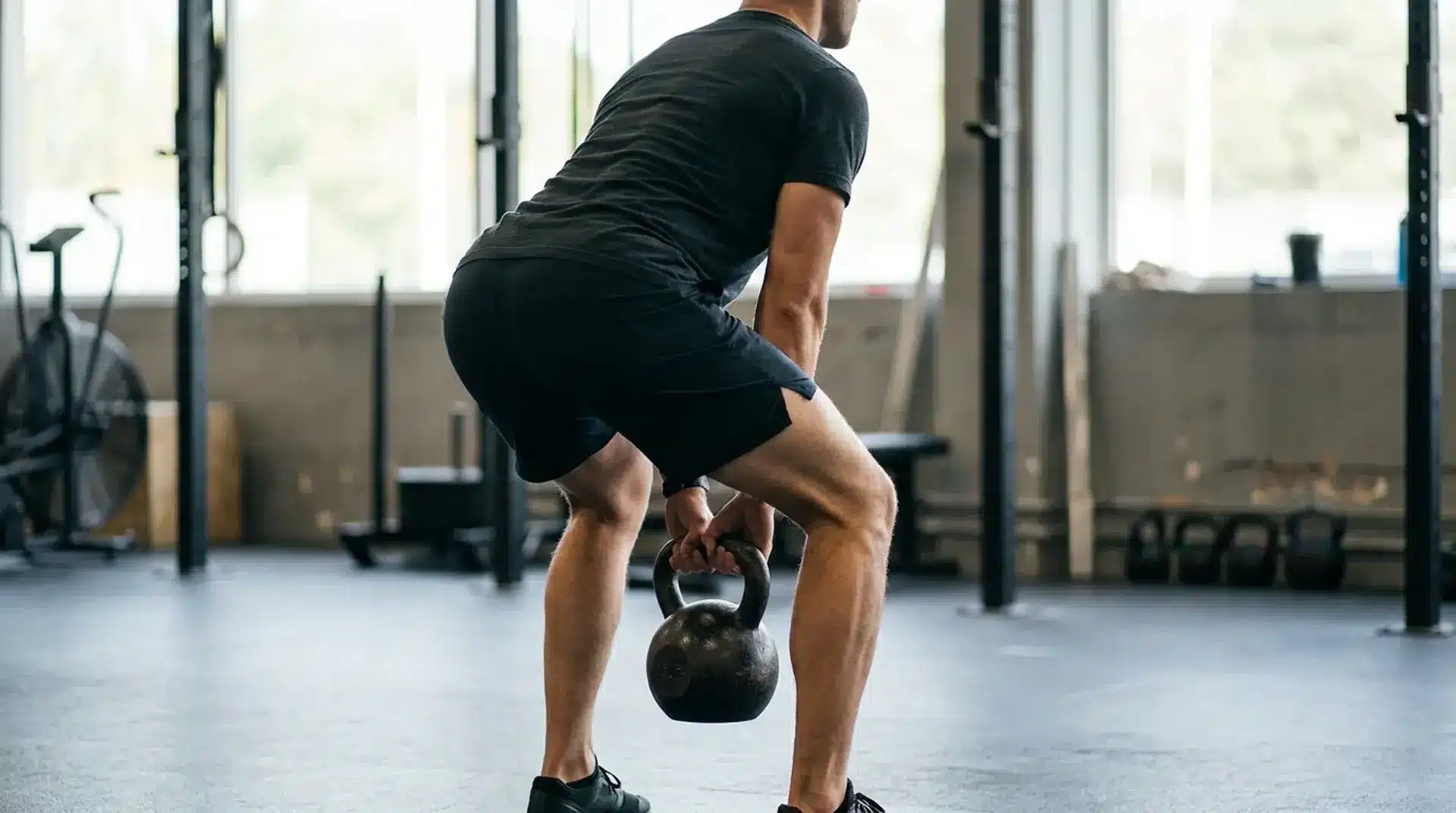
Kettlebell deadlifts build lower-body strength while teaching the hip hinge pattern used in everyday lifting. They target the glutes, hamstrings, and core, making them a great option for beginners learning proper deadlift form.
Research shows consistent resistance training improves strength and movement capacity when paired with proper technique.
This article covers setup, starting weight, common mistakes, and progressions to help you lift safely.
What Is a Kettlebell Deadlift?
A kettlebell deadlift is a strength exercise where you lift a kettlebell from the floor to a standing position. You do this by hinging at your hips, not bending primarily at your knees.
You can hold one kettlebell with both hands, or hold a single kettlebell in each hand at your sides. The movement trains the hip hinge, the same pattern used in kettlebell swings, cleans, and other lower-body exercises.
The hip hinge is one of the most fundamental movement patterns for everyday life. You use it any time you bend forward to pick something up, load the dishwasher, or lift a bag off the floor.
Kettlebells are lighter and easier to control than a loaded barbell. This makes the exercise a good starting point for anyone new to strength training or looking to refine their lifting mechanics.
Important: If you have current low back pain or a recent back injury, speak with a doctor or physical therapist before trying this movement.
What Muscles Do Kettlebell Deadlifts Work?
The kettlebell deadlift works more muscle groups than a glance at the exercise might suggest. The table below shows which muscles are active during the lift, what each one does, and why it matters.
| Muscle Group | Role During the Lift | Why It Matters |
|---|---|---|
| Glutes & Hamstrings | Primary movers; drive hip extension | These muscles do most of the lifting work from the floor to standing |
| Erector Spinae (Lower Back) | Stabilizes the spine throughout the lift | Weak spinal muscles increase the risk of lower back strain |
| Lats & Traps (Upper Back) | Keep the kettlebell close to the body and shoulders in position | Rotating elbows inward at setup activates these muscles |
| Forearms & Grip | Control the handle throughout the lift | Work harder here than in a barbell deadlift due to the narrower handle |
| Core | Stabilizes the torso under load | Bracing before each rep protects the spine |
| Adductors (Inner Thighs) | Support the narrower stance required by the kettlebell | More active here than in a wide-stance barbell deadlift |
Benefits of Kettlebell Deadlifts
Here is why this exercise works well in a beginner or intermediate strength program:
- Beginner-friendly: The compact, balanced load is easier to manage than a barbell, which makes it a lower-risk way to learn the hip hinge.
- Teaches a foundational movement pattern: The hip hinge you build here carries over directly to kettlebell swings, cleans, and everyday lifting tasks.
- Trains multiple muscles at once: One exercise works your glutes, hamstrings, back, core, and grip together, with no need for several isolation movements.
- Home training ready: One or two kettlebells are all the equipment you need to get started.
- Builds toward harder variations: Once the basics feel solid, sumo, single-leg, and double versions keep the challenge growing as your strength improves.
How Much Weight Should Beginners Use for Kettlebell Deadlifts?
Start with a weight light enough to complete every rep with a neutral spine and full control.
A common starting range is 2 to 3 sets of 6 to 15 repetitions. The right number depends on your current fitness level and how well your form holds across the full set.
If your back rounds or your form breaks down before the set is done, the weight is too heavy. Learning the movement with a lighter weight is far better. Rushing to heavier loads risks an injury that delays your progress.
Training Frequency Tip: Train kettlebell deadlifts 2 to 3 times per week. Include rest days between sessions to support muscle recovery and strength gains. Pair them with other lower-body exercises and allow enough recovery time between sessions.
How to Do a Kettlebell Deadlift
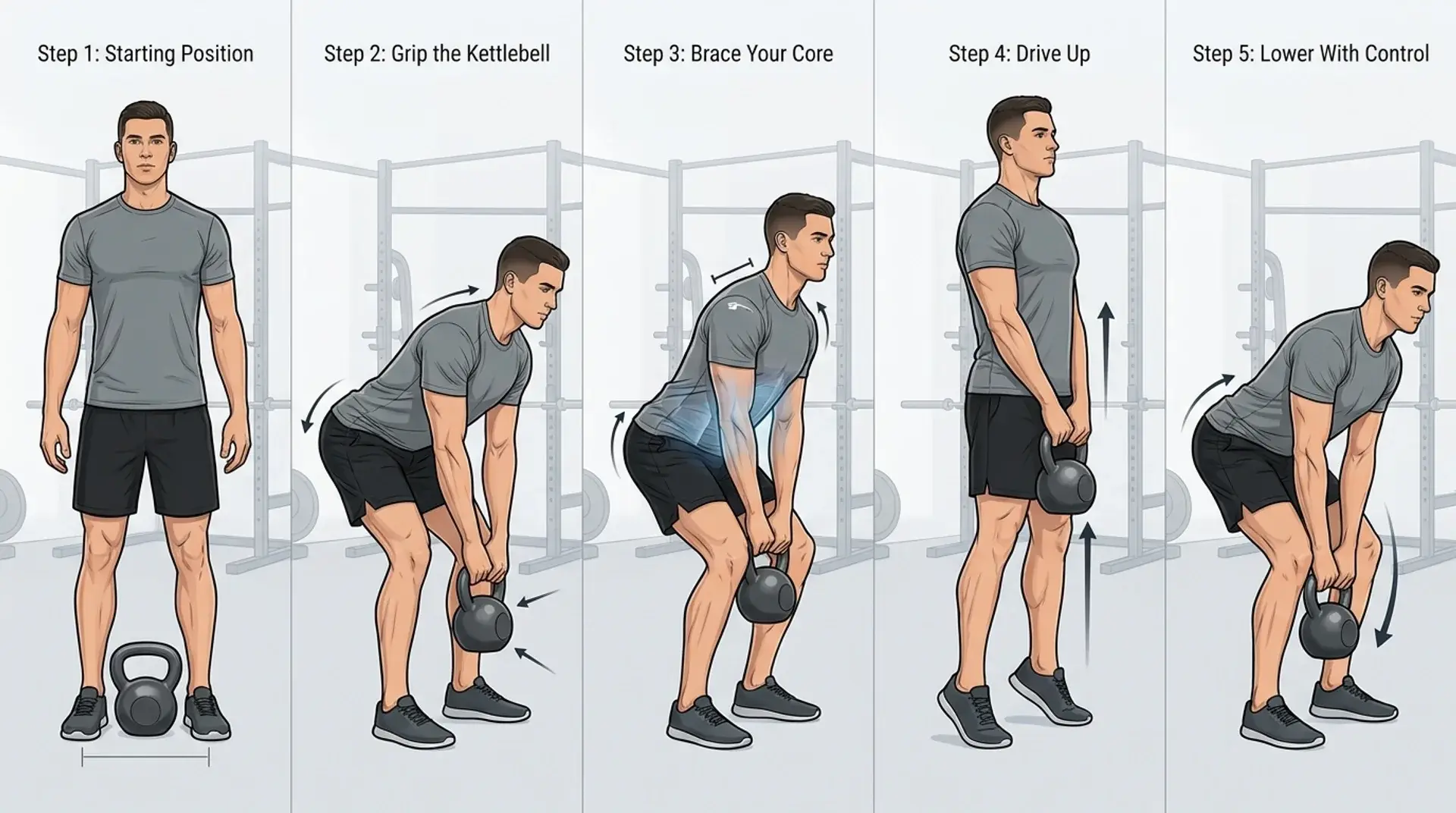
Follow these five steps to perform a kettlebell deadlift with correct form. Take your time at each stage, especially if you are new to the hip hinge movement.
Step 1: Set Your Starting Position
Stand with your feet about hip-width apart. Place the kettlebell on the floor between your feet, or a few inches in front of them.
Point your toes forward and shift your weight slightly back toward your heels. This setup keeps the kettlebell close to your body as you hinge down. It protects your lower back and makes the lift easier to control from the start.
Step 2: Set Your Grip
Hinge down to the kettlebell and grip the handle with both hands, palms facing your body. Hold the handle in the hook of your fingers, not pressed tightly into your palm.
A tight, squeezed grip tires your forearms out too quickly. Keep your wrists straight throughout the lift. Bent wrists weaken your arm position and can cause discomfort over time.
Step 3: Set Your Back and Brace Your Core
Before you lift, raise your chest and position your shoulders slightly higher than your hips. Keep your spine neutral, not rounded. Rotate your elbows slightly inward to engage your upper back muscles.
Take a breath and brace your core firmly, as if bracing against pressure to your stomach. This keeps your torso stable as you drive upward and protects your spine under load.
Step 4: Lift the Kettlebell
Push through your heels and mid-foot as you drive your hips forward to reach the standing position. Let the kettlebell rise naturally as your hips extend. Do not pull it up with your arms.
Squeeze your glutes firmly at the top. Avoid leaning back or arching beyond an upright position at the lockout. That adds stress to your lower back over time.
Step 5: Lower the Kettlebell
Reverse the movement by hinging your hips back first. Then bend your knees as needed to lower the kettlebell back to the floor. Keep it close to your legs throughout.
Maintain a neutral spine until the kettlebell touches down. If you are still learning the pattern, pause briefly at the bottom. Reset your grip and brace before starting the next rep.
Kettlebell Deadlift Mistakes and How to Fix Them
These five form errors appear regularly when learning the kettlebell deadlift. Each one comes with a simple correction you can apply at your next session.
| Mistake | Why It’s a Problem | How to Fix It |
|---|---|---|
| Rounding the lower back | Puts excessive stress on spinal discs and ligaments | Brace your core before you lift. If hamstrings are tight, raise the kettlebell slightly on a platform to shorten the range. |
| Squatting the weight up | Turns a hip hinge exercise into a knee-dominant movement, reducing glute and hamstring work | Push your hips back first, then bend your knees only as much as needed. |
| Gripping too tightly | Tires your forearms before your legs and back have finished working | Relax your hands. Hold the handle in the hook of your fingers, not squeezed into your palm. |
| Letting the kettlebell drift forward | Increases strain on the lower back by changing the pulling path | Start with the kettlebell between your ankles. Keep it close to your body throughout the entire lift. |
| Bending or cocking the wrist | Weakens your grip and overall arm position under load | Keep your wrists straight and locked from setup through to the top of the lift. |
Kettlebell Deadlift Variations to Try Next
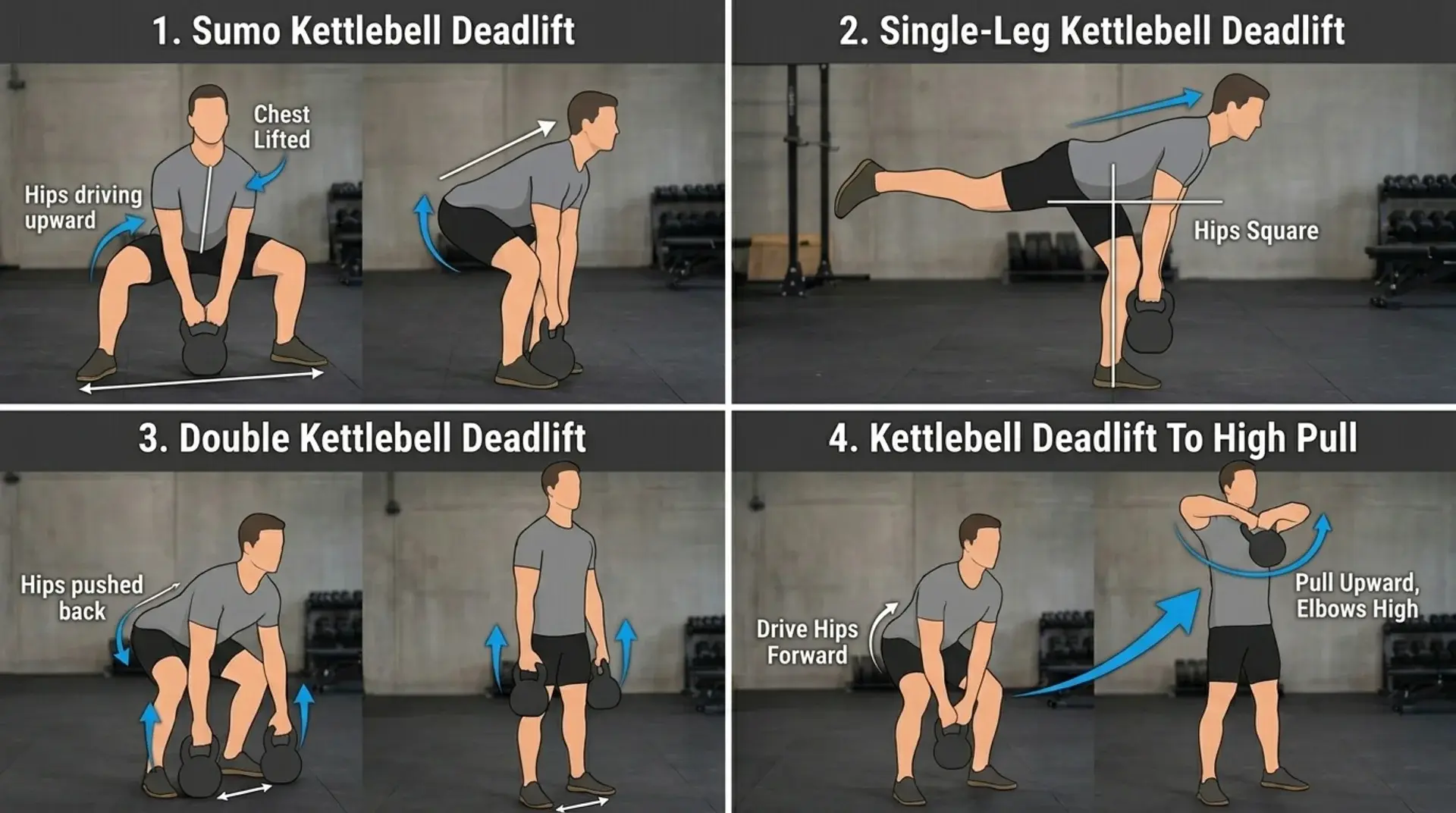
Once the standard kettlebell deadlift feels controlled and repeatable, these four variations give you new goals to work toward.
1. Sumo Kettlebell Deadlift
The sumo kettlebell deadlift uses a wider stance with your toes turned out. The kettlebell sits in line with your heels instead of between your feet.
This position places more work on your quads and inner thighs while reducing load on your lower back. It also shortens the range of motion, which can help if you have long legs or tight hips. Try this variation once your standard form feels solid.
2. Single-Leg Kettlebell Deadlift
The single-leg kettlebell deadlift works one hamstring and glute at a time while also training your balance. Hold the kettlebell in the opposite hand from your standing leg. Hinge forward while extending your free leg straight behind you.
Keep your hips square to the floor throughout the movement. This variation highlights strength differences between your left and right sides. Start with a light weight and move slowly at first.
3. Double Kettlebell Deadlift
The double kettlebell deadlift uses one kettlebell in each hand rather than both hands on a single handle. This setup lets you load more total weight, since you are no longer limited to one handle.
Keep both kettlebells close to your legs and your hips square as you lift. Move to this variation after you have full control of the single kettlebell version and want more resistance.
4. Kettlebell Deadlift to High Pull
The kettlebell deadlift to high pull adds an explosive pulling motion at the top of the movement. After standing up from the deadlift, pull the kettlebell up toward your chin, leading with your elbows.
This adds shoulder and upper back work on top of the hip hinge. Save this for when your basic deadlift form is consistent and controlled. The pull introduces a new movement layer that requires good body awareness.
Building Strength Starts with the Right Foundation
Kettlebell deadlifts build real strength in your glutes, hamstrings, and back. They also teach a movement pattern that carries directly into everyday life.
Start light, keep the kettlebell close, and brace before every rep. Form comes before load, every single time. Once the basics feel controlled, the sumo, single-leg, and double variations give you a clear path forward.
Disclaimer: This article is for general fitness information only and does not replace medical advice. Consult a doctor or physical therapist if you have injuries, health conditions, or concerns before exercising.
Frequently Asked Questions
Can kettlebell deadlifts replace barbell deadlifts?
They train the same hip-hinge pattern but cannot match a barbell for maximum load. They work well for learning the movement, improving mechanics, or training without a full gym setup.
Why do kettlebell deadlifts feel easier than barbell deadlifts?
The load sits between your feet, creating a natural, close-body pulling path. The simpler setup makes the movement feel more accessible even when your glutes and hamstrings are working hard.
Can kettlebell deadlifts help improve your kettlebell swing?
Yes. Both movements use the hip hinge. Deadlifts teach you to load and drive through your hips first. The swing then adds speed and momentum to that same pattern.
Why does the kettlebell drift away from my legs during a deadlift?
A forward-drifting kettlebell usually means your starting position or hinge path has shifted. Positioning the bell around your midfoot at setup helps maintain a tighter, more efficient pulling line.
Should you pause the kettlebell on the floor between reps?
A brief reset between reps helps you rebuild your brace, foot pressure, and hip-hinge position from scratch. It also stops momentum from changing the movement pattern across a longer set.
Is a kettlebell deadlift good for beginners?
Yes. The compact load and straightforward setup make it one of the best starting points for learning the hip hinge. Begin with a light weight and master form before increasing the load.