
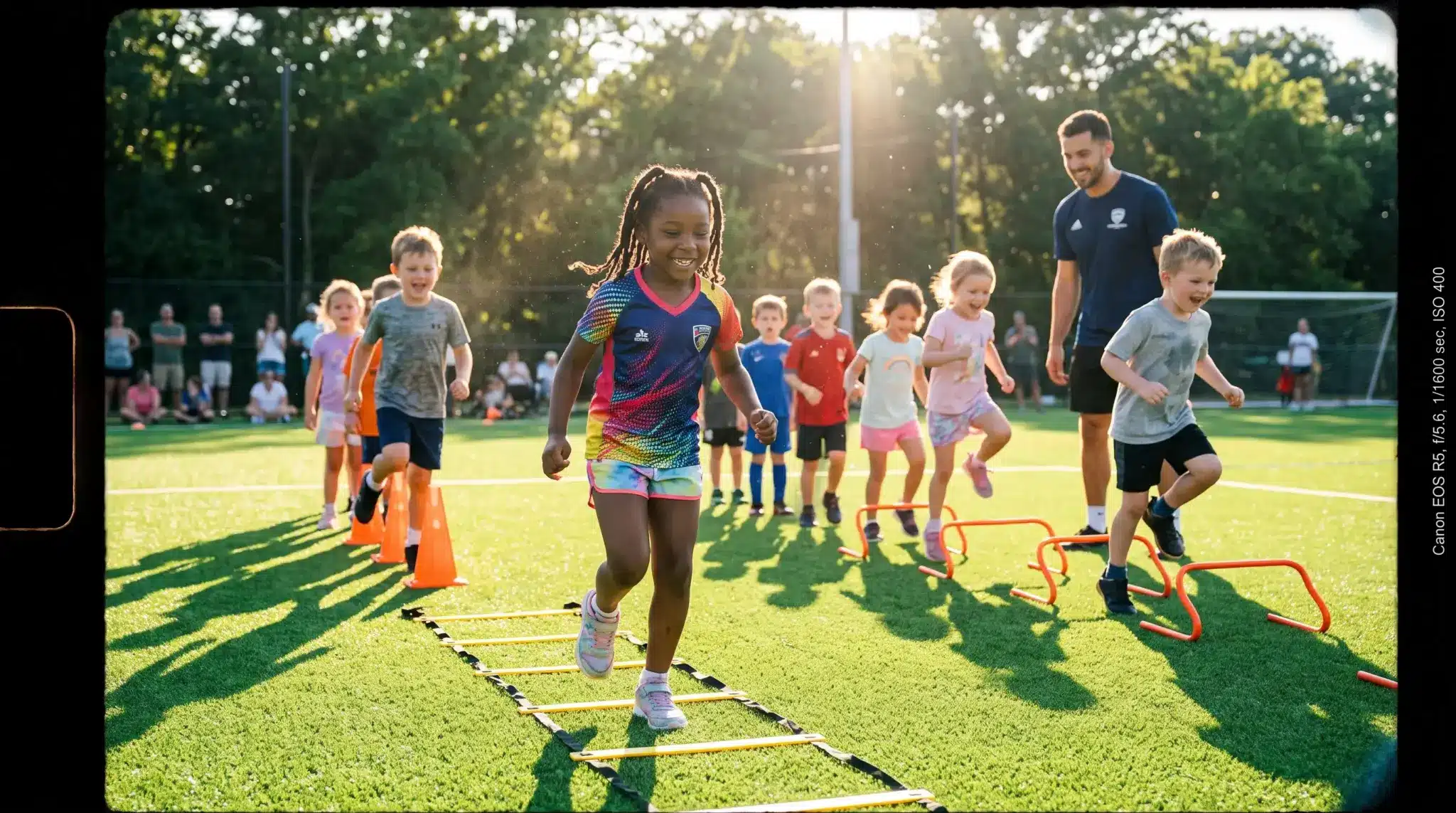
If you’ve searched for agility training for kids, you’ve probably found drill lists but little guidance on what fits each age group.
Real progress comes from matching movements to a child’s developmental stage, not just using cones or ladders. From toddlers learning basic coordination to teens improving sport-specific speed, each stage needs a different approach.
This post covers what agility is, age-based training tips, six key drills, a sample weekly routine, and important safety rules.
What Is Agility Training for Kids?
Agility is the ability to change direction, slow down, and speed back up while staying balanced and in control. It is different from pure speed, which is simply running fast in a straight line.
A child can be quick in a sprint and still struggle to cut sharply around a defender. They might also fail to catch themselves after tripping on the playground. That gap is what agility work closes.
Coaches break agility down into five working parts:
- Balance
- Coordination
- Raw speed
- Leg and core strength
- Reaction time
When these come together, a child can respond to an unpredictable cue. They can adjust their body quickly in response to a teammate, a bouncing ball, or a sudden cue.
Agility training is also worth separating from strength training. Building agility does not involve lifting anything heavier than a child’s own body weight. It teaches the nervous system and muscles to communicate faster. That is a skill, not a matter of force.
Benefits of Agility Training for Kids
Agility training helps kids build better coordination, balance, speed, and body control. These improvements support both physical and mental development.
Drills also strengthen reaction time and decision-making. Many exercises use visual or verbal cues, such as responding to colors, sounds, or a coach’s hand signal. This trains the brain alongside the body.
Learning to accelerate, slow down, and land safely helps children move more in control. It also reduces the risk of awkward falls or injury during play.
Beyond sport, these skills carry into everyday life. A child with agility training moves more confidently in busy spaces. They recover better from unexpected movements and stay balanced across many activities.
Children who build these foundations early are better prepared for speed and agility training as they move into sport-specific programs.
Agility Training by Age Group
Training should look different at age six than it does at age sixteen. The table below gives a quick overview before the full breakdown.
| Age Group | Main Focus | Recommended Frequency |
|---|---|---|
| 2–5 years | Body awareness, play-based movement | A few short sessions a week |
| 6–10 years | Coordination, rhythm, basic patterns | 1–2 sessions, 20–30 minutes |
| 11–13 years | Technique, change-of-direction control | 2 sessions, 25–35 minutes |
| 14+ years | Performance, reactive game-speed movement | 2–3 sessions, 30–40 minutes |
Ages 2–5: Foundational Movement Play
Source: The Moververse
At this stage, nothing should resemble a formal workout. The goal is to help a child feel comfortable moving in different directions.
Good activities for this age group include:
- Obstacle courses with tunnels, pillows to hop over, and chairs to zigzag between
- Animal walks such as bear crawls, crab walks, and frog hops
- Hopscotch on a chalk grid
- Games like freeze tag or sharks and minnows
Keep it short, playful, and low pressure. Fun is the only metric that matters at this age.
Ages 6–10: Building Coordination and Confidence
Source: Parenting Whispers
This is usually when simple ladder drills enter the picture for the first time. A chalk grid on the driveway works just as well as a store-bought ladder.
Good drills at this stage include:
- Ladder patterns: one foot per square, then in-in-out-out
- A light cone shuffle with three cones five feet apart, using side-to-side movement
- Toss-and-balance games: hopping on one foot while catching a ball
Two short sessions a week, kept under 30 minutes, are plenty at this stage.
Ages 11–13: Technique and Control
Source: Little Sports
As growth spurts begin to affect coordination, the focus shifts toward clean mechanics before adding speed.
Useful drills for this group include:
- Cone zig-zags for change-of-direction practice
- A simplified shuttle run between two lines
- Sport-specific weaving drills, such as dribbling a ball through cones
- Reaction sprints triggered by a coach’s cue rather than a countdown
Emphasize good form throughout. Speed comes after technique is consistent.
Ages 14+: Sport-Specific Agility Training
Source: JoeyBergles
Older kids can handle more reactive, sport-specific work. The training can now mirror the unpredictable demands of real game situations.
Effective drills for this group include:
- A four-cone box drill combining shuffle, backpedal, and sprint
- Hurdle hop progressions for explosive movement
- Resistance-band lateral shuffles
- Partner-cued sprints that mirror real game decisions
Across every age group, watching a demonstration first makes a real difference. Good form is far easier to build than to correct later.
A Sample Weekly Routine for Kids’ Agility Training
Most guides stop at listing drills without showing how to structure a full week. The template below works across age groups. Adjust duration and intensity based on your child’s age.
| Day | Focus | Sample Activities |
|---|---|---|
| Day 1 | Coordination | Warm-up jog, ladder drills, light cone weave, cool-down stretch |
| Day 2 | Speed and Reaction | Warm-up, sprint-and-stop drills, reaction cue sprints, partner toss-and-balance |
| Day 3 | Mixed Agility | Cone zig-zag, short hurdle work (older kids), bodyweight core work like planks |
Younger children can shorten each session and rely more on games. Older kids can extend drills and add resistance-based variations. Rest days between sessions matter just as much as the work itself.
Best Agility Exercises for Kids
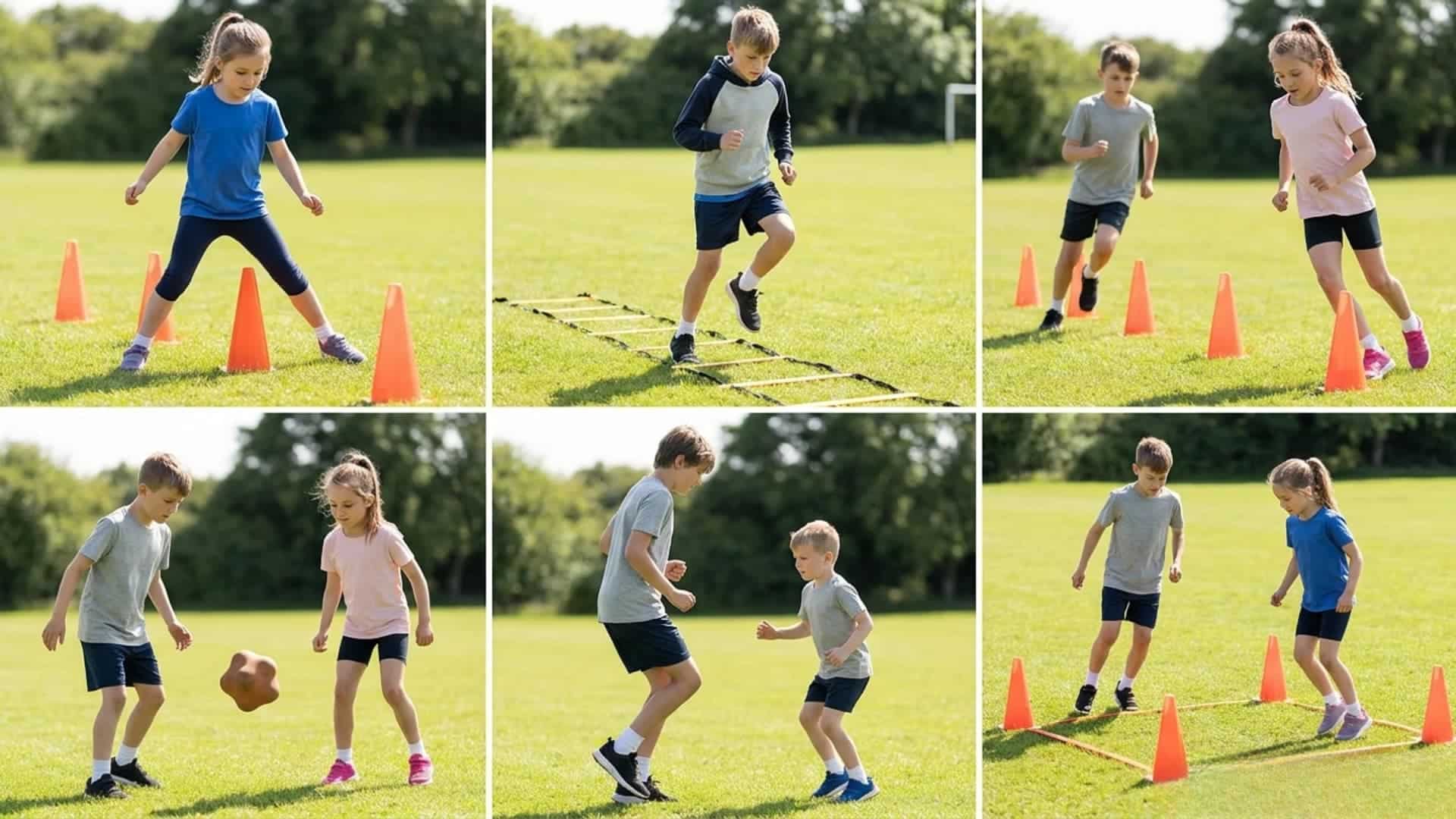
Agility exercises for kids focus on improving coordination, balance, speed, and body control through movement activities. Here are six exercises that work well across different age groups.
1. Cone Shuffle Drill
The cone shuffle drill helps kids improve lateral movement, balance, and body control. Set up cones in a straight line. Have your child shuffle side to side while staying low and keeping their feet moving quickly.
Good for: Ages 6 and up. Start slow, then build speed once the footwork is clean.
2. Agility Ladder Footwork Drills
Ladder drills build coordination, foot speed, and movement accuracy. Kids can practice patterns like one-foot steps, two-foot runs, and side steps. These improve quick reactions and overall agility over time.
Good for: Ages 6 and up. Chalk on a driveway works fine if you don’t have a physical ladder.
3. Shuttle Run Drill
The shuttle run builds acceleration, stopping ability, and quick direction changes. Kids sprint between two marked points while practicing controlled turns and explosive starts.
Good for: Ages 8 and up. Keep the distance short for younger children.
4. Reaction Ball Drill
A reaction ball drill improves reflexes, hand-eye coordination, and decision-making. The unpredictable bounce forces kids to react quickly and shift their movements on the spot.
Good for: Ages 10 and up. Start at a slow pace, so children build confidence with the bounce.
5. Mirror Drill
The mirror drill builds reaction speed and defensive footwork. One child leads with quick movements while the partner copies them. This improves responsiveness and coordination in both players.
Good for: Ages 8 and up. Works well in pairs and does not need equipment.
6. Box Drill
The box drill teaches kids how to change direction quickly while staying balanced. Moving around a square pattern builds agility, speed control, and efficient footwork.
Good for: Ages 10 and up. Use cones to mark the corners clearly.
Equipment Needed for Kids’ Agility Training
You do not need a training facility to get started. A backyard, driveway, or park works fine as long as there is enough open space to move safely.
Basic Equipment (Free or Low Cost)
- Open, flat space
- Chalk or tape to mark a DIY ladder or grid
- Four to six cones, or household items like cups or water bottles
Optional Additions
- A store-bought agility ladder for consistent spacing
- Mini hurdles for hop and bound work
- A reaction ball for unpredictable bounce drills
If motivation is a bigger challenge than equipment, give your child a short list of drills to choose from on training days. Letting them pick builds a sense of ownership. Kids who choose their own activities tend to stay more consistent than those given a fixed list each session.
Safety Tips for Kids Doing Agility Exercises
Following a few basic safety rules helps kids train well and avoid unnecessary strain. The table below covers the key dos and don’ts.
| Do | Don’t |
|---|---|
| Teach proper technique before adding speed | Add weighted vests or heavy resistance too early |
| Keep sessions short, playful, and age-appropriate | Run drills back-to-back without rest between sets |
| Warm up with light movement before starting drills | Push speed at the expense of clean form |
| Use supportive footwear on a safe surface | Compare one child’s progress to another’s |
Warning Signs the Program May Not Suit Your Child
- Your child consistently dreads sessions rather than enjoying them
- Complaints of joint pain rather than normal muscle fatigue
- Technique breaks down visibly as fatigue increases
- No visible improvement after six or more weeks of consistent practice
If any of these appear, scale back the intensity. Check in with a pediatrician or sports medicine professional before continuing.
Common Mistakes in Kids’ Agility Training to Avoid
Common mistakes include pushing speed or complexity too early, running sessions that are too long, and skipping warm-ups. Each one slows progress and increases the risk of frustration or injury.
Skipping the basics. Jumping to advanced ladder patterns before a child can hop, skip, and control their body weight leads to problems later. The basics are not optional steps to rush through.
Treating agility and strength as separate. The two work together. Core and leg strength support every change in direction. Training both at once produces better results than focusing on one alone.
Overloading the schedule. More drills per session does not equal faster progress. Recovery matters just as much as the work itself. A child who rests well between sessions improves faster than one who trains every day without a break.
Comparing children. Every child develops at their own pace. Pushing comparisons leads to frustration, not better results. Track individual progress over time, not performance against peers.
Start Simple and Build From There
Agility training for kids works best when it matches a child’s age and current stage. Rushing toward advanced moves before the basics are solid slows progress rather than speeding it up.
The same rules apply at every level: technique before speed, short and playful sessions, and enough rest between drills.
Cone drills, ladder footwork, and simple reaction games cost almost nothing and deliver steady results with consistent practice.
Pick two or three drills suited to your child’s age and try them this week. Watching a quick demonstration before a new drill helps you and your child get the footwork right from the start.
Frequently Asked Questions
At what age should kids start agility training?
Children can begin basic agility activities as early as age two or three. Play-based movement like obstacle courses, animal walks, and hopscotch works well at this stage. Structured drills with cones and ladders are more appropriate from around age six.
How often should kids do agility training?
Two to three short sessions per week is enough for most children. Sessions should stay under 30 to 40 minutes, depending on the child’s age and attention span.
Which game helps improve agility in kids?
Games like soccer, basketball, tennis, and tag improve agility by encouraging quick reactions and fast direction changes. Obstacle courses also build balance and body control. These games work because they are unpredictable and fun.
Why do many kids quit sports?
Many children quit sports due to burnout, pressure to perform, and a loss of enjoyment when play becomes too competitive. Lack of fun, poor coaching, limited playing time, and injuries are also common reasons.
Do kids with ADHD struggle with agility sports?
Some children with ADHD may find certain sports harder due to challenges with attention, impulse control, and multi-step instructions. Short, varied, and structured drills tend to work better for this group than long, repetitive sessions.