
Your neck should not hurt this much just from checking your phone. But for most people who sit at a desk or scroll through social media every day, neck pain has become a very routine part of daily life.
Tech neck is what happens when your head stays tilted forward for too long. The extra weight on your spine builds up over time, and your muscles end up paying the price. You can fix it, though.
This post walks you through practical ways to get rid of tech neck and feel better.
How Does Tech Neck Happen?
When you look down at a screen, your head shifts forward from its natural position. A neutral head weighs around 10 to 12 pounds. But at a 45-degree tilt, the load on your cervical spine rises to nearly 49 pounds.
This was confirmed by research conducted by Dr. Kenneth Hansraj and published in Surgical Technology International.
Your neck muscles were never designed to hold that kind of load for hours. That constant strain leads to tightness, muscle fatigue, and pain that does not go away without some direct attention.
Signs You Have Tech Neck
Not all neck pain traces back to a bad night of sleep or an old injury. If you spend most of your day looking at a screen, your body is probably sending clear signals that something needs to change.
- Stiffness at the base of your skull: You feel tightness or soreness right where your neck meets the back of your head.
- Aching between your shoulder blades: A dull ache settles in your upper back after long hours at a desk.
- Tension headaches: These start at the back of your head and move forward, usually by the end of the day.
- Rounded or hunched shoulders: Your shoulders roll forward without you noticing, a direct result of poor screen posture.
- Tight chest muscles: The muscles across your chest shorten from sitting hunched, pulling your posture further down over time.
- Numbness or tingling in your arms: This can mean the nerves in your cervical spine are being compressed. Get this checked by a doctor.
10 Ways to Get Rid of Tech Neck Pain
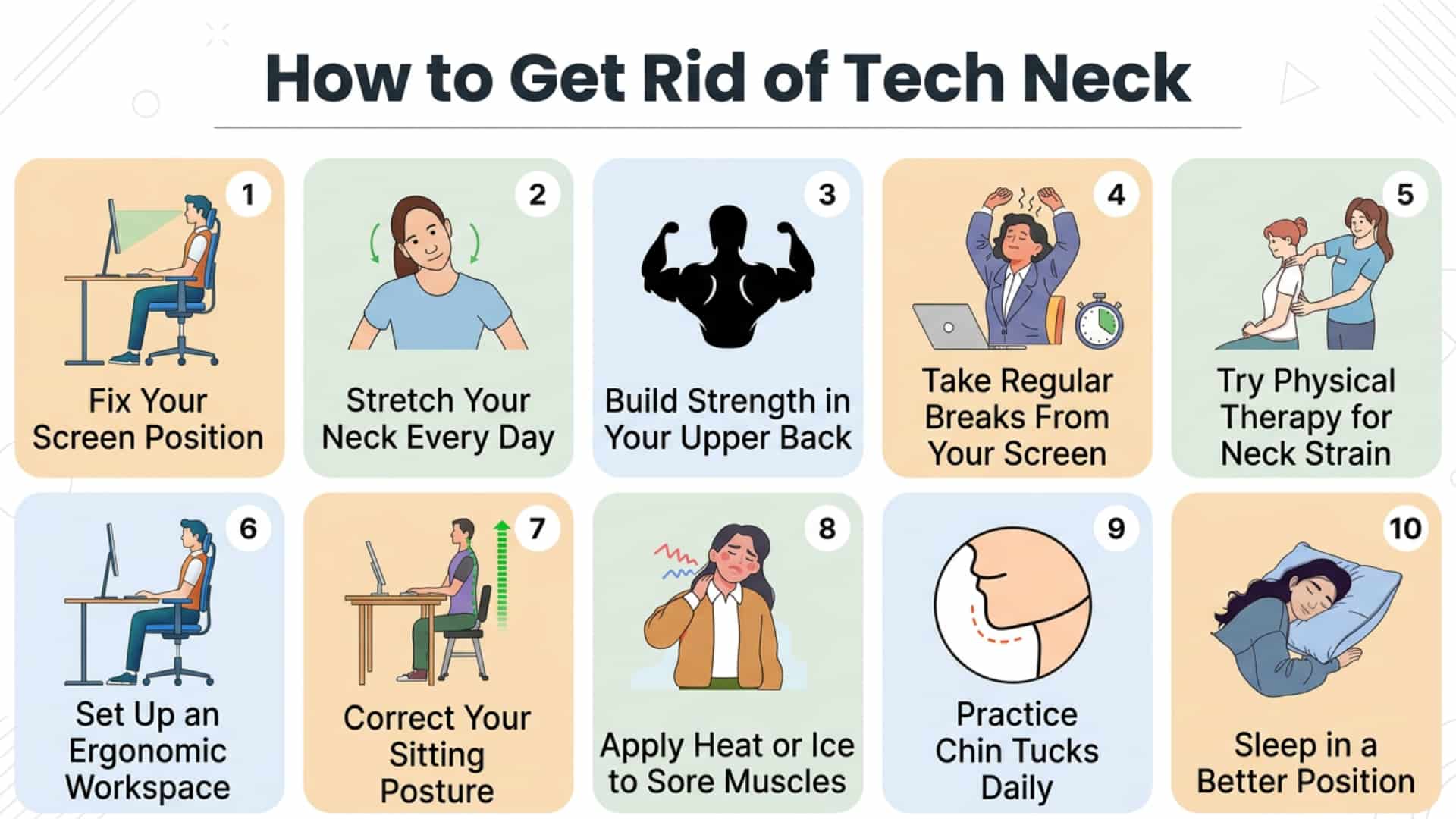
Fixing tech neck does not require expensive treatments or hours of free time. Small, consistent changes to how you sit, move, and set up your space produce real results over time.
1. Fix Your Screen Position
The top of your screen should sit at or just below your eye level. When you look slightly downward at the screen, your neck stays in a more neutral position.
Raise your laptop with a stand and pair it with an external keyboard so your arms stay relaxed. Use your phone at eye level instead of tilting your head down toward it.
Quick Positioning Check:
- Monitor the top edge at or just below eye level
- Screen roughly arm’s length from your face
- Phone held up, not looked down at
2. Stretch Your Neck Every Day
Stretching loosens the muscles that tighten from hours in a fixed position. The cervical side bend, chin-to-chest stretch, and gentle neck rotations are the three most useful moves for daily relief.
Hold each stretch for 20 to 30 seconds and repeat on both sides. Doing this twice a day makes a noticeable difference over a few weeks.
Want the full routine? We have broken down eachneck stretch step by step, with video references to help you get the movement right.
3. Build Strength in Your Upper Back
Stretching gives you short-term relief, but building strength prevents the pain from coming back. When your upper back muscles are weak, your head naturally drifts forward.
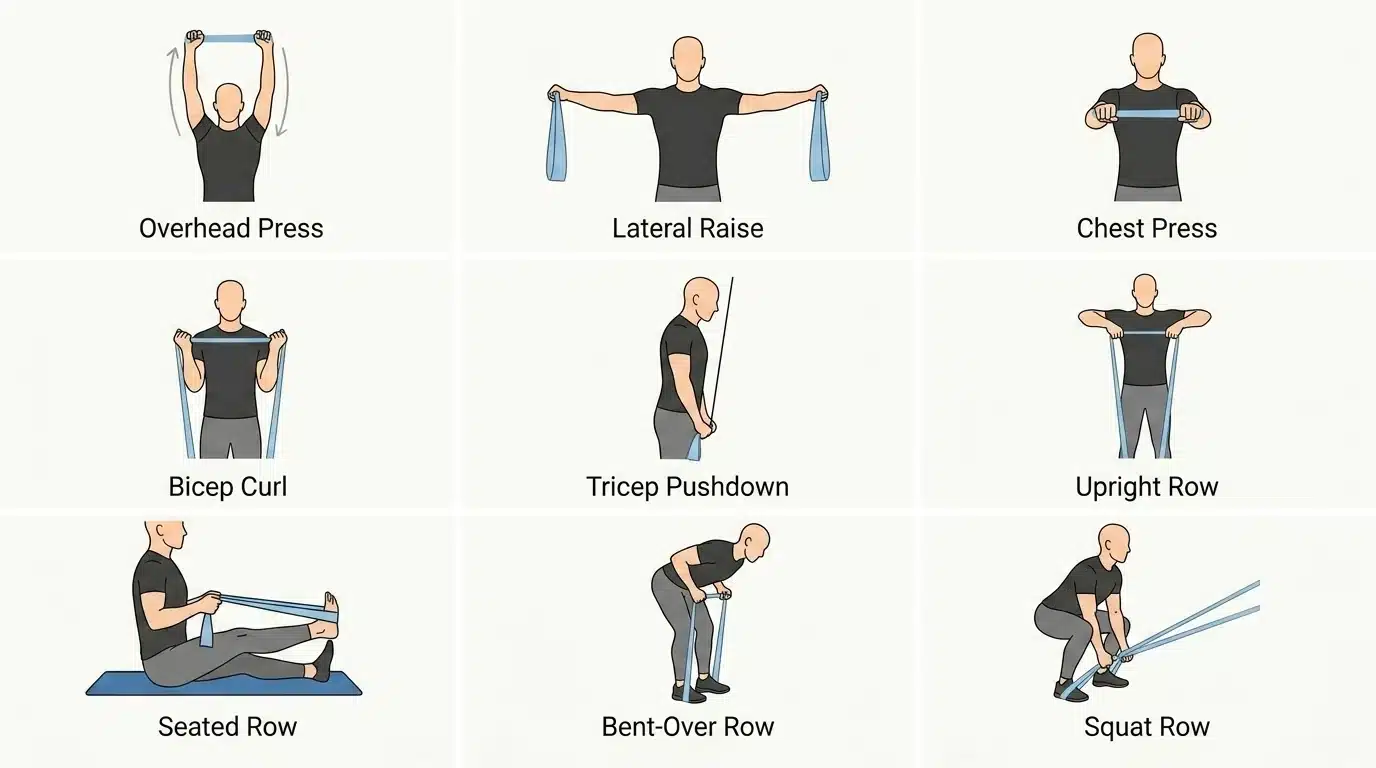
Exercises like scapular retractions, resistance-band pull-aparts, and wall angels train the muscles that help bring your head back into alignment. Start with 2 to 3 sets of 10 to 15 reps, three times a week.
4. Take Regular Breaks From Your Screen
Sitting in one fixed position for too long constantly loads your neck. Set a timer to stand up and move every 30 to 45 minutes. A two-minute walk or a few shoulder rolls can reset your posture and take pressure off your neck.
The 20-20-20 rule, recommended by the American Optometric Association, is also worth building into your day. Every 20 minutes, look at something 20 feet away for 20 seconds.
5. Try Physical Therapy for Neck Strain
If your pain has been around for more than two weeks, physical therapy for neck strain is worth looking into. A licensed physical therapist looks at your posture, range of motion, and muscle strength.
They identify what is out of balance and build a plan around your specific situation. Treatment typically includes manual therapy, targeted exercises, and posture coaching.
The American Physical Therapy Association has a therapist-finder directory to help you locate a qualified professional near you.
6. Set Up an Ergonomic Workspace
Your workspace setup directly affects your neck, whether you work from home or a traditional office. An adjustable monitor arm, an external keyboard, and a chair with lumbar support all work together to hold your body in a better position throughout the day.
A rolled towel behind your lower back provides low-cost lumbar support if you do not have a cushion. When your lower back is supported, your upper back and neck naturally fall into place.
Basic Ergonomic Checklist:
- Monitor at eye level
- Chair height: feet flat, hips at 90 degrees
- Keyboard and mouse within easy reach
- Lower back supported at all times
7. Correct Your Sitting Posture
Good posture does not mean sitting completely rigid all day. Returning to a neutral position regularly is what matters. Sit with your feet flat on the floor, hips at 90 degrees, and your lower back supported.
Your shoulders should stay back and down, not raised or rolled forward. Your ears should line up directly above your shoulders. If you catch yourself slumping, a quick reset takes less than 30 seconds.
8. Apply Heat or Ice to Sore Muscles
Both heat and ice help with tech neck pain, but they serve different purposes. Ice is best for acute pain or recent muscle inflammation. Apply it for 15 minutes with a thin towel between the ice and your skin. Heat works better for chronic stiffness and ongoing tension.
A warm compress on your neck and upper back for 15 to 20 minutes relaxes tight muscles before stretching. Use it as part of your pre-stretch warm-up for better results.
9. Practice Chin Tucks Daily
The chin tuck is one of the most recommended moves for correcting forward head posture. It gently retrains your neck to sit over your spine rather than in front of it.
Do 10 repetitions twice a day, and you will start to notice your resting posture improving within a few weeks. This move is simple, takes under two minutes, and needs no equipment.
How to Do a Chin Tuck:
- Sit or stand upright.
- Look straight ahead.
- Gently pull your chin straight back, as if making a double chin.
- Hold for 5 seconds, then relax.
- Repeat 10 times.
10. Sleep in a Better Position
Your sleeping position affects your neck for 6 to 9 hours every night. Sleeping on your stomach keeps your neck rotated for hours, worsening tech neck. Back sleeping with one supportive pillow is the best option for keeping your neck in alignment.
Side sleeping also works if your pillow fully fills the space between your ear and shoulder. Replace your pillow every 18 to 24 months as it loses support over time.
What to Look for in a Pillow:
- Keeps your neck in line with your spine
- Memory foam or cervical contour shape
- Not too high, not too low
- Replaced every 18 to 24 months
Mistakes That Make Tech Neck Worse
You might be following good habits during the day, while a few common mistakes quietly pull your progress backward. Knowing what to stop doing matters just as much as knowing what to start.
| Mistake | Why It Makes Tech Neck Worse |
|---|---|
| Cracking or forcing your neck | Puts sudden stress on joints and can irritate already compressed nerves. |
| Using a soft couch as your main workspace | Fully collapses your posture, removing all neck and back support. |
| Stretching without strengthening | Flexibility without muscle support creates more joint instability over time. |
| Fixing your posture for one day, then stopping | Consistency is what creates change. One good day does not move the needle. |
| Looking down at your phone while walking | Moving while tilting your head adds even more load to the cervical spine. |
| Ignoring early stiffness or soreness | Mild tension is your body’s early warning signal. Waiting makes recovery slower. |
| Sleeping on your stomach | Keeps your neck in rotation for hours and cancels your daytime posture work. |
| Skipping screen breaks | Long, unbroken screen time keeps your neck loaded without any chance to recover. |
When to See a Doctor for Tech Neck
Most cases of tech neck improve with consistent self-care over two to three weeks. Some situations do call for professional attention, though.
If your pain has not improved after two to three weeks, see a doctor. Numbness, tingling, or weakness in your hands or arms also needs prompt attention.
Frequent and worsening headaches tied to your neck pain are another reason to get checked. These can point to cervical nerve compression or disc involvement.
A doctor or physical therapist can conduct a thorough assessment and address any underlying issues before they progress.
Final Thoughts
Tech neck is not just a sore neck from a long day. Left unchecked, it changes your posture, strains your spine, and affects how you move and feel for years.
The ways in this post are practical starting points. You do not need special equipment or hours of free time. A few minutes of daily stretching and some changes to your screen setup can make a real difference.
Start with one thing today. Pick what feels most doable and build from there
Frequently Asked Questions
Is It Possible to Fix a Tech Neck?
Yes, most cases of tech neck are fully fixable. Consistent stretching, posture correction, and strengthening exercises bring real results over time.
Can I Get Rid of Tech Neck Hump?
Yes, but it takes time and consistency. A combination of chin tucks, upper back strengthening, and corrected screen posture gradually reduces the hump as the muscles rebalance.
How Long Does a Tech Neck Take to Heal?
Mild cases improve in two to four weeks with daily effort. More severe cases with muscle imbalance or postural changes can take two to three months of consistent work.
How to Get Rid of Tech Neck Lines Fast?
No method removes them instantly. Staying hydrated, using a good moisturizer with retinol, and keeping your neck in a neutral position more often slow their development and reduce their appearance over time.