

Chest pain can be alarming, especially when your mind immediately goes to your heart. Yet chest discomfort can have several causes, and the source is not always obvious at first.
Knowing how to tell if chest pain is muscular can help you better understand what your body may be signaling and when the pain deserves medical attention.
What Does Muscular Chest Pain Feel Like?
Musculoskeletal chest pain comes from the muscles, bones, or joints of the chest wall. It tends to stay in one exact spot rather than spreading across your chest.
The pain usually feels sharp, achy, or sore. It gets noticeably worse when you press on the tender spot, twist your torso, or take a deep breath. You may also notice stiffness or a limited range of motion in your upper body.
Muscular chest pain often has a clear trigger. It might follow a hard workout, heavy lifting, a persistent cough, or even sleeping in an awkward position.
Key Sign: Tenderness to Touch
If pressing on the sore spot recreates or sharpens the pain, that strongly points to a muscular or rib-related cause. Heart pain does not change when you press on your chest from the outside.
Common Causes of Musculoskeletal Chest Pain
Several specific conditions can cause chest wall pain. Knowing the most common ones helps you understand what you may be dealing with.
- Costochondritis: Inflammation where your ribs meet your breastbone. This is the single most common cause of non-cardiac chest pain. The main clue is sharp tenderness at the joint itself.
- Pulled pectoral muscle: A strain in the large chest muscle, usually from heavy lifting or sudden movement. Pain tends to worsen with pushing or pressing motions.
- Intercostal muscle strain: Strain between the ribs, often caused by a forceful cough, sudden twisting, or sports activity. Breathing deeply usually makes it worse.
- Rib strain: Stress or minor injury to a rib. Tenderness at a specific point along the rib is the main sign.
What Does Heart-Related Chest Pain Feel Like?
Heart-related chest pain usually feels very different from a muscle strain. Instead of a sharp jab, people describe pressure, squeezing, tightness, or a heavy weight in the center of the chest.
This discomfort often spreads beyond the chest. It can reach the arms, neck, jaw, or upper back. Unlike muscular pain, it does not change when you press on your chest or shift your position.
Heart attacks do not always announce themselves with obvious chest pain. Women may experience unusual fatigue, jaw pain, nausea, or shortness of breath instead, according to the American Heart Association. Older adults can also present with milder or less typical symptoms.
Call 911 immediately if you notice any of the following:
- Pressure or squeezing in the chest that lasts more than a few minutes
- Pain spreading to your arm, jaw, neck, or back
- Shortness of breath, sweating, nausea, or dizziness alongside chest discomfort
- Fainting or feeling like you might lose consciousness
Every minute matters during a cardiac event. Do not wait to see if the symptoms pass.
Other Conditions That Can Mimic Chest Pain
Chest pain does not always come from your muscles or your heart. Several other conditions can produce similar symptoms. This is one reason self-diagnosis alone is never reliable.
- Acid reflux (GERD): Stomach acid rising into the esophagus causes a burning sensation that can feel very similar to heart pain. It often worsens after eating or when lying down.
- Anxiety and panic attacks: A panic attack can bring on chest tightness, a racing heart, and shortness of breath. These symptoms closely mimic a cardiac event. If you experience them, still get checked, since anxious people can also have heart problems.
- Pulmonary embolism (PE): A blood clot in the lungs can cause chest pain that feels like a simple muscle strain at first. A PE can also cause shortness of breath and a rapid heart rate. This is one of the most missed emergencies. Any chest pain with sudden shortness of breath needs urgent evaluation.
- Pleuritis (pleurisy): Inflammation of the lining around the lungs causes sharp pain that worsens with breathing, similar to a muscle strain. A doctor can tell the difference with an exam and imaging.
A Simple 3-Step Self-Check for Chest Pain
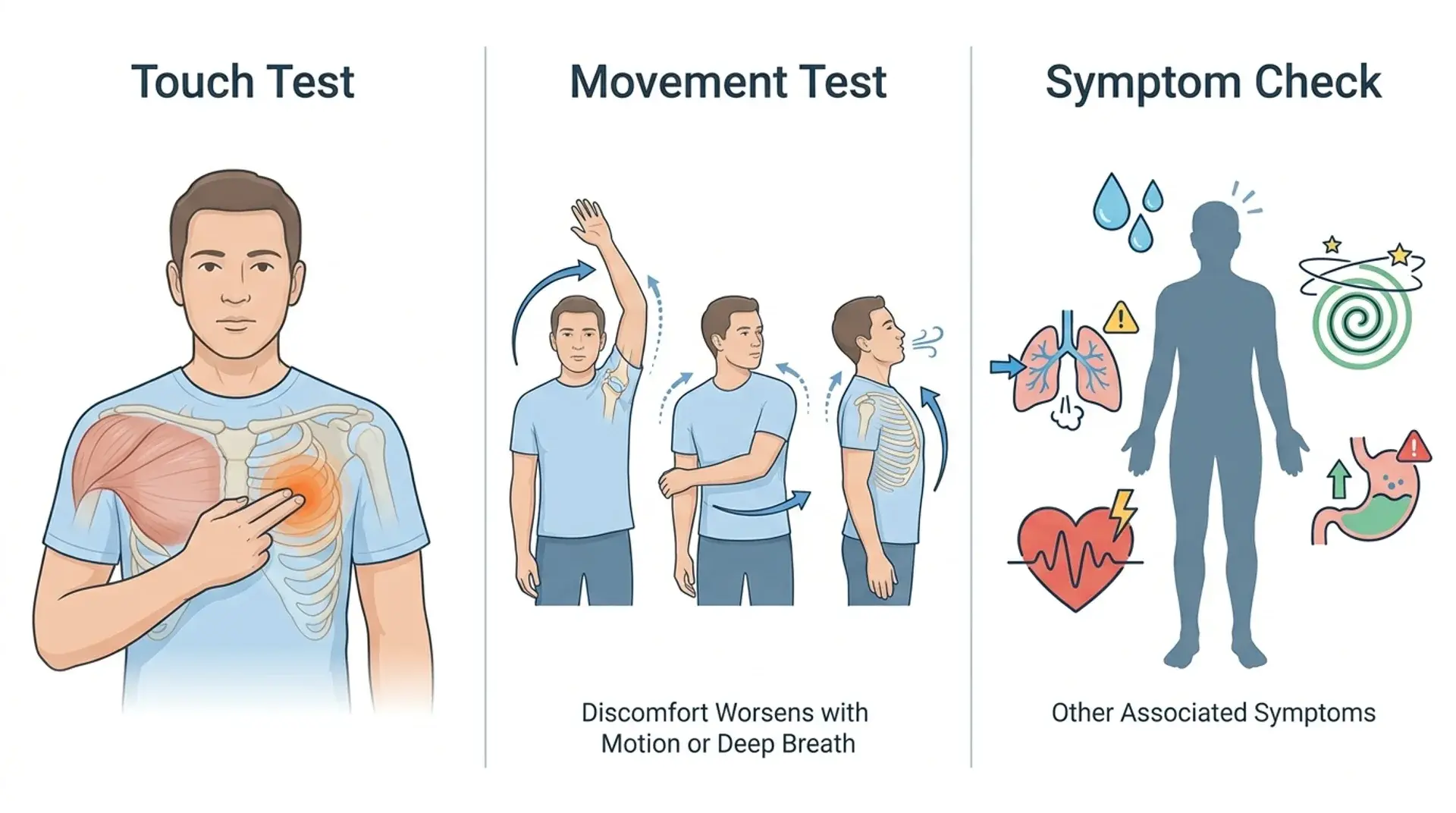
These three checks can help you get a clearer sense of what you may be dealing with. They do not replace a medical exam, but they give you useful information to act on.
Step 1: The Touch Test
Press gently on the sore spot. If the pain sharpens or worsens when you touch it, that points to a muscular or rib-related cause. Heart pain originates inside the chest, so pressing from the outside does not change it.
Step 2: The Movement Test
Twist gently at the waist, raise your arms, or take a slow, deep breath. Muscular chest pain almost always worsens with these movements. Heart-related pain tends to stay constant no matter how you move.
Step 3: The Symptom Check
Ask yourself whether anything else feels off. Sweating, nausea, dizziness, or shortness of breath paired with chest pain are strong signals pointing toward your heart. Muscular pain rarely comes with these extra symptoms.
If you notice even one of these signs, treat the situation as urgent and seek medical care immediately.
Muscular vs. Heart Chest Pain: Side-by-Side Comparison
Looking at the full pattern together gives you a far more reliable picture than focusing on just one clue. Use this comparison as a reference, not a diagnosis tool.
| Feature | Muscular Chest Pain | Heart-Related Chest Pain |
|---|---|---|
| Pain type | Sharp, achy, or sore | Pressure, squeezing, or tightness |
| Location | Stays in one exact spot | Often spreads to arm, neck, jaw, or back |
| Trigger | Movement, injury, coughing, or overuse | Exertion, stress, or even at rest |
| Response to touch | Worsens when you press on it | Does not change with touch |
| Response to movement | Reacts to twisting, stretching, or breathing | Stays fairly constant regardless of position |
| Other symptoms | Rarely comes with other symptoms | Often brings sweating, nausea, or dizziness |
| Duration | Days to a few weeks; changes with activity | May be constant, or come in waves |
How to Treat Musculoskeletal Chest Pain at Home
Once a doctor has ruled out cardiac or lung causes, most musculoskeletal chest pain responds well to simple care at home.
- Rest the area. Stop or reduce the activity that triggered the pain. Avoid movements that make it worse.
- Apply ice first. Use an ice pack for 10 to 20 minutes every one to two hours. Do this for the first 48 to 72 hours. This reduces swelling.
- Switch to heat after 72 hours. A heating pad or warm compress can ease muscle tightness once initial swelling has settled.
- Use over-the-counter pain relief. Ibuprofen reduces both pain and inflammation. Acetaminophen can ease pain if ibuprofen is not appropriate for you.
- Stretch gently. Light movement and gentle chest stretches help prevent stiffness. Avoid any stretch that causes sharp pain.
- Check your posture. Slouching or sitting for long periods can tighten chest wall muscles. Sit upright and take short standing breaks throughout the day.
When Home Care Is Not Enough
If the pain does not improve within about one week, contact your doctor. The same applies if it gets worse or new symptoms appear. Do not continue managing it on your own past that point.
Costochondritis can take several weeks to fully settle. Your doctor may recommend a short course of anti-inflammatory medication or a referral to physical therapy.
When to See a Doctor for Muscular Chest Pain
Chest pain should never be something you try to fully diagnose on your own. Muscle strain, acid reflux, anxiety, and heart problems share many symptoms. Even experienced clinicians rely on tests, not guesswork, to tell them apart.
Schedule a doctor visit if:
- Your chest pain is new, unexplained, or will not go away
- The pain has lasted more than one week with no improvement
- You have risk factors for heart disease (high blood pressure, high cholesterol, smoking, diabetes, family history)
- You are over 40 and chest pain is new for you
At that appointment, your doctor will review your medical history, examine the painful area, and may order an EKG or imaging to rule out cardiac or lung-related causes before confirming a musculoskeletal issue.
Medical Disclaimer: This article is for informational purposes only. It does not replace professional medical advice, diagnosis, or treatment. If you experience chest pain, especially with other symptoms, contact a qualified healthcare provider or call emergency services immediately.
Final Thoughts
Knowing how to tell if chest pain is muscular gives you a clearer way to respond when discomfort strikes. Sharp, localized pain that worsens with touch or movement usually points to your chest wall muscles or ribs.
Pressure, squeezing, or pain paired with sweating and shortness of breath points toward your heart. Acid reflux, anxiety, and pulmonary embolism can also produce chest pain. Each one is easy to mistake for something else.
The signs overlap enough that self-diagnosis alone is never fully safe. If your pain feels new, severe, or comes with other symptoms, get it checked right away. Your health is worth the peace of mind that only a proper evaluation can give you.
Frequently Asked Questions
Can chest pain from a muscle strain come and go?
Yes. A strained chest muscle can hurt on and off, especially when you repeat the movement that irritates it. Pain may flare with certain positions or activities rather than staying constant.
How long does muscular chest pain last?
Mild muscle strains usually ease within a few days to two weeks. Rest, ice or heat, and over-the-counter pain relief help speed recovery. Costochondritis can take several weeks to fully settle.
Can exercise cause muscular chest pain?
Yes. Heavy lifting or repetitive chest exercises can overload the chest wall muscles. This causes soreness that appears during or after activity. It usually improves with rest.
Can coughing cause a pulled muscle in the chest?
Yes. Repeated or forceful coughing can strain the muscles between the ribs. This causes chest wall pain that worsens with further coughing or deep breaths.
Is left-sided chest pain always from the heart?
No. Left-sided chest pain can come from muscles, ribs, or costochondritis. The heart sits more centrally than most people think. Location alone does not confirm a cardiac cause.
Can anxiety cause chest pain that feels muscular?
Yes. Panic attacks can produce chest tightness that feels similar to a muscle strain or a heart problem. If you are unsure of the cause, see a doctor to rule out both.
Can chest pain be muscular even without an obvious injury?
Yes. Muscle strain can develop from overuse, repetitive movement, prolonged coughing, or everyday physical stress. You do not always need a single memorable injury for this type of pain to occur.







One Response