Kettlebell training is one of the most efficient ways to build strength, burn fat, and improve stability using a single piece of equipment.
A kettlebell is a cast-iron weight with a flat base and a handle. Unlike a dumbbell, its off-center design forces your whole body to work harder to control each movement, meaning more muscles work in less time.
Whether you train at home or in a gym, one kettlebell can replace an entire rack of equipment.
This guide walks you through the best kettlebell exercises for beginners, with step-by-step instructions and practical tips to help you start strong.
Benefits of Kettlebell Exercise
Kettlebell training offers a high return on a small investment of time and equipment. Here is what you can expect when you train with kettlebells consistently.
- Builds full-body strength. Every major kettlebell movement works multiple muscle groups at the same time, so you get more done in fewer exercises.
- Burns fat efficiently. Kettlebell workouts combine strength and cardio, keeping your heart rate elevated throughout the session and helping you burn more calories than with traditional weight training.
- Improves your grip strength. The thick handle and shifting center of mass make your forearms and hands work harder on every rep.
- Trains your core without crunches. Most kettlebell exercises require you to brace your core to control the weight, which naturally builds deep core strength.
- Corrects muscle imbalances. Single-arm and single-leg kettlebell movements force each side of your body to work independently, helping address strength imbalances between your left and right sides.
- Easy to use at home. One or two kettlebells take up very little space and replace an entire rack of gym equipment for most beginners.
- Improves mobility and stability. Movements like the Turkish get-up and windmill build joint stability and flexibility alongside strength.
25 Kettlebell Exercises to Start Training Today
The exercises below are listed in a progression that builds on the previous one. Start with the foundational moves and add the more complex ones once your form feels solid.
1. Kettlebell Deadlift
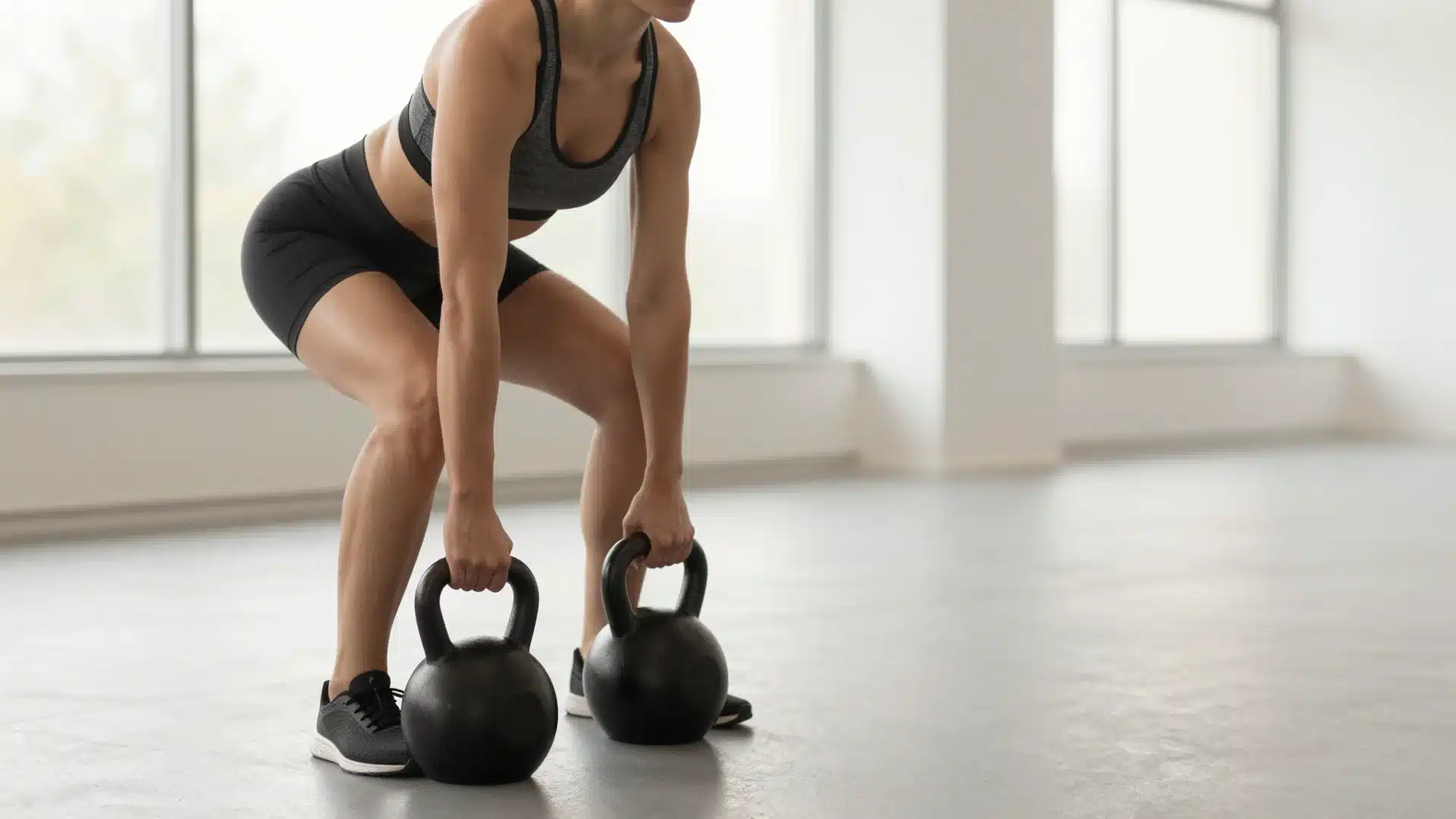
The kettlebell deadlift is the starting point for almost every beginner. It teaches you the hip hinge pattern, which is the foundation of swings, cleans, and most other kettlebell movements. Get this one right first, and everything else becomes easier.
Muscles worked: Hamstrings, glutes, lower back, core
How to do it:
- Stand with feet hip-width apart and the kettlebell on the floor between your feet
- Push your hips back, hinge forward, and grip the handle with both hands
- Keep your chest up, back flat, and shoulders pulled down
- Drive through your heels and squeeze your glutes to stand up tall
- Lower the kettlebell back to the floor with control and repeat
Form tip: Think about pushing the floor away from you as you stand. Do not pull the weight up with your back.
2. Kettlebell Goblet Squat
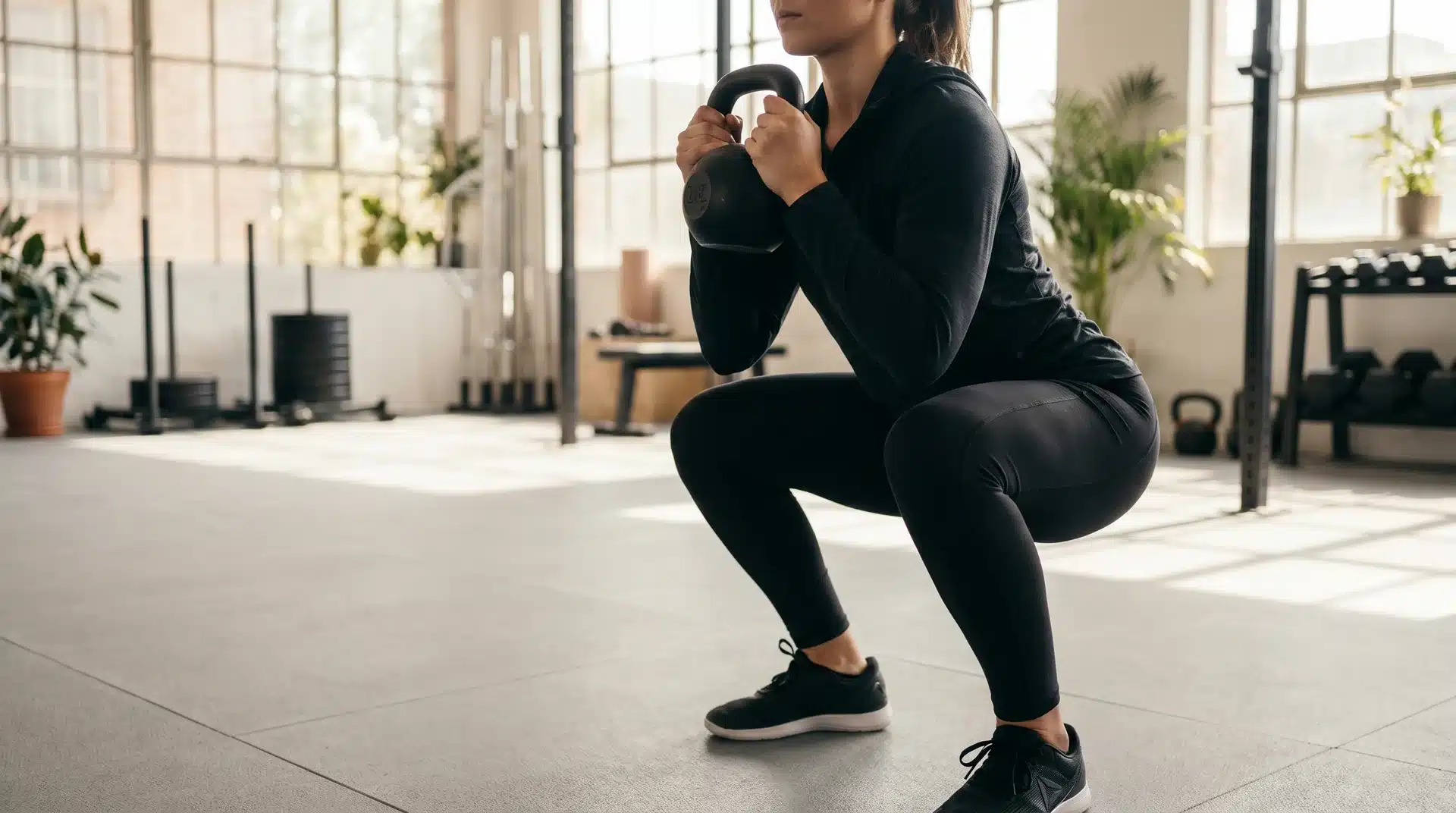
The goblet squat is the safest and most beginner-friendly squat variation you can do with a kettlebell. Holding the weight at your chest naturally keeps your torso upright and teaches your body what a proper squat should feel like.
Muscles worked: Quads, glutes, core, upper back
How to do it:
- Hold the kettlebell at chest height with both hands cupping the sides of the handle
- Stand with feet shoulder-width apart and toes slightly turned out
- Squat down until your thighs are parallel to the floor or lower
- Keep your chest up and your elbows inside your knees at the bottom
- Press through your heels to return to standing
Form tip: If your heels come off the floor, widen your stance slightly or work on ankle mobility before adding more weight.
3. Kettlebell Swing
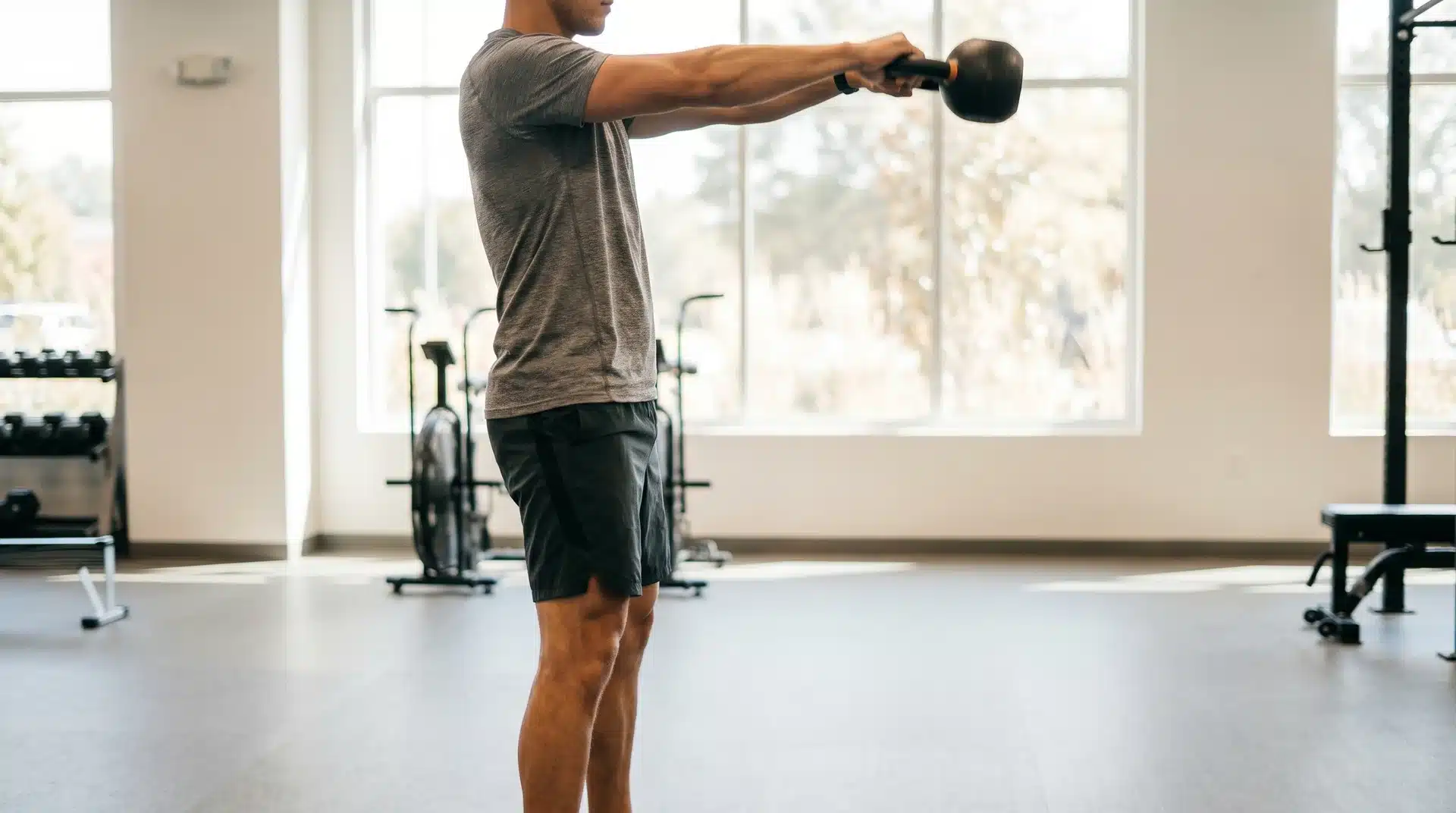
The kettlebell swing is arguably the most well-known kettlebell exercise and one of the most effective full-body movements you can do. It builds power, trains the posterior chain, and gets your heart rate up fast. The key is understanding that the power comes from your hips, not your arms.
Muscles worked: Glutes, hamstrings, core, shoulders, back
How to do it:
- Stand with feet shoulder-width apart and the kettlebell on the floor about a foot in front of you
- Hinge forward, grip the handle with both hands, and hike it back between your legs like a football snap
- Drive your hips forward explosively to swing the kettlebell up to shoulder height
- Let the kettlebell fall back naturally and hike it behind you again
- Repeat in a smooth, controlled rhythm
Form tip: At the top of the swing, your body should form a straight vertical line. Squeeze your glutes hard at that moment.
4. Kettlebell Romanian Deadlift (Single Leg)
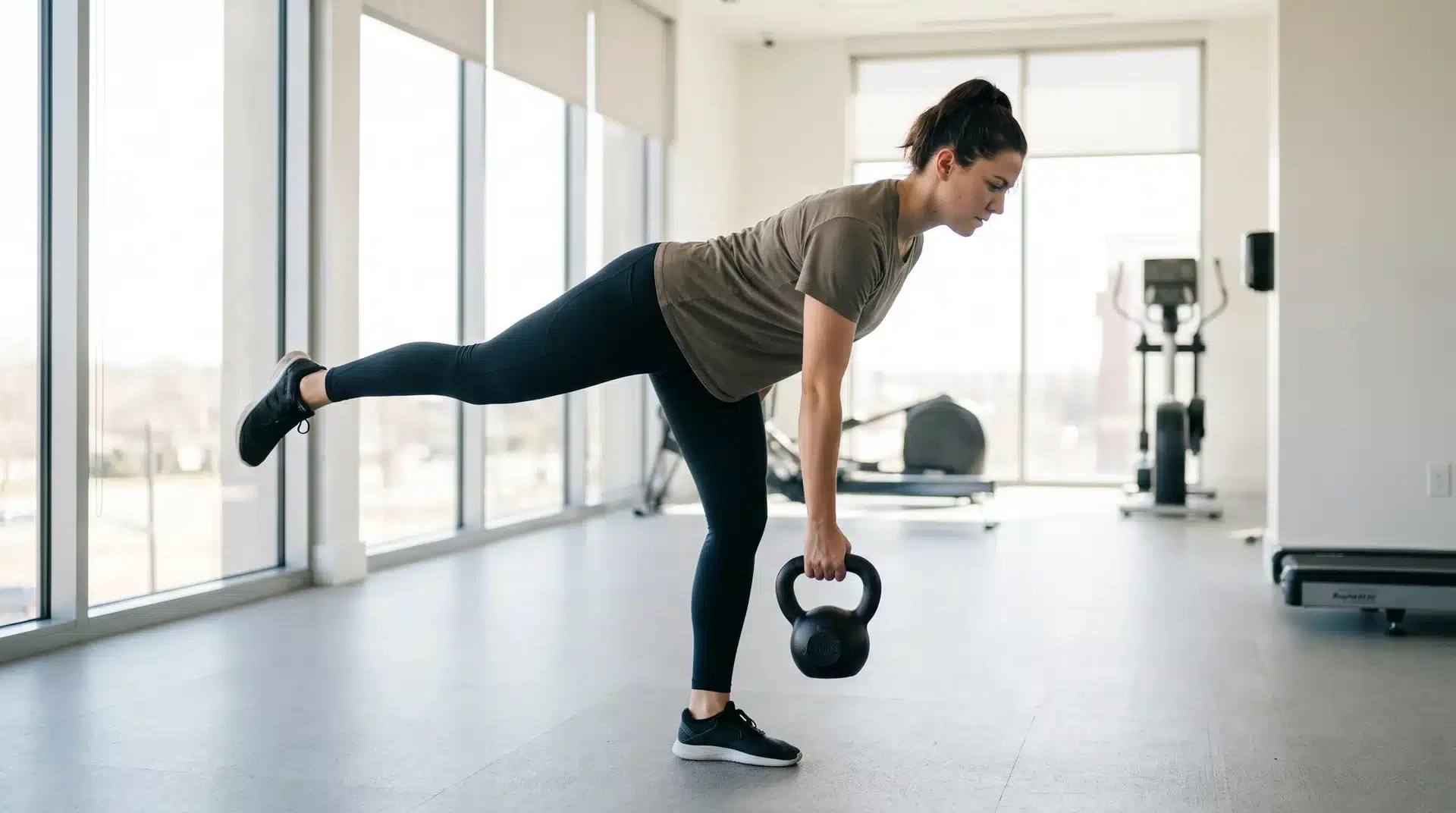
Once you have the standard deadlift down, the single-leg version challenges your balance and trains each leg independently. It is one of the best exercises for building strong glutes and hamstrings while also improving stability.
Muscles worked: Hamstrings, glutes, core, ankle stabilizers
How to do it:
- Hold one kettlebell in your right hand and shift your weight onto your right foot
- Hinge forward at the hips while extending your left leg straight behind you
- Lower the kettlebell toward the floor, keeping it close to your standing leg
- Stop when your torso is parallel to the floor, then drive through your heel to stand
- Complete all reps on one side before switching
Form tip: Keep your hips square to the floor throughout. Letting them rotate open reduces the benefit and strains your lower back.
5. Kettlebell Goblet Reverse Lunge
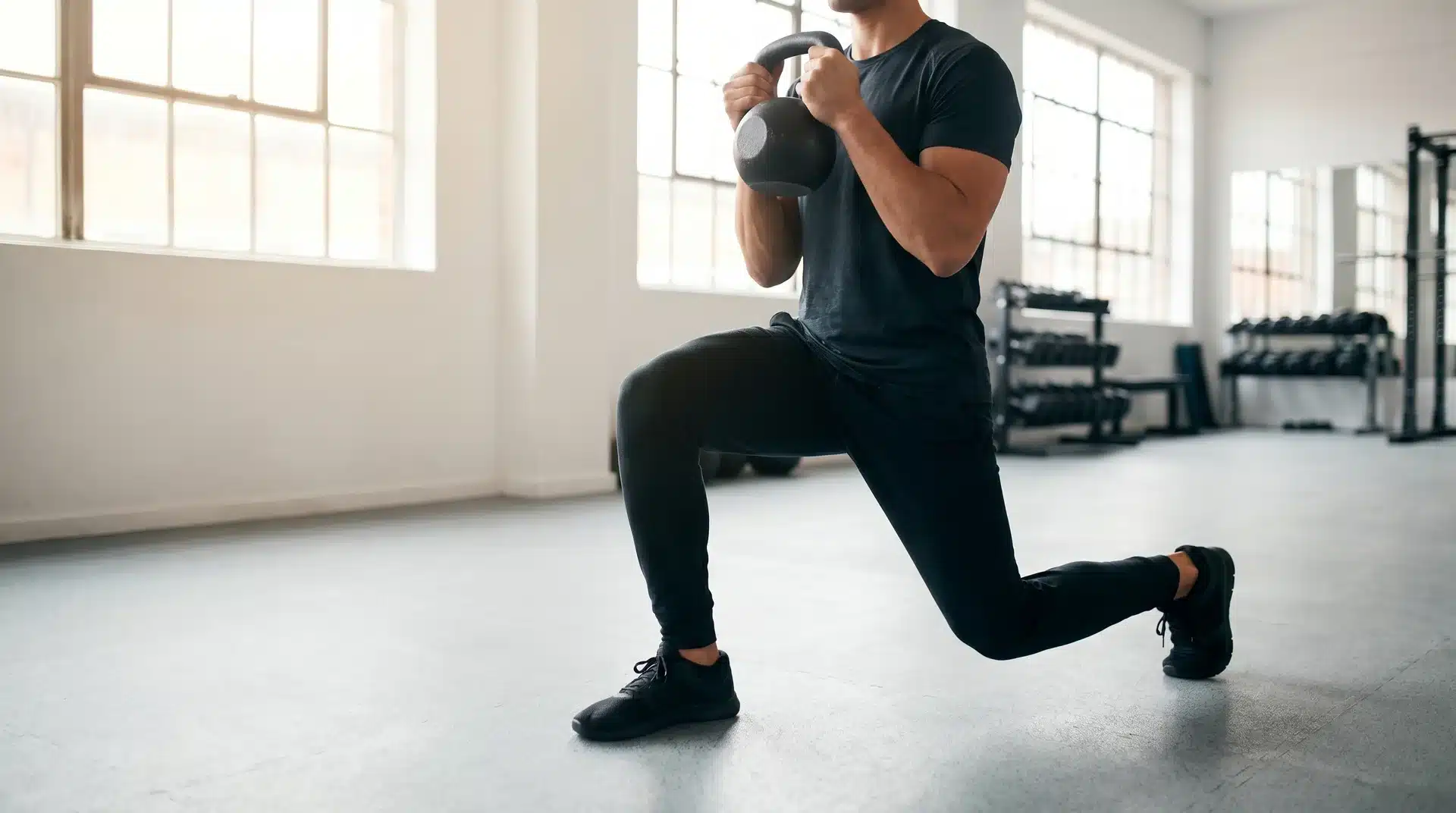
The reverse lunge is gentler on the knees than a forward lunge, making it a smart starting point for beginners. Adding a kettlebell at chest height keeps your posture tall and adds a core challenge at the same time.
Muscles worked: Quads, glutes, hamstrings, core
How to do it:
- Hold the kettlebell at chest height with both hands
- Stand with feet together and step one foot straight back
- Lower your back knee toward the floor until your front thigh is parallel to the ground
- Drive through the front heel to return to standing
- Alternate legs each rep
Form tip: Keep your front shin as vertical as possible and avoid letting your front knee cave inward.
6. Kettlebell Sumo Deadlift
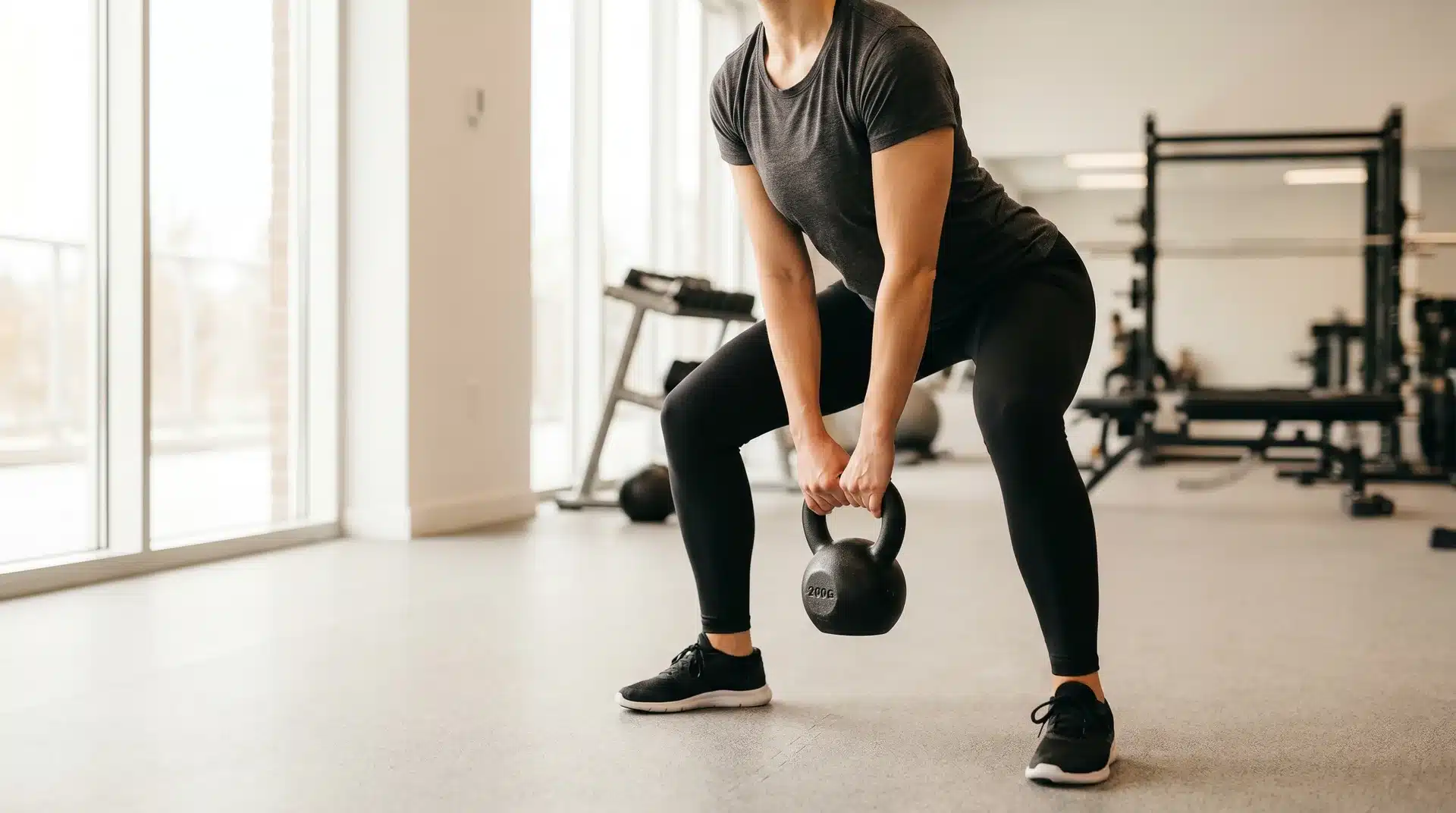
The sumo stance shifts more of the load onto your inner thighs and glutes compared to a standard deadlift. It is a great variation to add once you feel comfortable with the basic hip hinge pattern.
Muscles worked: Inner thighs, glutes, hamstrings, lower back
How to do it:
- Stand with feet wider than shoulder-width, and toes turned out at about 45 degrees
- Place the kettlebell on the floor between your feet
- Hinge at the hips and grip the handle with both hands
- Keep your chest up and knees tracking over your toes as you lower
- Drive through both heels to stand, squeezing your glutes at the top
Form tip: Push your knees out actively as you lift to protect your knee joints and get more from your inner thighs.
7. Kettlebell Single-Arm Row
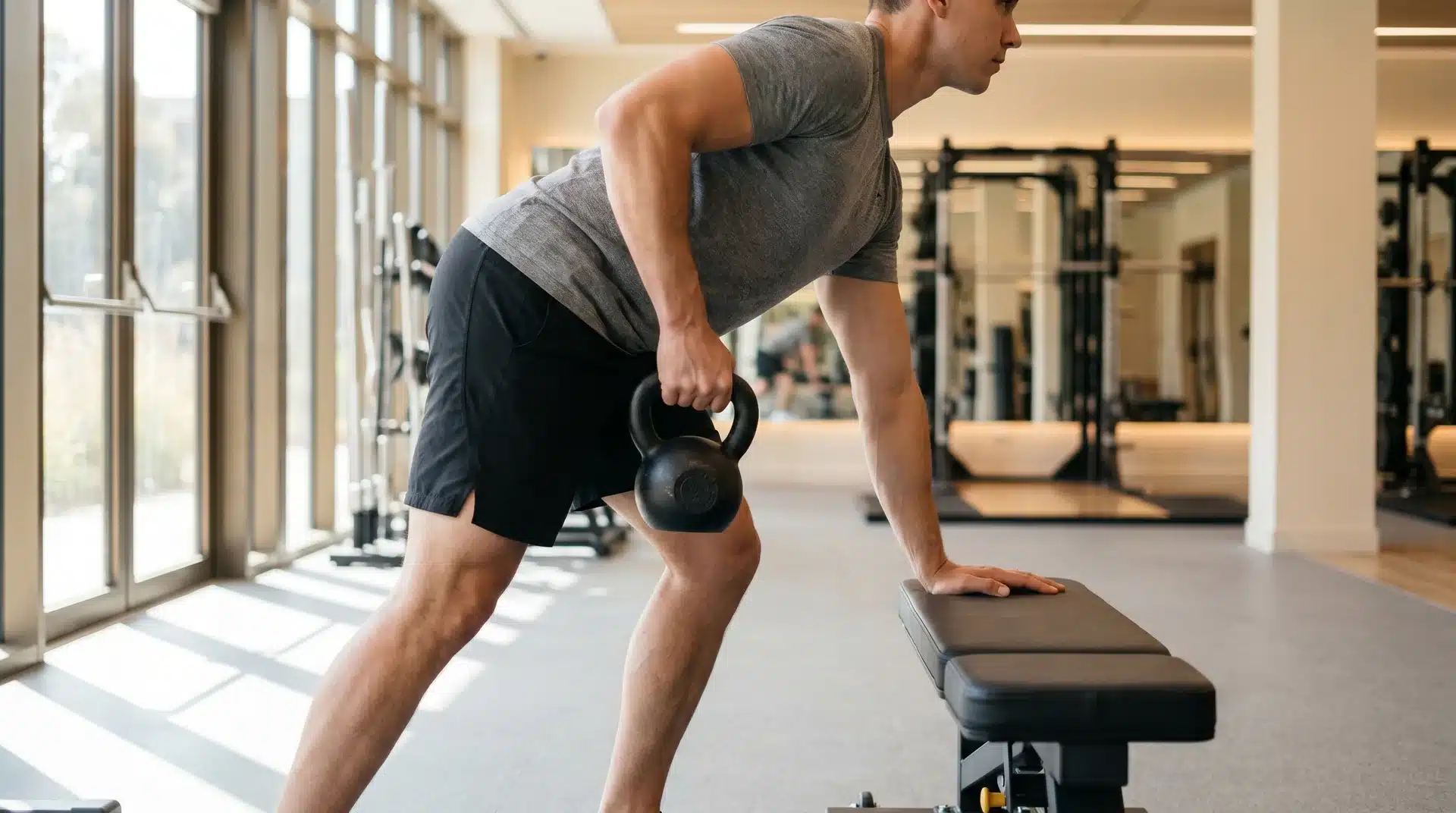
The single-arm row builds the pulling strength that most beginners are missing. A strong back balances out all the pressing work you do and keeps your posture healthy over time.
Muscles worked: Lats, rhomboids, biceps, rear deltoids, core
How to do it:
- Place your left hand on a bench or sturdy surface for support
- Hold the kettlebell in your right hand with your back flat and parallel to the floor
- Pull the kettlebell up toward your right hip, keeping your elbow close to your body
- Pause briefly at the top and then lower with control
- Finish all reps on one side before switching
Form tip: Do not rotate your torso to help lift the weight. If you are twisting, the kettlebell is too heavy.
8. Kettlebell Overhead Press
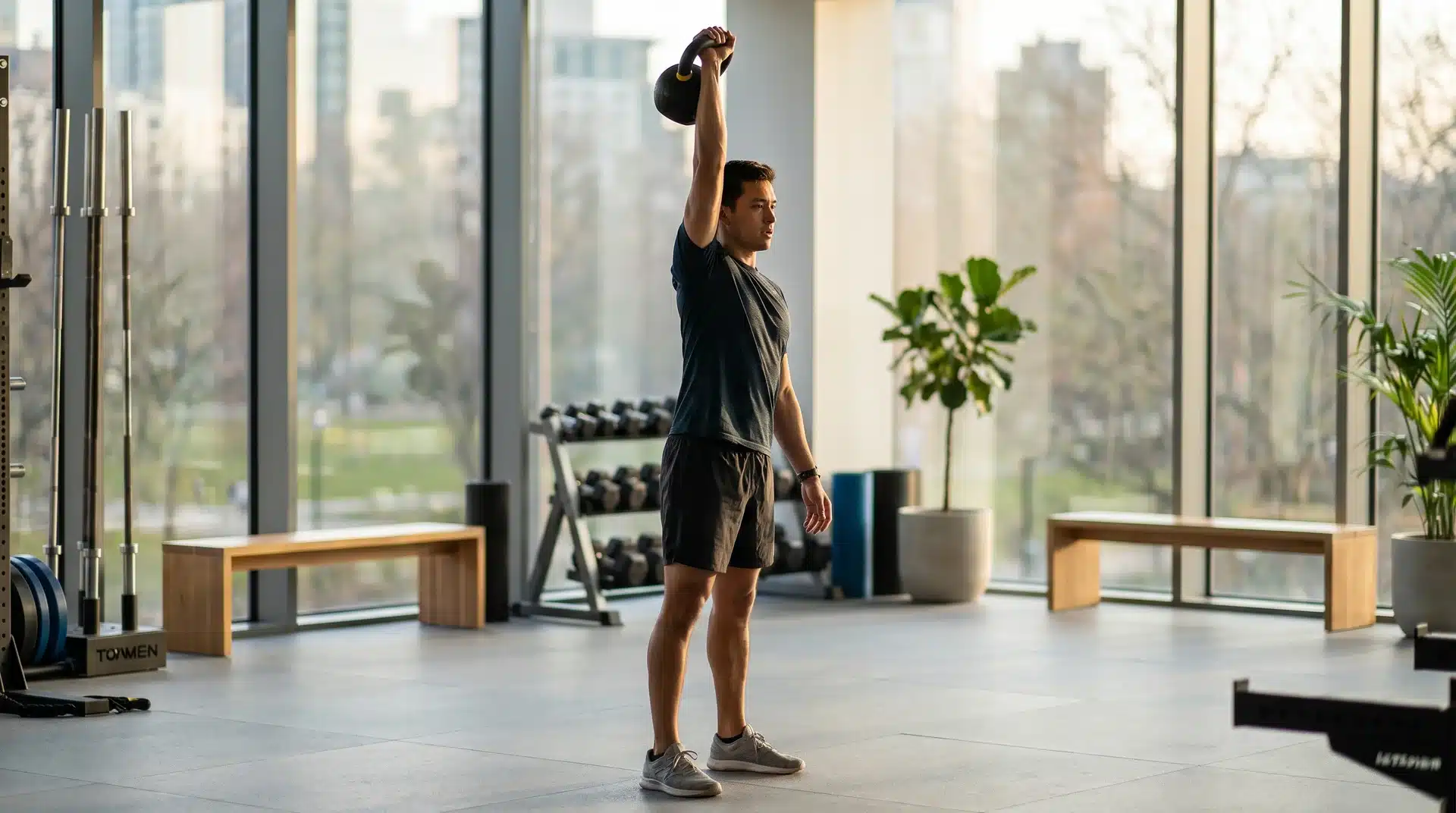
The overhead press builds shoulder strength and teaches you to safely control weight above your head. Pressing from the rack position also trains your core to stay rigid under load.
Muscles worked: Shoulders, triceps, upper back, core
How to do it:
- Hold the kettlebell in the rack position at your right shoulder
- Brace your core and squeeze your glutes before pressing
- Press the kettlebell straight overhead until your arm is fully extended
- Keep your wrist straight and your elbow from flaring out to the side
- Lower it back to the rack position slowly and repeat
Form tip: Avoid leaning back as you press. If you cannot press without arching your lower back, the weight is too heavy.
9. Kettlebell Halo
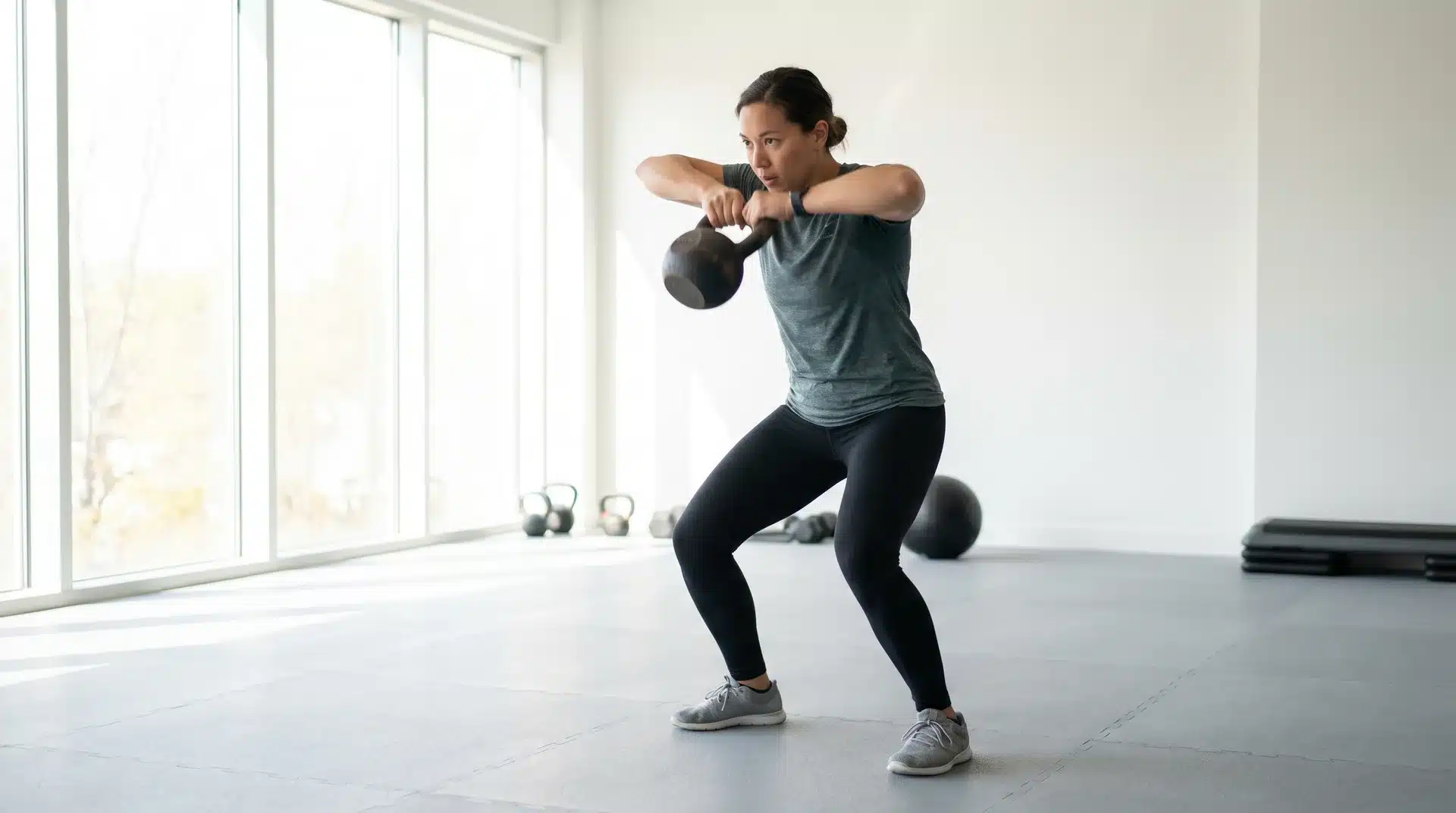
The kettlebell halo is a mobility and shoulder warm-up exercise that beginners often skip. That is a mistake. It opens up your shoulders, warms up your upper back, and builds the kind of overhead control that protects your joints during pressing movements.
Muscles worked: Shoulders, upper back, neck, core
How to do it:
- Hold the kettlebell by the sides of the handle at chest height, ball facing up
- Circle it slowly around your head in one direction, keeping it close to your head
- After several reps, reverse the direction
- Keep your hips still and your core braced throughout
Form tip: Move slowly and stay in control. This is a mobility drill, not a speed exercise.
10. Kettlebell Farmers Carry
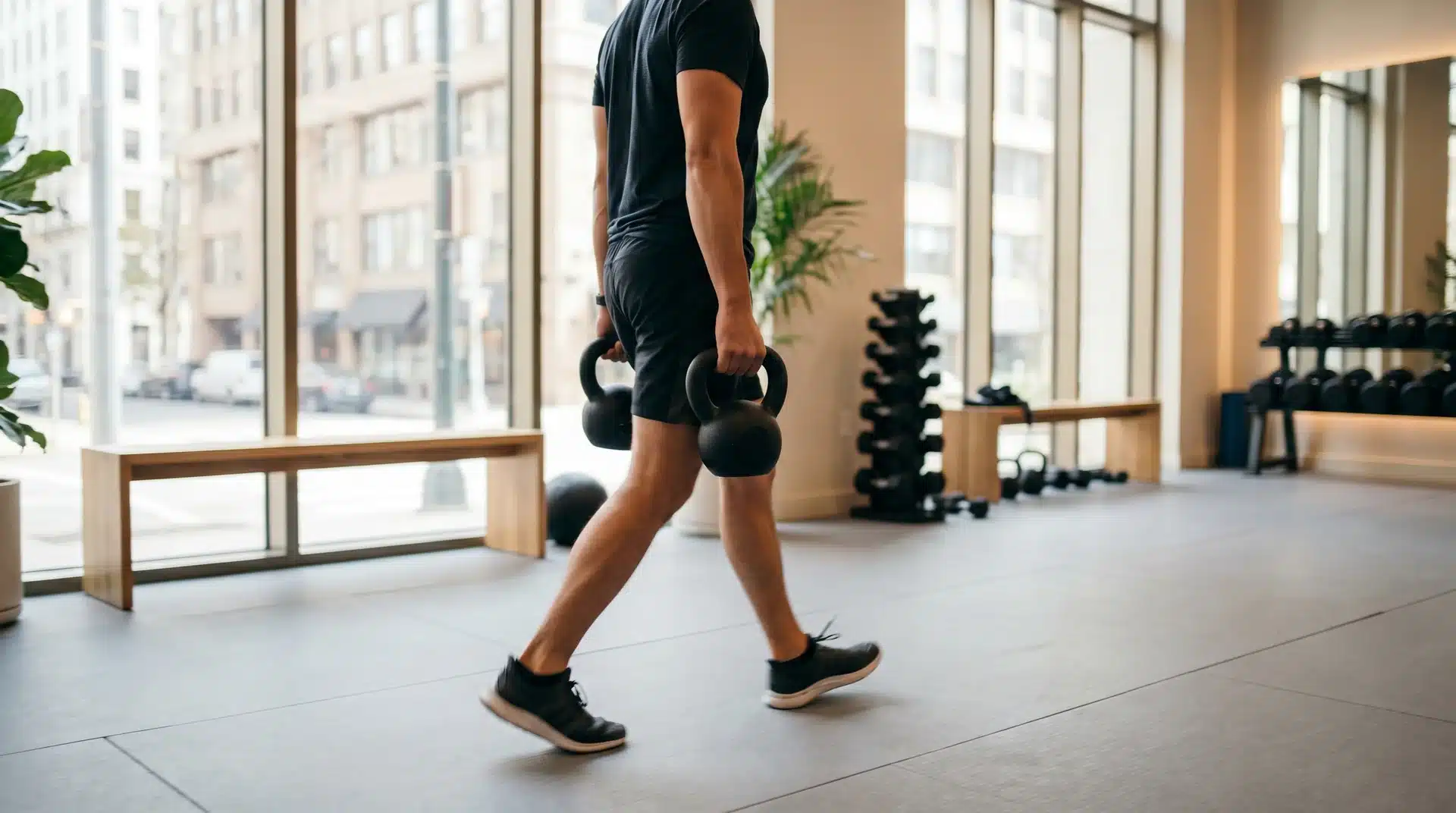
The farmers carry looks simple, but it is one of the hardest exercises to do well. Walking with heavy weight in both hands builds grip strength, trains your core, and improves posture all at once.
Muscles worked: Grip, forearms, traps, core, glutes, legs
How to do it:
- Hold a kettlebell in each hand at your sides, arms straight
- Stand tall with your shoulders pulled back and down
- Walk forward with short, controlled steps for a set distance or time
- Keep your core braced and avoid letting the weights pull your shoulders forward
Form tip: Think about carrying two full buckets of water without spilling a drop. That mental image keeps your posture exactly right.
11. Kettlebell Suitcase Carry
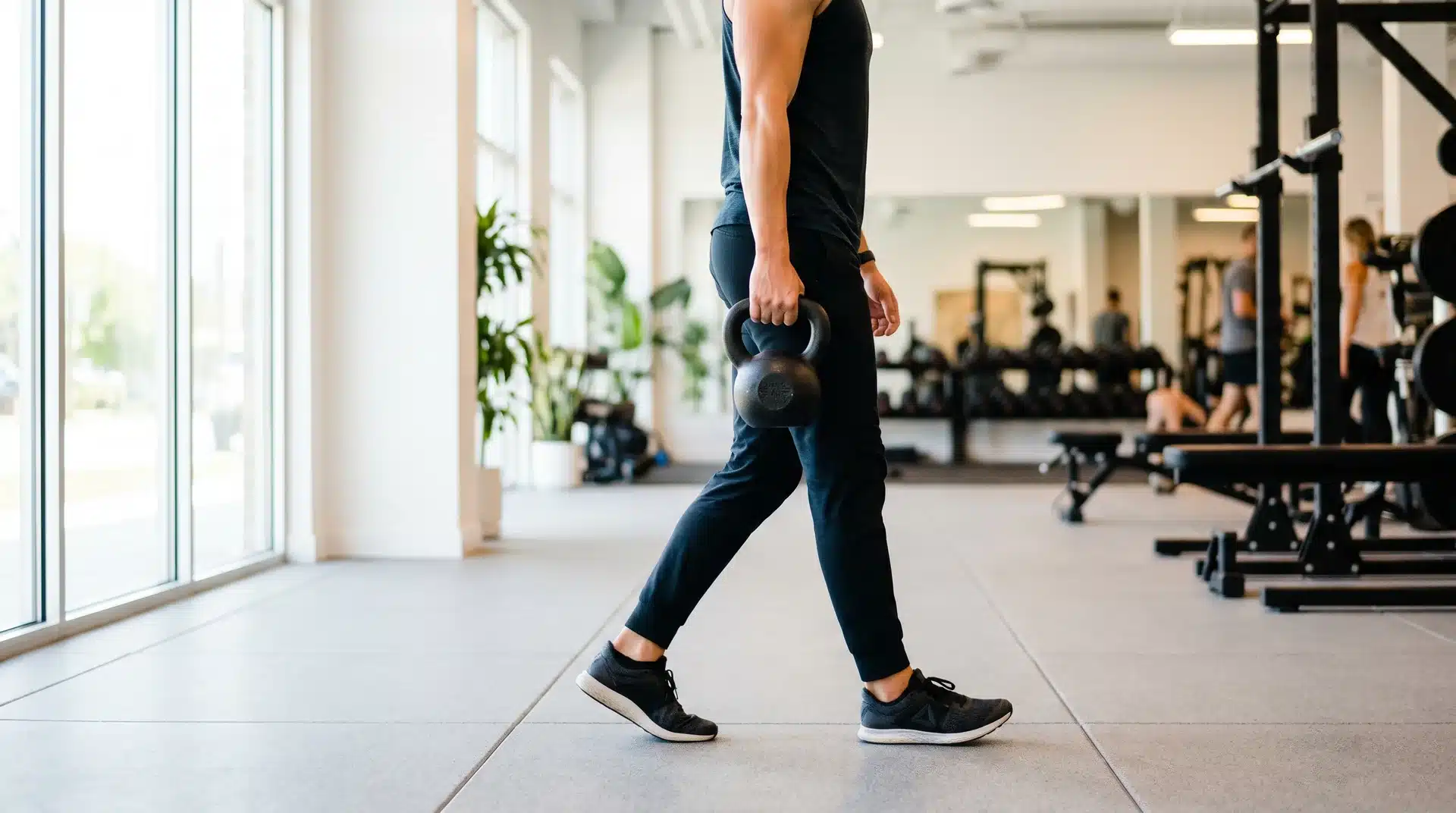
The suitcase carry is the one-sided version of the farmers carry, and it works your core in a completely different way. Your obliques have to work hard to stop you from leaning toward the weight, which builds functional core strength that carries over to everyday life.
Muscles worked: Obliques, core, grip, glutes, traps
How to do it:
- Hold one kettlebell in your right hand at your side
- Stand tall and walk forward without tilting toward the weight
- Keep both shoulders level and your spine straight
- Switch hands halfway through or at the end of each set
Form tip: The goal is to look like you are carrying nothing. If people can tell which hand holds the weight by the way you walk, your core is not working hard enough.
12. Kettlebell Push Press
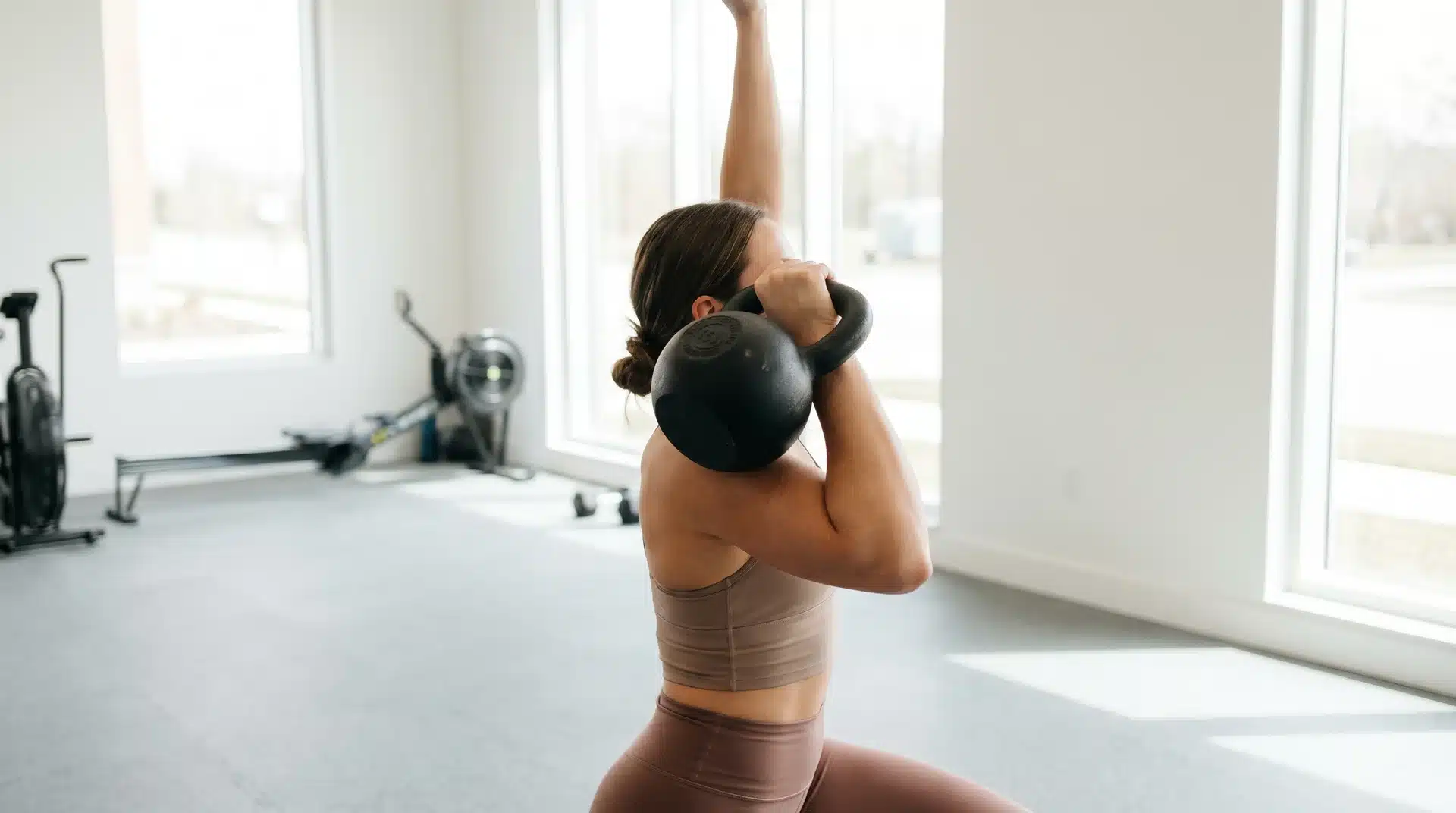
The push press lets you move a heavier weight overhead than a strict press by using a small dip from your legs to help initiate the movement. It is a great step between the standard press and more advanced overhead work.
Muscles worked: Shoulders, triceps, legs, core
How to do it:
- Hold the kettlebell in the rack position at your shoulder
- Dip slightly at the knees, keeping your torso upright
- Drive up through your legs and use that momentum to press the kettlebell overhead
- Finish with your arm fully extended and your bicep close to your ear
- Lower the kettlebell slowly back to the rack
Form tip: The dip should be quick and shallow. A deep squat before pressing makes the movement less efficient and harder to control.
13. Kettlebell Thruster
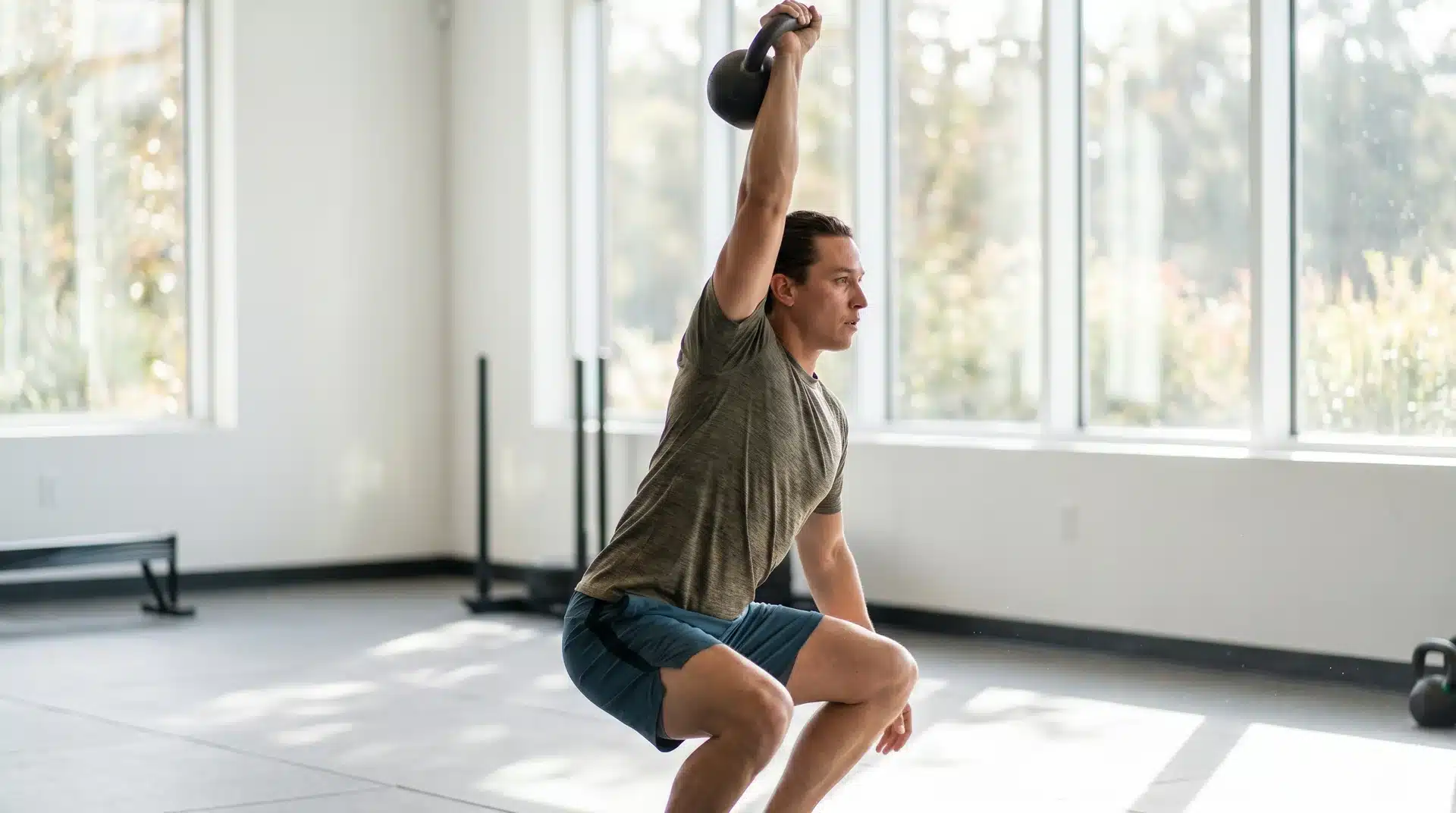
The thruster combines a front squat and an overhead press into one continuous movement. It is a high-output exercise that builds strength and spikes your heart rate, making it one of the most effective moves you can add to a beginner kettlebell workout once you have the basics down.
Muscles worked: Quads, glutes, shoulders, triceps, core
How to do it:
- Hold the kettlebell in the rack position at your shoulder
- Squat down with your chest up and your elbow pointing forward
- As you drive up from the squat, use that momentum to press the kettlebell overhead
- Lower it back to the rack as you descend into the next squat
- Move in one smooth, unbroken motion
Form tip: Do not pause between the squat and the press. The movement should flow together, not happen in two separate stages.
14. Kettlebell High Pull
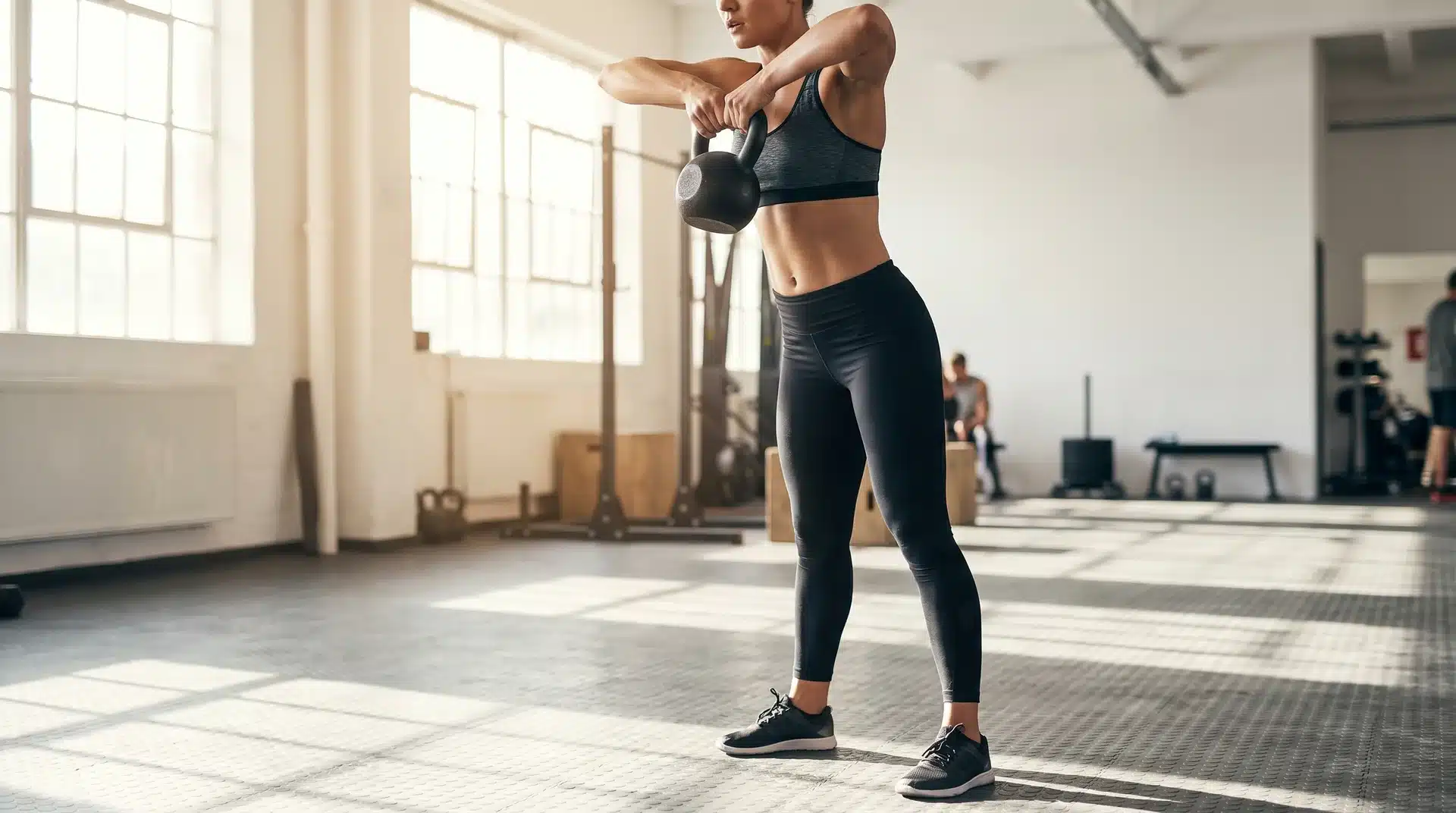
The high pull trains the pulling muscles of your upper back and shoulders in a powerful, athletic way. It builds on the swing pattern and prepares beginners for the clean, which comes next in this list.
Muscles worked: Upper back, traps, shoulders, glutes, hamstrings
How to do it:
- Start in the swing setup with the kettlebell between your feet
- Drive your hips forward to start the swing
- At the top of the movement, pull the handle up toward your chin with your elbows flaring out
- Let the kettlebell swing back down and repeat
- Keep the movement fluid from the hip drive through to the pull
Form tip: The pull comes from your upper back, not your arms. Your elbows should lead the movement upward.
15. Kettlebell Clean
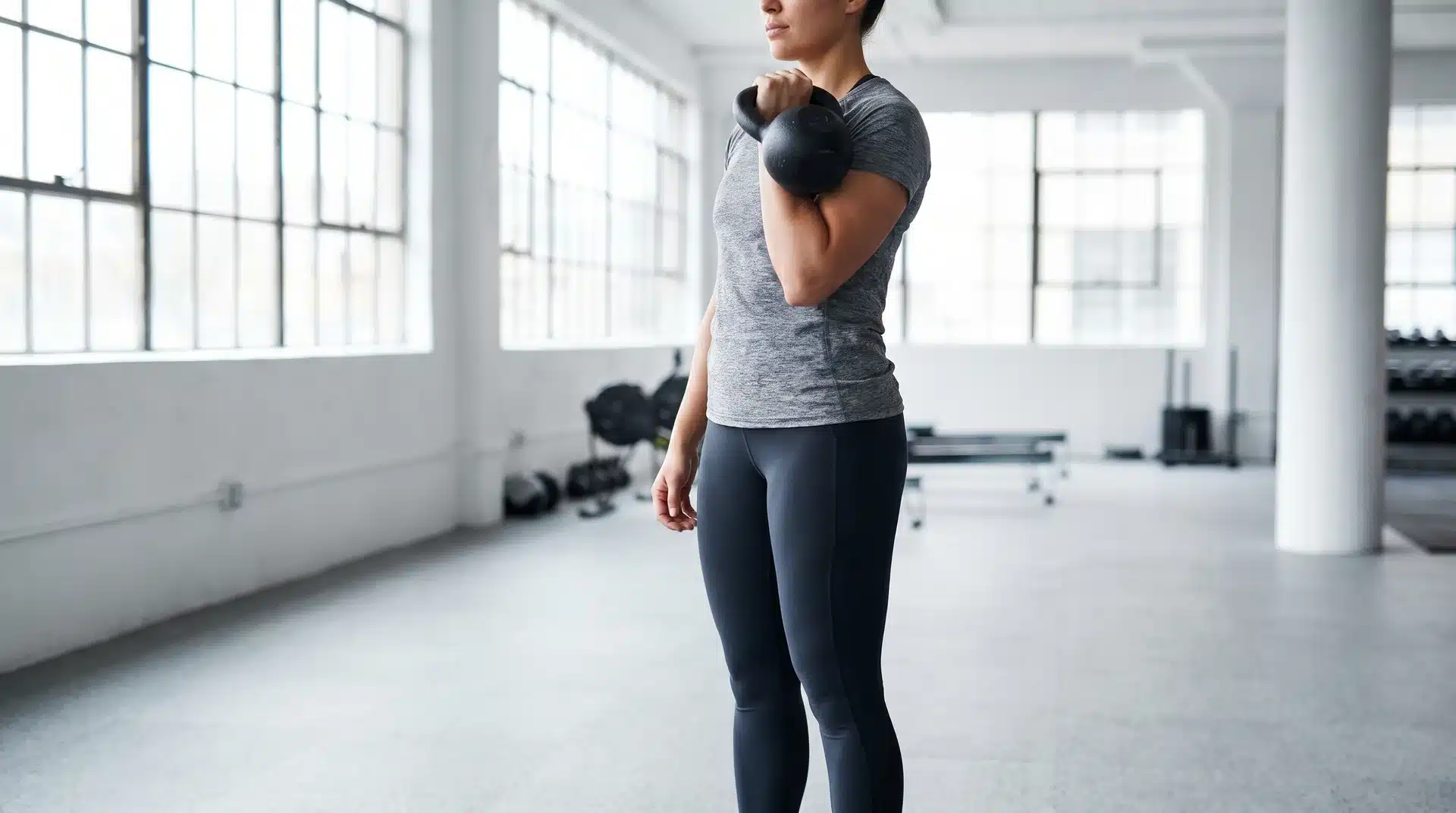
The kettlebell clean takes the power from a swing and guides the weight into the rack position in one smooth movement. It is worth spending time learning the proper form because it is the foundation of the push press and many other combination movements.
Muscles worked: Full body, with emphasis on hips, glutes, forearms, and shoulders
How to do it:
- Start in the swing hinge position with the kettlebell between your feet
- Drive your hips forward and pull the kettlebell upward, keeping it close to your body
- As it reaches chest height, guide your hand around the weight so it settles in the rack position
- Keep your elbow close to your body and your wrist flat
- Lower it back down and repeat
Form tip: If the kettlebell is banging your forearm at the top, you are letting it swing out too wide. Keep it as close to your body as possible throughout the pull.
16. Kettlebell Figure Eight
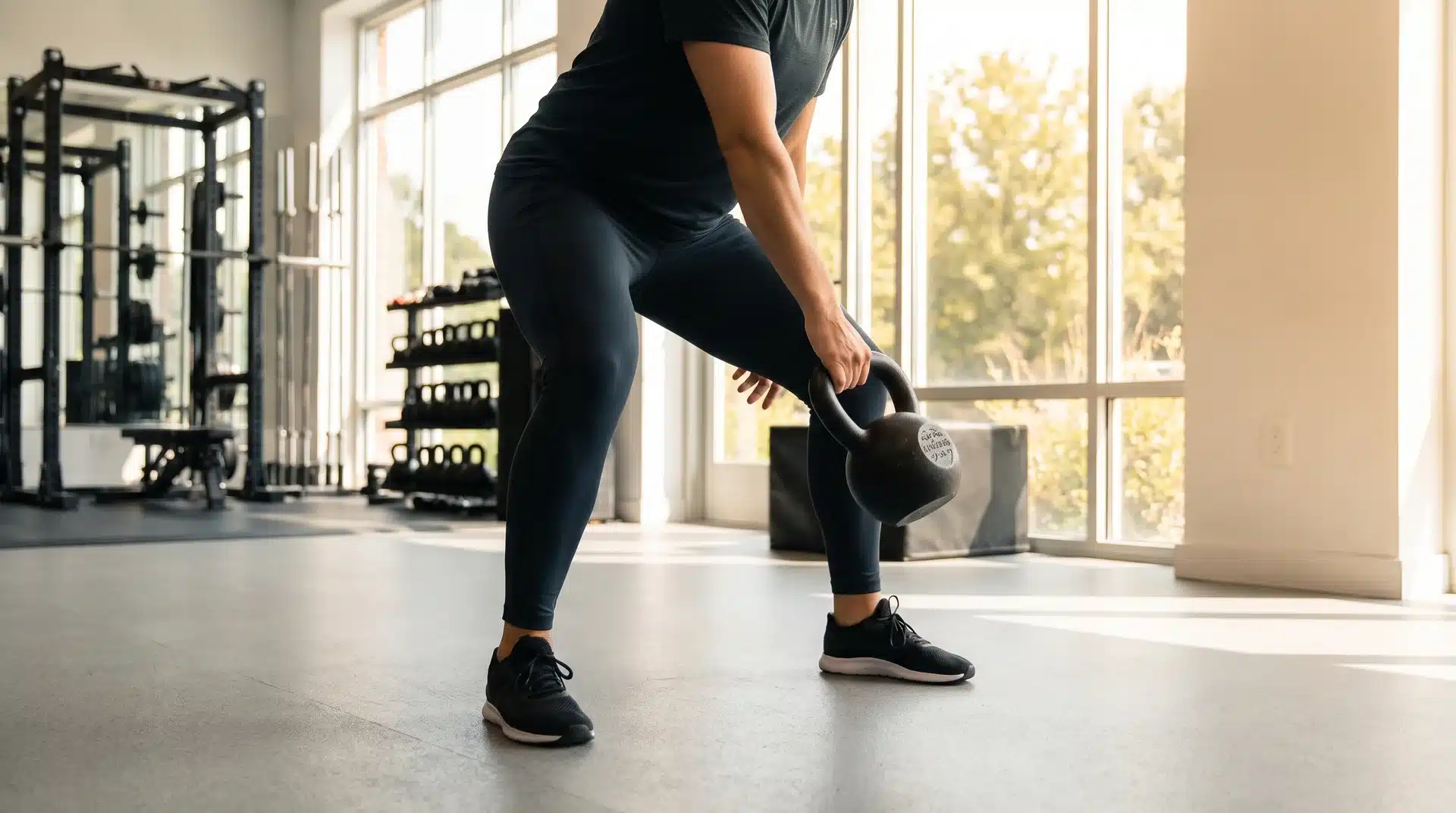
The figure eight is a coordination drill that gets your hips moving, warms up your inner thighs, and challenges your grip and focus at the same time. It is a fun exercise that beginners usually enjoy from the first session.
Muscles worked: Inner thighs, hips, core, grip, forearms
How to do it:
- Stand with feet wider than shoulder-width, toes pointed slightly outward
- Hinge slightly at the hips to bring the kettlebell between your legs
- Pass it from one hand to the other in a figure-eight pattern around each leg
- Keep a steady rhythm and stay low throughout
- Reverse the direction after several reps
Form tip: Keep your back flat and hips hinged. If you are squatting straight down instead of hinging, you will lose control of the weight.
17. Kettlebell Around the World
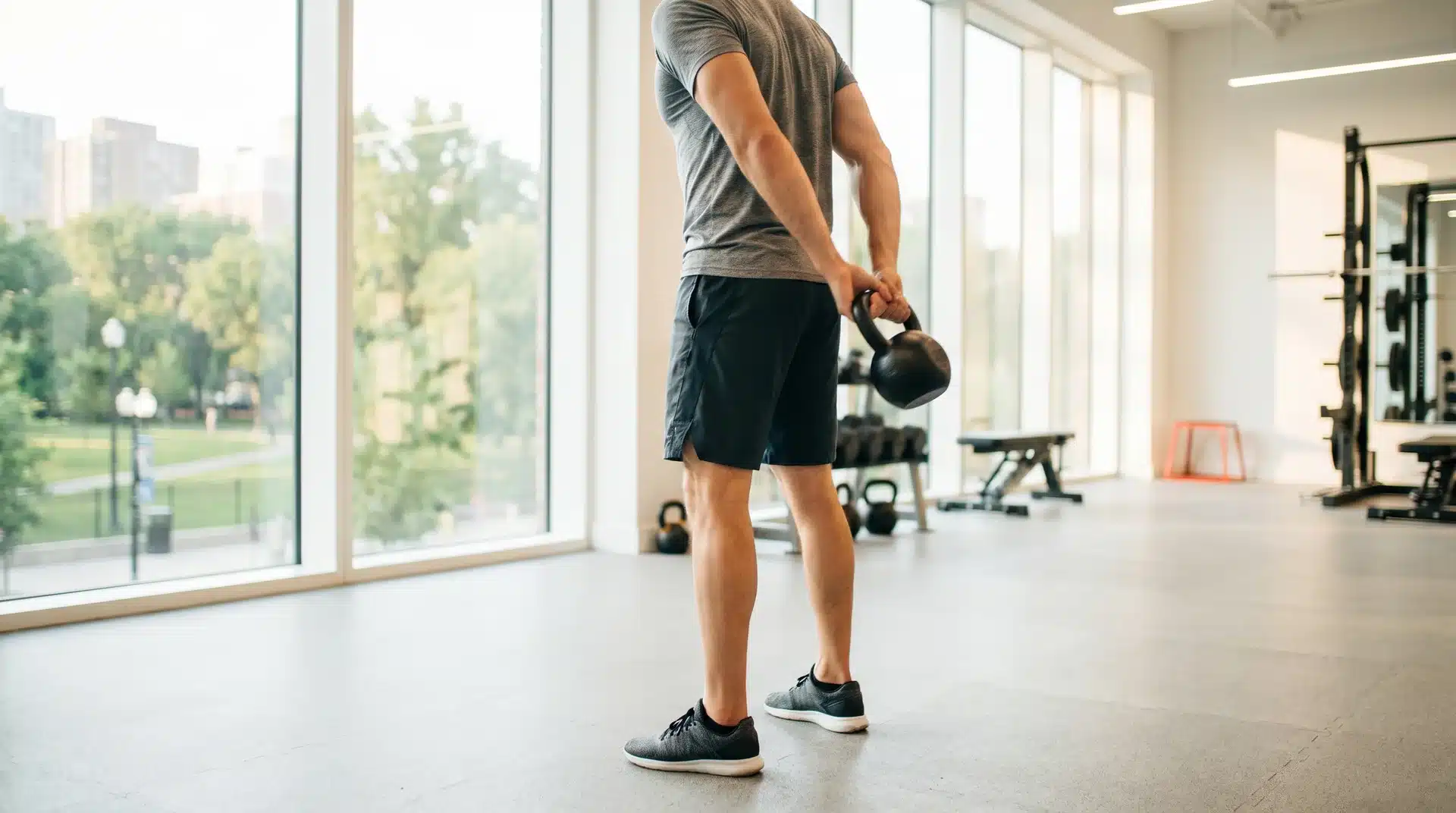
This is a great shoulder warm-up and grip drill that also trains your ability to control a moving weight around your center. It looks simple, but it requires real focus to keep your hips from swaying.
Muscles worked: Shoulders, forearms, grip, core
How to do it:
- Hold the kettlebell in one hand at hip height
- Pass it behind your back and grab it with the other hand
- Continue passing it in a circle around your body
- Keep your feet planted and hips still
- Reverse the direction every few reps
Form tip: Go slowly at first until you get the timing of the hand-to-hand pass right. Dropping the weight because you rushed is a common beginner mistake.
18. Kettlebell Windmill
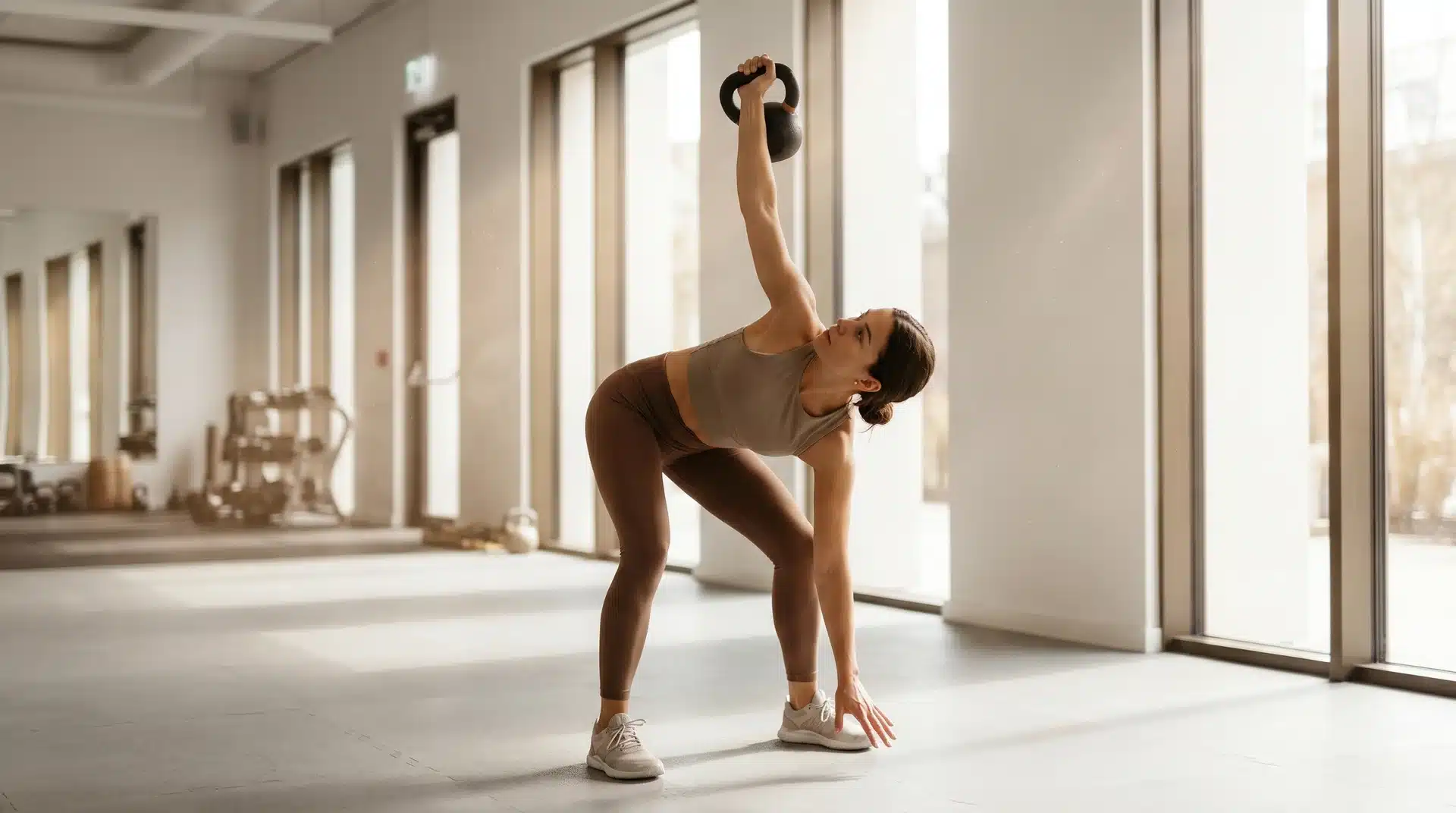
The windmill is one of those exercises that challenge your shoulder stability, hip mobility, and core all at once. It looks impressive, but more importantly, it builds the kind of structural strength that keeps you injury-free.
Muscles worked: Obliques, shoulders, hips, hamstrings, core
How to do it:
- Hold the kettlebell in your right hand and press it overhead with your arm fully extended
- Turn your feet slightly to the left and push your right hip out to the side
- Slide your left hand down your left leg as you lower your torso toward the floor
- Keep your eyes on the kettlebell the entire time
- Return to standing and repeat before switching sides
Form tip: Start without any weight or with a very light kettlebell until you get comfortable with the movement pattern.
19. Kettlebell Lateral Lunge
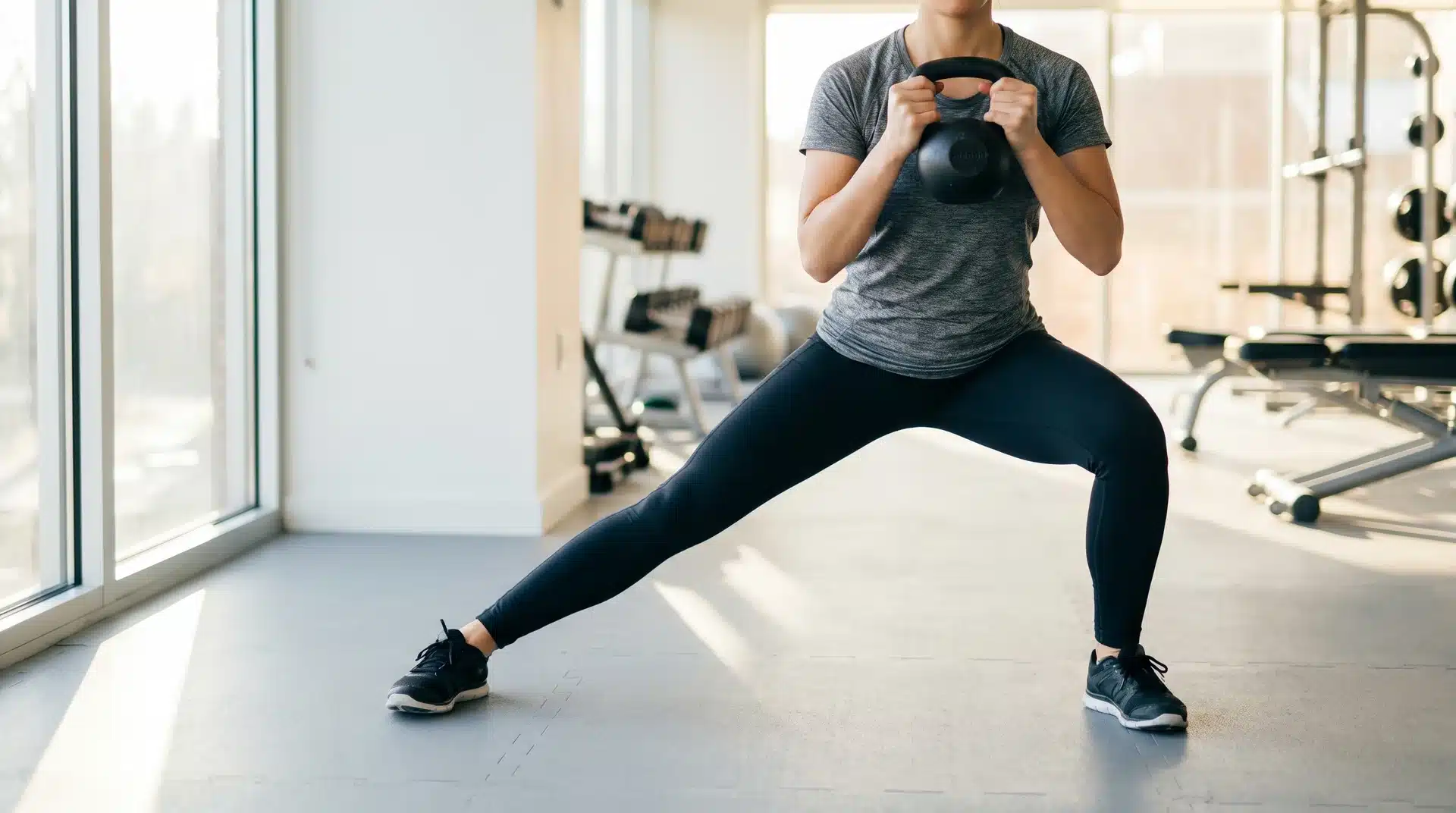
The lateral lunge moves your body in a side-to-side direction that most gym exercises completely ignore. It strengthens your inner thighs, challenges your hip mobility, and builds the kind of lateral stability that helps you in everyday movement and sport.
Muscles worked: Inner thighs, quads, glutes, core
How to do it:
- Hold the kettlebell at chest height with both hands
- Stand with feet together, then step one foot out wide to the side
- Shift your weight onto that foot, bending the knee and sitting your hips back
- Keep your other leg straight and your chest up
- Push off the lunging foot to return to standing and alternate sides
Form tip: Keep your lunging knee directly over your foot and pointing in the same direction as your toes. Never let it collapse inward.
20. Kettlebell Step-Up
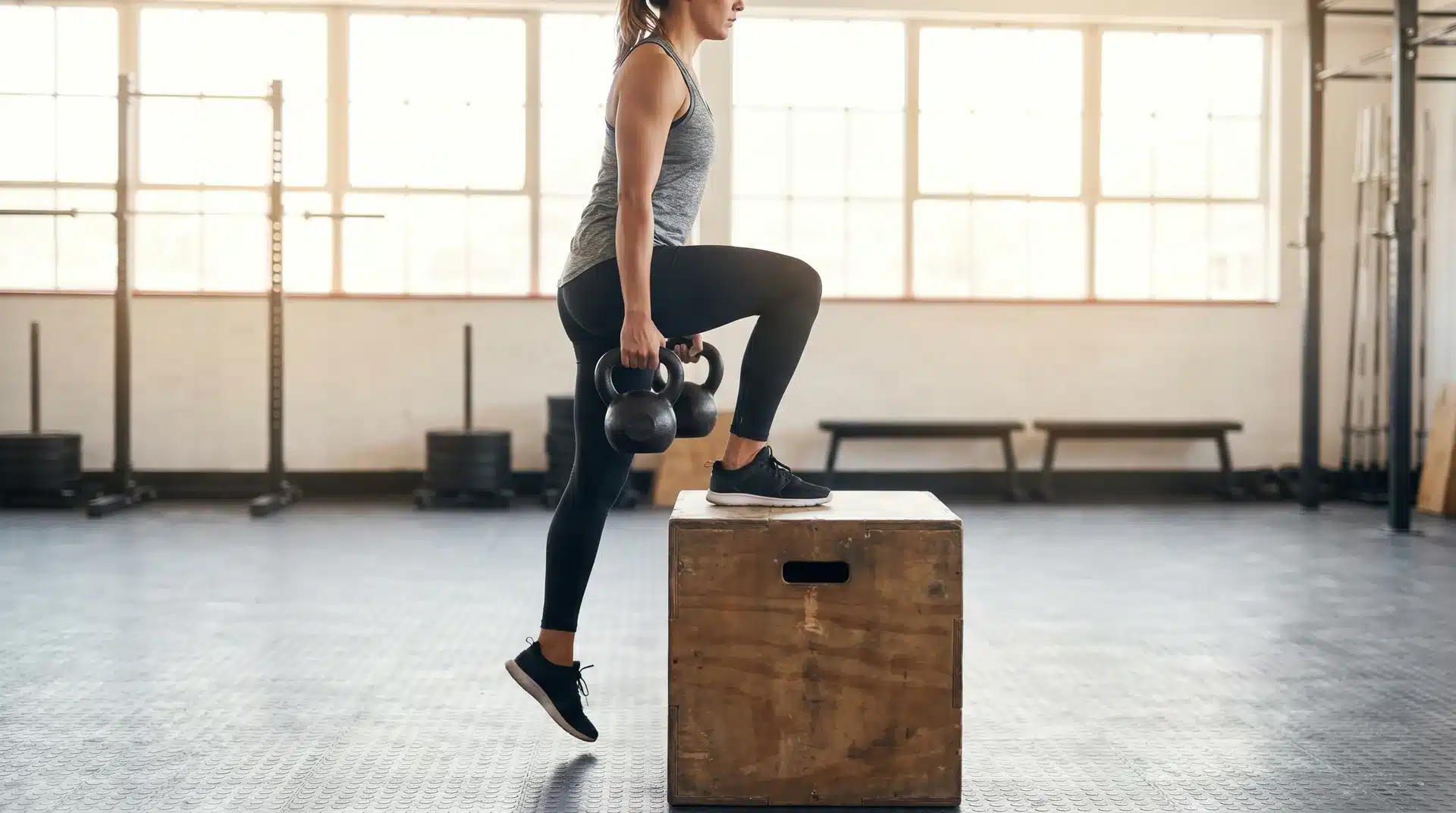
The step-up is an underrated lower-body exercise that trains each leg individually and builds functional strength for climbing stairs, hills, and uneven ground. Adding a kettlebell makes it a full-body challenge.
Muscles worked: Quads, glutes, hamstrings, core, balance
How to do it:
- Hold a kettlebell in each hand at your sides
- Place one foot fully on a bench or sturdy box
- Drive through that heel to stand on the box, bringing your other foot up to meet it
- Step back down with control, leading with the same foot
- Complete all reps on one side before switching
Form tip: Do not push off your back foot to help you up. All the work should come from the raised leg. If you are pushing off, the box is too high, or the weight is too heavy.
21. Kettlebell Bent-Over Row (Two Hands)
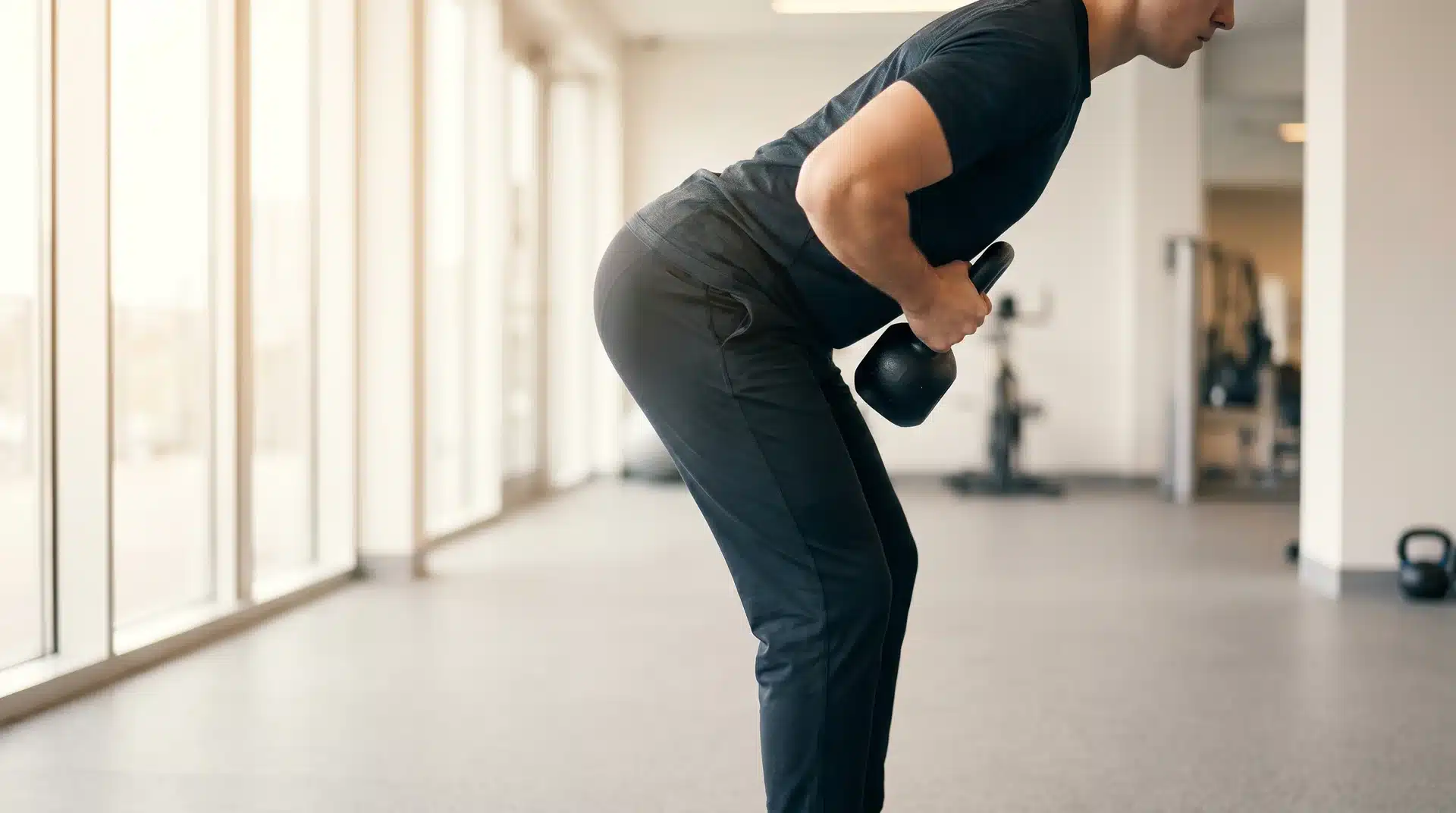
The two-hand bent-over row builds the upper and middle back strength that most beginners neglect. A strong back improves your posture, protects your spine, and makes every other exercise feel more stable.
Muscles worked: Upper back, lats, rhomboids, biceps, core
How to do it:
- Stand with feet hip-width apart and hinge forward until your torso is close to parallel with the floor
- Hold the kettlebell with both hands, arms hanging straight down
- Pull it up toward your lower chest, squeezing your shoulder blades together at the top
- Lower it back slowly with control
- Keep your back flat and your head in a neutral position throughout
Form tip: Think about pulling your elbows back toward the wall behind you rather than just lifting the weight up.
22. Kettlebell Bottoms-Up Press
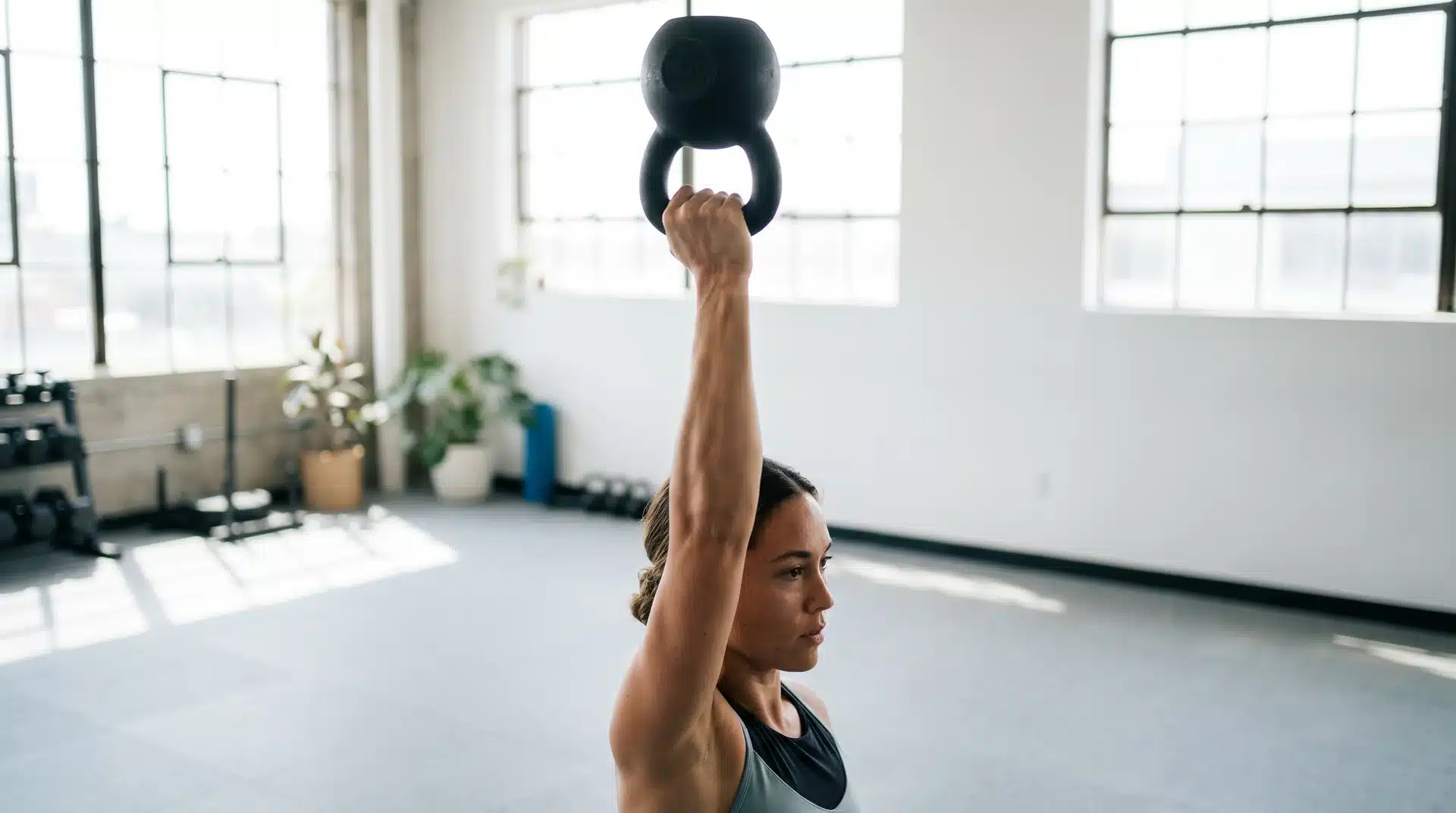
The bottom-up press flips the kettlebell upside down so the ball points toward the ceiling and your grip has to work overtime to keep it balanced. This might be the single best exercise for building shoulder stability and improving pressing mechanics.
Muscles worked: Shoulders, forearms, grip, core, stabilizer muscles
How to do it:
- Hold the kettlebell by the handle with the ball pointing up
- Start in the rack position with your elbow tucked in
- Press slowly overhead, fighting to keep the kettlebell from tipping
- Hold for a moment at the top, then lower with full control
- Start with a lighter weight than you think you need
Form tip: Squeeze the handle as hard as you can throughout the entire movement. The harder you grip, the more stable the kettlebell will be.
23. Kettlebell Dead Bug with Pass
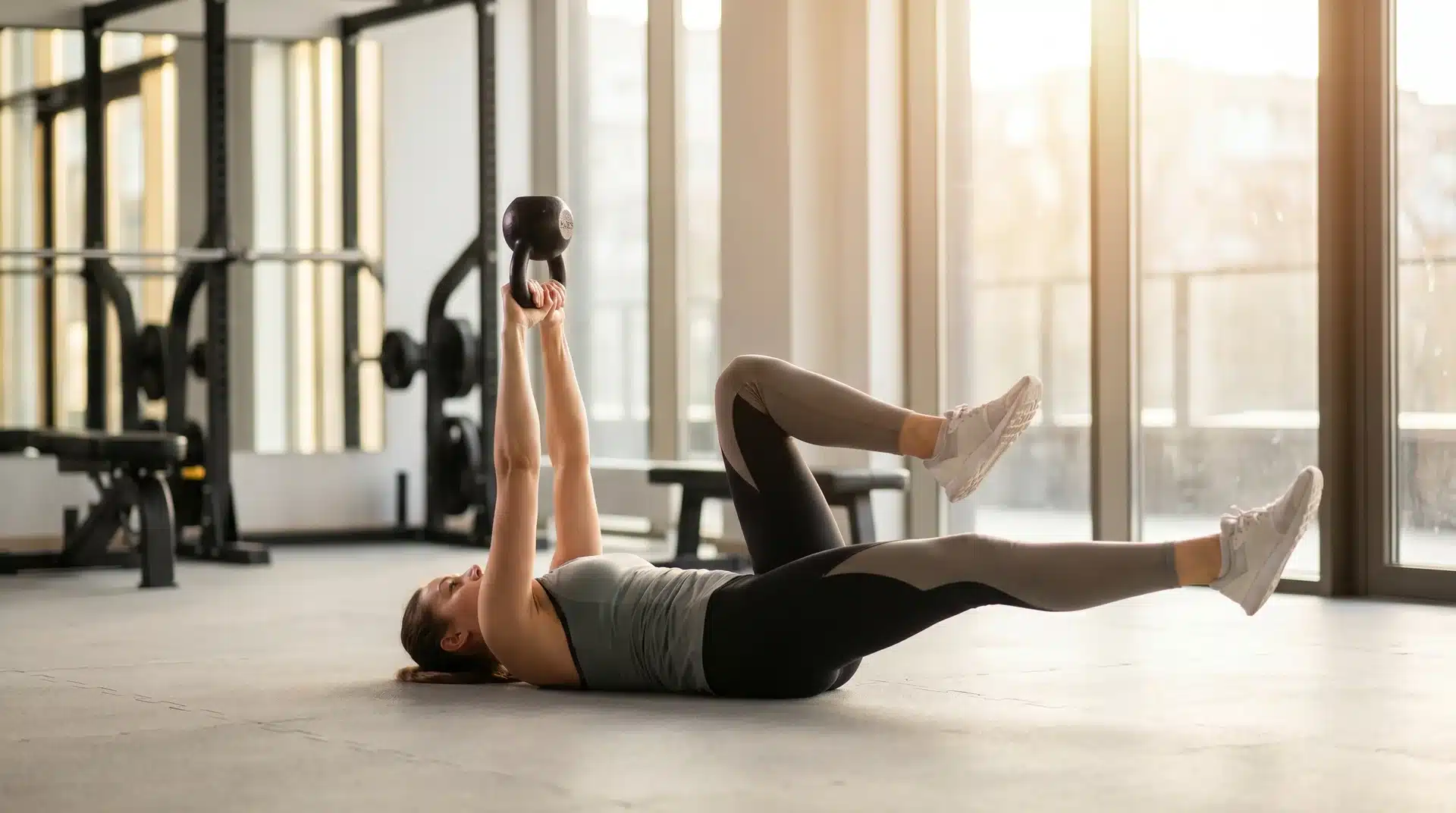
The dead bug is a core stability exercise done on the floor, and adding a kettlebell pass makes it significantly more challenging. It trains the deep core muscles that protect your spine during every standing exercise on this list.
Muscles worked: Deep core, transverse abdominis, hip flexors
How to do it:
- Lie on your back with knees bent and feet flat on the floor
- Hold the kettlebell with both hands directly above your chest, arms extended
- Slowly extend your right leg straight out while lowering the kettlebell behind your head with straight arms
- Keep your lower back pressed flat into the floor throughout
- Return to the start and switch legs
Form tip: The moment your lower back lifts off the floor, stop. That is the limit of your current core strength. Work within that range and build from there.
24. Kettlebell Core Pass (Lying)
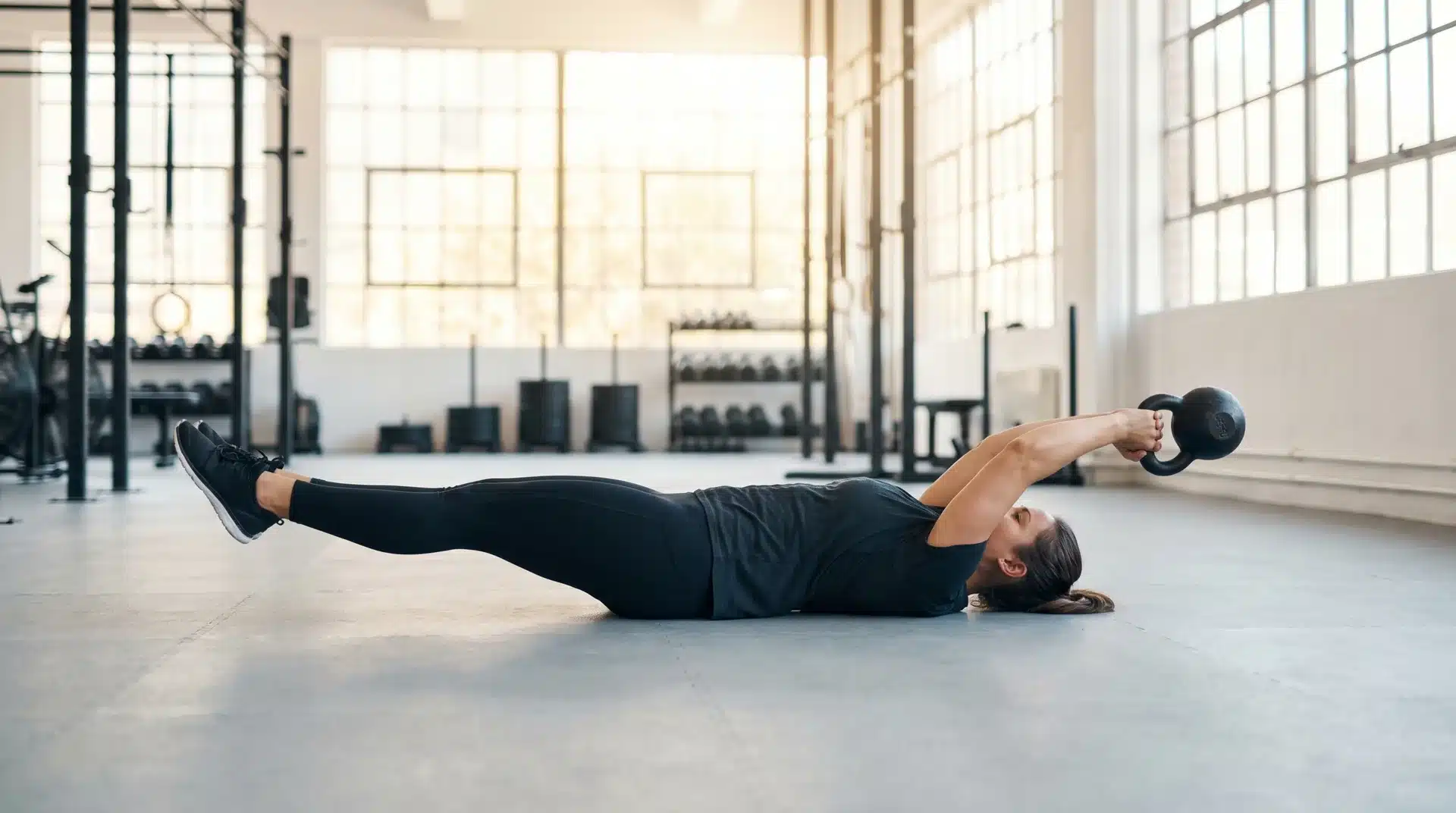
This lying core drill teaches you to transfer weight across your body while keeping your spine completely stable. It is simpler than the dead bug variation and a good starting point for beginners who find the dead bug too challenging.
Muscles worked: Core, obliques, shoulders
How to do it:
- Lie on your back with knees bent and feet flat
- Hold the kettlebell with both hands above your chest
- Slowly lower the kettlebell to one side, keeping it just above the floor
- Return it to the center and lower it to the other side
- Keep your lower back flat and your shoulders on the floor throughout
Form tip: Use a lightweight for this exercise. The goal is control, not load.
25. Kettlebell Turkish Get-Up
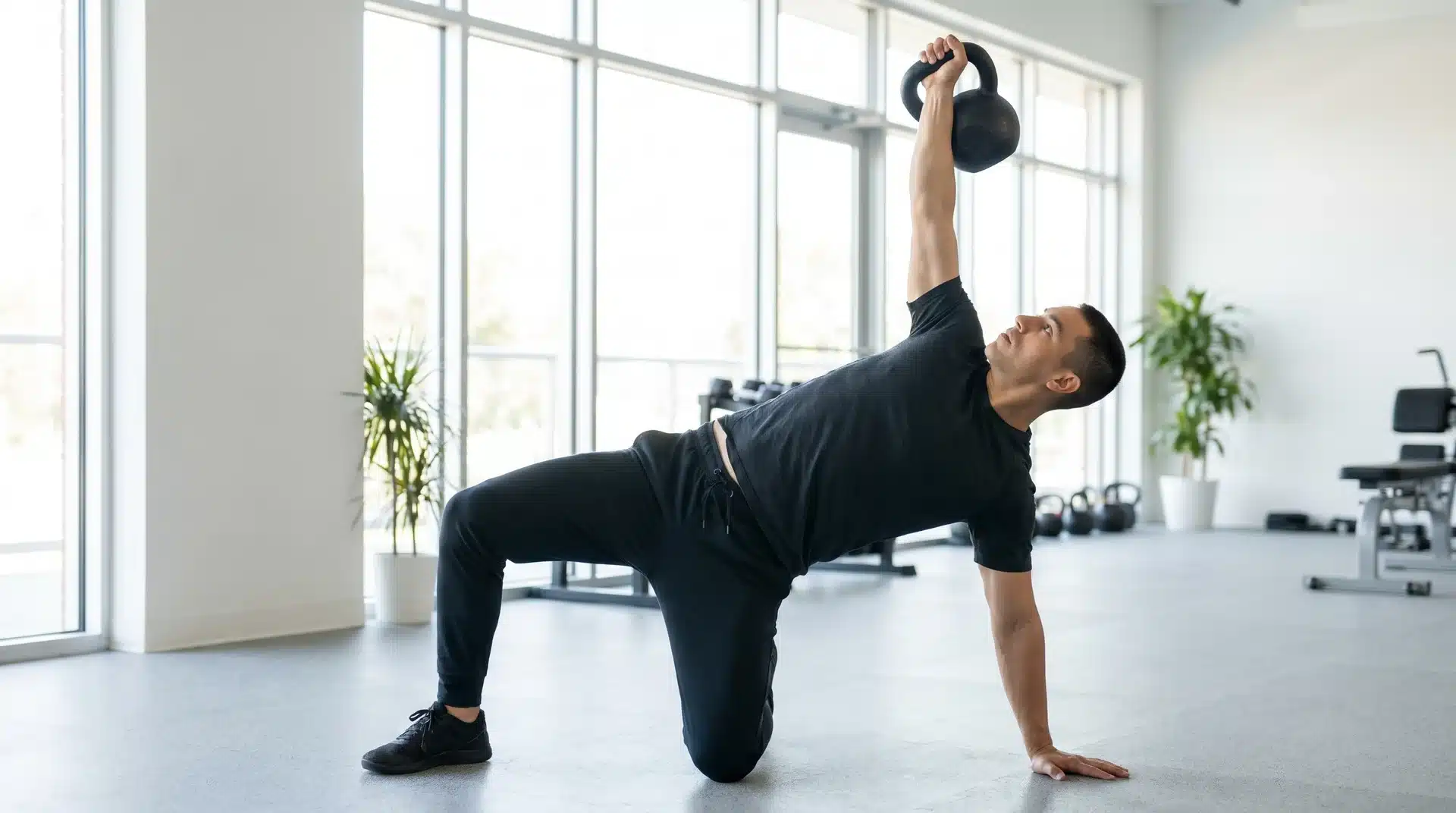
The Turkish get-up is the most complex exercise on this list and one of the most rewarding to learn. It trains your entire body in a slow, controlled sequence that builds shoulder stability, hip strength, core endurance, and body awareness all in one movement. Many coaches say it is the best single exercise ever created for full-body strength.
Muscles worked: Full body, with emphasis on shoulder stability, core, hips, and glutes
How to do it:
- Lie on your back and hold the kettlebell in your right hand with your arm extended straight up
- Bend your right knee and plant your right foot flat on the floor
- Roll onto your left forearm, keeping your eyes on the kettlebell
- Press up onto your left hand and lift your hips off the floor
- Sweep your left leg back and place your left knee on the ground
- From the half-kneeling position, stand up fully
- Reverse each step to return to the floor
- Complete all reps on one side before switching
Form tip: Never look away from the kettlebell. Keeping your eyes on it the whole time keeps your shoulder locked in a safe position and helps you move with control.
What Size Kettlebell Should a Beginner Use?
Going too heavy leads to poor form and injury. Going too light means you will not get much out of the session. The right starting weight is one that challenges you without breaking down your technique. Use the table below as a starting point, then adjust based on how each specific exercise feels.
| Experience Level | Women | Men |
|---|---|---|
| Complete beginner (no prior training) | 8 kg (18 lbs) | 12 kg (26 lbs) |
| Some fitness background | 10 to 12 kg (22 to 26 lbs) | 14 to 16 kg (31 to 35 lbs) |
| Active with strength training experience | 12 to 16 kg (26 to 35 lbs) | 16 to 20 kg (35 to 44 lbs) |
A good rule of thumb: if your form breaks down before you finish the set, the weight is too heavy. If the last few reps feel almost effortless, it is time to go heavier.
How to Hold a Kettlebell Correctly
The grip you use depends on the exercise, but the fundamentals stay the same across all movements. For two-hand exercises like swings and goblet squats, wrap both hands around the handle and keep your wrists straight, never bent.
For one-hand exercises like presses and rows, hold the handle diagonally across your palm with your thumb wrapped firmly around it. In the rack position, used for presses and carries, let the kettlebell rest against your forearm close to your chest with your elbow tucked in and your wrist flat.
A solid grip protects your wrist, keeps the weight under control, and makes every exercise more effective.
The Bottom Line
Kettlebell exercises for beginners are some of the most effective and practical movements you can add to your fitness routine. You do not need a full gym, a lot of time, or years of training experience to get real results.
Start with the fundamentals, learn the hip hinge, practice the goblet squat and swing, and build from there, one movement at a time.
Focus on form before adding weight, and be patient with the process. The exercises in this guide give you everything you need to get started and keep progressing for months to come.