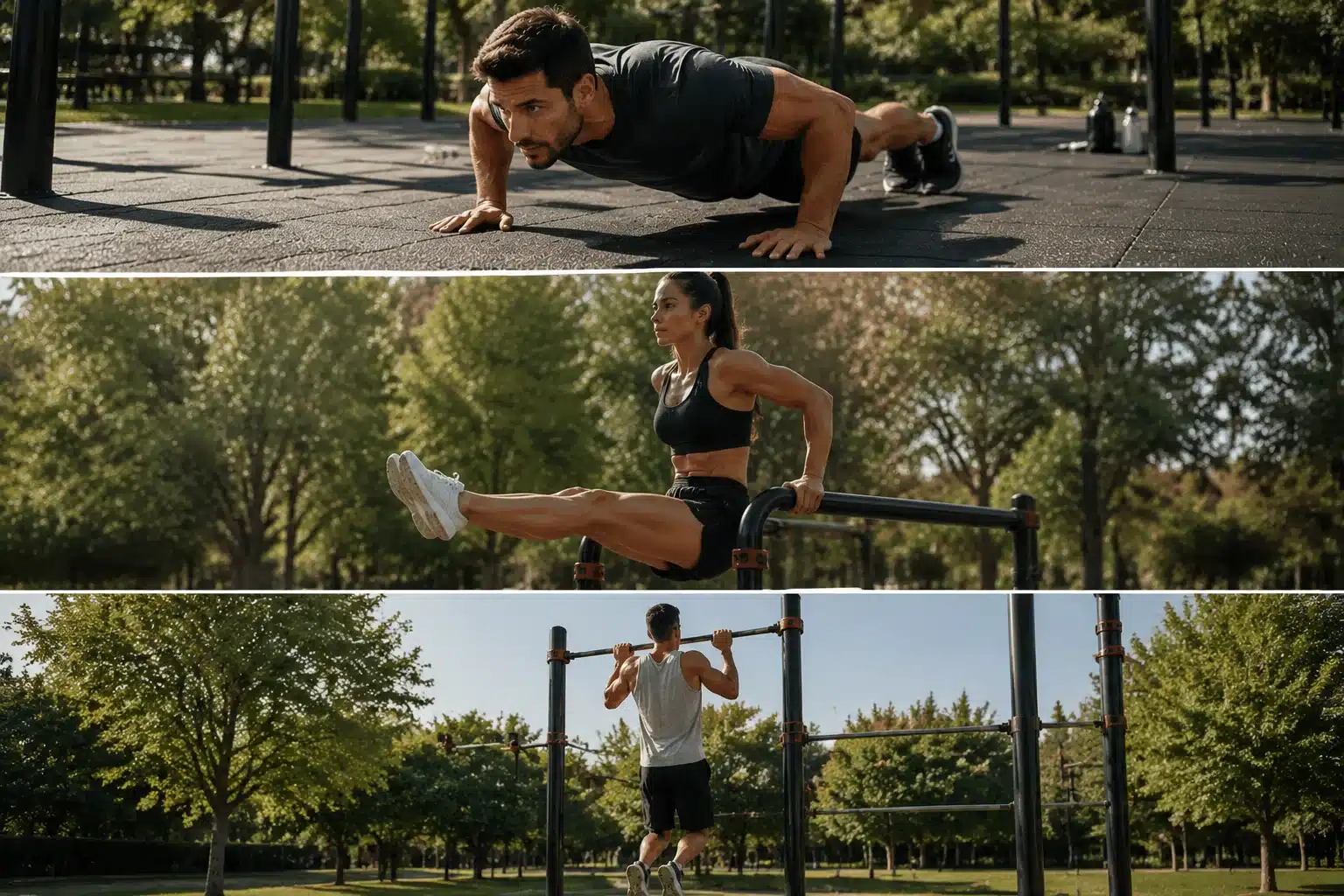
You don’t need a gym to build real strength. Your body weight is enough.
This calisthenics workout plan gives you a 4-week schedule, a full exercise breakdown, and clear progression rules. It works for beginners and intermediate trainees who want a structured path forward.
Inside, you’ll find:
- A complete weekly training split with full tables for all four weeks
- A warm-up and cool-down routine to use before and after every session
- All the foundational exercises, grouped by muscle
- Four progression methods to keep making progress
- Nutrition targets for muscle gain and fat loss
This plan works for muscle building, everyday strength, and no-gym training alike. It gives you a structured starting point to follow week by week.
What Is Calisthenics Training?
A calisthenics workout plan uses your body weight instead of external equipment. It builds strength, control, and flexibility through controlled movement and gradual increases in difficulty.
The word “calisthenics” comes from the Greek words for beauty (kallos) and strength (sthenos). It has been used as a training method since ancient Greece, by Spartan warriors, Shaolin monks, and European gymnasts.
A few principles separate it from typical gym training:
- Bodyweight resistance: Your muscles work against your own mass, not a barbell or machine.
- Progressive difficulty: Exercises get harder by changing the angle, load position, or range of motion.
- Controlled movement: Slow, deliberate reps build more strength than rushed ones.
- Strength-to-weight ratio: Progress means controlling more of your own body, not lifting more weight.
- Mobility: Many calisthenics movements improve joint range of motion as a built-in side effect.
Form matters more than rep count. A push-up with a stable core and full range of motion builds more strength than 20 sloppy ones. It also reduces stress on the shoulders and wrists.
Calisthenics trains your body to move well before it trains your body to move heavy.
Benefits of Following a Calisthenics Workout Plan
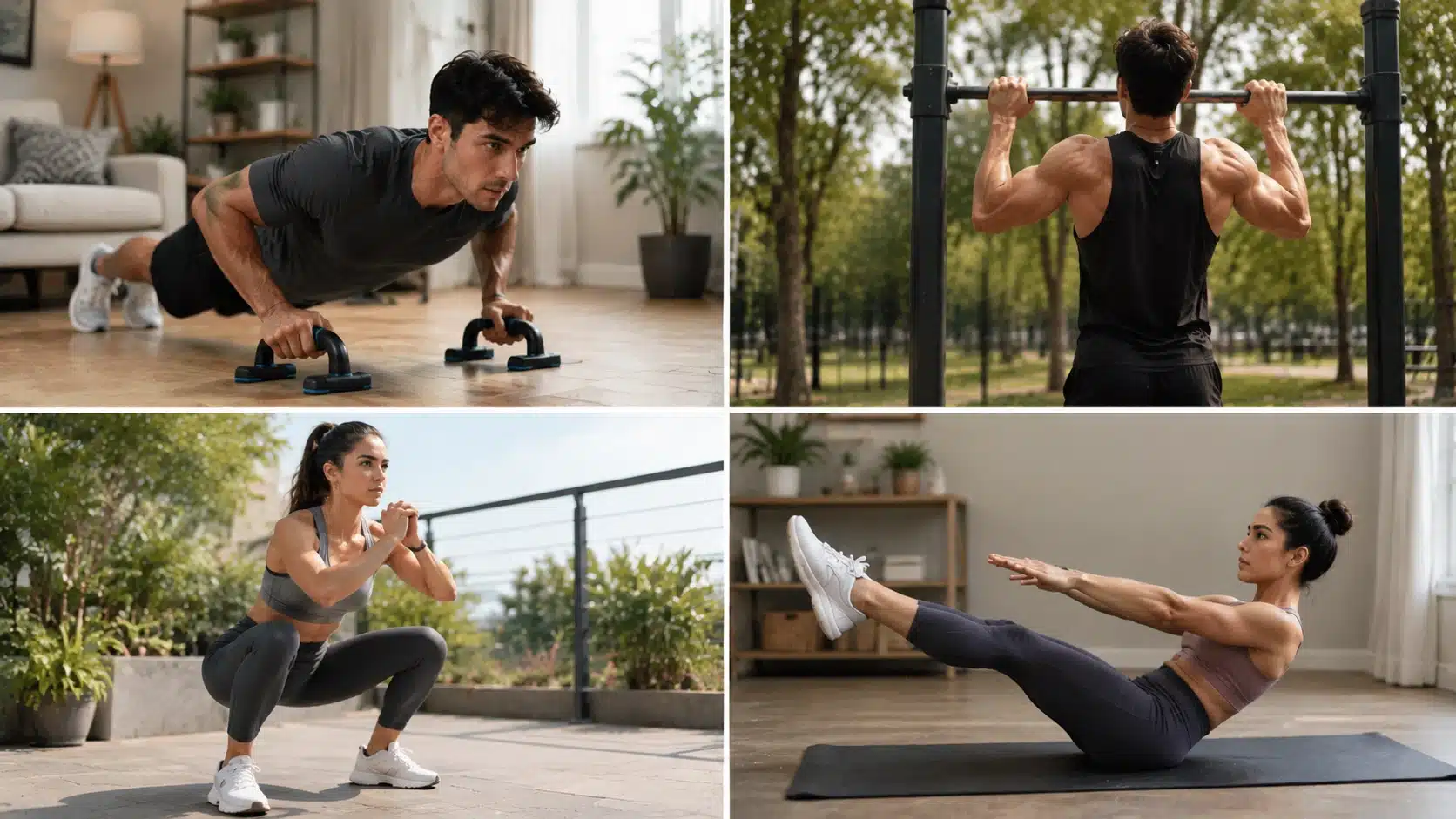
A structured calisthenics program does more than build muscle. It trains the body as a single connected system rather than as isolated parts.
Here is what a consistent plan can offer:
1. Build Functional Strength: Compound bodyweight movements like push-ups, pull-ups, and squats recruit several muscle groups at once. This carries over into everyday tasks such as lifting, climbing stairs, and carrying groceries.
2. Increase Muscle and Definition: Muscle growth in calisthenics comes from time under tension and progressive overload. Slowing down a rep, adding pauses, or moving to a harder exercise variation all create the resistance needed for muscle growth.
3. Improve Mobility and Coordination: Bodyweight training asks the joints to move through a full range while staying stable. This builds better balance, joint control, and overall body awareness compared to machine-based training.
4. Train Anywhere Without Equipment: A calisthenics workout plan travels well. The same routine works in a living room, a hotel room, or an outdoor park, which makes it easier to stay consistent.
A calisthenics routine builds strength, mobility, and consistency all at once, which is why it works well for people who want results without a gym membership.
What to Do Before Every Session
Warm-Up (5 Minutes)
A warm-up takes 5 minutes. Do not skip it. It reduces injury risk and makes the first working set feel better from the start.
Run through this sequence before each session:
- Jumping jacks or marching in place: 60 seconds. Raises heart rate and body temperature.
- Arm circles: 10 forward, 10 backward. Prepares the shoulder joint for push-and-pull work.
- Hip circles: 10 each direction. Loosens the hip flexors before squats and lunges.
- Easy bodyweight squats: 10 reps at half depth. Warms the knees and ankles gradually.
- Cat-cow stretch: 8 reps. Mobilizes the spine before plank and core work.
By the end, you should feel warm and slightly out of breath. Not tired.
Cool-Down (2 to 3 Minutes)
After each session, hold these three stretches:
- Standing quad stretch: 30 seconds per leg
- Chest opener, arms clasped behind the back: 20 seconds
- Seated hamstring stretch: 30 seconds per leg
Static stretching after training reduces next-day soreness. It also keeps joints flexible over time.
4-Week Calisthenics Workout Plan for Beginners
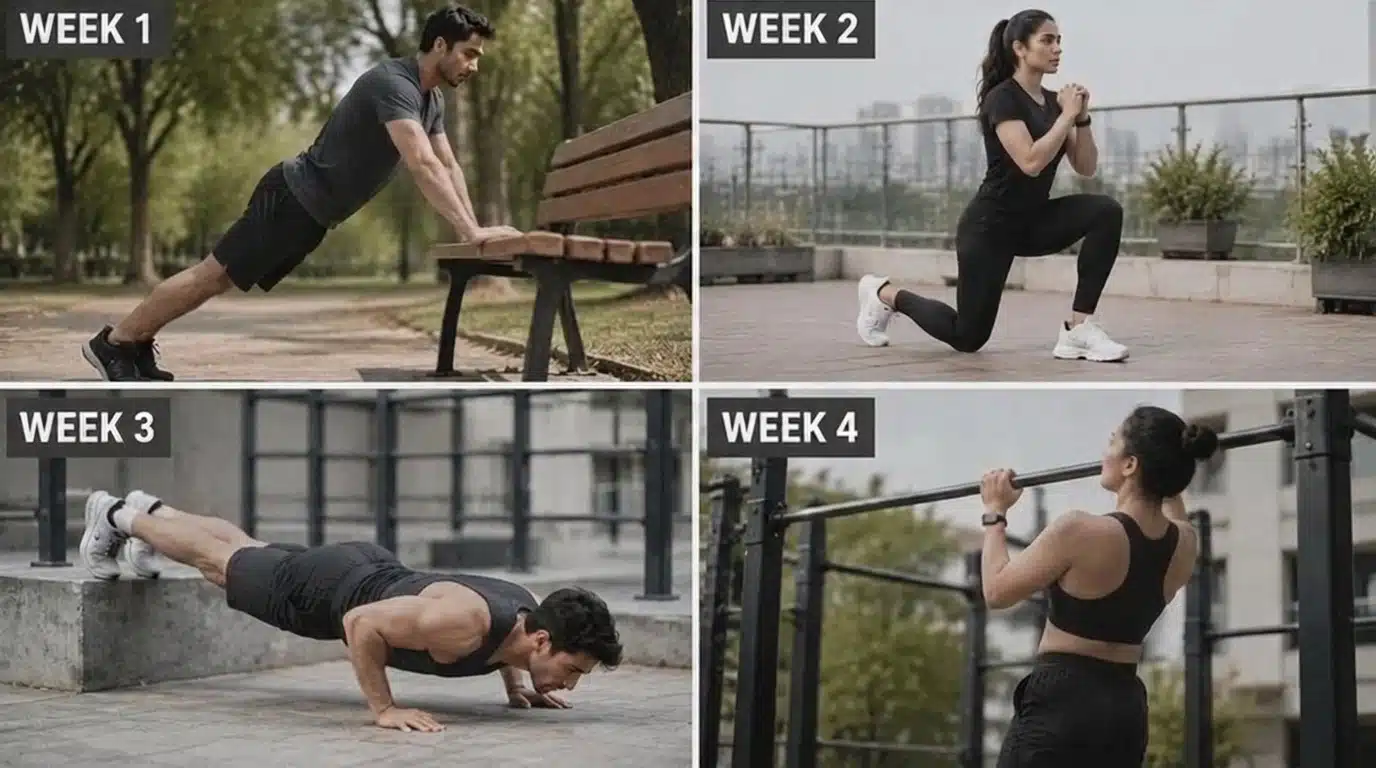
A beginner plan should build consistency first and intensity second. Each session in this plan takes 30 to 40 minutes, including warm-up and cool-down.
You do not need longer sessions at the beginner stage. A focused 35-minute session produces better results than a long, fatigued one.
The weekly split below balances strength, recovery, and conditioning across the week.
| Day | Workout Focus |
|---|---|
| Monday | Upper Body Strength |
| Tuesday | Lower Body and Core |
| Wednesday | Rest or Mobility Work |
| Thursday | Full Body Training |
| Friday | Strength Progression |
| Saturday | Conditioning |
| Sunday | Recovery |
Week 1: Build Your Foundation
The first week focuses on learning correct movement patterns and building a consistent habit, not on pushing intensity.
| Exercise | Sets | Reps |
|---|---|---|
| Incline Push Ups | 3 | 8 to 12 |
| Bodyweight Squats | 3 | 12 to 15 |
| Assisted Pull Ups | 3 | 5 to 8 |
| Plank | 3 | 30 seconds |
| Glute Bridges | 3 | 12 to 15 |
Week 2: Increase Strength Capacity
Once the movement patterns feel natural, the second week slightly increases the demand by increasing repetitions and the range of motion.
Focus exercises for this week include:
- Standard push-ups
- Walking lunges
- Negative pull-ups (slow lowering phase)
- Hollow body holds
Week 3: Add More Difficulty
By week three, the body is ready for harder variations that increase leverage and load.
Add these movements to the routine:
- Decline push-ups
- Bulgarian split squats
- Longer plank and hollow hold durations
- Advanced core movements such as leg raises
Week 4: Test Progress
The final week is a checkpoint rather than a new challenge. Use it to measure how far you’ve come in the first three weeks.
Track these three markers:
- Maximum controlled push-up reps
- Maximum controlled pull-up reps (assisted or unassisted)
- Plank and hollow hold duration
Following this 4-week structure builds a strength base that makes every later stage of calisthenics training easier to progress into.
Best Calisthenics Exercises for Beginners
Every calisthenics routine is built from a small set of core movement patterns. Learning these well makes every future progression easier.
The exercises below are grouped by the muscles they train most directly.
Upper Body Exercises
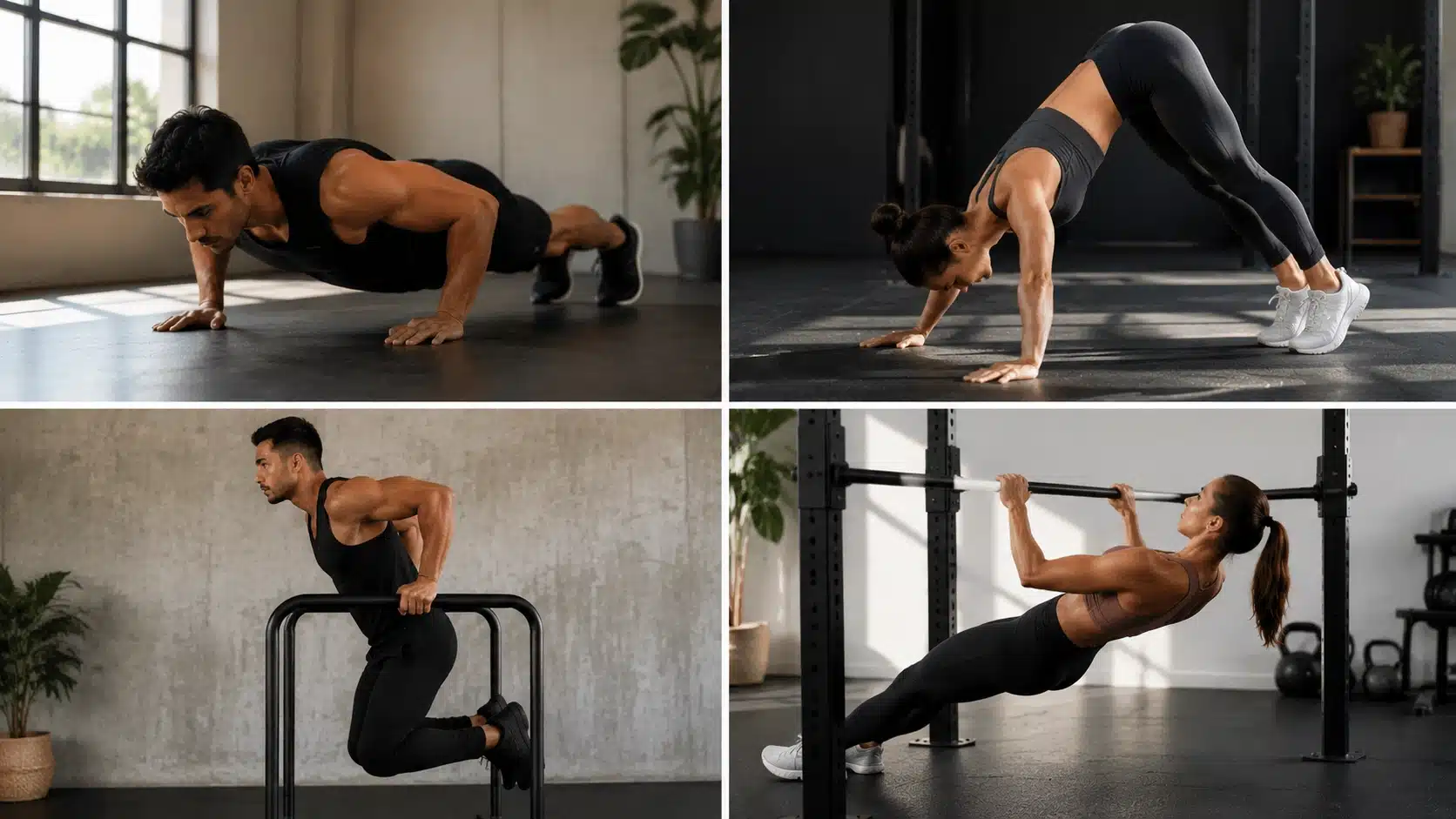
Upper body glute workout movements fall into two categories: pushing and pulling.
Push movements train the chest, shoulders, and triceps:
- Push ups
- Pike push-ups
- Dips
Push exercises should be balanced with an equal amount of pulling work, since relying on push movements alone can lead to rounded shoulders and posture issues over time.
Pull movements train the back and biceps:
- Pull ups
- Chin ups
- Australian rows
Pull-ups and chin-ups are often the hardest bodyweight exercises for beginners to perform with strict form, so starting with assisted or Australian row variations is a practical way to build the strength needed for a full pull-up.
Lower Body Exercises
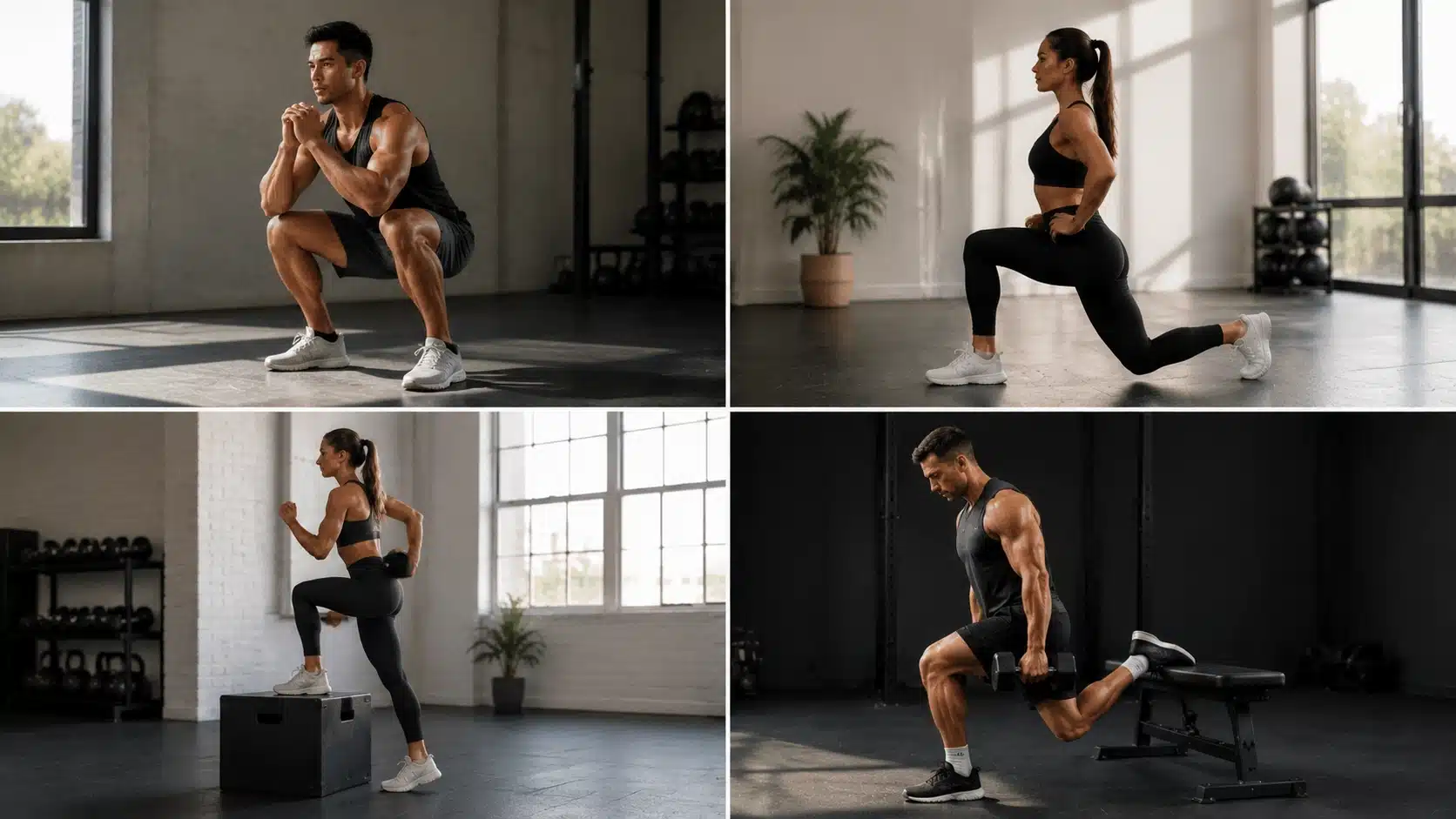
Lower body training in calisthenics builds strength through single-leg and double-leg movement patterns:
- Bodyweight squats
- Lunges
- Step ups
- Bulgarian split squats
- Calf raises
Single-leg exercises like lunges and step-ups also improve balance and stability, which double-leg movements such as squats do not train as directly.
Core Calisthenics Exercises
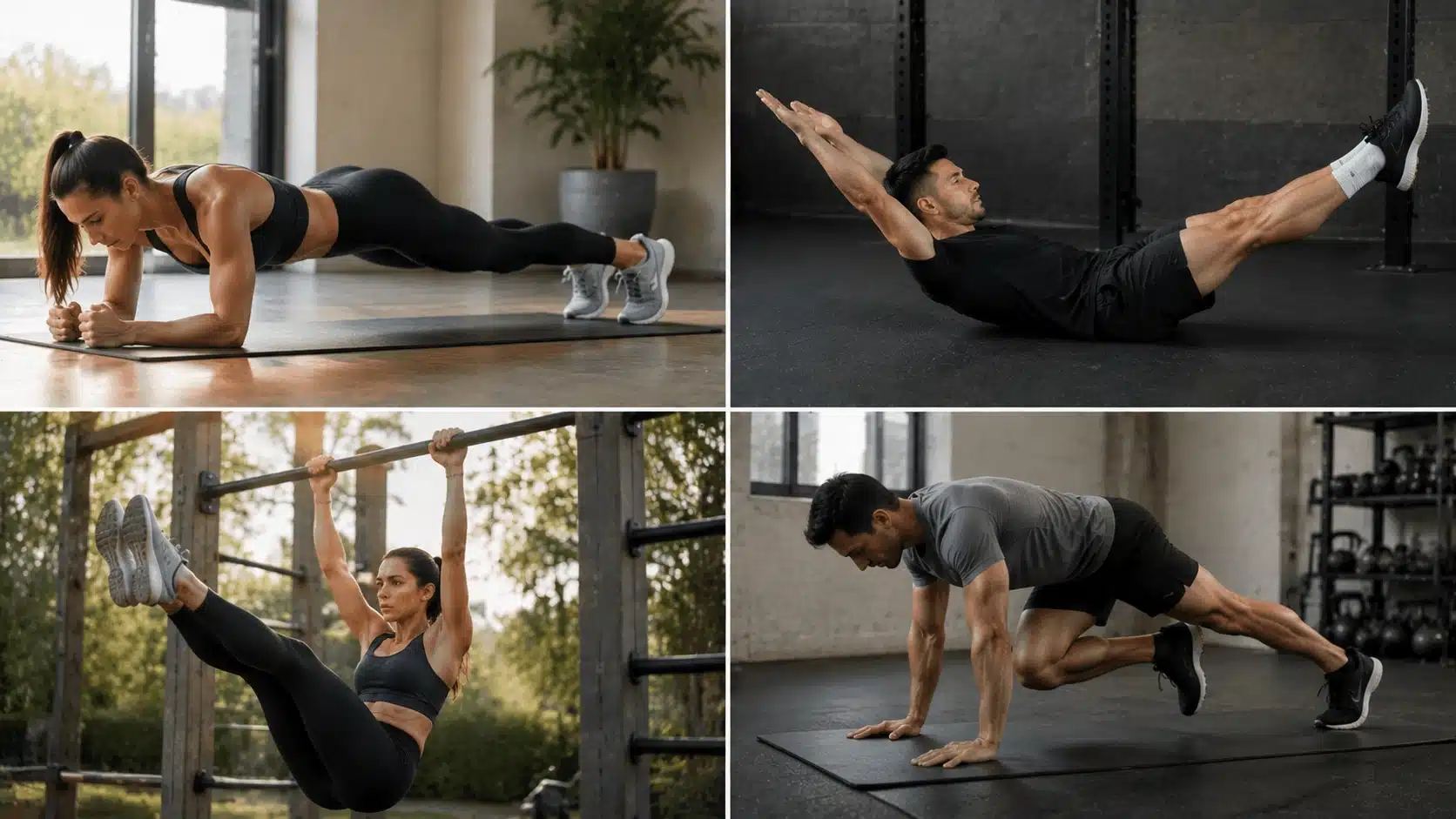
A strong core supports nearly every other calisthenics movement, from push-ups to pull-ups:
- Planks
- Hollow body holds
- Leg raises
- Mountain climbers
A stable core helps protect the spine during harder upper- and lower-body movements, which is why core work is included in nearly every day of the weekly schedule rather than as a separate add-on.
Mastering these foundational exercises gives you the base strength needed to progress to more advanced calisthenics skills.
How Do You Know When to Move to a Harder Exercise?
You’re ready to progress when you complete the current exercise with full control across all prescribed sets and reps.
Use these three markers as your guide:
- Push movements: Move up when you complete 3 sets of 15 clean reps with no form breakdown.
- Pull movements: Move up when you complete 3 sets of 8 full-range reps with no swinging.
- Lower body and core: Move up when fatigue no longer affects your technique within the target rep range.
Do not progress based on time alone. Spending three weeks on the same variation is fine if it still challenges you. Rushing to a harder exercise too early raises injury risk and slows real progress.
How to Build Muscle With a Calisthenics Workout Plan
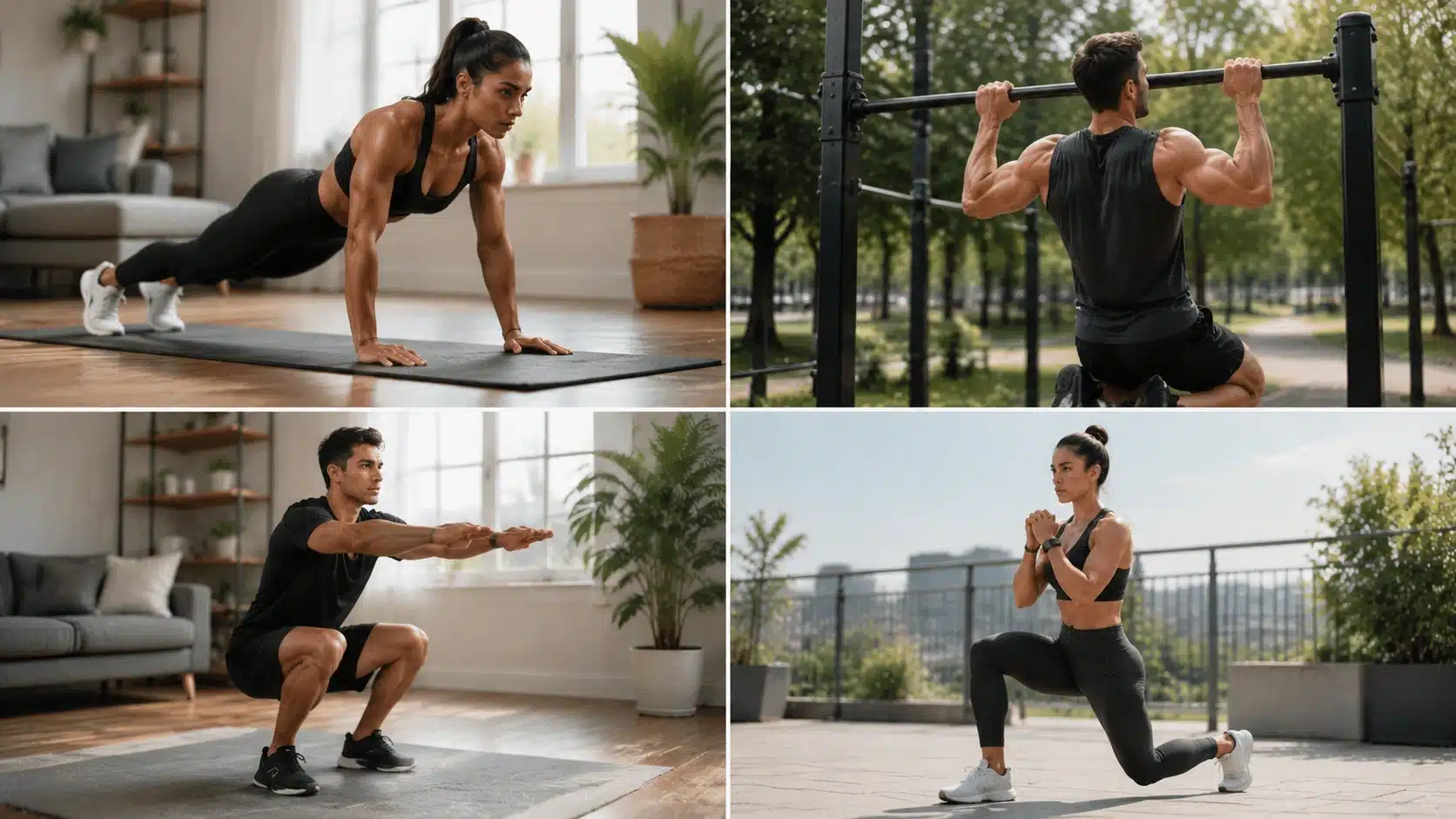
Calisthenics builds real muscle when difficulty and volume are managed correctly. It is not only an endurance training method.
Muscle growth in bodyweight training comes from four main drivers:
- Increasing exercise difficulty
- Adding training volume
- Slowing down repetitions
- Progressing to advanced variations
The table below shows how a single movement pattern scales from beginner to advanced. These are your long-term milestones, not week-one targets.
| Beginner | Intermediate | Advanced |
|---|---|---|
| Push-Up | Diamond Push-Up | One-Arm Push-Up |
| Assisted Pull-Up | Pull-Up | Muscle-Up |
| Bodyweight Squat | Bulgarian Split Squat | Pistol Squat |
Building muscle with calisthenics means consistently making each movement harder. Doing more of the same exercise without increasing difficulty stops producing results past a certain point.
How to Progress in Calisthenics Training
Progressive overload without weights works by changing the difficulty of a movement, not by adding external load. There are four practical methods to apply this.
1. Increase Repetitions
Add more reps over time. Moving from 10 to 20 push-ups over several weeks is a clear sign of progress.
This works well early in training. Once 20 to 25 clean reps feel easy, increase the difficulty instead of adding more reps.
2. Increase Difficulty
Move to a harder variation. A regular push-up becomes a decline push-up. Changing the angle or contact point makes the same movement harder without any equipment.
This is the most effective long-term method for building strength.
3. Improve Tempo
Slow the lowering phase. A 3-second descent on a push-up or squat increases time under tension. Your muscles work harder through the full range of motion.
This method works well when a harder variation feels too advanced but more reps no longer challenge you.
4. Reduce Rest Time
Shorten rest periods between sets once strength in a movement has already improved. Apply this method after the first two. Cutting rest too early, before form is solid, leads to shortcuts in technique.
These four methods give this calisthenics workout program the same progressive structure as weight training, just without a barbell.
Calisthenics Workout Plan Without Equipment

One of the biggest practical strengths of calisthenics is that it needs almost nothing to get started.
These exercises need zero equipment and work in any small space:
- Squats
- Push-ups
- Lunges
- Planks
- Burpees
- Mountain climbers
A few optional tools can expand what is possible once the basics feel manageable:
| Tool | What It Adds |
|---|---|
| Pull-up bar | Full pull and chin-up training |
| Resistance bands | Assisted pull-ups and mobility work |
| Parallettes | Dip depth, L-sit, and handstand practice |
| Gymnastic rings | Full-body instability and upper-body control |
A complete calisthenics workout along with a 5-day split workout plan can be built and maintained without any of these tools. They are additions, not requirements.
Frequent Errors When Starting Calisthenics
Most calisthenics setbacks come from a handful of avoidable habits rather than a lack of effort.
1. Doing Too Many Advanced Exercises Too Soon: Jumping straight to advanced variations before mastering the basics increases the risk of injury and slows real progress.
2. Ignoring Pull Movements: Many beginners focus heavily on push-ups while skipping pull-ups and rows, which creates muscle imbalances between the chest and back.
3. Training Without Proper Form: Rushing through reps or using a partial range of motion reduces the strength benefit of an exercise and increases strain on the joints.
4. Skipping Recovery: Rest days, sleep, and nutrition are what allow muscles to actually rebuild after training. Skipping recovery slows progress even when workouts are consistent.
5. Not Tracking Progress: Without a workout journal, rep counts, or progress photos, it becomes difficult to know whether a plan is actually working.
Avoiding these five mistakes keeps a calisthenics routine safe, sustainable, and effective over the long term.
Nutrition Tips to Support Calisthenics Training

Training alone will not produce results without the right nutrition. What you eat determines whether your body has the raw material to repair and grow after each session.
For Muscle Gain:
- Eat enough protein at each meal
- Maintain a small calorie surplus
- Keep meals balanced with carbohydrates and healthy fats
For Fat Loss:
- Prioritize a protein-focused diet
- Maintain a moderate calorie deficit
- Keep training consistent to protect muscle while losing fat
The table below shows the core differences between eating for muscle gain and eating for fat loss.
| Goal | Calorie Target | Protein Focus | Training Priority |
|---|---|---|---|
| Muscle Gain | +200 to +300 calories above maintenance | High protein per meal | Progressive difficulty and volume |
| Fat Loss | -300 to -500 calories below maintenance | High protein to protect muscle | Consistency over intensity |
Pro Tip: Spread protein across 3 to 4 meals instead of one large serving. This helps the body use it more efficiently for muscle repair, whether the goal is muscle gain or fat loss.
Getting the training right and the diet wrong tends to stall results. So does the reverse. Both sides matter.
How Often Should You Do Calisthenics?
Beginners should train 3 to 4 days per week. Intermediate trainees can train 4 to 6 days per week, depending on recovery. Training frequency should match your experience level, not just your enthusiasm on day one.
| Experience Level | Recommended Frequency |
|---|---|
| Beginner | 3 to 4 days per week |
| Intermediate | 4 to 6 days per week |
Watch for these signs that you need more rest:
- Performance dropping during workouts
- Persistent soreness that does not clear between sessions
- Poor sleep quality
- Low motivation to train
Matching training frequency to recovery capacity is what keeps any calisthenics plan going week after week.
Frequently Asked Questions
Can you build muscle with calisthenics?
Yes, calisthenics can build muscle when exercise difficulty and volume increase. Progressions like a push-up to a one-arm push-up create enough resistance to trigger muscle growth similar to weight training.
How long does it take to see results from calisthenics?
Most beginners notice strength improvements within 3 to 4 weeks of consistent training. Visible muscle changes typically take 8 to 12 weeks, depending on training frequency, nutrition, and recovery habits.
Is calisthenics good for beginners?
Calisthenics is well suited for beginners because it uses simple bodyweight movements that scale in difficulty. Starting with basic variations like incline push-ups allows new trainees to build strength safely.
Can calisthenics replace weight training?
Calisthenics can replace weight training for most strength and muscle goals, especially at beginner and intermediate levels. Advanced lifters seeking maximal muscle size may benefit from combining both styles.
How many days a week should beginners do calisthenics?
Beginners should train 3 to 4 days per week, leaving room for rest and recovery between sessions. This frequency allows enough recovery while still building consistent strength gains.
Is calisthenics good for weight loss?
Yes. Calisthenics burns calories while building muscle. A moderate calorie deficit paired with consistent bodyweight training supports fat loss. The nutrition section in this article covers specific calorie targets for this goal.
Your Next Steps Toward Calisthenics Strength
A calisthenics workout plan builds real strength through progressive bodyweight training. No gym or equipment is needed to get started. Focus on consistency and proper form before adding difficulty.
Progress by increasing reps, switching to harder variations, slowing your tempo, or reducing rest time between sets. Start with the foundational exercises in this plan. Follow the 4-week schedule. Build at a pace that matches your recovery.
Want to keep building? Sign up for the Fitness Explorer newsletter for new workout progressions, skill guides, and training tips delivered weekly.
Disclaimer: This article is for informational purposes only. It does not replace professional medical or fitness advice. Consult a doctor or certified trainer before starting a new exercise program. This is especially important if you have an existing injury or medical condition.