
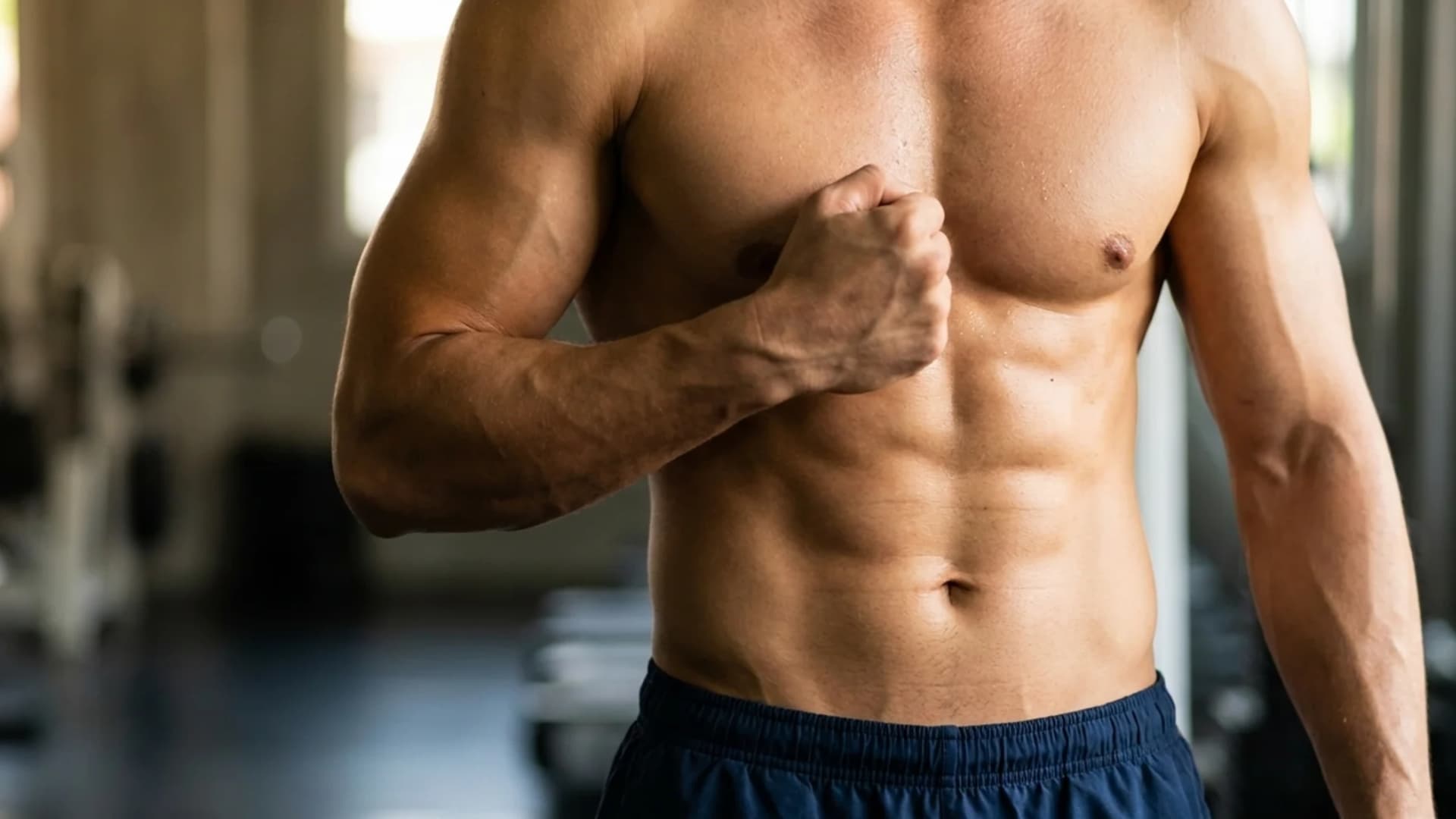
Building a bigger chest is not just about doing more bench presses. Your results depend on how you train different regions of the pectoralis major, manage weekly volume, and recover between sessions.
Since the chest is one continuous muscle with fibers that respond differently to exercise angles, a balanced approach matters.
This article breaks down chest anatomy, the most effective exercises, beginner-friendly workouts, nutrition targets, and mistakes that can slow progress.
Please note: This article is for informational purposes only. Speak with a qualified fitness professional or doctor before starting a new training program. This is especially important if you have a pre-existing injury or medical condition.
Chest Muscle Anatomy: What Makes Your Chest Look Muscular?
A chest looks muscular when the upper, middle, and lower pectoral muscles are well-developed, balanced, and visibly defined. The primary contributor is the pectoralis major. This large, fan-shaped muscle forms most of the chest’s visible size and shape.
Its development, combined with relatively low body fat and balanced overall muscle growth, creates a fuller and more defined appearance. Visible chest growth typically takes several months of consistent training. It does not happen in days or weeks.
The Pectoralis Major
The pectoralis major has two commonly described regions:
- Clavicular head: The upper portion, which originates from the collarbone. Incline pressing places greater emphasis on this area.
- Sternocostal head: The larger lower portion, arising mainly from the sternum and upper ribs. It contributes substantially to the appearance of the middle and lower chest.
The pectoralis major is a single, continuous muscle. There are no separate inner or outer muscles. Different exercises and joint angles simply shift emphasis toward different regions of the same muscle.
Supporting Chest Muscles
Two other muscles support upper-body function during chest training:
- Pectoralis minor: This lies beneath the pectoralis major and helps move and stabilize the shoulder blade.
- Serratus anterior: This runs along the side of the rib cage. It stabilizes and rotates the scapula, supporting pushing and reaching movements.
These muscles are not the main contributors to chest size. They do play an important role in shoulder health and upper-body stability during pressing exercises.
Core Training Principles for Chest Growth
Chest growth depends on how you train, progress, and recover. The four principles below apply regardless of the movements you select.
| Principle | What It Means | How to Apply It |
|---|---|---|
| Progressive Overload | Gradually increase weight, reps, or sets over time | Track each session. Add difficulty when you reach the top of your rep range with good form |
| Training Frequency | Train chest twice a week rather than once | Leave enough time between sessions for full recovery and proper form |
| Reps and Sets | 3 to 5 sets of 6 to 15 reps per exercise | Finish most sets with 1 to 2 reps in reserve. Challenge muscles without losing form |
| Recovery Time | Allow 48 to 72 hours between chest sessions | Support recovery with sleep, hydration, protein, and balanced nutrition |
Apply these four principles consistently. Steady progression and proper recovery produce balanced, lasting muscle growth over time.
Best Exercises to Build a Muscular Chest
The exercises below target every region of the pectoralis major. Choosing movements from each group gives your chest a balanced stimulus for growth. Most beginners do best with two or three exercises per session.
1. Best Exercises for the Upper Chest
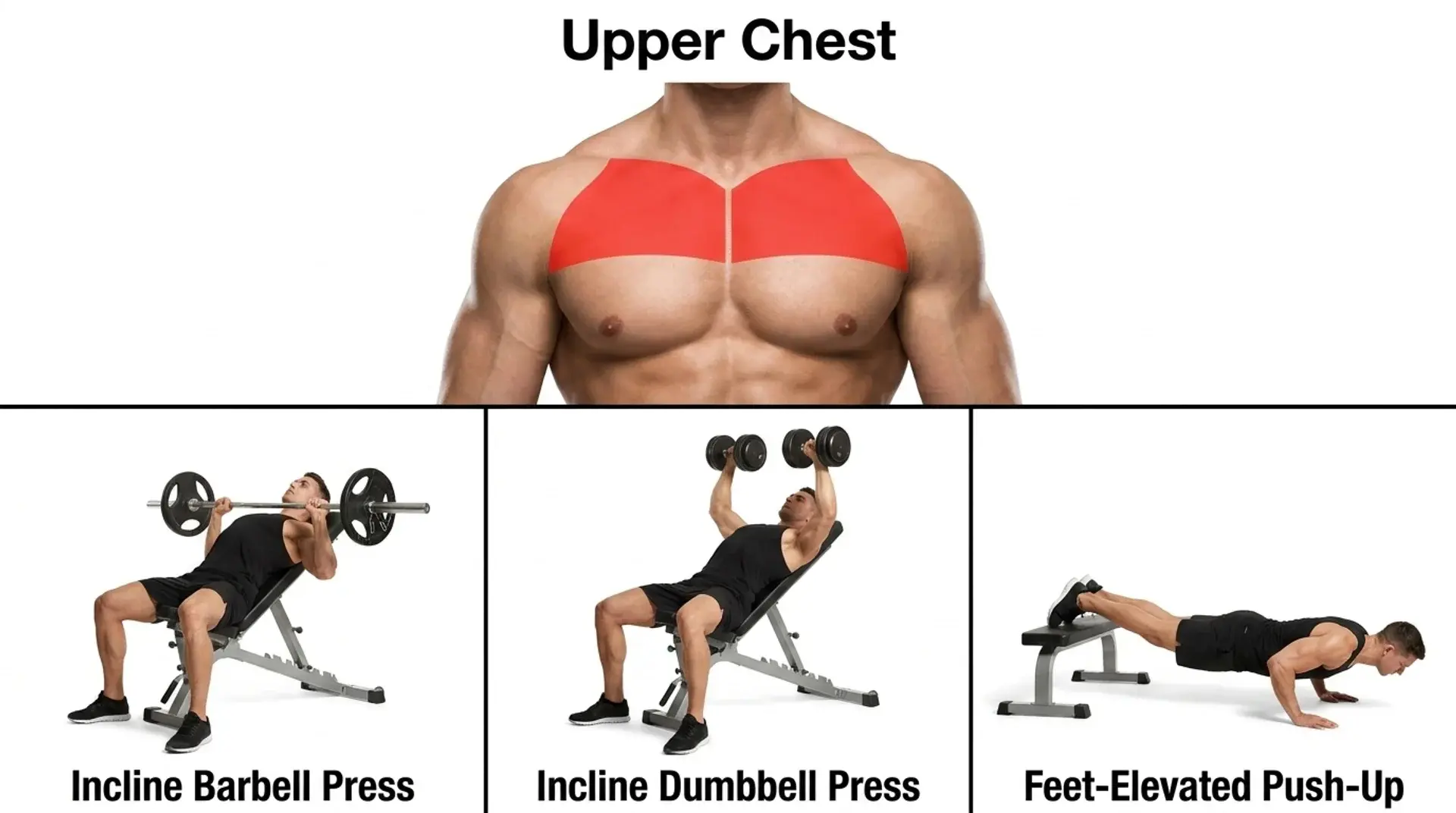
These movements angle your arms upward, placing more tension on the clavicular head near your collarbone. Keep the bench at a moderate incline. Too steep an angle shifts the work to your shoulders instead of your chest.
- Incline Barbell Press: Lie on an incline bench set to 30 to 45 degrees. Hold the barbell just wider than shoulder-width. Lower the bar to your upper chest in a controlled way, then press it back up. Keep your feet flat on the floor and your shoulder blades pulled back throughout.
- Incline Dumbbell Press: Sit on an incline bench with a dumbbell in each hand. Bring them to shoulder height with palms facing forward. Press both dumbbells up until your arms are fully extended, then lower them slowly. Dumbbells allow a slightly greater range of motion than a barbell.
- Incline Push-Up: Place your hands on an elevated surface such as a bench or step. Keep your body in a straight line from head to heels. Lower your chest toward the surface, then push back up. This is the best bodyweight option for targeting the upper chest at home.
2. Best Exercises for the Lower Chest
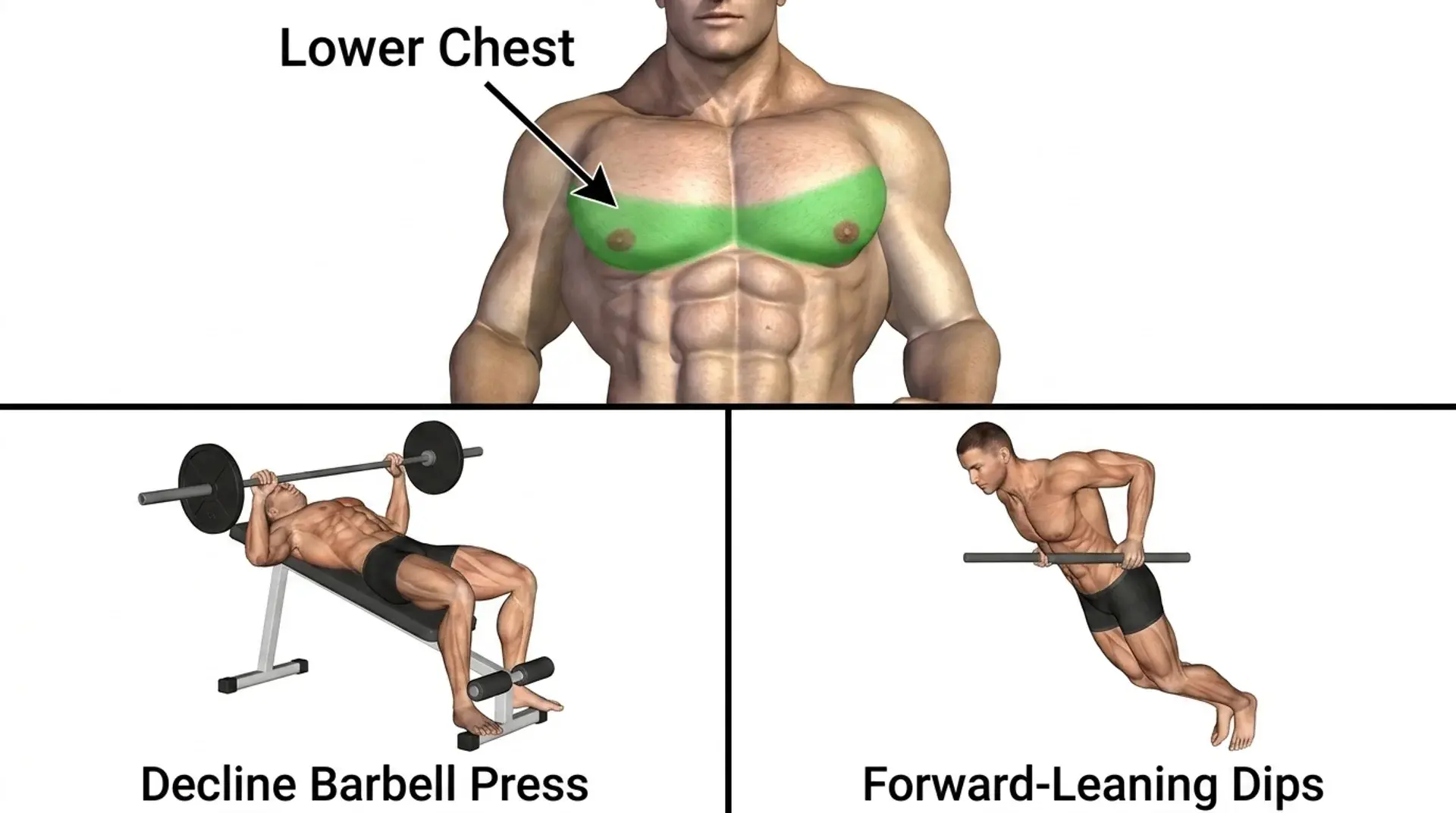
These movements position your arms in a downward path relative to your torso. This angle stretches and loads the lower pec fibers more directly than flat pressing does.
- Decline Bench Press: Set the bench to a slight decline of around 15 to 30 degrees. Secure your feet under the pad. Lower the barbell to the lower part of your chest, then press it back up in a controlled arc. This targets the sternocostal head more directly than a flat bench does.
- Forward-Leaning Dips: Grip the parallel bars and lean your torso forward at roughly 30 degrees. Lower yourself until your elbows reach about 90 degrees, then push back up. Staying upright shifts the work to your triceps. Leaning forward keeps the tension on your lower chest.
- High-to-Low Cable Fly: Set both cable pulleys to a high position. Hold one handle in each hand and step forward. Pull both handles down and inward in a wide arc, bringing them together in front of your hips. Squeeze at the bottom, then return slowly. This places steady tension on the lower pec fibers throughout the movement.
3. Best Exercises for the Middle Chest
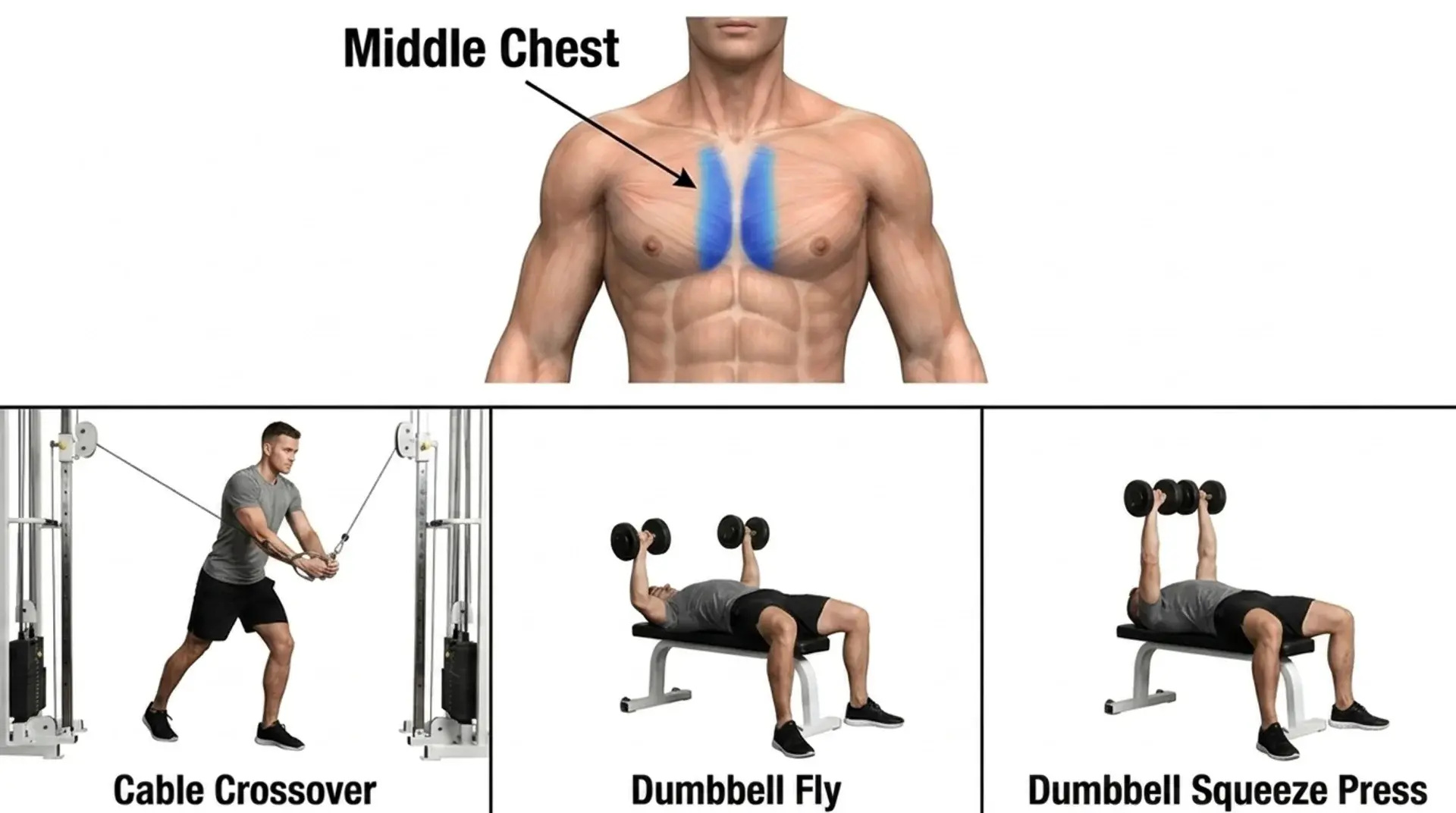
There is no separate inner chest muscle. The midline area of your pectoralis major responds best to movements that bring your hands across the center of your body. Squeeze hard at the point of peak contraction to stimulate these fibers.
- Cable Crossover: Set both pulleys to a mid or low position. Hold one handle in each hand and step forward. Pull both handles inward and across your body until your hands meet or cross in front of you. Squeeze your chest at the end of the movement, then return slowly. The cable keeps tension on the muscle throughout the full range of motion.
- Dumbbell Fly: Lie flat on a bench with a dumbbell in each hand, palms facing each other. With a slight bend in your elbows, lower both arms out to the sides in a wide arc. Bring them back together above your chest and squeeze. Lower the weight slowly to get the full stretch through the pec fibers.
- Hex Press: Lie flat on a bench and hold two dumbbells pressed together directly above your chest. Lower them slowly toward your sternum while keeping them in contact with each other the entire time. Press back up and squeeze hard at the top. The constant inward pressure activates the midline chest fibers well.
Sample Weekly Chest Workout Plan for Beginners
A beginner chest plan needs two focused sessions per week with at least 48 hours of recovery between them. Start with manageable volume, controlled form, and 1 to 2 reps left before failure on each set. The table below shows how to structure both a gym-based and a home-based version.
| Category | Gym-Based Routine | Home-Based Routine |
|---|---|---|
| Schedule | Monday and Thursday | Monday and Thursday |
| Session One | Barbell bench press: 3 × 8–10 Incline dumbbell press: 3 × 8–12 Cable fly: 2 × 12–15 |
Standard push-ups: 3 × 8–15 Incline push-ups: 3 × 10–15 Wide push-ups: 2 × 8–12 |
| Session Two | Incline machine press: 3 × 8–12 Assisted chest dips: 2 × 8–12 Pec deck fly: 2 × 12–15 |
Decline push-ups: 3 × 6–12 Standard push-ups: 3 × 8–15 Slow-tempo push-ups: 2 × 6–10 |
| Rest Between Sets | 90–120 seconds after presses; 60–90 seconds after flyes | 60–90 seconds, extending to 2 minutes when needed |
| Training Effort | Stop each set with 1–2 controlled reps remaining | Choose a variation that leaves 1–2 controlled reps remaining |
| Progression | Add 1–2 reps first, then increase weight by the smallest available amount | Add reps, slow the lowering phase, raise the feet, or use a resistance band |
| Safety | Use a spotter or safety arms for barbell presses; keep shoulders stable throughout | Use a firm, non-slip surface; avoid unstable chairs or furniture for dips |
Complete each rep through a comfortable range of motion. Record your reps and weights after every session. When you reach the top of the rep range with good form, increase the difficulty.
How Nutrition Supports Chest Muscle Growth
Training creates the signal for muscle growth. Food provides the material your body uses to build new tissue. Skipping nutrition attention limits your results no matter how hard you train.
Sports nutrition research recommends 1.4 to 2.0 grams of protein per kilogram of body weight per day for people who train regularly. Spread that protein across three to four meals. Aim for 20 to 40 grams per meal to support muscle repair throughout the day.
You also need enough total calories. A modest calorie surplus supports muscle gain. Eating at maintenance can still build some muscle if you are new to training.
Staying well-hydrated and eating consistently will take you further than any single food choice ever could.
Common Training Mistakes That Slow Chest Growth
Even dedicated lifters hit plateaus. Most of the time, minor technical errors are the cause, not a lack of effort. Fixing these usually restarts progress quickly.
- Cutting the range of motion short: Partial reps reduce the stretch and contraction your muscle fibers need to grow. Use a full, controlled range on every rep.
- Only doing flat bench presses: Flat pressing alone ignores the upper and lower chest fibers entirely. Add incline and decline work to every training week.
- Not recovering enough between sessions: Muscle repair happens during recovery, not during the workout itself. Give your chest at least 48 hours between sessions.
- Lifting too heavy with poor form: Too much weight with sloppy form reduces muscle tension where it matters most. Lower the weight and focus on the muscles working.
- Skipping the mind-muscle connection: Consciously feeling the chest working during each rep makes every set more productive. Do not rush through the movement.
Building a Muscular Chest Takes Consistency, Not a Secret Exercise
Building a muscular chest comes down to a few things done consistently. Train each area with the right angles, recover well between sessions, and eat enough protein to support muscle repair. Use incline movements for the upper chest and decline exercises for the lower chest.
Cable crossovers and flyes target the middle fibers well. Train twice a week, add difficulty gradually, and give your muscles 48 to 72 hours to recover.
Avoid the common mistakes covered here, and your progress becomes far more predictable. Browse the workout guides on The Fitness Explorer for more plans built around real training principles.
Frequently Asked Questions
Is a muscular chest attractive?
A muscular chest is often considered attractive because it creates a broader upper-body shape and improves overall proportions. However, attractiveness also depends on factors like posture, body composition, confidence, and balanced muscle development.
What is a man’s muscular chest called?
A man’s muscular chest is commonly called developed pecs or well-built pectoral muscles. The main chest muscle is the pectoralis major, which gives the chest its size and shape.
How do I get a muscular chest?
Build your chest by combining progressive resistance training, enough protein, and proper recovery. Exercises like bench presses, incline presses, push-ups, dips, and cable flyes help develop different areas of the chest. Gradually increasing weight or reps over time is key for growth.
How do I know if my chest is muscular?
A muscular chest usually feels firm, has visible muscle shape, shows some separation between muscle areas, and looks fuller when flexed. Chest definition also depends on body fat levels, not just muscle size.
Why are chest muscles so hard to build?
Chest growth can be slow because many people train with poor exercise selection, inconsistent progression, or too much focus on heavy pressing without enough volume. Recovery, nutrition, genetics, and proper technique all affect muscle development.
What does a fatty chest look like?
A fatty chest usually looks softer, less defined, and may appear rounded or droopy. It often lacks visible muscle separation and does not become significantly more shaped when flexed.
What are the symptoms of weak chest muscles?
Weak chest muscles may cause difficulty with pushing movements, reduced pressing strength, poor upper-body endurance, and muscle imbalance. Weakness can also affect shoulder stability because the chest works with other upper-body muscles during movement.






One Response