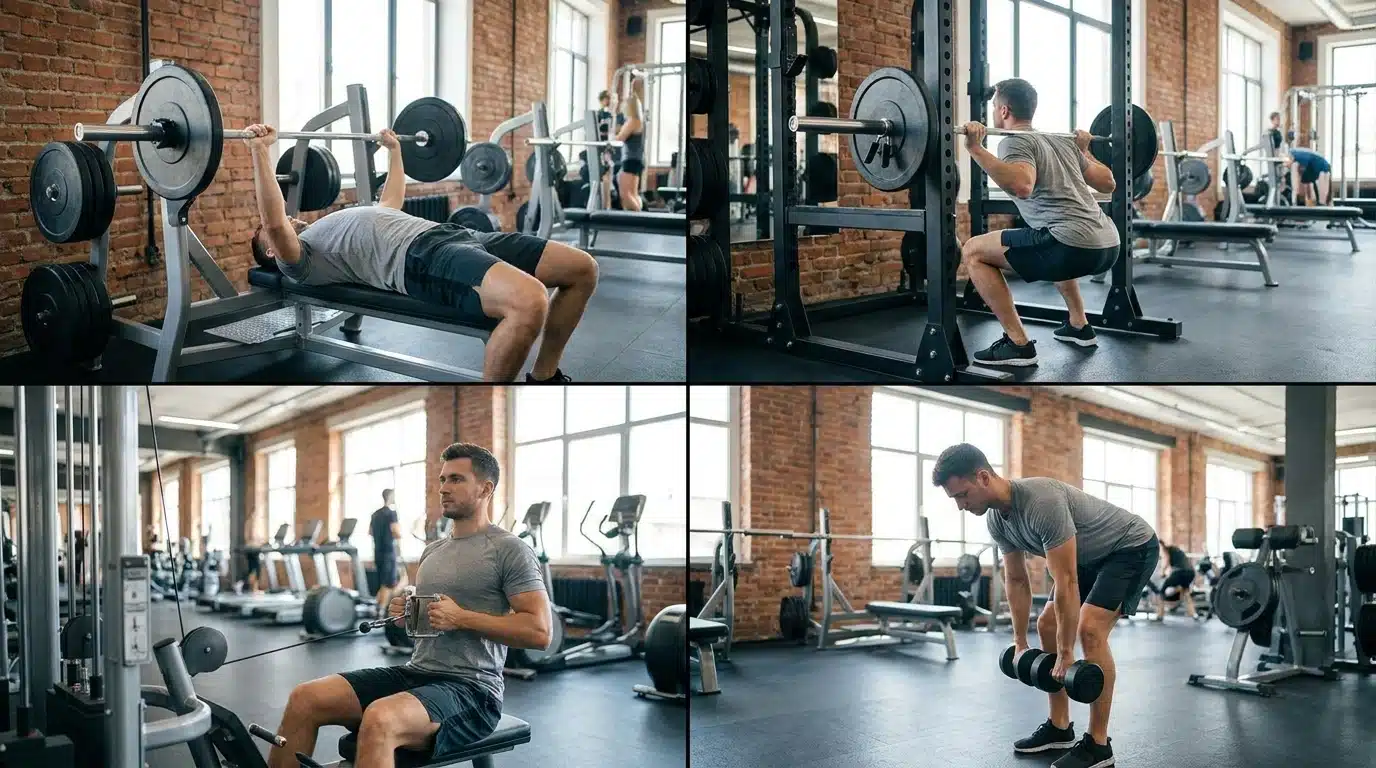
Most lifting programs ask you to choose: train heavy for strength, or train with volume for size. PHUL skips that choice.
PHUL stands for Power Hypertrophy Upper Lower. It is a 4-day powerbuilding split. You train upper and lower body twice each week, once heavy for strength and once with higher volume for size.
This post gives you everything you need to start. You get the full weekly schedule and all four workouts with sets and reps. Guidance on progression and common mistakes is included too.
If you want strength and size at the same time, this program delivers both.
What Is the PHUL Workout?
PHUL stands for Power Hypertrophy Upper Lower. It is a 4-day powerbuilding split that pairs heavy compound work with higher-volume muscle-building sessions each week.
The name breaks into three ideas:
- Power means heavy loads, low reps, and big compound movements. The goal is raw strength.
- Hypertrophy means moderate weights and higher reps with isolation work. The goal is muscle size.
- Upper/Lower means the upper and lower body are trained on separate days. Each area gets full attention rather than split focus mid-session.
Brandon Campbell, a powerlifter and YouTube coach known as Basement Brandon, created the program. He published it on Muscle & Strength.
The structure works because of training frequency. Muscle protein synthesis repairs and grows muscle tissue after training. It stays raised for up to 48 hours after a session. Hitting each muscle group twice a week keeps that growth signal active far more often than a once-a-week split does.
All sets in PHUL should be performed at around RPE 8–9. That means finishing each set with 1–2 reps still left. Going to complete failure on a regular basis is not recommended here. The weekly volume is already high, and grinding every set to failure slows recovery.
PHUL Weekly Workout Schedule
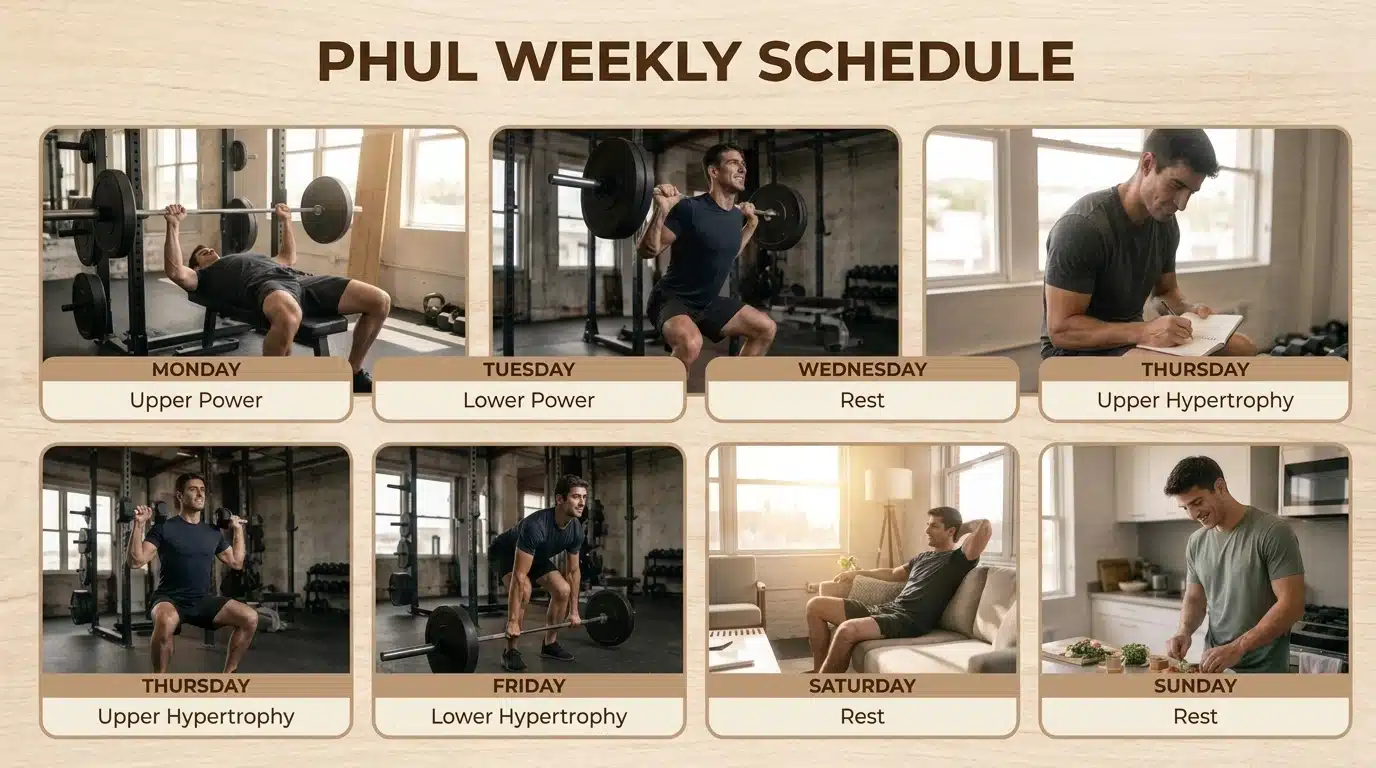
The standard PHUL week runs four training days with rest placed between the harder sessions.
| Day | Workout |
|---|---|
| Monday | Upper Power |
| Tuesday | Lower Power |
| Wednesday | Rest |
| Thursday | Upper Hypertrophy |
| Friday | Lower Hypertrophy |
| Saturday | Rest |
| Sunday | Rest |
Rest days are placed on purpose. Wednesday sits between your two power days and your two hypertrophy days. Your central nervous system gets a break after heavy squats and deadlifts before the volume work starts. The weekend rest lets your body finish repairing before the next week begins.
You can shift the days to fit your schedule. One rule applies: do not stack both power days or both hypertrophy days back-to-back without a rest day between them.
Equipment You Need for PHUL
PHUL requires a full gym setup. Make sure you have consistent access to the following before starting:
- A barbell with a squat rack or power cage
- A full set of dumbbells
- A cable machine
- A lat pulldown station or pull-up bar
- A leg press and leg curl machine
The progression model in PHUL assumes you can repeat the same movements week over week. If key equipment is unavailable regularly, the program will stall.
PHUL Workout Routine: Exercises, Sets, and Reps
Below is the full four-day template based on Brandon Campbell’s original program. You can swap accessory or isolation exercises if needed. Do not replace the four main lifts: squat, deadlift, bench press, and overhead press. Only make a swap if injury or lack of equipment makes it unavoidable.
Each exercise lists a set range. Start at the lower number in your first few weeks. Add sets as your body adapts to the workload.
One note on sets: each exercise lists a set range (e.g. 3–4 sets). Start at the lower number in your first few weeks and add sets as your body adapts to the workload.
Day 1: Upper Power Workout
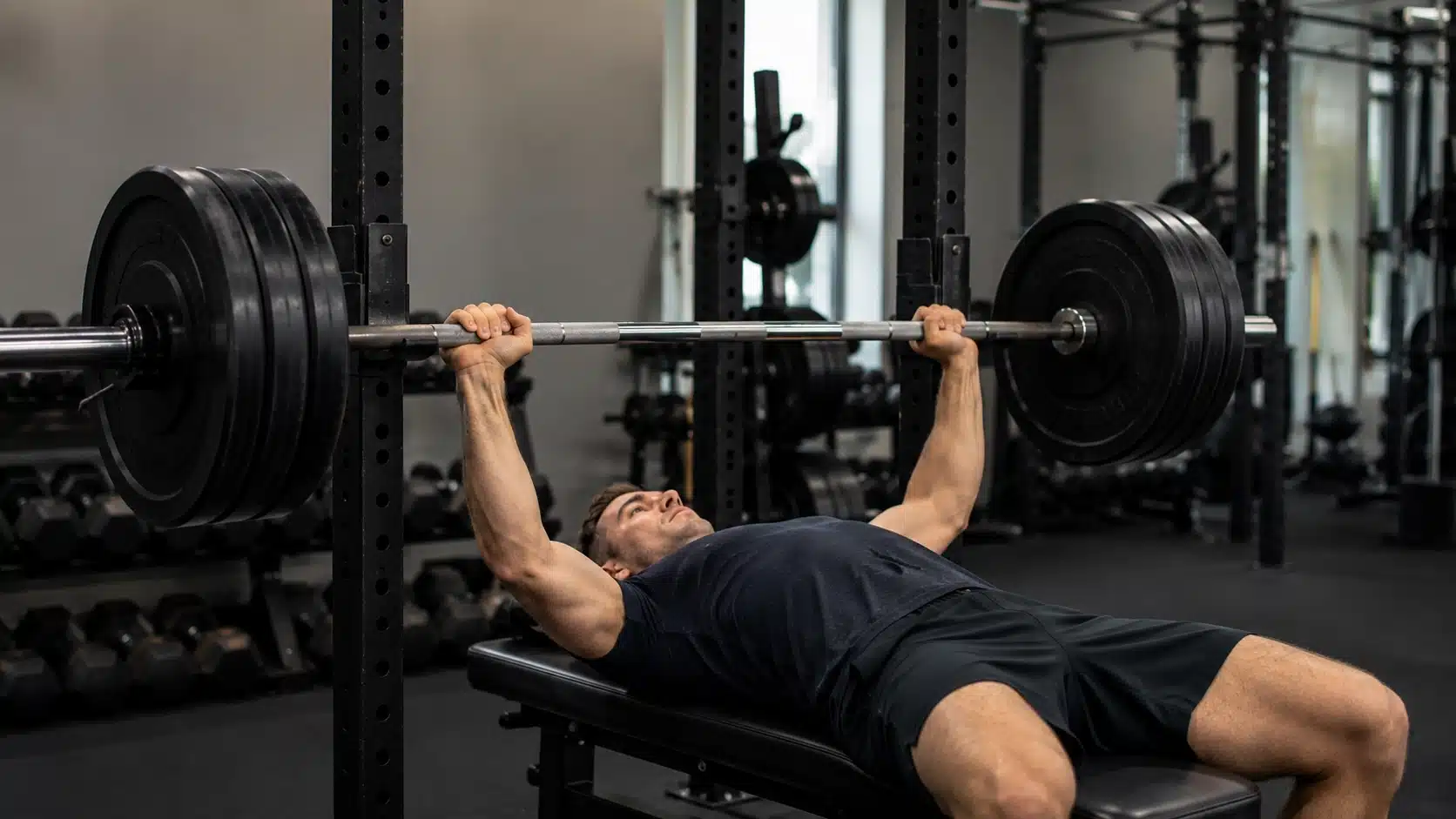
Upper power day is about moving heavy weight on your main pressing and pulling lifts. Reps stay low so you can focus on strength and clean technique.
| Exercise | Sets | Reps |
|---|---|---|
| Barbell Bench Press | 3–4 | 3–5 |
| Barbell Row | 3–4 | 3–5 |
| Overhead Press | 3 | 5–8 |
| Pull-ups/Lat Pulldown | 3 | 6–8 |
| Incline Dumbbell Press | 3 | 6–8 |
| Barbell Curl | 2–3 | 6–10 |
| Skull Crushers | 2–3 | 6–10 |
Rest 2–3 minutes between your main compound lifts. Take only what you need between accessory work. Add load only when your form holds across all target reps, not just the first set.
Day 2: Lower Power Workout

Lower power day is anchored by the two hardest lifts in the program: the squat and the deadlift. These build total-body strength, so treat them with respect.
| Exercise | Sets | Reps |
|---|---|---|
| Squat | 3–4 | 3–5 |
| Deadlift | 2–3 | 3–5 |
| Leg Press | 3 | 6–10 |
| Romanian Deadlift | 3 | 6–8 |
| Calf Raises | 3–4 | 8–12 |
Heavy squats and deadlifts tax your whole body, not just your legs, which is exactly why Wednesday’s rest day follows this session. Prioritize technique over ego. A clean miss beats a heavy grinder with a rounded back every time.
Day 3: Upper Hypertrophy Workout

By Thursday, your nervous system has had a day off. The goal now is volume, not maximal load. Weights come down, reps go up, and isolation work moves in to fatigue the muscle directly.
Controlled tempo beats bouncing the weight every time. Some lifters treat this day as the easy session. It should not be. The quality of your hypertrophy days is what builds the size.
| Exercise | Sets | Reps |
|---|---|---|
| Incline Chest Dumbbell Press | 3–4 | 8–12 |
| Machine Chest Press | 3 | 10–12 |
| Cable Row | 3–4 | 8–12 |
| Lat Pulldown | 3 | 10–12 |
| Lateral Raises | 3 | 12–15 |
| Bicep Curl | 3 | 10–15 |
| Tricep Pushdown | 3 | 10–15 |
Rest 60–90 seconds between sets here. Shorter rest periods build the metabolic fatigue that drives growth. Chase a good muscle contraction rather than the heaviest possible load.
Day 4: Lower Hypertrophy Workout
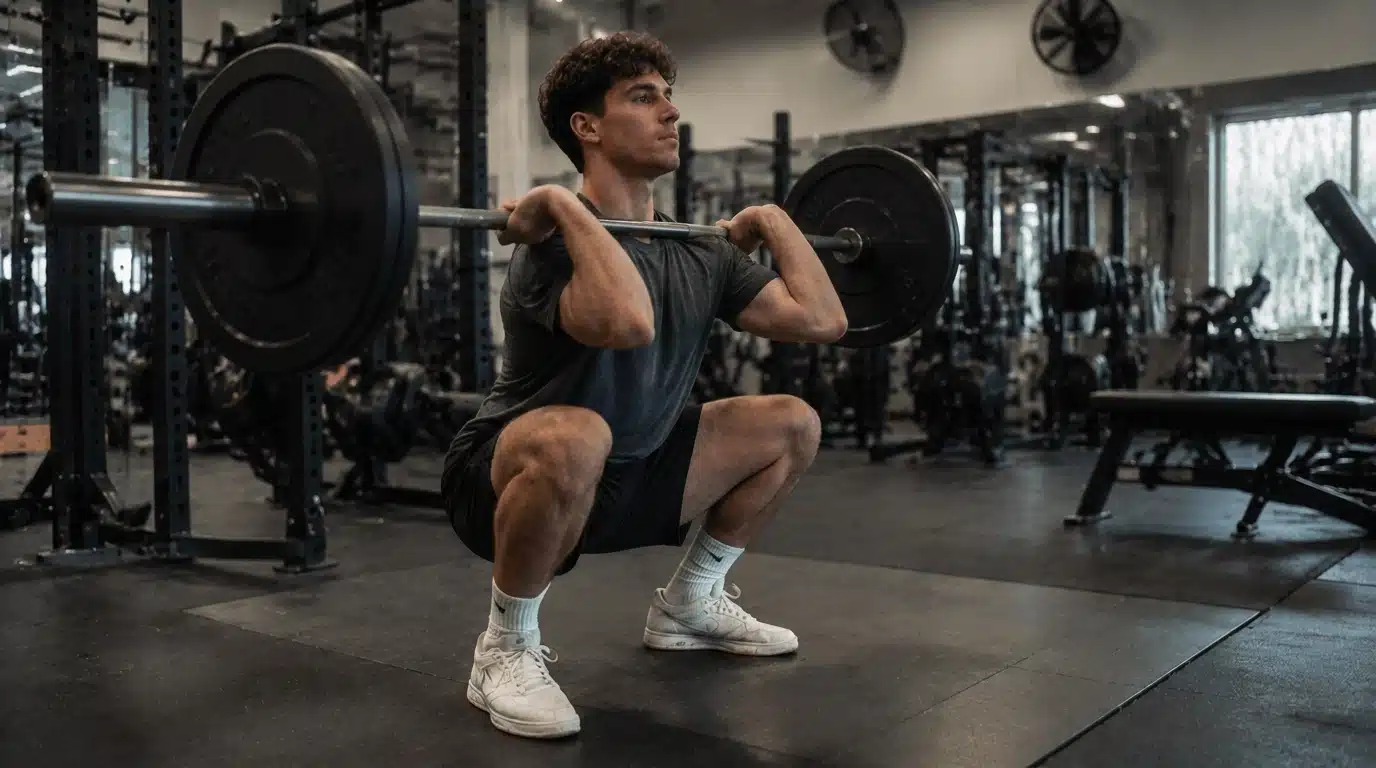
The final session brings volume to your legs. You still train hard, but the rep ranges are higher, and the loads are lighter than on lower power day.
| Exercise | Sets | Reps |
|---|---|---|
| Front Squat | 3 | 8–10 |
| Romanian Deadlift | 3 | 8–12 |
| Leg Curl | 3 | 10–15 |
| Walking Lunges | 3 | 10–12 |
| Calf Raises | 4 | 12–15 |
Push the last few reps of each set close to hard without grinding to complete failure every time. That balance keeps quality high across the whole session.
Ab training: PHUL does not include dedicated core work. Add 2–3 sets of your preferred ab exercise at the end of any session or on rest days. Weighted crunches, hanging leg raises, and planks all work well alongside this program.
How to Get Started with Your PHUL Workout

To start PHUL, pick your four training days and set a starting weight for each lift. Then run the same plan every week. You do not need to redesign anything. Follow the template above and build from there.
- Set your four days. Monday, Tuesday, Thursday, Friday works well. Any four days work as long as at least one rest day separates the power block from the hypertrophy block.
- Choose starting weights. Pick a weight you can complete for all sets and reps with 1–2 reps left. Go lighter in week one. You will have plenty of time to add load.
- Follow each session exactly. Do the listed exercises, sets, and reps. Rest 2–3 minutes between big compound lifts on power days. Keep rests to 60–90 seconds on hypertrophy days.
- Match your eating to your goal. To gain muscle, eat 300–500 calories above your daily maintenance level. For fat loss, eat in a moderate deficit of 300–500 calories below maintenance. In both cases, keep protein at 0.7–1g per pound of bodyweight. Protein matters most for recovery and muscle retention.
Run the plan for at least 8 weeks before making any judgment. Progress on PHUL shows up over a training block, not a single week.
Power vs Hypertrophy Days: What Is the Difference?
The two day types are not interchangeable. This distinction is what makes PHUL different from a plain upper/lower split. The weights, reps, and rest periods all shift depending on the goal for that session.
| Factor | Power Days | Hypertrophy Days |
|---|---|---|
| Goal | Strength | Muscle growth |
| Weight | Heavy | Moderate |
| Reps | 3–6 | 8–15 |
| Rest | Longer | Shorter |
| Exercises | Mostly compounds | Compounds + isolation |
Training only for strength leaves smaller muscles underdeveloped. Training only for volume lets top-end strength stall. PHUL runs both in the same week so each quality feeds the other. More strength means you can load the bar heavier on volume days. More muscle gives you more to keep getting stronger with.
In practice, I’ve watched lifters plateau on purely strength-focused programs because they never built enough muscle to keep progressing.
Who Should Do the PHUL Workout?
PHUL is aimed at intermediate lifters. It combines heavy loads with high volume, which is a demanding mix if you are still learning the basic lifts.
Best For
- Intermediate lifters with at least 6 months of consistent training and solid form on the squat, bench, deadlift, and press.
- People who want strength and muscle gains at the same time instead of picking one.
- Lifters who can reliably train four days a week and recover from it.
Not Ideal For
- Complete beginners who still need to build basic movement patterns. The combined load and volume raises injury risk before you are ready for it.
- Advanced athletes who need highly specialized programming for a specific sport or competition.
- Anyone who cannot recover from four demanding sessions a week due to sleep, stress, or time.
If you are new to lifting, start with a simpler beginner program. Move to PHUL once your form is dependable and your base strength is built.
How to Progress on the PHUL Program
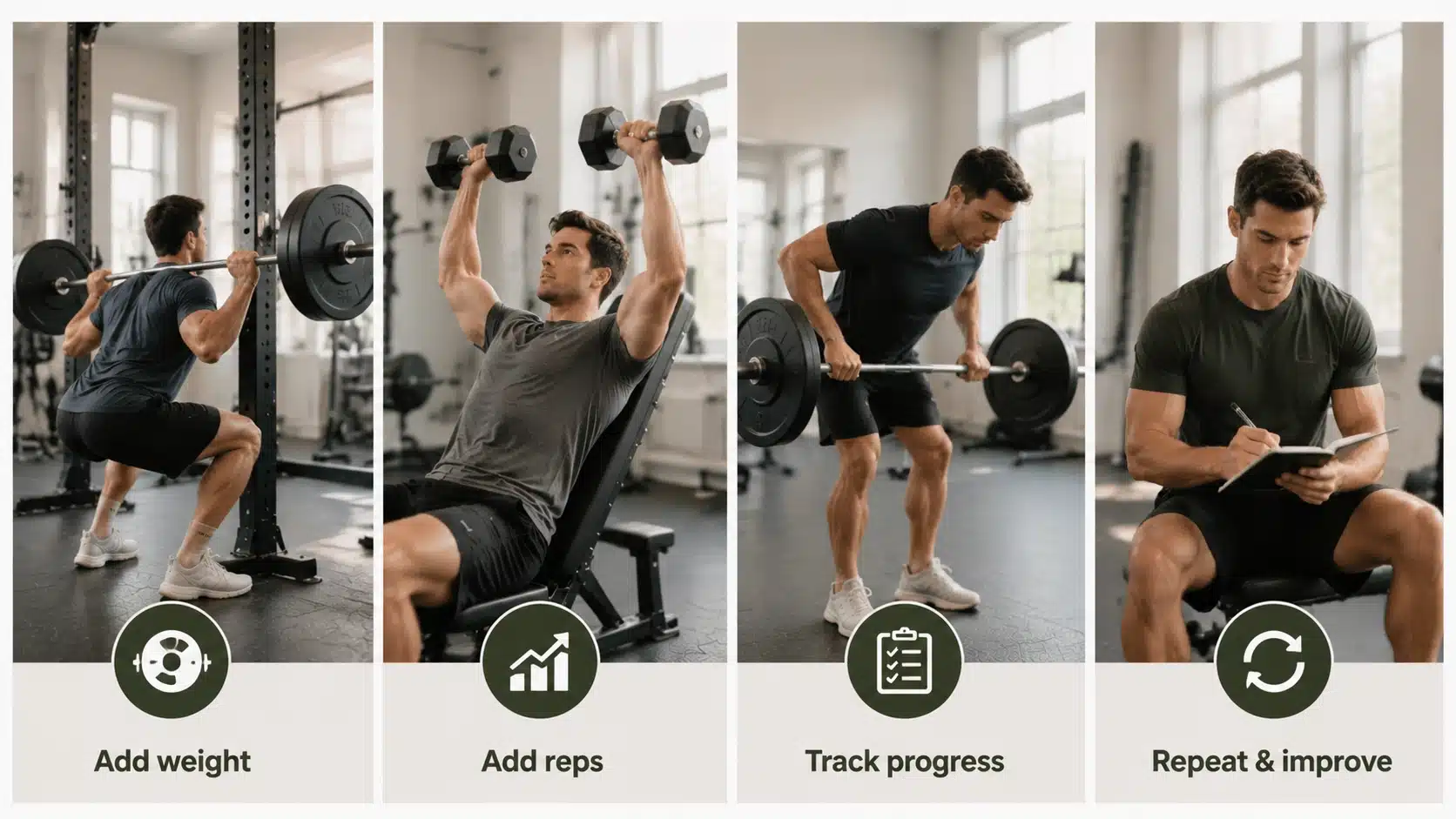
Progress on PHUL runs on progressive overload. That means consistently doing a little more than you did last time. These are the most reliable ways to apply it.
- Increase weight. Once you hit the top of your target rep range with good form, add a small amount of weight. On big lifts, jumps of 2.5–5 pounds are enough to keep moving without breaking down technique.
- Increase reps first. Before adding weight, build up through your rep range. If your target is 6–10 reps, reach 10 across all sets, then add load and drop back to the bottom of the range.
- Track your sessions. Keep a simple training log. Write down weights, sets, and reps each session so you can see progress and know exactly what to beat next time.
Watch three things week to week:
- Your working weights and reps
- How your main lifts trend over several weeks
- Your recovery, including sleep quality and how fresh you feel walking into the gym
Sample Progression
You bench 135 pounds for 3 sets of 5 on upper power day. Once all three sets hit 5 clean reps, add 5 pounds the following week and aim for 5 reps again. Repeat that, and small jumps add up fast over a training block.
Many intermediate lifters on PHUL see upper body lifts improve by 5–10 pounds per month in early training blocks. Lower body lifts often move faster. These numbers slow after the first block. That is normal. Look at your trend over 4-week periods, not week to week.
How Long Should You Follow PHUL?
PHUL has no fixed end date. Many versions are written as a 12-week block, but you can run it longer as long as you keep making progress.
Stay on it until progress clearly stalls. When your main lifts stop moving over several weeks despite solid sleep and nutrition, that is your signal. Either swap in new exercise variations, take a planned break, or shift to a different program.
Deloading on PHUL
After every 6–8 weeks of hard training, plan a deload week. Reduce your working weights by 40–50% and keep the same exercises and rep ranges. This gives your muscles, joints, and nervous system time to fully recover without breaking the routine entirely.
Some lifters prefer a full rest week every 8–10 weeks instead. Both approaches work. The reduced-intensity deload tends to feel better and keeps movement patterns fresh.
Whichever you choose, treat the deload as part of the program. It is not a skipped week.
Common PHUL Workout Errors
A few recurring mistakes hold lifters back on this program.
Using too much weight on power days. Loading a bar you cannot control breaks down form. Bad reps do not build strength, and they raise injury risk. Pick a weight you can move cleanly for all your target reps.
Ignoring hypertrophy days. Some lifters treat power days as the real work and coast through the volume sessions. Muscle growth needs that volume. Skipping or rushing hypertrophy days leaves size on the table.
Changing exercises too often. Swapping lifts every week makes it impossible to track progress. If you never repeat a movement, you have no way to tell if you are getting stronger.
Cutting sleep or under-eating. Cutting sleep below 6 hours slows recovery fast. So does under-eating by more than 500 calories. No training tweak can fix either of those. Strength and muscle are built during recovery. Shortchanging it undercuts the work you do in the gym.
PHUL vs Other Workout Splits
PHUL sits in a specific position among popular training splits. Here is how it compares to the most common alternatives.
| Split | Best For | Days Per Week |
|---|---|---|
| PHUL | Strength and muscle growth | 4 |
| Push Pull Legs (PPL) | Higher training frequency | 5–6 |
| Upper Lower | Balanced general strength | 4 |
| Bro Split | Bodybuilding-focused routines | 5 |
| PHAT | Powerbuilding with more volume | 5 |
| 5/3/1 | Long-term strength development | 4 |
PHUL gives you more variety than a plain upper/lower split by separating power and hypertrophy work. It asks for fewer days per week than a full push/pull/legs setup.
PHAT (Power Hypertrophy Adaptive Training) is a similar powerbuilding concept but runs on five days with significantly more weekly volume. It suits lifters who have already run PHUL and want to push frequency higher.
5/3/1 uses monthly progression cycles and submaximal training. It is better for long-term strength focus but includes less hypertrophy-specific work than PHUL. Many lifters run 5/3/1 for their main lifts and add PHUL-style accessory work alongside it.
If your main goal is getting stronger and bigger on four days a week, PHUL is a well-matched choice.
Disclaimer: This article is for general information and education only. It is not medical advice. Heavy lifting carries injury risk, especially for beginners or anyone with an existing condition. Talk to a doctor or a qualified coach before starting a new training program, and stop any exercise that causes pain.
Frequently Asked Questions
Are chest stretches good for posture?
Yes. Tight chest muscles pull the shoulders forward into rounded posture. Opening them helps the shoulders sit back naturally, and pairing chest stretches with upper-back stretches gives the best results.
How often should I stretch my chest?
Aim for two to three days per week to maintain flexibility, or stretch daily to improve range of motion. Desk workers benefit from a short daily session countering forward-shoulder sitting.
Why do my chest muscles feel tight?
Tight chest muscles usually come from prolonged sitting, frequent pushing exercises, poor posture, or skipping stretches after activity. Each keeps the pecs shortened, so they gradually lose length and flexibility.
Should I stretch my chest before or after a workout?
Use dynamic movements before a workout to warm up without reducing strength. Save static holds for after, because they can briefly lower power before heavy pressing sessions.
Can chest stretches reduce shoulder tightness?
Often, yes. The chest muscles affect how shoulders move, so tight pecs often feel like shoulder stiffness. Loosening the chest restores range, but persistent pain needs a professional’s check.
Is the PHUL Workout Worth It?
The PHUL workout gives you a clear structure to train for strength and size in the same week. Two heavy power days build your main lifts. Two hypertrophy days bring the volume that grows muscle. The four-day structure keeps recovery manageable.
It suits intermediate lifters who want balanced progress and can commit to training four times a week. Your results come down to the basics: progressive overload, real recovery, and consistency over weeks and months.
Start with the template above. Adjust the weights to your experience level and keep a log. That is how you see yourself getting stronger over time. That is where the PHUL workout earns its reputation.
Follow us on Instagram for weekly training tips. Or subscribe to our newsletter for full programs sent straight to your inbox.