
You can spend 45 minutes running cone drills and still feel no quicker when the game starts.
The problem is not always effort. Many athletes focus on fast feet without training the full skill of speed. Acceleration, braking, cutting, reacting, and getting back up to pace all matter.
When these skills are trained together, the results are easier to feel during real play. With the right exercises and a balanced weekly routine, soccer players, weekend athletes, and young athletes can all move faster and with better control.
What Speed and Agility Training Actually Means
peed isn’t one thing. It’s a set of skills that work together:
- Acceleration: getting from zero to full speed in the first 3–10 steps
- Max velocity: how fast you move once you’re up to speed
- Deceleration: slowing down quickly and under control
- Re-acceleration: getting back up to speed after stopping or cutting
Deceleration gets skipped the most. That’s a mistake for performance and for health. Athletes who can’t brake cleanly put extra stress on their knees and ankles every time they change direction.
Agility sits on top of all this. There are two types. Planned change of direction means running a set route or drill pattern. Reactive agility means responding to a moving opponent, a loose ball, or a coach’s signal mid-play.
Most drill programs only train the first type. Reactive agility is where games are actually won and lost.
Why it’s worth training. Speed and agility work do more than shave time off a sprint. Sharper deceleration and change-of-direction control lower your risk of knee and ankle injuries. Better reactive agility means you get to the ball, the gap, or the open man before your opponent does. Coaches see it show up in game speed, not just stopwatch times.
Science Behind Speed and Agility Training
Speed and agility work draws on the phosphagen energy system, not the aerobic system.
This system fuels short, all-out efforts using creatine phosphate stored in your muscles. It runs dry after about 10 seconds of full effort.
That’s why rest between reps isn’t laziness. It’s required. A PLOS One study tracked young female football players doing SAQ (speed, agility, quickness) training. Sprint speed and change-of-direction performance both improved. But it only worked when players trained at 80–100% effort. Drop below that, and the gains disappeared.
Doing speed drills while you’re already tired trains conditioning, not speed. That’s a different goal.
The practical rule: rest for roughly 10 to 12 times as long as each working rep. A 5-second sprint gets 50 to 60 seconds of recovery before the next one.
The Warm-Up That Preps Your Nervous System
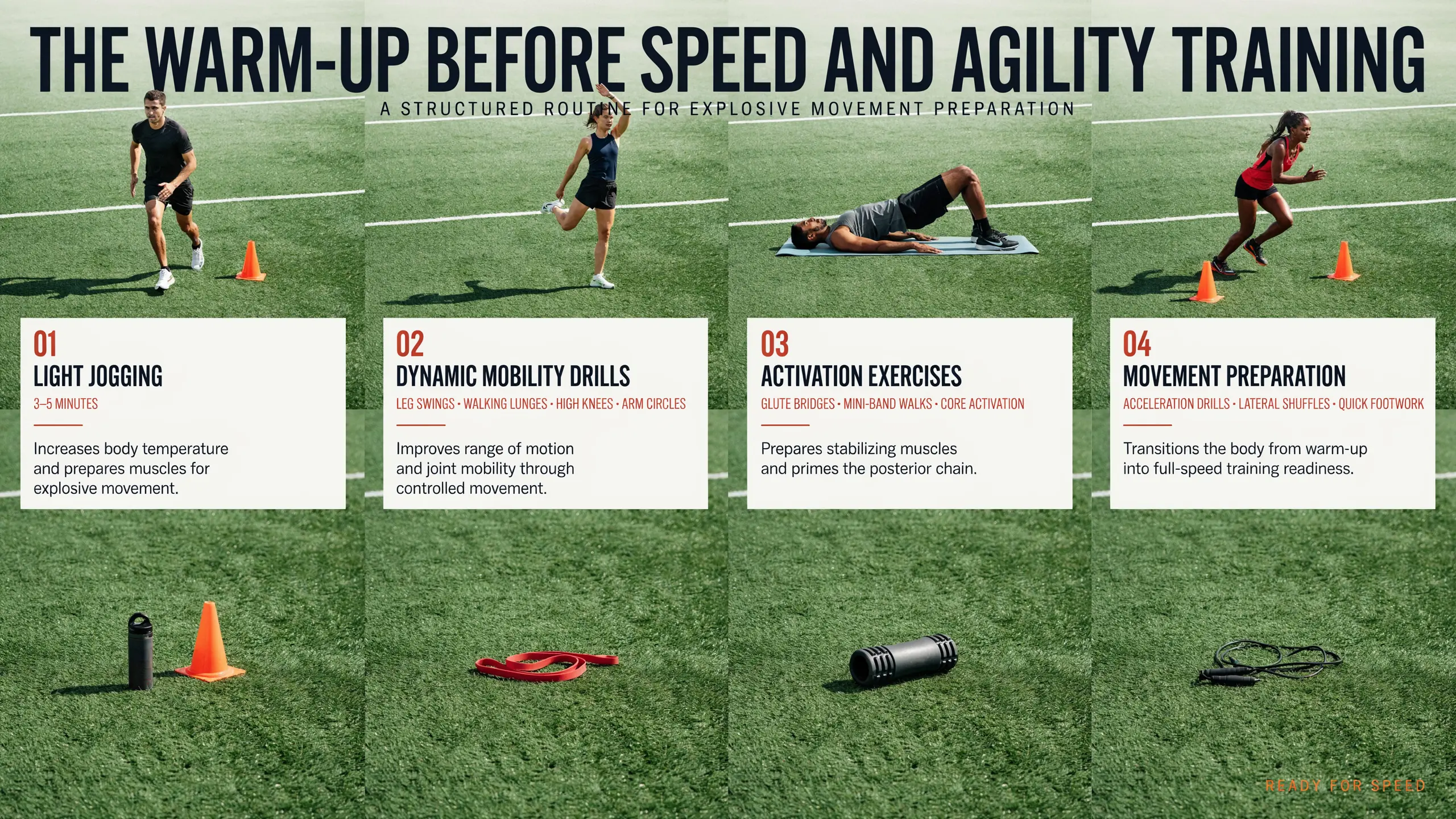
Speed and agility drills need your nervous system switched on, not just your muscles warmed up. A movement-based warm-up does both.
Here’s a 6- to 8-minute routine that works:
- Leg swings: forward and lateral, 10 each side
- Hip circles: 10 each direction
- High knees: 20 meters, focus on knee drive
- Butt kicks: 20 meters
- Carioca (lateral crossover steps): 20 meters each way
- A-skips: 20 meters, drive the foot down on each step
- Wall drives: 3 sets of 5 quick reps per leg
One rule worth remembering: do speed and agility work first in any session.
Once you’re fatigued from strength training or conditioning, your movement quality drops. The adaptation you’re chasing stops happening.
Best Speed and Agility Training Exercises
These drills build explosive movement. They combine acceleration, coordination, and control.
Done right, they sharpen your reaction time, your direction changes, and your overall movement efficiency.
1. Acceleration Sprints

Set up markers at 10, 20, and 40 yards. Start from a staggered stance: one foot forward, a slight forward lean, weight on the front foot.
Drive hard with both arms on your first step. Keep your body angle low for the first 5 yards before rising up. Do 4 to 6 reps per distance, with full rest between each.
Common mistake: standing upright too early. A tall posture in the first few steps kills your acceleration.
2. Ladder Drills
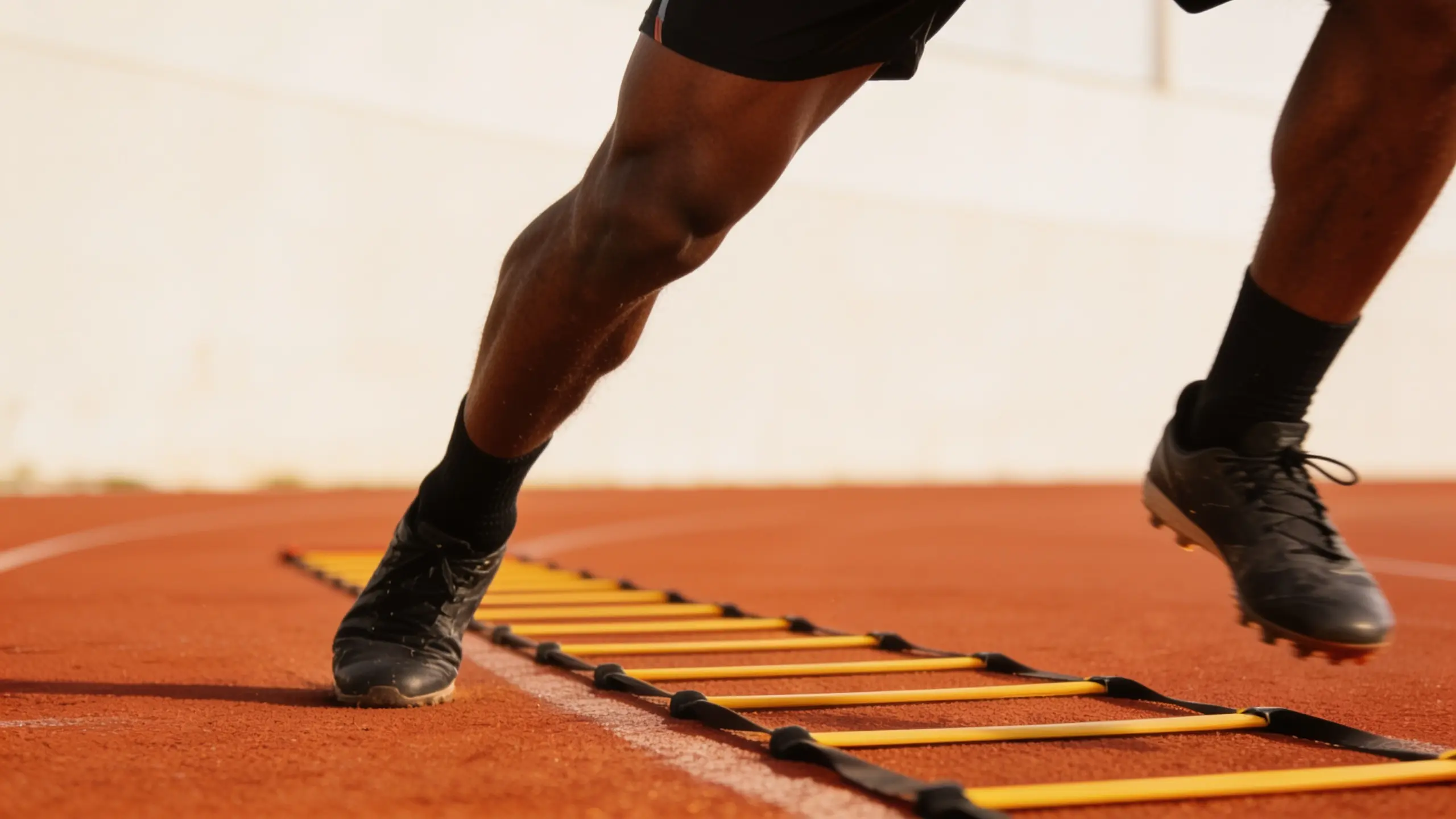
Ladder drills train foot speed, rhythm, and coordination. Three progressions to build in order:
- Two-feet-each-box: both feet land in each box before moving forward; focus on quick ground contacts
- Icky shuffle: lateral pattern, in-out-in as you move sideways down the ladder
- Lateral in-and-out: step in and out of each box sideways, keeping hips low and knees slightly bent
Speed matters less than precision at first. Once the pattern is clean, add speed. Sloppy fast reps train sloppy fast movement.
3. Cone Drills

Athletic performance comes from more than raw speed. It comes from how efficiently your body produces force, controls movement, and reacts to change.
Cone drills train planned change of direction: the ability to plant, redirect, and reaccelerate cleanly. Run each pattern 4 to 6 times, with full rest between reps.
- T-Drill: Set cones in a T shape (10 yards forward, 5 yards left and right). Sprint to the center cone, shuffle left, shuffle right, then return to center and sprint back to the start.
- 5-10-5 Shuttle (Pro Agility): Place 3 cones 5 yards apart in a straight line. Start at the middle cone and sprint to one side. Plant, sprint 10 yards to the far side, and plant again. Sprint back through the center to finish.
- 3-Cone Drill (L-Drill): Set 3 cones in an L shape, 5 yards apart. Sprint the pattern with sharp, controlled cuts. Focus on a low body position, quick deceleration, and smooth re-acceleration.
4. Reactive Agility Drills

Face a partner. They move left or right at random; you mirror them. Start slow, then increase speed, then add distance. Run 6 to 8 reps of 5 to 8 seconds each.
This is the most direct way to train the reactive agility that carries over to your sport. A simpler solo option: a reaction ball. Drop it on a hard surface and react to where it bounces.
5. Deceleration Drills

Sprint 15 yards at full effort, then stop completely within 3 steps. Aim for a stiff, controlled landing, not a stumble. Do 4 to 5 reps.
Once that’s clean, progress to: sprint, stop, then immediately sprint in a new direction. This builds the stop-start pattern that separates quick athletes from just fast ones.
Speed and Agility Training Equipment
Speed and agility training equipment can make drills more effective by improving footwork, resistance, reaction time, and movement control. The right tools help athletes build faster, sharper, and more efficient movements.
| Equipment | How It Helps Speed and Agility Training |
|---|---|
| Agility Ladder | Improves foot speed, coordination, balance, and quick movement patterns through fast footwork drills. |
| Training Cones | Used for sprinting, cutting, shuttle runs, and change-of-direction drills that improve movement control. |
| Resistance Bands | Builds strength for acceleration, lateral movement, and explosive starts by adding resistance. |
| Speed Hurdles | Develops quick ground contact, rhythm, coordination, and lower-body explosiveness. |
| Sprint Parachute | Adds running resistance to improve acceleration and sprint power when used with proper form. |
| Reaction Equipment | Improves reaction time and decision-making through unpredictable movement drills. |
| Stopwatch or Timing App | Tracks sprint times, drill results, and progress during training sessions. |
Agility Training for Kids: A Different Approach
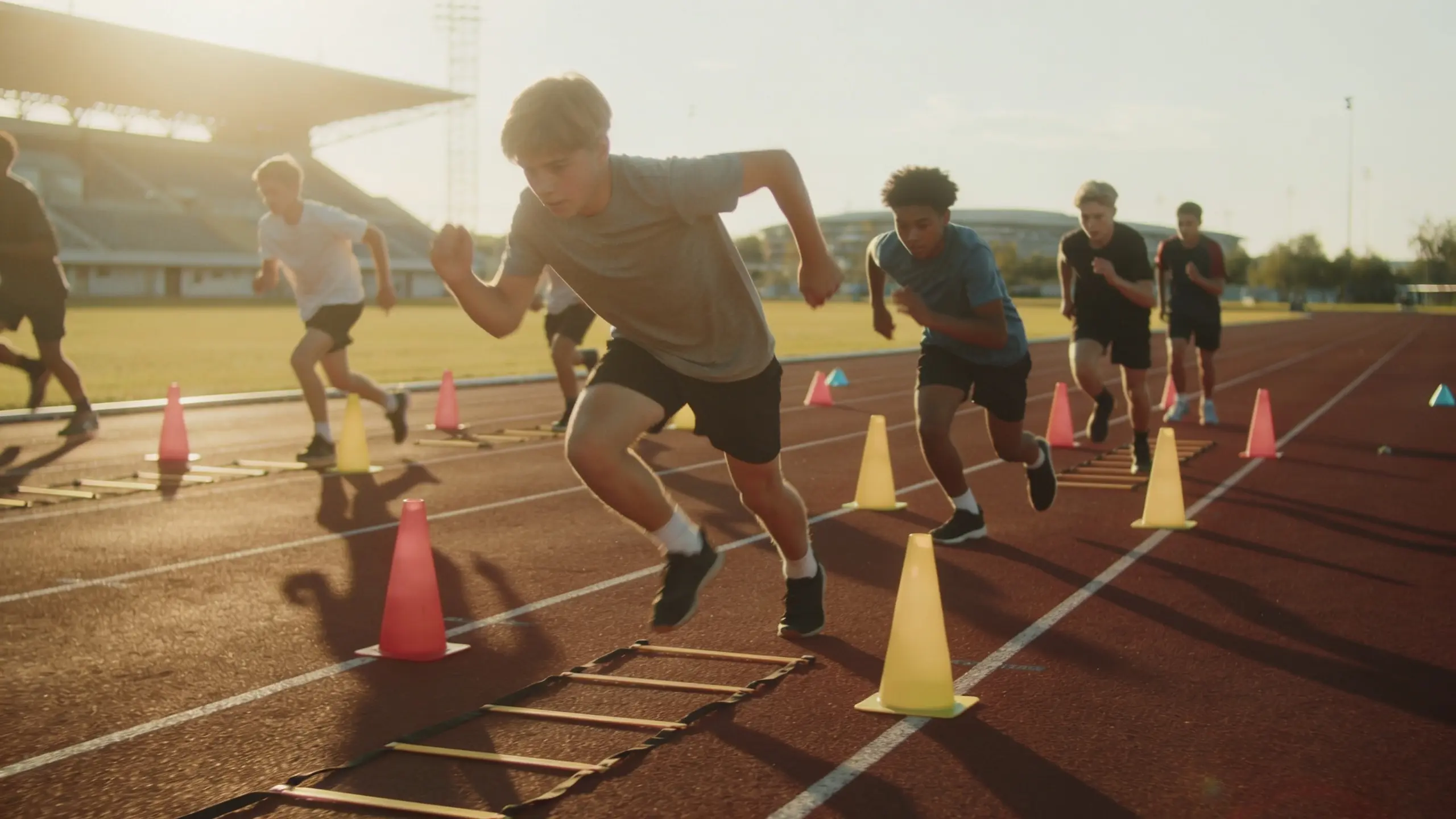
Agility training for kids needs a different approach than adult programming. Young athletes aren’t just smaller adults. Their tendons, bones, and nervous systems are still developing.
Pushing complex cone patterns or heavy sprint volume too early causes problems. It leads to burnout, overuse injuries, and bad movement habits that take years to undo.
Build these first:
- Jumping and landing mechanics: can the child hop on one foot and stick the landing without wobbling? This comes before any speed drill.
- Pogo jumps: both feet, quick ground contacts, ankle stays stiff. This builds the elastic strength that later translates to faster sprints.
- Skipping: better for building rhythm and coordination than most parents expect.
- Simple mirror drills: reactive movement in a game-like setting. Kids give high effort here because it feels like play.
For agility training for kids ages 7 to 11, three 30-minute sessions a week are enough. Sessions should feel more like structured play than structured practice.
Games with quick direction changes, like tag, reaction races, and ball-drop chases, build the same qualities as formal drills. And kids buy in faster.
A Sample Weekly Schedule for Speed Training
Here’s a 4-day structure that works for athletes in their off-season:
| Day | Focus | Key Work |
|---|---|---|
| Monday | Acceleration | Wall drives, 10-yard sprints, broad jumps |
| Tuesday | Agility | T-drill, 5-10-5 shuttle, reactive mirror drill |
| Thursday | Top-end speed + plyos | 30-yard sprints, pogo jumps, lateral bounds |
| Friday | Strength | Squat, single-leg deadlift, hip flexor march |
Wednesday, Saturday, and Sunday are for active recovery or sport practice, not more speed work. More isn’t better here. The adaptation happens during rest.
In-season, cut the volume roughly in half. One agility day and one acceleration day a week keep you sharp without adding fatigue before games.
Recovery After a Speed and Agility Session
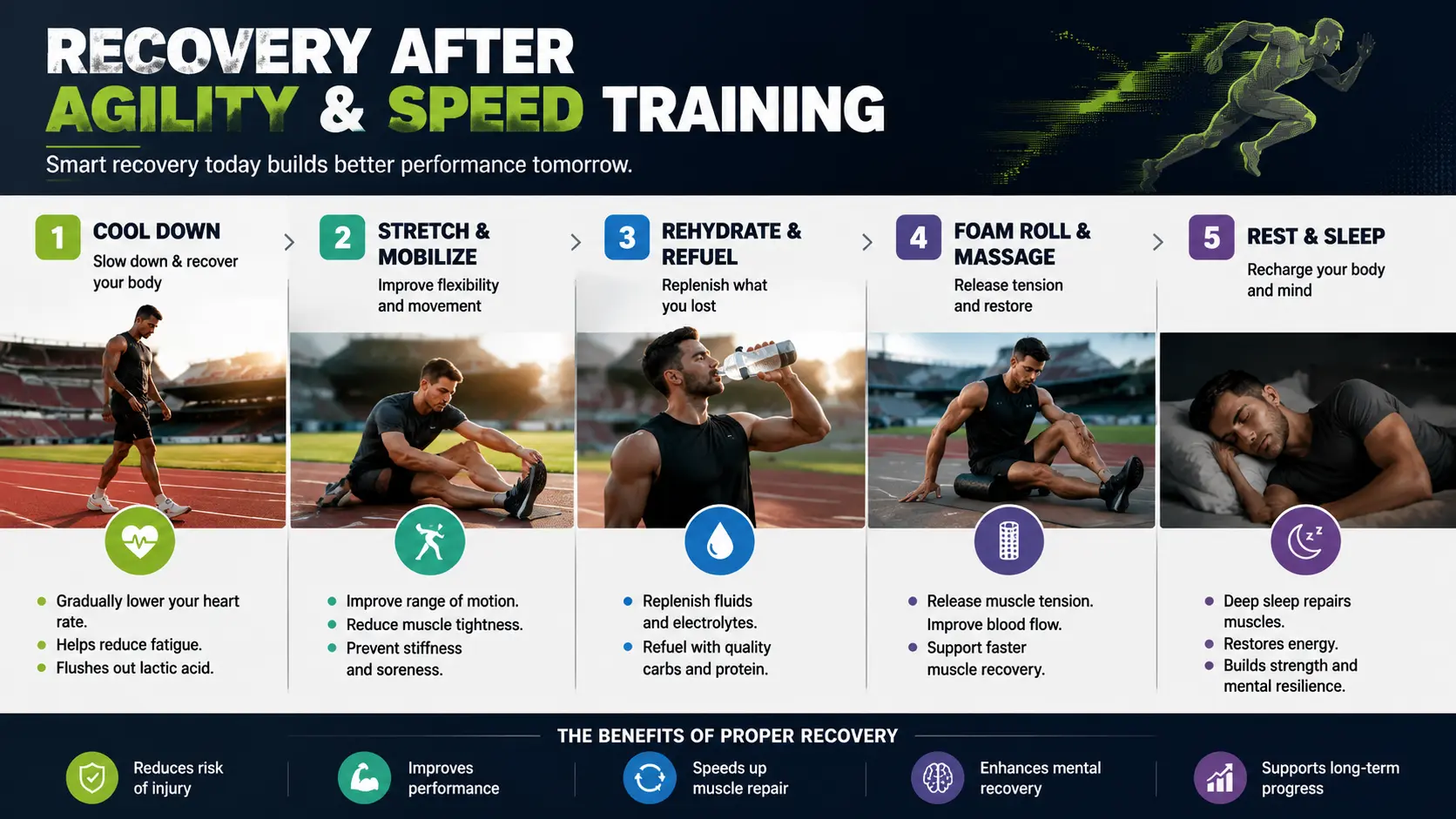
Speed training stresses your nervous system, not just your muscles. You can feel fine and still have slower reaction time and sloppier movement 24 to 48 hours after a hard session.
Signs of under-recovery: slower-than-usual reaction time, sloppy footwork in drills you normally handle well, and low motivation to train. These aren’t mental. They’re neuromuscular.
Three things that actually help:
- Sleep. A Stanford study on college basketball players had athletes extend sleep toward 10 hours a night. Sprint time dropped and shooting accuracy rose by 9%. Reaction time and alertness improved too. Skip the sleep, and you skip part of the recovery your nervous system needs.
- Hip flexor and ankle mobility. These are the two tightest spots in most athletes. They’re also the two biggest limits on stride length and change-of-direction speed.
- Rest-to-work ratios. You already know why rest matters: the phosphagen system needs it to reload. Cut that rest short to keep your heart rate up, and you’ve switched from speed work to conditioning without meaning to.
Putting Speed and Agility Training Into Practice
The athletes who see the biggest gains from speed and agility training stop treating it like a cardio session.
Sprint quality matters more than sprint volume. Rest intervals aren’t wasted time. And strength work in the weight room pays off on the field in ways cone drills alone can’t replicate.
Start with the basics: a proper warm-up, one acceleration drill, one agility drill, and clean deceleration work. Build from there.
Track one measurable metric, like your T-drill time or your 10-yard split. Test it every 4 weeks. Speed is trainable. But it responds to patience and structure, not just effort.
Frequently Asked Questions
What causes poor agility?
Poor agility usually comes from weak coordination, slow reaction time, and weak stabilizing muscles.
How many days a week should you do speed and agility training?
Most athletes should train speed and agility 2 to 3 times a week, with at least 48 hours of recovery between sessions. This lets the nervous system adapt without piling on fatigue.
What food increases agility?
Lean protein, complex carbs, and healthy fats fuel the energy and reaction time that agility depends on. Think eggs, oats, and nuts.
What certification is best to train strength, speed, and agility?
The NSCA Certified Strength and Conditioning Specialist (CSCS) is one of the most respected certifications in the field.
How long does it take to see results from speed training?
Most athletes notice improvements in speed and movement quality within 6 to 8 weeks. Bigger gains in sprint performance and agility usually take 3 to 6 months of consistent training.