Picture Pilates and a room full of reformer machines, springs, and pulleys, and it probably comes to mind. But the method didn’t start that way.
Long before any of that equipment existed, Joseph Pilates built his entire system on the floor, using nothing but a mat and his own bodyweight.
Mat Pilates is that original practice, and it’s harder than it looks. No gym membership required, no machines to learn, just enough floor space to lie down.
Here’s what mat Pilates actually is, how it works, which exercises to start with, and how it stacks up against reformer Pilates.
What Is Mat Pilates?
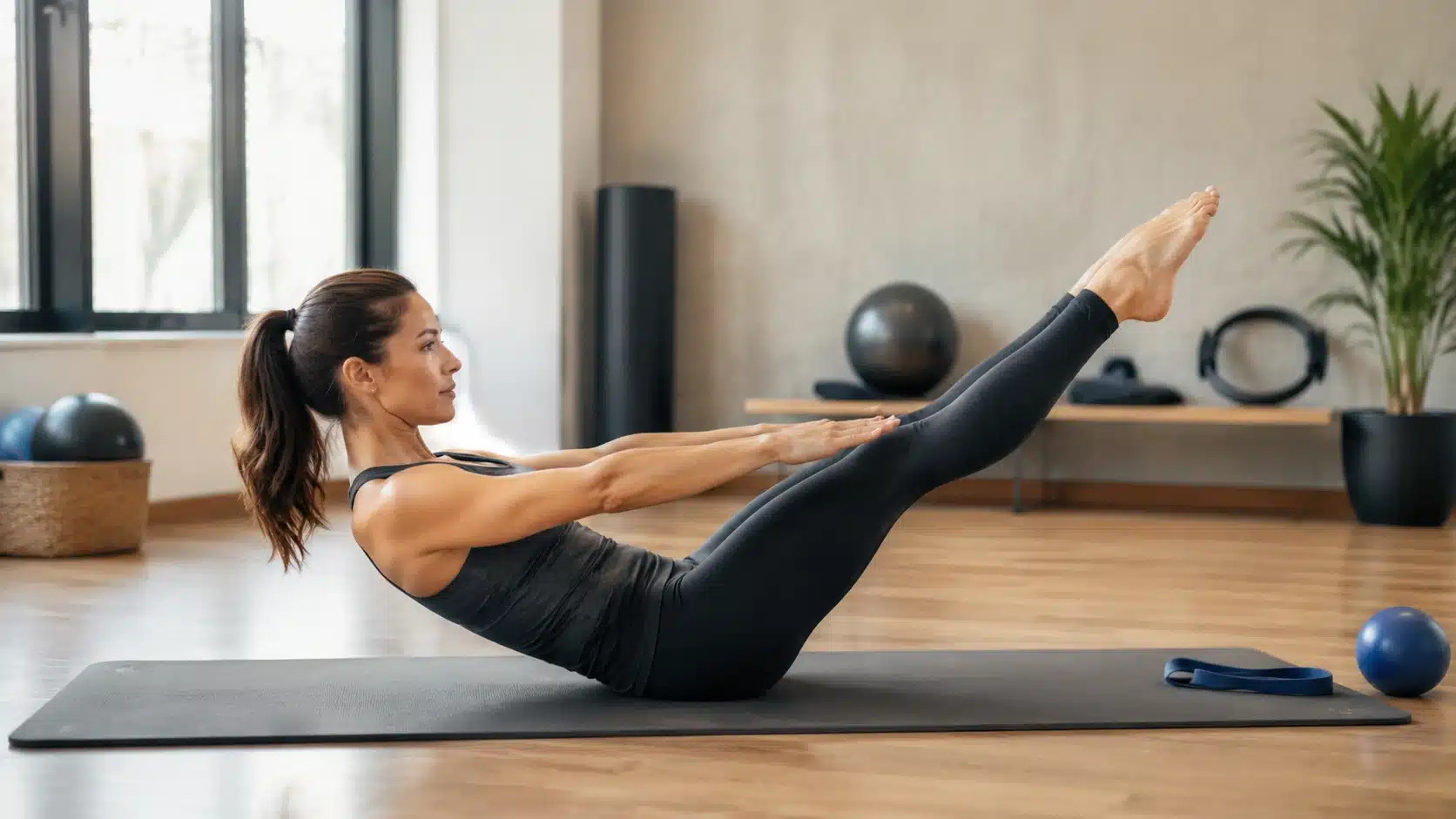
Mat Pilates, also called floor Pilates, is a bodyweight-based form of exercise performed on the floor using only a mat. It focuses on controlled, deliberate movement to build core strength, improve posture, and increase flexibility through breath and alignment work.
Joseph Pilates developed the method in the early 20th century. He originally called it “Contrology.” He began shaping the system while interning in England during World War I. He taught fellow internees a series of floor-based conditioning exercises.
Mat work came first. The reformer and other equipment came later. Those machines were built to help students prepare for harder math sequences, not to replace them.
Expert tip: Mat Pilates looks gentle because the movements are slow and low to the ground, but holding proper alignment while controlling every inch of a movement puts real demand on the muscles.
How Does Mat Pilates Work?
Mat Pilates trains the body through control rather than speed or heavy loads. Each exercise asks you to move with full intention while keeping your core engaged. That combination of slow pacing and constant core engagement is what makes the method work without any external weight.
It Prioritizes Controlled Movement
Every rep is slow and deliberate. There is no swinging or bouncing to get through a set.
That pace forces the working muscles to stay active the entire time. This is where most of the strength benefit comes from. Fewer reps are needed to feel the effort because there is no momentum to coast on.
It Uses Bodyweight as Resistance
There are no machines or dumbbells involved. Your own bodyweight, combined with body angle and positioning, creates the resistance.
Lifting a leg slowly at a specific angle can feel far harder than it looks. The muscles have to control the movement the entire way through, not just at the start and end.
It Builds From the Core Outward
Pilates refers to the core region as the “powerhouse.” This includes the abdominals, lower back, pelvic floor, hips, and glutes.
Nearly every mat exercise draws on this area first, then builds outward into the limbs. That is why even arm or leg movements in mat Pilates tend to feel like a core workout.
The 6 Principles Behind Mat Pilates
Joseph Pilates built his method around six guiding principles. Pilates instructors still teach these today. Understanding them helps the exercises click faster, since they explain why the movements are done a certain way.
| Principle | What It Means |
|---|---|
| Breath | Coordinating inhales and exhales with each movement |
| Concentration | Staying mentally focused on what the body is doing |
| Control | Avoiding rushed or sloppy repetitions |
| Centering | Initiating movement from the core |
| Precision | Performing each movement correctly, not just repeatedly |
| Flow | Moving smoothly from one exercise into the next |
These principles separate mat Pilates from a typical bodyweight workout. It is less about how many reps you finish and more about how well each one is executed.
Benefits of Mat Pilates
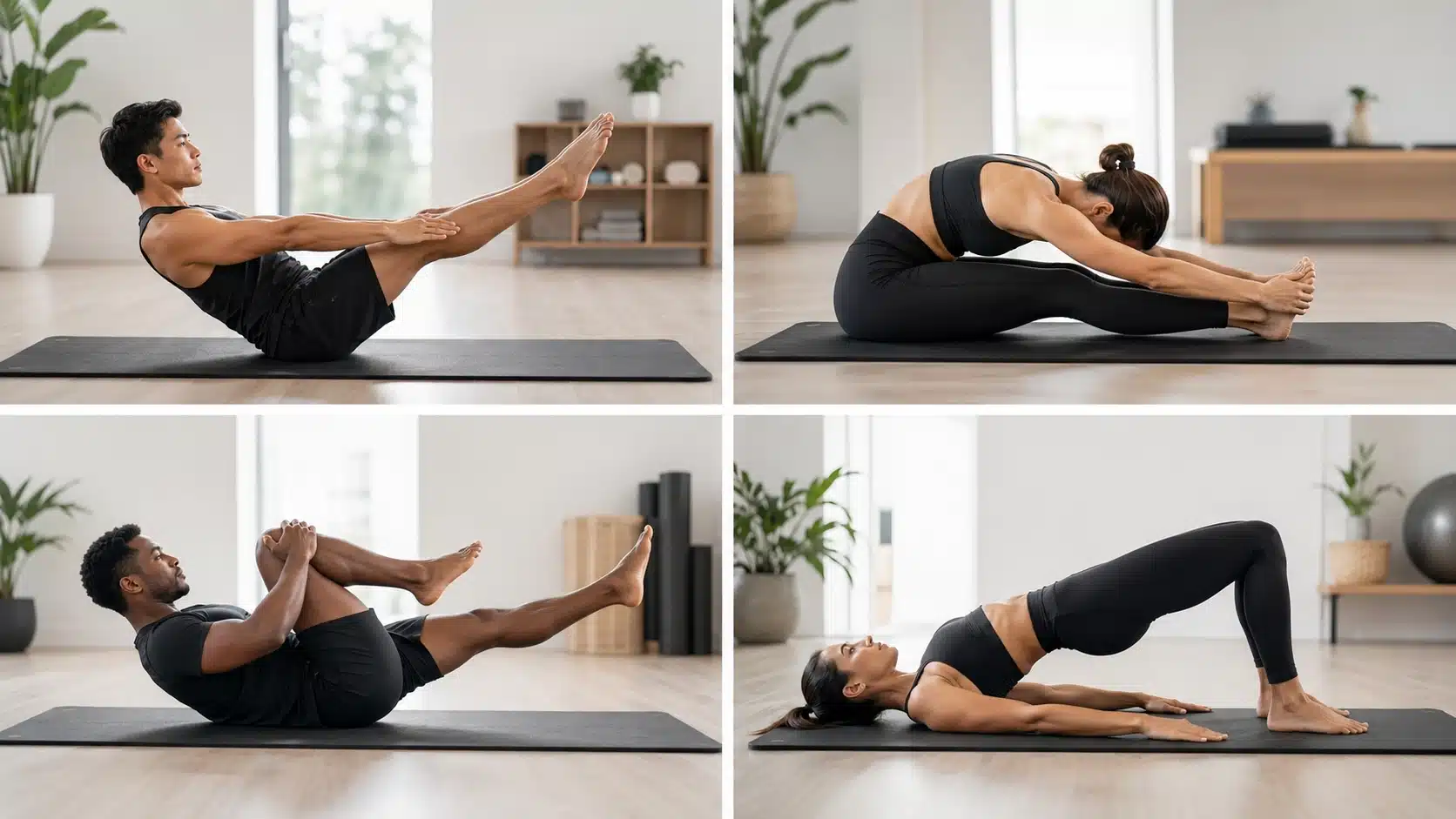
The key Pilates benefits build on each other the longer you stay consistent. Below are the most consistently reported improvements from regular practice.
1. Improves Core Strength
Mat Pilates activates the deep abdominal muscles that support the spine. These are not the surface-level muscles you see in a mirror. They are the stabilizers that protect your back during everyday bending, lifting, and twisting.
Over time, stronger deep core muscles improve your stability across almost every movement you make.
2. Supports Better Posture
Many exercises in mat Pilates focus directly on spinal alignment. Regular practice can help counter the effects of sitting at a desk for long hours.
Stronger postural muscles make it easier to hold an upright position without thinking about it. This can also ease tension in the neck and shoulders.
3. Increases Flexibility and Mobility
The stretching in mat Pilates is controlled rather than passive. This can gradually improve the range of motion in the hips, spine, and shoulders.
Controlled stretching also reduces the risk of overstretching compared to bouncing into a static stretch.
4. Improves Balance and Coordination
Slow, single-limb movements challenge stability in a way that fast-paced workouts often skip. That balance work carries into daily activities and other sports, from walking on uneven ground to changing direction quickly.
5. Offers a Low-Impact Option
Mat Pilates is gentle on the joints. It is a practical choice for people managing joint sensitivity or wanting a lower-impact addition to their routine.
Anyone recovering from an injury or managing a health condition should check with a doctor or physical therapist before starting.
6. Supports Mental Well-Being
Regular mat Pilates practice has been linked to improvements in mood, sleep quality, and stress levels.
The slow, breath-focused nature of the practice encourages full mental focus during each session. That deliberate attention to breath and movement can reduce mental tension in a way that faster workouts often do not.
Back pain relief is also a widely reported benefit. Strengthening the deep core muscles that support the spine can reduce strain on the lower back during daily activities.
Best Mat Pilates Exercises for Beginners
These beginner exercises appear in nearly every mat Pilates class and provide a solid starting point for anyone new to the method.
| Exercise | Main Focus |
|---|---|
| The Hundred | Core endurance and breath control |
| Roll Up | Spinal mobility and abdominal strength |
| Single Leg Stretch | Core control and coordination |
| Glute Bridge | Glute and hip stability |
| Plank | Full-body strength |
| Side-Lying Leg Lifts | Hip and outer thigh strength |
Start with fewer repetitions than you find challenging, and modify the range of motion as needed. The goal early on is to learn the movement pattern correctly, not to push through fatigue.
What Equipment Do You Need for Mat Pilates?
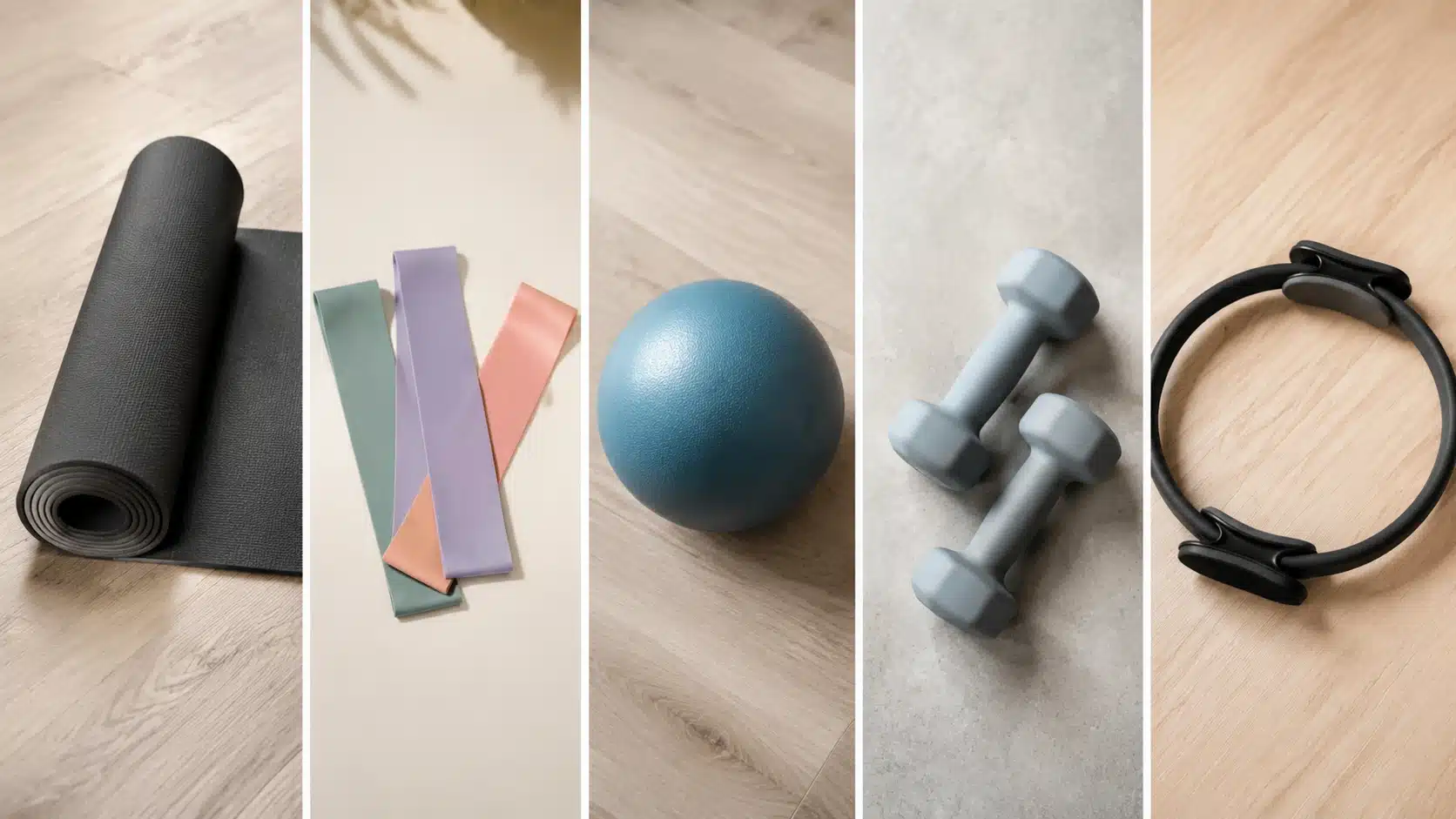
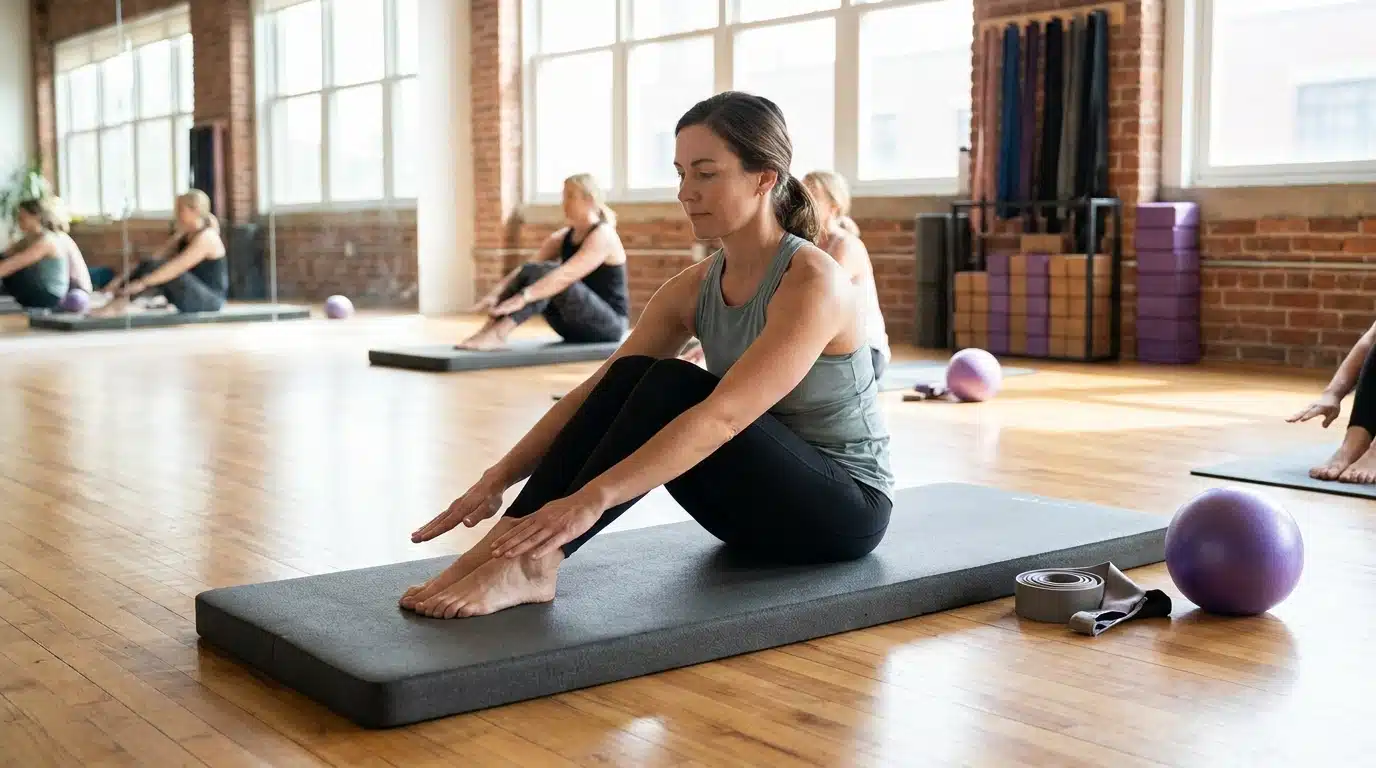
One of the biggest draws of mat Pilates is how little it takes to get started. Unlike many workout styles, floor Pilates can be practiced with just a few basics. Most of these you may already have at home.
Essential:
- Pilates or thick exercise mat: cushions the spine and joints during floor work
- Comfortable, fitted clothing makes it easy to check your alignment during exercises
- Water: keeps you hydrated through longer or warmer sessions
Optional:
- Resistance bands: add light tension to certain stretches and leg exercises
- Small Pilates ball: helps with balance work and deepens core engagement
- Light hand weights: increase the challenge in upper-body sequences
- Pilates ring: adds resistance for inner-thigh and core exercises
Unlike reformer Pilates, mat work requires no specialized equipment. That makes it one of the most accessible ways to start the practice. You can train in your living room or join a studio class.
Mat Pilates vs. Reformer Pilates: What Is the Difference?
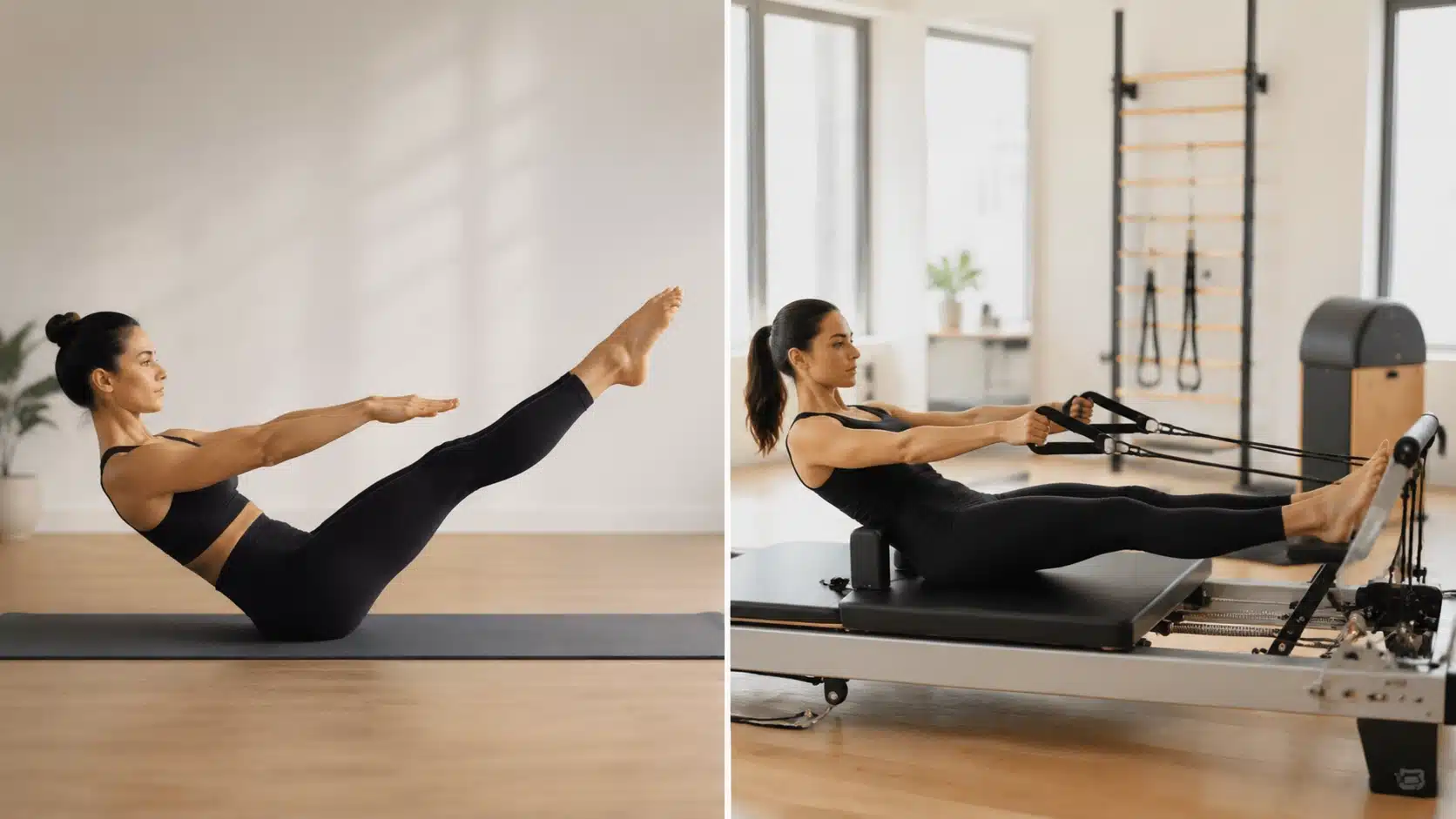
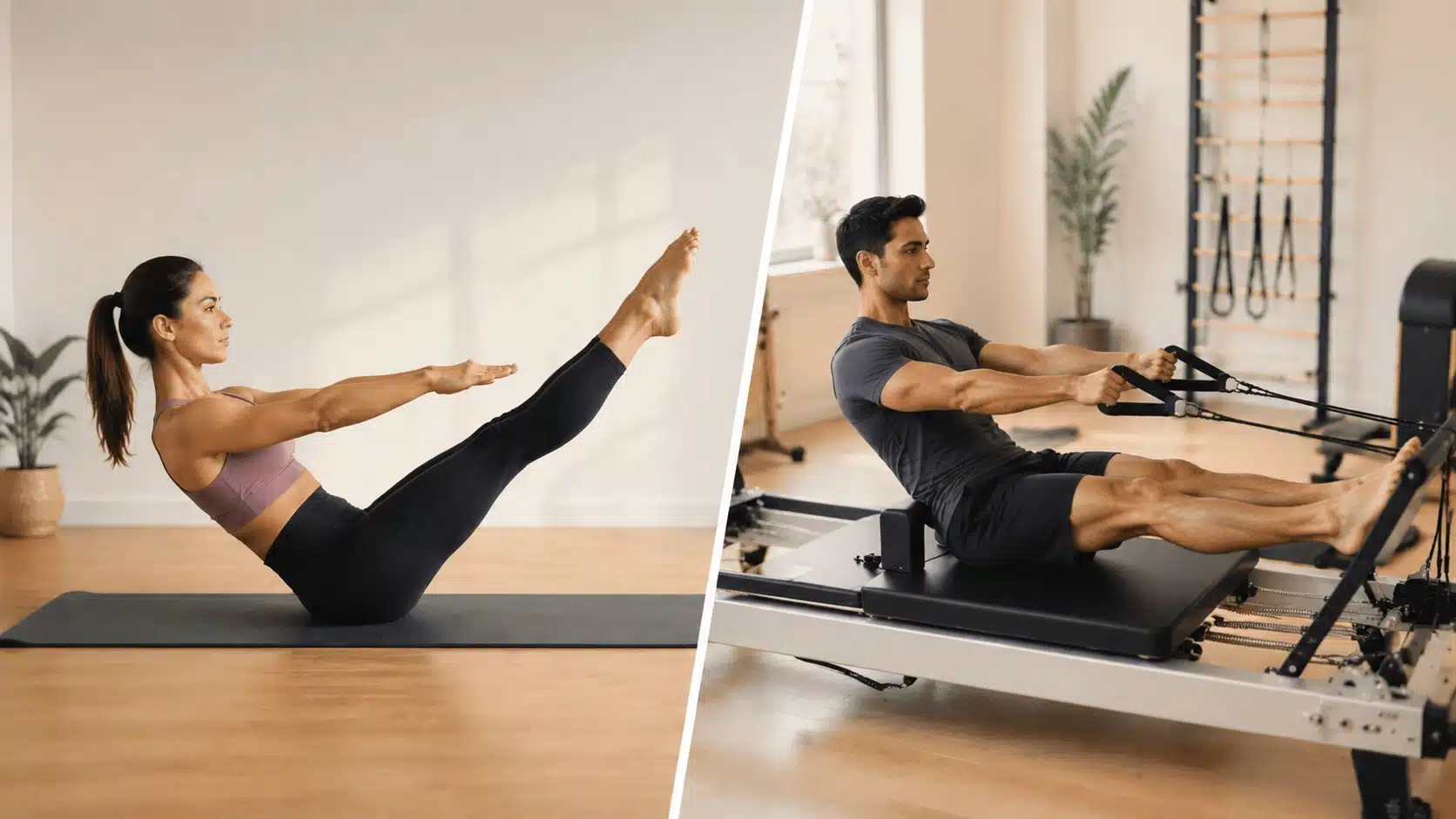
Both forms trace back to the same method but differ in a few key ways.
| Feature | Mat Pilates | Reformer Pilates |
|---|---|---|
| Equipment | Exercise mat | Reformer machine |
| Resistance | Bodyweight | Springs and machine resistance |
| Cost | Lower | Usually higher |
| Location | Home or studio | Mostly studios |
| Difficulty | Depends on control and form | Depends on the resistance settings |
Both forms are part of a wider group of Pilates practice styles, each with its own equipment, format, and focus. Neither version is better than the other.
Mat Pilates builds the foundational control on which the entire method is based. The reformer adds external resistance and assistance. This can make certain movements more accessible or more challenging depending on the setup.
Is Mat Pilates Good for Beginners?
Yes, mat Pilates is a strong starting point for beginners. It requires no equipment, can be practiced at home, and every exercise can be scaled to match your current fitness level.
You can modify the range of motion, reduce the number of reps, or slow the pace down without losing the benefit. That flexibility makes it easy to work around physical limitations and build body awareness from your very first session. The slow pace may feel less intense than expected, and progress can be harder to measure than lifting heavier weights.
But the foundational core control you build here carries into almost every other workout you do. That said, “beginner-friendly” does not mean effortless. The exercises are simple to learn but genuinely challenging to perform with correct form. Quality matters more than speed here.
How Often Should You Do Mat Pilates?
Frequency depends on your experience level, overall fitness goals, and how much recovery time your body needs between sessions.
| Experience Level | Suggested Frequency |
|---|---|
| Beginner | 2 to 3 sessions per week |
| Intermediate | 3 to 5 sessions per week |
| Advanced | Regular practice alongside other training |
Consistency matters more than session length. A focused 20-minute practice done regularly will build strength faster than an occasional 60-minute class. Skipping weeks slows your progress. Trying to make up for lost time in one long session rarely works.
Who Should Avoid or Modify Mat Pilates?
Mat Pilates is low-impact, but it is not automatically safe for every situation. Anyone with a recent injury, severe back pain, or a chronic condition affecting movement should consult a doctor first. Pregnancy-related concerns also warrant a conversation with a qualified Pilates instructor before starting.
| Generally Fine to Practice | Should Modify or Get Clearance First |
|---|---|
| Healthy adults of most fitness levels | Recent surgery or injury |
| People easing into exercise for the first time | Severe or chronic back pain |
| Those wanting a low-impact addition to their routine | Pregnancy, especially past the first trimester |
| Older adults, with modifications as needed | Diagnosed conditions affecting balance or movement |
| People recovering from minor soreness or fatigue | Uncontrolled cardiovascular or joint conditions |
A trained instructor can also modify exercises to fit specific limitations rather than skipping the practice altogether.
Common Errors When Starting Mat Pilates
A few habits tend to slow beginners down or cause early frustration. Most stem from treating mat Pilates as a typical bodyweight workout rather than a control-based one.
- Moving through exercises too quickly trades muscle engagement for speed
- Holding the breath instead of coordinating it with movement limits core activation
- Letting alignment slip to squeeze in more repetitions
- Using momentum to swing through a movement instead of controlling it with muscle
- Comparing progress to more experienced practitioners instead of tracking personal form
- Skipping the warm-up or cooldown raises the risk of strain in cold muscles
Slowing down and paying attention to form fixes most of these issues within a few sessions. Practicing in front of a mirror can help catch small alignment errors. These are easy to miss by feel alone.
Start Your Mat Pilates Practice Today
Mat Pilates strips the method down to its original form: a mat, your bodyweight, and controlled movement. It builds core strength, supports better posture, increases flexibility, and supports mental well-being, all without any equipment or gym access.
The exercises look simple. They demand real focus on form and breath. That is exactly what makes mat Pilates effective.
Starting with two or three sessions a week is enough to feel a difference. Pay attention to how your body responds. Adjust your frequency or intensity as your confidence with the movements grows.
Your mat is all you need to begin.
Frequently Asked Questions
What Is the Difference Between Yoga and Mat Pilates?
Yoga emphasizes flexibility, breath, and mind-body connection through held poses, while mat Pilates focuses more directly on core strength and controlled, repeated movement patterns.
Can Mat Pilates Help With Weight Loss?
Mat Pilates alone burns fewer calories than cardio, but it builds lean muscle and can support weight management when combined with a balanced diet and regular movement.
How Long Does a Mat Pilates Workout Usually Take?
Most mat Pilates sessions run between 20 and 50 minutes, depending on the routine, experience level, and whether it’s a full class or a shorter home practice.
Do You Need an Instructor to Start Mat Pilates?
Not necessarily. Many beginners start with online videos, but working with an instructor early on helps correct form and avoid habits that are harder to fix later.
Is Mat Pilates Good for Back Pain?
Yes. Mat Pilates strengthens the deep core muscles that support the spine, which can reduce lower back strain over time. Anyone with a diagnosed back condition should consult a doctor first.