
I'm Darryl Edwards, a personal trainer and clinical nutritionist based in London, England.  This blog documents my experiences with a primal lifestyle that has made me fitter and healthier in my forties than ever before.  

Let's Explore Fitness!

More about me...

More about my services... 

Recent Updates
Recent Comments

Latest Tweets
Facebook

Images
As Featured In

Friends


Subscribe to The Fitness Explorer Newsletter


Categories
Reading List
  • The Paleo Solution
    The Paleo Solution
    by Robb Wolf

    Paleo for weight loss, performance and disease prevention. Read my full review here.

  • Why Zebras Don't Get Ulcers
    Why Zebras Don't Get Ulcers
    by Robert M. Sapolsky

    The impact of too much stress in our lives - impotence, obesity, heart disease and much more...

  • The Primal Blueprint: Reprogram Your Genes for Effortless Weight Loss, Vibrant Health, and Boundless Energy
    The Primal Blueprint: Reprogram Your Genes for Effortless Weight Loss, Vibrant Health, and Boundless Energy
    by Mark Sisson

    Usually we have to go back to basics to progress, this is a great place to start!

  • Slow Death by Rubber Duck: The Secret Danger of Everyday Things
    Slow Death by Rubber Duck: The Secret Danger of Everyday Things
    by Rick Smith, Bruce Lourie, Sarah Dopp

    "Think about the toxic chemicals you put onto your body, and are exposed to on a daily basis.  Frankly, quite worrying..."

  • Protein Power
    Protein Power
    by Michael R. Eades, Mary Dan Eades, Mary Deans

    First published in the mid 1990s.  Amongst other things, disputes the 'fat intake causes obesity' argument and reasons why the high carb/low-fat diet doesn't work.

  • Born to Run: The Hidden Tribe, the Ultra-Runners, and the Greatest Race the World Has Never Seen
    Born to Run: The Hidden Tribe, the Ultra-Runners, and the Greatest Race the World Has Never Seen
    by Christopher McDougall

    An inspirational read, whether you are a 'runner' or not.  This book also investigates why expensive 'cushioned' running shoes increases the likelihood of injury.

  • In Defence of Food: The Myth of Nutrition and the Pleasures of Eating: An Eater's Manifesto
    In Defence of Food: The Myth of Nutrition and the Pleasures of Eating: An Eater's Manifesto
    by Michael Pollan

    An insight into real, simple and nutritious food.  Insightful.

  • Food Rules: An Eater's Manual
    Food Rules: An Eater's Manual
    by Michael Pollan

    An excellent, non-scientific common sense quick reference to the often confusing question : "What should I eat?"

  • The Paleo Diet for Athletes
    The Paleo Diet for Athletes
    by L. Cordain

    An alternative to Cordain's first book "The Paleo Diet" if who want to consider the impact of Paleo on athletic performance.  It is geared towards endurance athletes but an interesting read nonetheless.

  • Vegetarian Myth, The
    Vegetarian Myth, The
    by Lierre Keith

    I'm an omnivore.  I believe it is healthy to eat naturally-reared meat, non-farmed fish as well as a wide variety of fresh vegetables.  This book is an interesting read and has a lot to say about why becoming a vegetarian isn't necessarily the best option for humans.  However read this, do your own research and make up your own mind.

  • The Second Brain
    The Second Brain
    by Michael D. Gershon

    A discussion about the complex nervous system working in the gut, which produces neurotransmitters such as serotonin.  In fact much more serotonin is produced in the gut than the brain!

  • The Rise and Fall of Modern Medicine
    The Rise and Fall of Modern Medicine
    by James Le Fanu
  • Swindled: From Poison Sweets to Counterfeit Coffee - The Dark History of the Food Cheats
    Swindled: From Poison Sweets to Counterfeit Coffee - The Dark History of the Food Cheats
    by Bee Wilson
  • Cancer: The Evolutionary Legacy
    Cancer: The Evolutionary Legacy
    by M.F. Greaves
  • The Paleo Diet: Lose Weight and Get Healthy by Eating the Foods You Were Designed to Eat
    The Paleo Diet: Lose Weight and Get Healthy by Eating the Foods You Were Designed to Eat
    by Loren Cordain

    This provides extraordinary insight into the reasons behind adopting a paleolithic diet.  Some aspects are controversial and many may feel it is too dogmatic.  I have often gone back to this book and re-read it for clarification as Dr Loren Cordain is often mis-quoted.  There is now a revised edition (2010 edition) to counter some of its earlier criticisms, this is an excellent resource and a must-read for any one serious about paleo nutrition.

  • Lore of Running
    Lore of Running
    by Tim Noakes

    This book offers a comprehensive insight into the science, coaching and discipline of running.  Energy systems, coaching and training.  Often quoted as the bible of running.

Entries in Fat (4)

Friday
Oct072011

Health: What a Waist!

Do you know a bulging waistline has a host of wealth problems?  
Men with a waistline of greater than 40 inches (100cm) and women with a waistline greater than 35 inches (89cm) have a significantly increased risk of cancer, type II diabetes and heart disease.  Currently 32% of men in the UK have a waistline exceeding 40 inches.  

The correct method to measure the circumference around the waist is the midpoint between the top of the hips and the bottom of the rib cage (usually just above the belly button).

So why is this measurement relevant?  

Fat that resides in the torso surrounding internal organs is known as visceral fat.  Visceral fat is toxic, inflammatory and metabolically active.  Excessive visceral fat is one risk factor associated with heart disease, cancer and diabetes.

Current research suggests that waist size is a more accurate predictor of future disease risk than body weight.  This view is endorsed by the British Heart Foundation, World Health Organisation, Cancer Research UK and Diabetes UK.

Quote from Cancer Research UK: "Being overweight or obese increases the risk of at least seven types of cancer.  The 2nd highest risk factor after smoking."

Tuesday
Aug242010

Does muscle weigh more than fat?

How many times have you heard or even used the expression.

"Muscle weighs more than fat!"

Well it's not something I've really questioned before. But however you look at it - this phrase is misleading. A kilo of muscle and a kilo of fat placed on a scale would both weigh exactly the same. A kilo.  It is something we come to terms with when comparing feathers and lead, but it seems subliminal to many with reference to body composition.

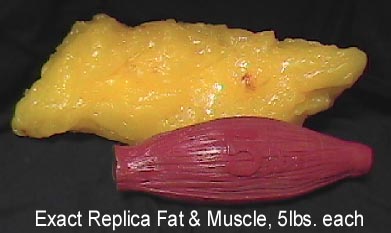
What people are really comparing is not weight, but density and volume. Muscle tissue has greater density than adipose (fat) tissue and so fat has a greater volume.  Or more strictly speaking muscle has more weight by volume.

Imagine if a kilo of muscle was the size of a grapefruit, a kilo of fat would be 3 times larger.  This could mean a significant difference to body composition, shape, size and health when the percentage of your body fat changes.


I've also been asked by clients:  

"What exercises can I do to convert my excess fat into muscle?"

For clarification it is a complete myth that you can turn fat into muscle with training.  It is also a myth that your muscle will turn into fat when a training regime subsides.  Fat and muscle are completely different tissues. They have different composition and respond to training in different ways.

I will discuss this in more detail in a future post, but in simple terms: 

  • to decrease fat, make the right nutritional, activity and lifestyle choices;
  • to increase muscle, overload muscles with resistance activity.  Different training programs can be used to: increase strength, increase muscle size (hypertrophy), improve tone, density and efficiency (or all of these simultaneously);
  • muscle cells burn more calories;
  • fat cells store calories;
  • focusing on body weight alone is not enough, a woman who weighs 60 kilos (9 stones 6 or 132lbs) and has 12% body fat will look completely different to a woman who weighs 60 kilos, but has a body fat percentage of 20%
Tuesday
Aug102010

Nutrition: Coconut Milk - is it good for you?

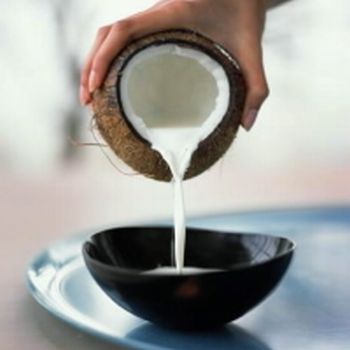
Coconut milk and oil is often berated because its fat levels contain about 90% saturated fat. It is often dismissed as a high-fat food and thus eliminated from many diets or viewed as an occasional unhealhty 'treat'.

It is a staple of many Caribbean dishes (as well as Thai, Indian dishes) for its unique flavour.

But is it really bad food?

Well there is growing evidence that a diet containing these fats actually have numerous health benefits and are not contributors to high levels of blood cholesterol.

The benefits include:


  • improved lung function;

  • reduced risk of cardiovascular diseases - by unclogging arteries;

  • boosting the immune system, due to it's anti-fungal, anti-viral and anti-bacterial properties;

  • aids in digestion;

  • its short and medium chain fatty acids being readily converted to energy, rather than being stored as fat;

  • a rich source of Vitamin A, E, potassium, iron, phosphorous, magnesium and zinc;

  • excellent at providing hydration;

  • lactose free, therefore a good substitute for milk;

  • high in antioxidants;

  • contains less sugar and more protein than bananas, apples or oranges;
  • Coconut oil has the ability to act as an antimicrobial and antiviral agent 

Well worth incorporating into your diet, whether you follow a strict Paleo lifestyle or not.

If you're in the UK, you can order Organic Coconut Oil here

Thursday
Aug052010

60 Second Interview: David Csonka


Who are you?

David Csonka. I'm an application developer at a university, and I blog about fitness, nutrition, and barefoot running.

What is fitness to you?

Being healthy, and unencumbered by physical limitations.

What are your goals?

To be as healthy as I am now, 40 years in the future.

What is one of your main concerns in relation to health?

Fitness and nutrition plans guided by misinformation and faulty "common knowledge". Specifically, the fallacious low-fat diet.

What is your favourite meal?

Something new I recently tried, a Meat-za. Burger patties with pizza sauce, bacon, cheese, and pepperoni on top. It was love at first bite.

What is your favourite exercise/activity?

Trail running, hiking. I love running out into the woods to experience nature, and take photos of flowers and animals. Being away from the noises and distractions of civilization is nice.

Blog:

http://blog.naturallyengineered.com