
I'm Darryl Edwards, a natural movement therapist, paleo clinical nutritionist, blogger and published author based in London, England. This blog documents my experiences with a primal lifestyle that has made me fitter and healthier in my forties than ever before. I am a contributor to Paleo Magazine and presenter at various symposiums such as Paleo:f(x), PrimalCon and other events globally.
The impact of too much stress in our lives - impotence, obesity, heart disease and much more...
The Primal Blueprint: Reprogram Your Genes for Effortless Weight Loss, Vibrant Health, and Boundless Energy
by Mark Sisson
Usually we have to go back to basics to progress, this is a great place to start!
Slow Death by Rubber Duck: The Secret Danger of Everyday Things
by Rick Smith, Bruce Lourie, Sarah Dopp
"Think about the toxic chemicals you put onto your body, and are exposed to on a daily basis. Frankly, quite worrying..."
Protein Power
by Michael R. Eades, Mary Dan Eades, Mary Deans
First published in the mid 1990s. Amongst other things, disputes the 'fat intake causes obesity' argument and reasons why the high carb/low-fat diet doesn't work.
Born to Run: The Hidden Tribe, the Ultra-Runners, and the Greatest Race the World Has Never Seen
by Christopher McDougall
An inspirational read, whether you are a 'runner' or not. This book also investigates why expensive 'cushioned' running shoes increases the likelihood of injury.
In Defence of Food: The Myth of Nutrition and the Pleasures of Eating: An Eater's Manifesto
by Michael Pollan
An insight into real, simple and nutritious food. Insightful.
Food Rules: An Eater's Manual
by Michael Pollan
An excellent, non-scientific common sense quick reference to the often confusing question : "What should I eat?"
The Paleo Diet for Athletes
by L. Cordain
An alternative to Cordain's first book "The Paleo Diet" if who want to consider the impact of Paleo on athletic performance. It is geared towards endurance athletes but an interesting read nonetheless.
Vegetarian Myth, The
by Lierre Keith
I'm an omnivore. I believe it is healthy to eat naturally-reared meat, non-farmed fish as well as a wide variety of fresh vegetables. This book is an interesting read and has a lot to say about why becoming a vegetarian isn't necessarily the best option for humans. However read this, do your own research and make up your own mind.
The Second Brain
by Michael D. Gershon
A discussion about the complex nervous system working in the gut, which produces neurotransmitters such as serotonin. In fact much more serotonin is produced in the gut than the brain!
The Rise and Fall of Modern Medicine
by James Le Fanu
Swindled: From Poison Sweets to Counterfeit Coffee - The Dark History of the Food Cheats
by Bee Wilson
Cancer: The Evolutionary Legacy
by M.F. Greaves
The Paleo Diet: Lose Weight and Get Healthy by Eating the Foods You Were Designed to Eat
by Loren Cordain
This provides extraordinary insight into the reasons behind adopting a paleolithic diet. Some aspects are controversial and many may feel it is too dogmatic. I have often gone back to this book and re-read it for clarification as Dr Loren Cordain is often mis-quoted. There is now a revised edition (2010 edition) to counter some of its earlier criticisms, this is an excellent resource and a must-read for any one serious about paleo nutrition.
Lore of Running
by Tim Noakes
This book offers a comprehensive insight into the science, coaching and discipline of running. Energy systems, coaching and training. Often quoted as the bible of running.
Saturday, November 24, 2012 at 17:51 | by Darryl Edwards
Workout:
60 minutes walk
---
Note:
Please scale all Fitness Explorer workouts to your current ability. This may mean increasing or decreasing the weights prescribed, modifying distances and times, or changing number of sets and reps to complete. Get adequate rest and sufficient nutrition to fuel the activity and to aid in recovery. Work hard and play hard but never sacrifice correct form.
Please visit the exercise FAQ for details on individual exercises or consult the advice of a registered exercise professional to ensure safe execution of the above movements.
Please scale all Fitness Explorer workouts and playouts to your current ability. This may mean increasing or decreasing the weights prescribed, modifying distances and times, or changing number of sets and reps to complete. Get adequate rest and sufficient nutrition to fuel the activity and to aid in recovery. Work hard and play hard but never sacrifice correct form.
Please visit the exercise FAQ for details on individual exercises or consult the advice of a registered exercise professional to ensure safe execution of the above movements.
I watched a documentary on BBC 1 last night entitled "The Truth About Exercise". The programme uses the latest research to dispel some myths about exercise and to report the latest research on studies helping us to live healthier and longer lives.
This is what I took away from the programme (most of these figure in my personal philosophy in relation to movement):
short bursts of High Intensity Interval Training (HIIT) using protocols such as Tabata can be more advantagous than hours spent with moderate level steady state work such as jogging;
Non-Exercise Activity Thermogenesis (NEAT) i.e. as I call it "Pottering" around - i.e. low intensity movement that is not sitting - like standing, walking and just generic day-to-day everyday movement is more benefical than we realise;
that we all respond to exercise in different ways - "one size does not fit all";
that diet (as well as exercise) contributes to a healthy body composition;
improving V02 max and insulin sensitivity (through exercise) is a key way to improve long term health and longevity;
mind over matter - the mind tires before the muscle even though we often assume it is the opposite;
(and with a little tongue-in-cheek) the irony that most people (in this case scientists) advising us on what we should be doing - often don't seem to practice what they preach or don't appear to be reaping the benefits themselves. I call this the "hairdresser syndrome" they can create great hairstyles for clients but that doesn't mean they will make the best decisions for their own hair.
If you reside in the UK you can use the BBC's iPlayer to watch this documentary for a limited time (expires 30 March 2012) --> Horizon: The Truth About Exercise
There is a small clip below from the documentary on High Intensity Training for those who reside outside the UK via YouTube.
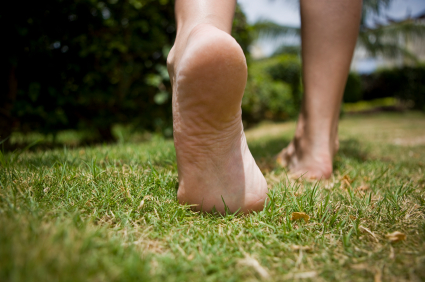
Today's workout is actually a walkout. Often over-looked for not being 'intense' enough. But our bodies were designed for walking - it is an essential locomotive motor pattern not optional or required in times of danger. Aim for 3-6 miles (5-10 km) a few times per week.
Here are some other benefits off the top of my head.
It is low impact, therefore less stress on the joints (than say jogging);
As it is a weight-bearing activity it improves bone density;
It improves mood, and mental well-being by allowing you to take time away from day-to-day stresses;
It improves circulation and has been shown to reduce the risk of cardiovascular diseases such as coronary heart disease and stroke by reducing blood fats;
It means you are likely to sit-down on fewer occasions;
It is a great recovery from an intense period of activity;
You can save money (no car or public transport required);
Easier to get your daily dose of Vitamin D with sun exposure.